Australian cavers have stumbled upon a vast network of tunnels containing fossils that could offer key insights into species’ adaptation to climate change, scientists have confirmed.
The limestone caves in Australia’s far north contained what University of Queensland paleontologist Gilbert Price described as a “fossil goldmine” of species ranging from minute rodents and frogs to giant kangaroos.
Once part of an ancient rainforest, the remote site now lies in arid grassland and Price said the fossilised remains could hold key clues about how the creatures had adapted to climate change and evolved to their current forms.
The caves’ oldest specimens are estimated to be 500,000 years old. Price said they lived in a period of major aridification of central Australia and retreat of the rainforest that triggered a “formal extinction event”.
“What we’re trying to do up here is really look at the fossils and look at the animals and see how they responded to those prehistoric climatic changes, and that’s something that’s really quite relevant to today,” Price told AFP.
Our Gilbert would have been delighted to stumble across a fascinating hoard of fossils for their intrinsic interest and, of course, paleontologists are hard pressed to be paleontologists without them. He would have been thrilled at any time, but at this particular time he displays them to the world through the prism of climate change.
And if he wants a grant, why not? Philippa Martyr has been having a look at successful grant applications, she writes …
Along the way, I was tickled to see just how far-reaching the impact of climate change will be in Australia.
She gives a quite detailed list. Areas of research to benefit from climate change include …
- Physiology
- Civil Engineering
- Public Health and Health Sciences
- Political Science
Some are just too delicious to resist giving in greater detail
Psychology: “Climate change represents a moral challenge to humanity, and one that elicits high levels of emotion. This project examines how emotions and morality influence how people send and receive messages about climate change, and does so with an eye to developing concrete and do-able strategies for positive change.” ($197,302)
Journalism and Professional Writing: “This project will examine the use of news management or ‘spin’ by Australian governments. Is it a legitimate tool of government in the face of a hyper-adversarial news media or a technique which undermines democracy? It will examine ‘spin’ in connection with policies on climate change, economic policy, indigenous policy and asylum seekers policy.” ($95,000)
Sociology: “We know very little about the ways food security is governed in Australia. This study – the first social-science based study of food security in the nation – will allow us to understand how a multiplicity of agencies come together to ensure the delivery of food, especially at a time of climate change impacts.” ($100,000 – 2 years)
Literary Studies: “The project will devise and develop a new ‘cultural materialist’ paradigm for science fiction studies and apply it to a case study of science fictional representations of catastrophe, especially nuclear war, plague and extreme climate change.” ($239,000)
Historical Studies: “This project will produce a comprehensive new biography of H.V. Evatt, High Court judge, minister in the 1940s, President of the United Nations General Assembly and leader of the Australian Labor Party opposition during the 1950s. Evatt’s life resonates with modern challenges both of liberty in a time of terror, and of internationalism in a time of global warming.” ($185,000)
Move over and make room on the gravy train.
The earth has been around for a very long time. The geological timescale using eons, eras, epochs, periods and ages is one way of breaking that immense time into useable chunks. It’s often represented something like this …
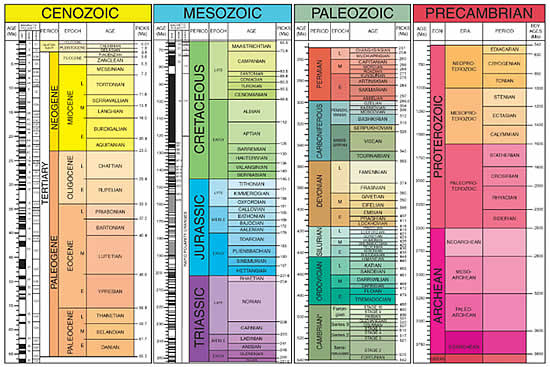
Once life began and started to leave fossils the paleontologists were able to make a considerable contribution to this scheme. In almost all instances the boundaries of these time slices are the result of major climate change.
One of those boundaries is the subject of a 1994 book on our planet as it was 33 million years ago by veteran paleo-climatologist Donald A. Prothero—The Eocene-Oligocene Transition: Paradise Lost. The Eocene (55-33 million years ago) began what is sometimes called the Golden Age of Mammals. This geological age was at least 10°C warmer than today, free of ice caps, and with CO2 levels, Prothero suggests, of up to 3,000 parts per million, which is almost eight times today’s level of about 400 ppm. Yet Prothero calls the Eocene a “lush, tropical world.”
The reality is earth is currently its coldest in almost 300 million years.
Price’s fossils have no descendents in the north Australian desert because of a great cooling that brought an end to the lush rainforests that formerly flourished there.
 bobmcgee