It was the last day of our voyage. We were heading back to Longyearbyen. It had been a very successful expedition. Two very sharp-eyed local guides had found us eight different individual Polar Bears and we’d had the opportunity to spend many hours in their company. We had seen Walruses by the dozen and had close encounters with other seals. We visited bird cliffs and watched Reindeer and Foxes. Pete Oxford Expeditions had delivered everything on the packet and more.
Pete has a childlike engagement with the natural world. He is enthusiastic, energetic but I would not have chosen the word excitable until this happened on our port side. He yelled “There she blows”, so loudly it was a wonder the whales were not frightened away.
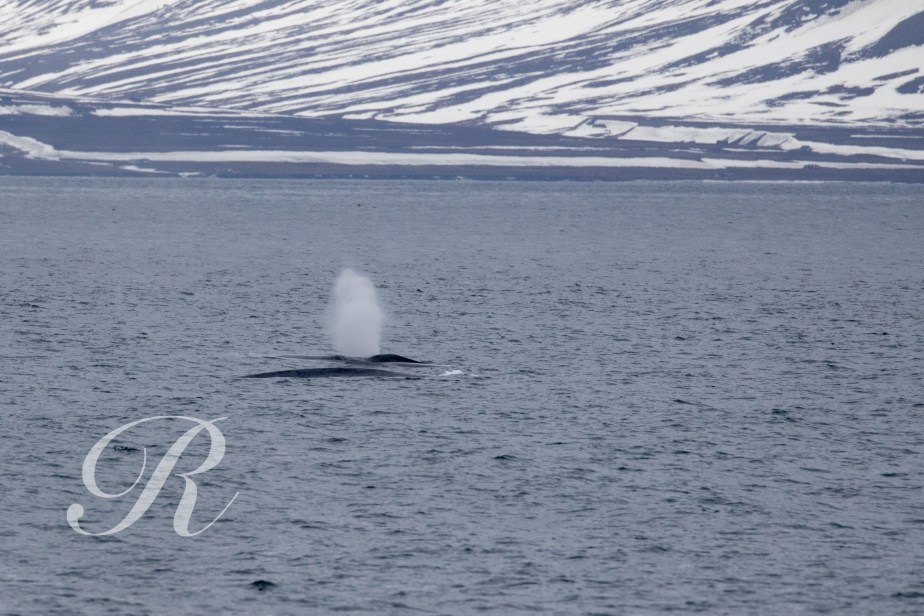
Blue Whale, mother and youngster. We had learnt by marine radio that there had been sightings and now we were lucky enough to find them near us. Early in the trip we had seen some Belugas at a distance but they had paid us no mind. This duo seemed to enjoy our company and swam along side us for a while.
One Captain Pool made a voyage to Svalbard in 1612 and reported that the sea was so full of whales that it was almost necessary for the ship to break its way through. Whaling commenced in earnest soon after. Initially it was shore based. As numbers declined it was necessary to take to the high seas and it was relentless …
“So little by little they wipe out the whale until they are all gone – and the winter take back its undisturbed control of the land” (Nansen 1920).
Norway continues to hunt whales but it restricts the numbers and takes only Minke Whales which are not endangered. Blue Whales are increasing in numbers but there is a long way to go before ships will have trouble finding a way through the crowd.
The ice ages were a series of major glaciations with intervening interglacials. This process has been playing out over about two and a half million years. The epoch over which this all occurred is the Pleistocene.
The last glaciation finished about 11,500 years ago. Our present epoch has been given a new name, the Holocene, which implies that this is something different not just another interglacial. We shall see.
Prior to the Pleistocene the world was a warmer place. This was the Pliocene an epoch that spanned about 9 million years. In mid-Pliocene temperatures were 2 or 3°C warmer than present , sea levels were about 25 metres higher. Continents were wandering very slowly. In the late Pliocene South America collided with North America, bringing about an interchange of flora and fauna and also bringing about a change in ocean currents and climate.
A collection of cold adapted mammals emerged from a variety of families. Where did they come from? Ice is the unifier of the Arctic, in its absence sea levels are higher and land mammals don’t enjoy the ability to wander from one side to the other. That makes it a poor candidate . The Antarctic continent is cut off by the Southern Ocean making it an even worse candidate.
By contrast the Tibetan Plateau even though close to the equator is at sufficient altitude to rival the true poles for cold weather. It was called the third pole by Marcel Kurz, the great Swiss geographer, mountaineer and explorer. It is well-connected to surrounding land masses meaning that a good variety of mammalian families were represented there during the good times of the Pliocene. As the cold times came on the Tibetan fauna adapted. During the height of the glaciations they could radiate out far to the north.
The Out of Tibet Hypothesis suggests that the Mammoth, Woolly Rhinoceros, the Three-toed Horse, Sabre-toothed Cat and other cold adapted megafauna originated in the Himalayan mountains. For example the Arctic Musk Ox and the Himalayan Takin are fairly closely related being the only extant members of the tribe Ovibovini.
Since most of the cold adapted megafauna shuffled off this mortal coil in the last 10,000 years you might be wondering where this is going. There are Musk Ox on Svalbard but I wasn’t lucky enough to see or photograph them but I did catch up with another creature that provides a strong link with Tibet …
Arctic Fox
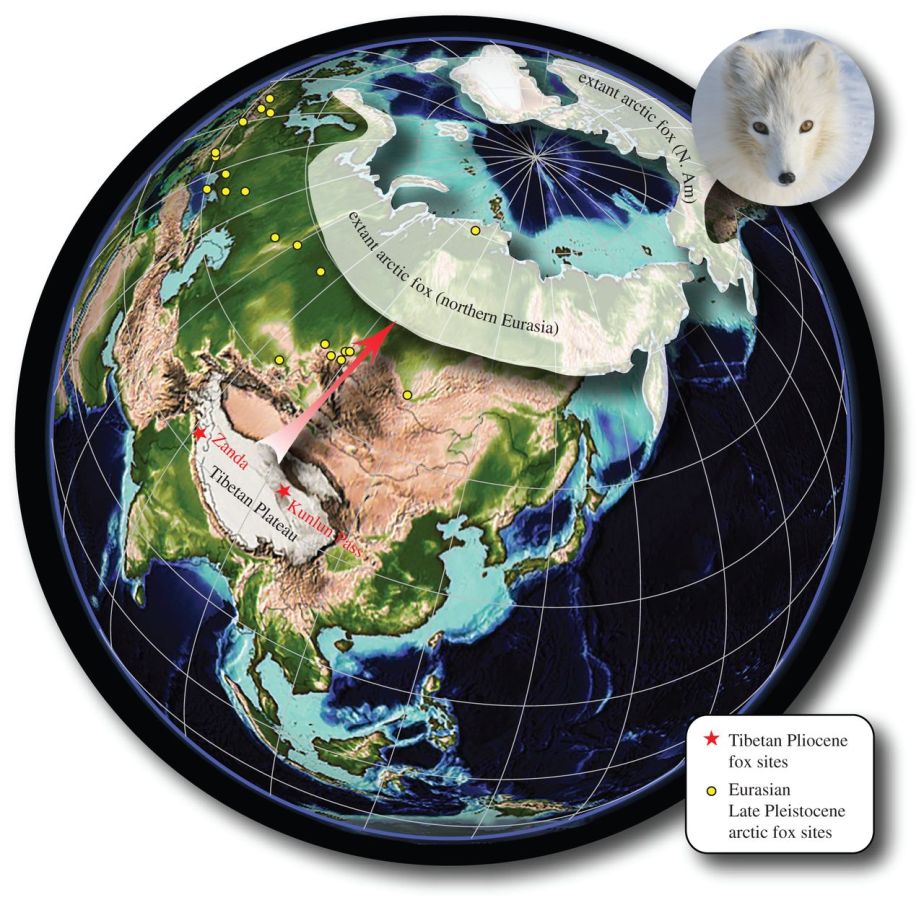
At under 5kg they don’t qualify as megafauna but according to Xiaoming Wang et al. the Arctic Fox is descended from the Early Pliocene (3.60–5.08 Myr ago) high altitude fox, Vulpes qiuzhudingi which they have recently discovered, and which they consider support for the Out of Tibet Hypothesis. The following figure is shamelessly stolen from their article.
The Arctic Fox has a fairly short life, typically 3 or 4 years, 10 or so if they are lucky. When food is abundant they can have large litters (as many as 25 – the largest litter size among the Carnivora) although 5 or 6 is more usual. This is a very different life strategy than the Polar Bear.
As can be seen in the photo above there are two colour morphs. This is genetically determined. On Svalbard 85 – 98% of the population is the white form. This despite the fact that the gene for the blue form is dominant. There is clearly some selection pressure against the blue form. This was certainly true in the fur hunting days when pelts of the blue form were worth considerably more.
If you do a Google search for Arctic Fox you will be overwhelmed with links for a semi-permanent, vegan haircolouring. An odd choice of name for a vegan product – the Arctic Fox is a ferocious little predator. Lemmings are high on the menu where they occur (no Lemmings on Svalbard) and birds elsewhere. They take carrion, seal pups and some plant food . When you see a Polar Bear there is often a fox not far away hoping to steal a few mouthfuls. Some food is cached for winter consumption.
Arctic Foxes are susceptible to rabies and toxoplasmosis. They are the final host of the tape worm Echinococcus multilocularis, a parasite that can be fatal in humans.The Norwegian Polar Institute recommends wearing gloves if you intend to handle fox faeces.
The summer visitor to Svalbard will see a few ducks. The commonest is the Common Eider but if you’re lucky there will be an occasional King in the flock.
Kings and Commoners
The male King is hard to misidentify …
King Eider
the female can be distinguished from Common Eider by its slightly smaller size and more concave face.
Common Eider
Both species are sea ducks that dive for their food. They nest on the ground which puts them at the mercy of Arctic Foxes. There are often small nesting colonies of Common Eider near the compounds where the sled dogs are kept. Foxes tend to keep away from the dogs. They also lose eggs and young to Glaucous Gulls and occasionally Polar Bears.
A rare bird among the Eiders on Svalbard is one named after Georg Wilhelm Steller, a biologist that I have more than a little admiration for. Steller’s Eider is the smallest of the eiders and we were lucky to get fairly distant views of a single male.
Steller’s Eider
We encountered some other ducks on fresh water.
Long-tailed Duck (or Oldsquaw to some of the politically incorrect) has the distinction of being the deepest diving duck (60 metres, ~200 feet). It is a sea duck but the one pair encountered were on a freshwater pond.
Long-tailed Duck
Not a sea duck and the only representative of its species that we saw was this Tufted Duck.
Tufted Duck
All of these birds dive for their food so too does this one. It’s not a duck it’s a diver or, as the Americans would have it, a loon.
Red-throated Diver (Loon)
Where the Eiders are seasonally gaudy the Divers are elegantly understated in designer pastels. Note how far back the legs are set on the body. They are on a different evolutionary path than the Auks. All five species of Diver are foot propelled underwater. They can use their wings to change direction but essentially their wings are for flight.
Over winter Svalbard is pretty much a bird free zone. The only land bird you are likely to encounter is the Ptarmigan and the sea birds leave their nesting colonies and head out to sea. Come the spring the birds return, each to their preferred habitat.
The birds that dominate the inshore waters are the Auks.
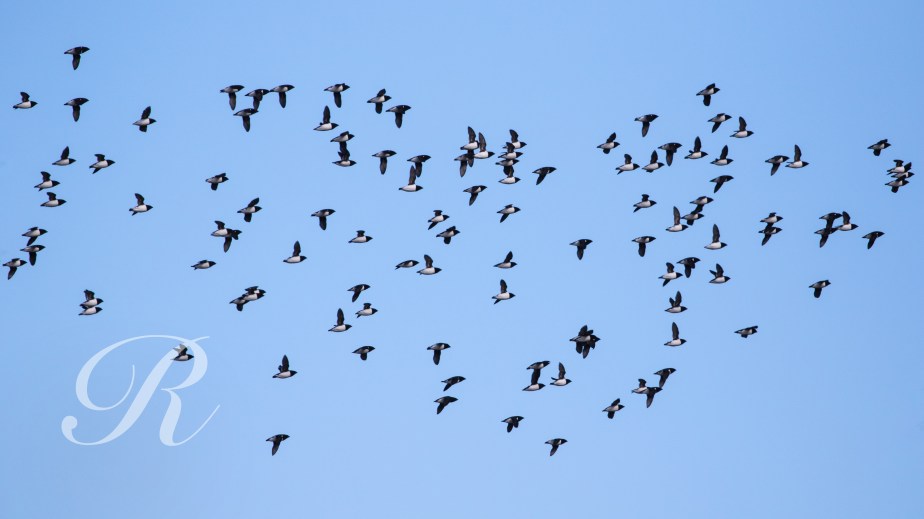
The most numerous representative of the group is the Little Auk of which there are more than a million pairs.
Little Auk
These guys nest in scree on fairly step slopes not necessarily at the edge of the sea. The other common Auks are Brünnich’s Guillemot and the Black Guillemot. These both favour cliff ledges for their nesting sites.
Take a closer look …
Auks propel themselves under water with their wings. Water is 784 times more dense than air. To be efficient in water wings need to be stiffer and smaller. Auks do not fly well, Brünnich’s Guillemot has the highest wing loading and energy cost for flight of any bird. The ability to catch fish comes at a price. Nonetheless they make repeated flights to and from the sea to feed their young during the breeding season.For more detailed information see <HERE>.
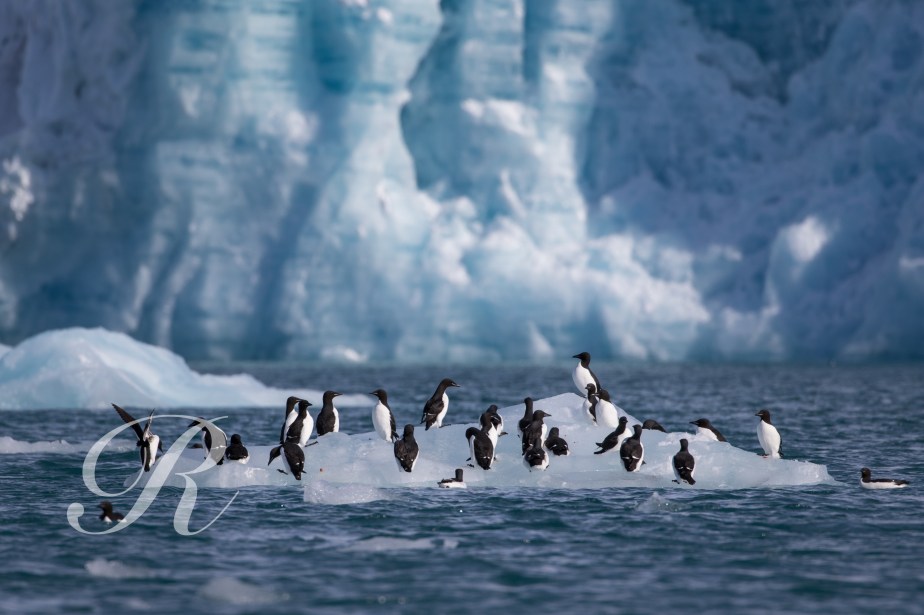
Brünnich’s Guillemot
This must be close to the limit of what is possible for a dual purpose wing. The now extinct Great Auk was flightless.
Brünnich’s Guillemot
Sitting on an ice floe the Guillemots look remarkably like penguins. It is likely that the ancestor of penguins was rather like an auk. Once the species crossed the boundary and became flightless the body size could increase and the wing could become relatively smaller, stiffer and more flipper-like. Coexistence with a predator like the Arctic Fox presents a challenge that Penguins don’t need to face. Access to cliff faces is much easier if you can fly.
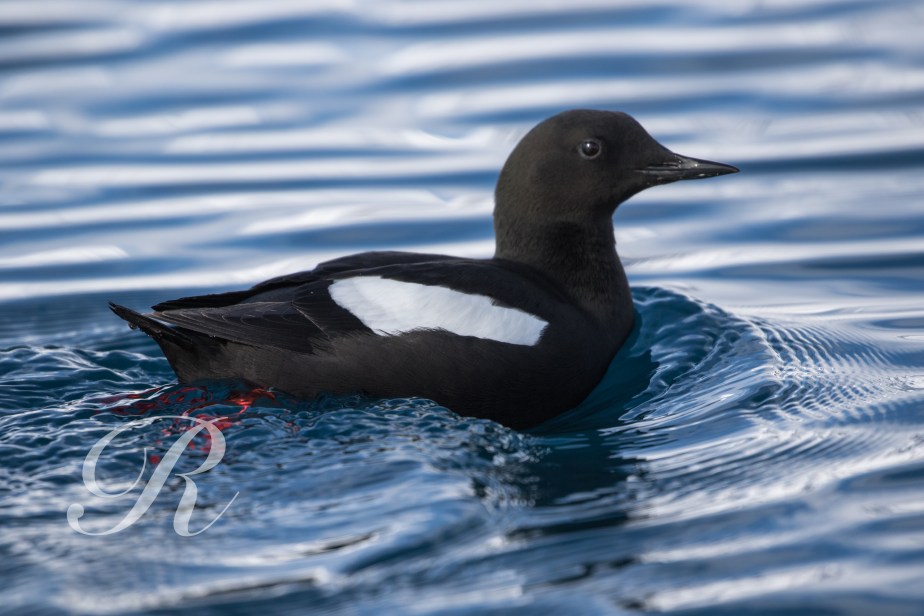
The next most common auk is the Black Guillemot distinguished by the white wing flash and bright red feet, very handsome …
Black Guillemot
Puffins are present in small numbers …
Atlantic Puffin
Common Guillemots are also said to occur but we did not encounter any.
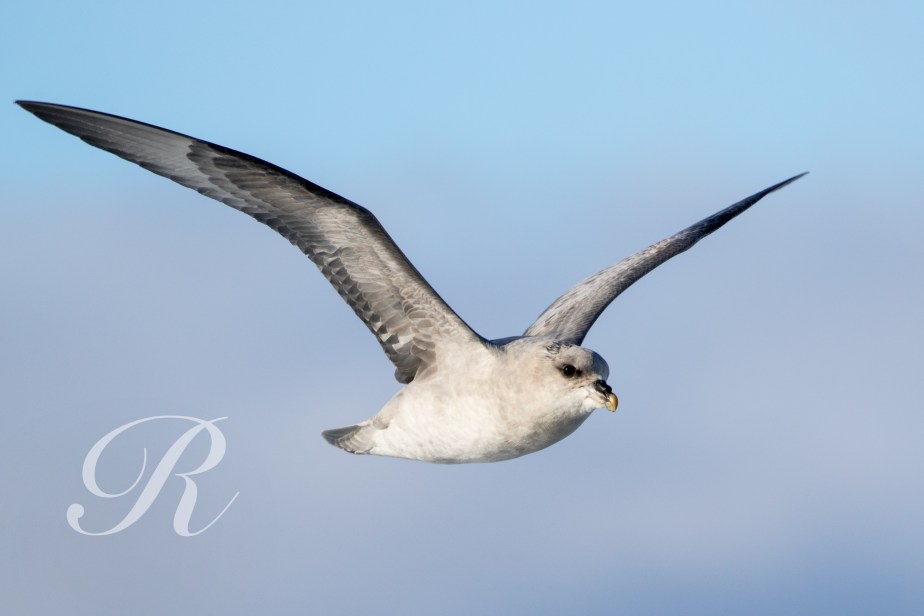
The Northern Fulmar is a tubenose (Procellariiform) which glides almost effortlessly through the air and uses its momentum to plunge to shallow depths after its food. Almost the exact opposite strategy to the auks.
Northern Fulmar
Gulls and Skuas are also far more accomplished in the air than auks. The Black-legged Kittiwake is the most numerous gull. Like the guillemots it nests on steep cliffs usually at the higher levels.
Kittiwake
The commonest large gull is the Glaucous Gull. This one is getting stuck into a guillemot carcass.
Glaucous Gull
They are common around nesting cliffs where they take eggs and young and there always seems to be one around a Polar Bear hoping to share in the spoils. They don’t get it all their own way though …
Great Skua attacking a Glaucous Gull
The Great Skua has a similar diet and is even bigger and nastier than the gulls. It is mostly found around the nesting cliffs.
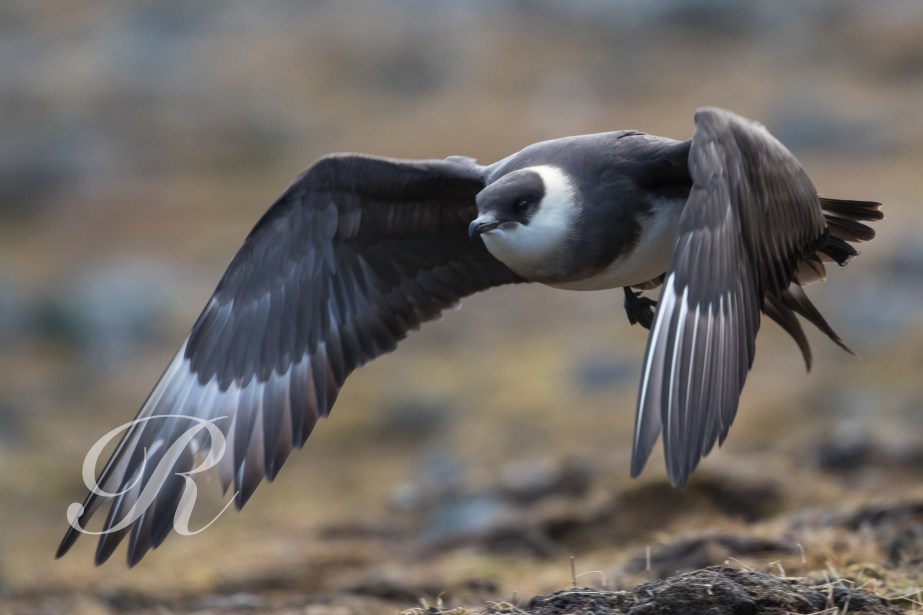
It has a smaller and more aerobatic cousin, the Arctic Skua, that is a specialist kleptoparasite. It harasses other seabirds until they disgorge the food they are carrying back to their young. The skua then catches it in mid-air. You can experience what it’s like for their victims by venturing near their nest.
The northernmost functional civilian settlement in the world. It has a winter population in the thirties which swells to more than 200 in the summer.
Ny-Ålesund started out as a coal mining town. There is a nicely restored steam train to remind us of its roots.
These days the town is a research centre owned and operated by the Kings Bay Company who provide the infrastructure to scientists from around the globe. The attraction being a nice civilised outpost close to the north pole yet with a warm climate. Everything is relative, James Bay Canada is the southerly limit of the Arctic marine ecosystem at just 53°N. Thanks to the gulf stream the weather is just as nice here at 78°N.
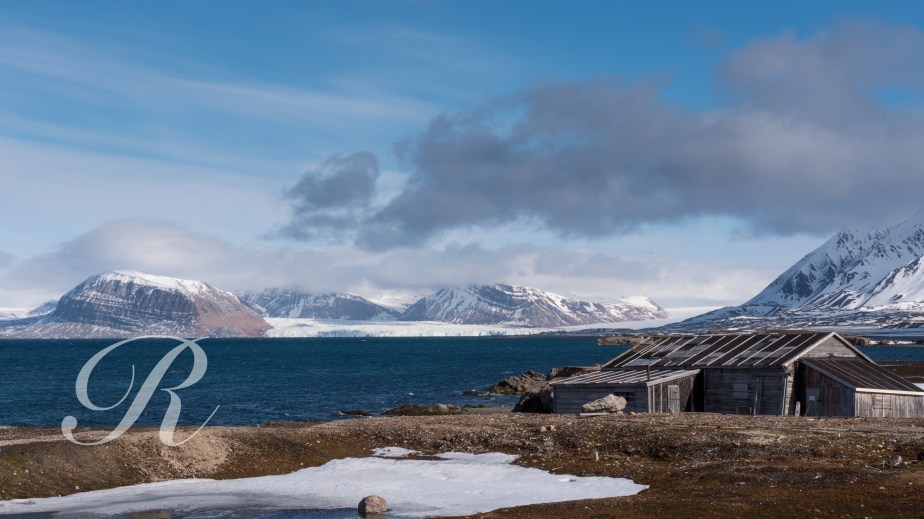
The view is amazing …
but the facilities are modern …
None of the front doors are locked. Should you meet a Polar Bear in the street duck into the nearest building and dial the number placarded by every telephone. You can’t use your cell phone – there is no service because it would interfere with some of the research equipment.
Downtown there is a statue to the glory of Roald Amundsen, first to the South Pole. He and Umberto Nobile flew an airship from here, over the North Pole to Alaska in 1926. Some regard this as the first successful expedition to the pole.
Roald Amundsen
At the city limit, about 100 metres away there are a couple of signs reminding you to take your rifle and giving explicit instruction on loading and unloading it as you come and go.
Every new arrival at Ny-Ålesund must learn to shoot if they wish to leave the base. The Local.
The good ship Freya took the Pete Oxford Expeditions expedition with its Birdlife International cohort up the west side of the Svalbard archipelago to 81°N. Some of us were reluctant to turn back and decided to swim to the north pole.
photos – Gilly Banks
The deserters were quickly lassoed and confined to the brig (which doubled as the sauna).
And why the sea is boiling hot
   And whether pigs have wings.
I can assure you the sea is not boiling hot. Splice the main brace.
The world is warming, the ice is melting, Polar Bears are cute and cuddly and will be extinct any moment. The Polar Bear is to the Thermageddon enthusiast what the Giant Panda is to the WWF, a poster child. Please send money.
The reality is far more complicated.
The Arctic has indeed been warming. In some years summer ice coverage has been well below average.
Polar Bears eat seals, mainly Ringed Seals. Ice plays an extremely important role in the life style of both seal and bear. Ringed Seals are widespread throughout the Arctic. They have the ability to keep open a breathing hole through ice giving them access to feeding grounds that would otherwise be unavailable. Pregnant females build a lair covering a breathing hole. Hidden from the gaze of Polar Bears and sheltered from the worst of the weather they give birth to a single pup in March or April which they nurse for 5 to 7 weeks.
Sea ice and fast ice is where Polar Bears can hunt efficiently. In some parts of their range ice persists throughout the year either because it never gets warm enough for it to melt or because currents bring a stream of ice from elsewhere. Especially in the warmer parts of their range ice disappears in summer. In these regions Polar Bears have a lot in common with tourist operators. During the season they must make enough to cover their overheads for the entire year. For the Polar Bear this means eating lots of fat young seal pups and then depending on their fat reserves through the summer.
A mother Polar Bear stands at a Ringed Seal breathing hole. Two young bears are parked nearby. We observed this situation for about 11 hours. At the end of that time the bear gave up and the trio wandered off. Click on the photo to enlarge it.
During the summer they will eat a wide variety of other food stuff but unless it contains a high proportion of fat their fat reserves and physical condition drops. Going hungry is part of the normal cycle of their lives.
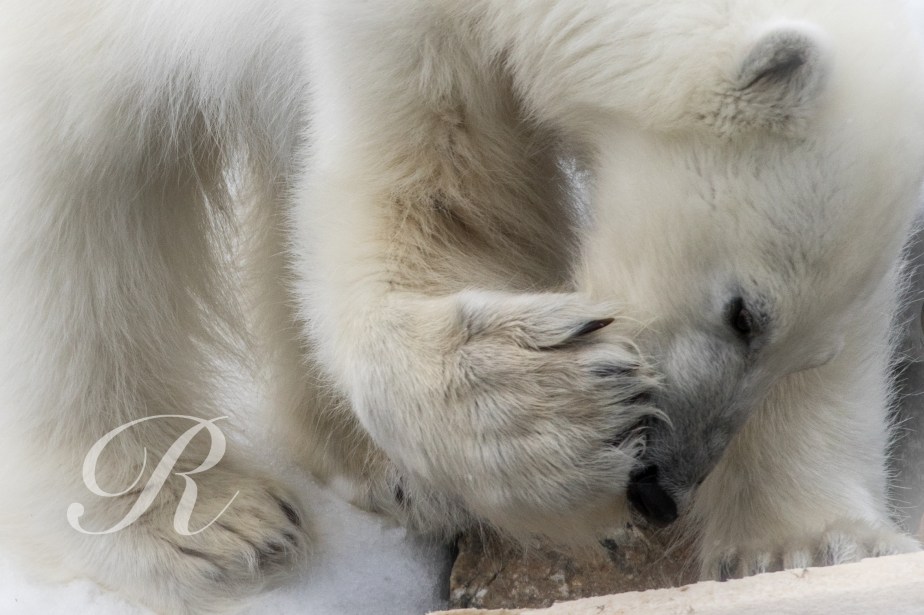
Mother and cub chewing a whale mandible.
It follows that as ice diminishes the carrying capacity of the environment also diminishes. QED.
But, what is the current carrying capacity and are seals and bears presently at it? For a century or so prior to the early years of last century the Arctic was plundered for fur and blubber. Populations of seals were decimated. The Walrus on Svalbard was brought to the point of extirpation. Around Svalbard 900 bears a year were harvested in the 1920s and after World War II, there were as many as 400–500 harvested annually. Bear hunting on Svalbard ceased in 1973. The Polar Bear is a K-selected species with late sexual maturity, small litter size, high maternal investment and high adult survival. The Polar Bear’s reproductive rate is among the lowest in all mammals so the population may take a long time to recover. Comparing censuses of 2004 and 2015 gives an increase in population of 42%. Is this due to reproduction or immigration?
Dutch ornithologist Maarten Loonen, who has been studying migratory geese and Arctic Terns in Svalbard for more than two decades, has seen the increase, “In 1988, there weren’t even any (polar bear) guidelines and I would camp alone and without a gun.” Not any more.
So how many Polar Bears are there? The IUCN which lists the bear as Vulnerable gives a figure of approximately 26,000 and the population trend as unknown. The sole criterion for listing is the projected loss of sea ice. As it stands at present the Polar Bear is one of the most secure large predators on earth.
Polar Bear research is not an easy occupation. It occurs in a harsh, remote and dangerous environment. Polar Bears occur at low density over a vast area and are highly mobile. One satellite-tracked female trekked 4,796 kilometers (2,980 miles) from Alaska’s Prudhoe Bay to Greenland to Canada’s Ellesmere Island and back to Greenland. When youngsters part company with their mother at around two years of age they often travel 1000 km to establish their own home range. A study of the swimming behaviour of 52 tracked females found that a third of them made a swim exceeding 30 miles (48 km), as a group they averaged 96 miles (154 km) and longest swim recorded was 220 miles (352 km). Researchers do not follow bears around with a pen and clipboard in the way that Chimpanzees are studied. The accuracy of purported population estimates and changes is uncertain.
The Polar Bear Specialist Group and the IUCN link the future of the Polar Bear to the future of Summer sea ice. Since the listing as Vulnerable in 2006 sea ice has declined faster than expected but populations have not.
Crockford notes that the thickness of spring ice may be a more important factor. Counterintuitively, thicker than normal spring ice is the problem. It makes it difficult for seals to keep a breathing hole open and they must move further off-shore to den. Polar Bears give birth ashore and then have greater difficulty finding food. Thick snow on top of sea ice has a similar effect. She notes …
Thick spring sea ice conditions have occurred repeatedly in the Southern Beaufort (where numbers may have declined up to 50%, most recently in 2004-2006, but also in 1974-76) and occasionally in Hudson Bay. Historically, similar conditions have been noted in East Greenland.
Fortunately, when sea ice returns to normal, numbers have largely rebounded.
Future climate is hard to predict but any creature alive today has survived a variety of past climates. Polar Bears have been around for a while. How long? DNA studies, which have thrown bird taxonomy into a state of chaos, offer us a couple of answers. When mitochondrial DNA (inherited only through the matrilineal line) is examined it suggests the Polar Bear diverged from the Brown Bear, Ursus arctos, roughly 150,000 years ago.Further, some clades of Brown Bear are more closely related to Polar Bears than to other Brown Bears. So fairly recently. A study of nuclear DNA found that Brown and Polar Bears diverged approximately 603,000 years ago. So not so recent. Either way it has been through a number of ice ages and the intervening warm periods some of which have been warmer than present. I suspect that there is little risk of their imminent extinction.
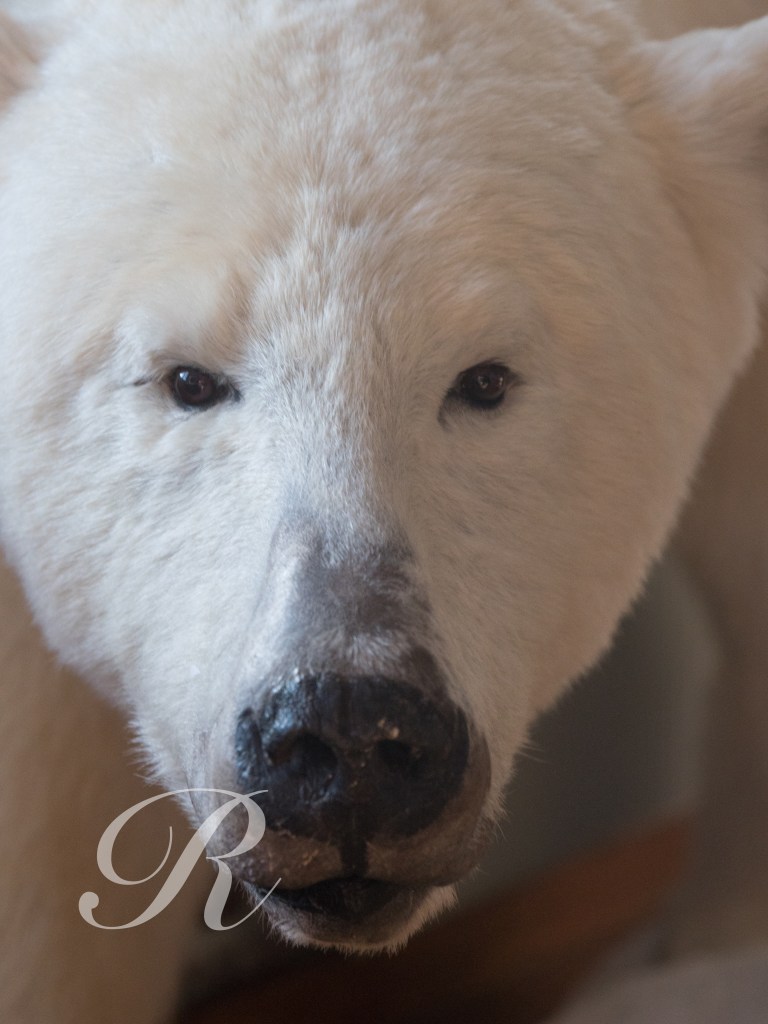
You meet the first one at the airport. It is strategically located by the luggage carousel. You can’t miss it. I photographed this one in the church …
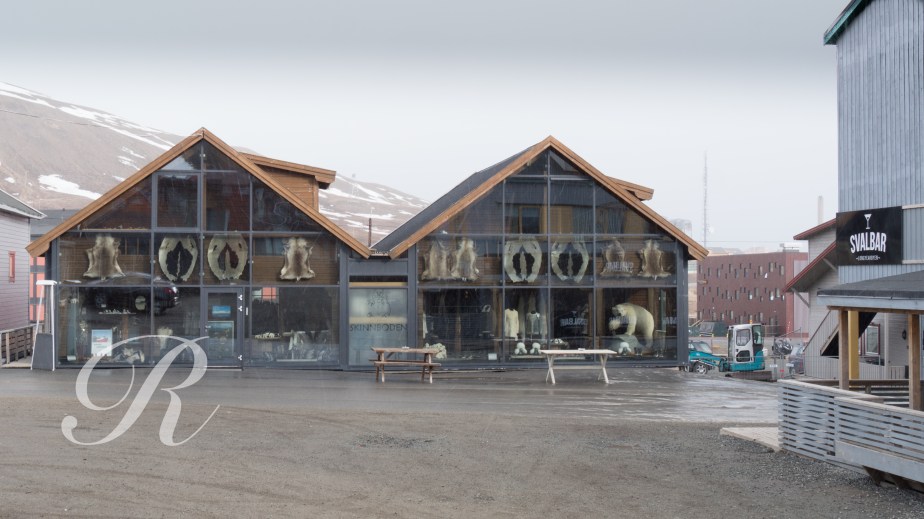
If you want one to take home you can apparently buy one here …
home of this notice …
Perhaps you frown on such things and prefer a more artistic representation …
At the city limits you find this …
a warning that, as the sign says, applies to all of Svalbard including behind you. Last year a mother and two cubs spent the night in Longyearbyen.
Polar Bears are extremely dangerous and especially hungry for two or three months after the ice goes out. That’s the tourist season. Until new-born seals become available you are the best source of nourishment on the menu. There have been quite a few attacks recorded and five have been fatal in the last 40 years. When you are traveling in the back country there may be a bear just over the next rise. Never leave town without your rifle or a well equipped guide.
With a certificate of good behaviour from your local police you can rent a rifle. A flare pistol is also recommended. Our guide, Jens, is modelling the appropriate outfit …
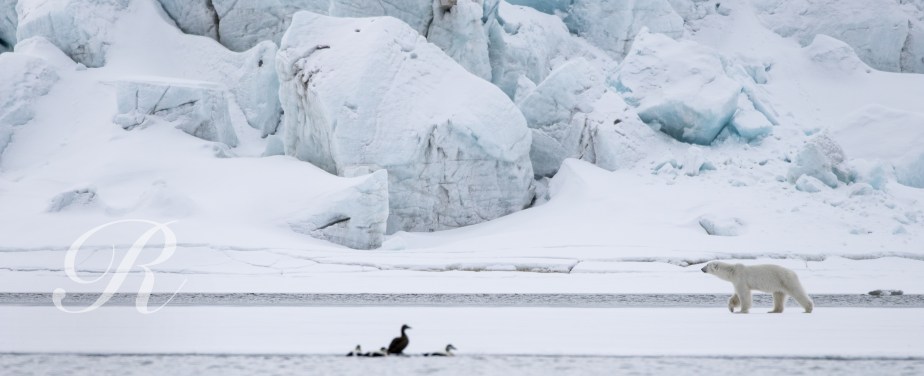
But Polar Bears are what I’ve come for. Will I get a photo that conveys their majesty? Will I get a photo at all?



















 bobmcgee