Brazzaville …

King Leopold ll of Belgium managed to convince the world that he had the best interests of the African people in his heart as he sponsored exploration of the Congo Basin. Whilst projecting a virtuous image he carved out not a Belgian colony but a personal fiefdom in what is now the Democratic Republic of the Congo.

The local people were enslaved and treated most brutally. As mighty as the river Congo is, it is not navigable from its mouth. Having staked his claim, Leopold’s first objective was to make a route from the coast, around the rapids that hindered exploitation. This was initially a foot slog with humans forced to be the beasts of burden, it ultimately became a railway.

With that achieved lucky Leo began enriching himself by extracting as much ivory as he could. When Mr Dunlop working in Belfast in 1887 reinvented the pneumatic tyre in a form that would become a commercial success the new commodity was rubber. Initially this was harvested from wild growing vines. Until plantations of rubber trees took over the natives could be persuaded, usually by holding their wives and children hostage, or by killing the reluctant, to get out there and bring in an increasingly burdensome quota of rubber.

To ensure that bullets weren’t going to waste in Leopold’s Congo an ingenious accounting method was devised. For each bullet issued a human right hand had to be returned. If you wanted to shoot something other than a human, say for the pot, the problem could be solved by amputating the right hand of someone not yet dead. If you want to learn more on this grisly subject I recommend the book King Leopold’s Ghost by Adam Hochschild.

The Belgian Government did eventually take over the colony but continued in the same style.

Leopold’s ambitions on the north bank of the Congo were checked by the French. In 1880 Pierre Savorgnan de Brazza, a naturalised Frenchman of Italian origin, reached the river from Gabon and persuaded the local king to accept the protection of France. Thus the modern day Republic of Congo was once part of French Equatorial Africa.

De Brazza returned in 1886 as Governor-General but lacked the capacity or rapacity to deliver the sort of profits his masters desired. He was replaced in 1897. By 1905 the civilised world was waking up to the realities of colonial excess. De Brazza was sent back to investigate the goings on. His report was scathing and quickly buried. Conveniently, he died soon after. And was also buried. Given a state funeral but little recognition, his widow had his remains exhumed and reinterred in Algiers.

The Congo became independent of France in 1960. The city founded by de Brazza and named Brazzaville by the colonisers managed to keep its name. In fact further honour was heaped on de Brazza in the form of a splendid mausoleum, his remains and the remains of his wife and children were brought from Algiers and treated to a state funeral again.

OLYMPUS DIGITAL CAMERA

Brazzaville is an unpretentious city. A few notable buildings stand out …

OLYMPUS DIGITAL CAMERA

OLYMPUS DIGITAL CAMERA

The old religions of Christianity and Islam are represented and also the new religion of Association Football …

OLYMPUS DIGITAL CAMERA

The stadium is going up for the 2015 African Games. The architects are PTW, an Australian firm. It is being built by the China State Construction Engineering Corporation.

The Nabemba Tower is the tallest building on the skyline. It is named after the Congo’s highest mountain. It is 106 metres or 30 floors high and supposedly costs £3,000,000 a year to maintain, in a city that struggles to provide garbage removal, dumps its sewage in the river and has only rudimentary hospital facilities.

OLYMPUS DIGITAL CAMERA

I walked around the city by day and after dark, I was never pestered or fearful for my safety. Poto Poto market and the nearby Cathedral are well worth a visit. Razor wire and private security suggest that burglary might be a problem. Expat South Africans that I spoke to uniformly said it was safer than South Africa. Almost every vehicle on the road is a taxi, price is fixed for the central area of the city and very reasonable. Negotiate the fee for longer journeys before getting in … the vehicle behind is also likely to be a taxi, if your French is up to it you can conduct an auction from the footpath!

Sadly there is little opportunity to access and enjoy the river frontage.
The African Queen …

My African sojourn was coming to an end but there would be one last adventure, a two day cruise on the Congo River. It is the deepest river in the world and second only to the Amazon in the water it discharges to the sea. Home of the Mokèlé-mbèmbé, boundary between nations, highway of colonial subjugation, heart of darkness or artery of Africa, take your pick. Mark, my traveling companion, had done all the travel organisation. So far a splendid job. He was a little nervous about this final flourish. It was all organised by email, no receipts, no address, no phone number. Would our guide pick us up at Mikael’s Hotel?

OLYMPUS DIGITAL CAMERA

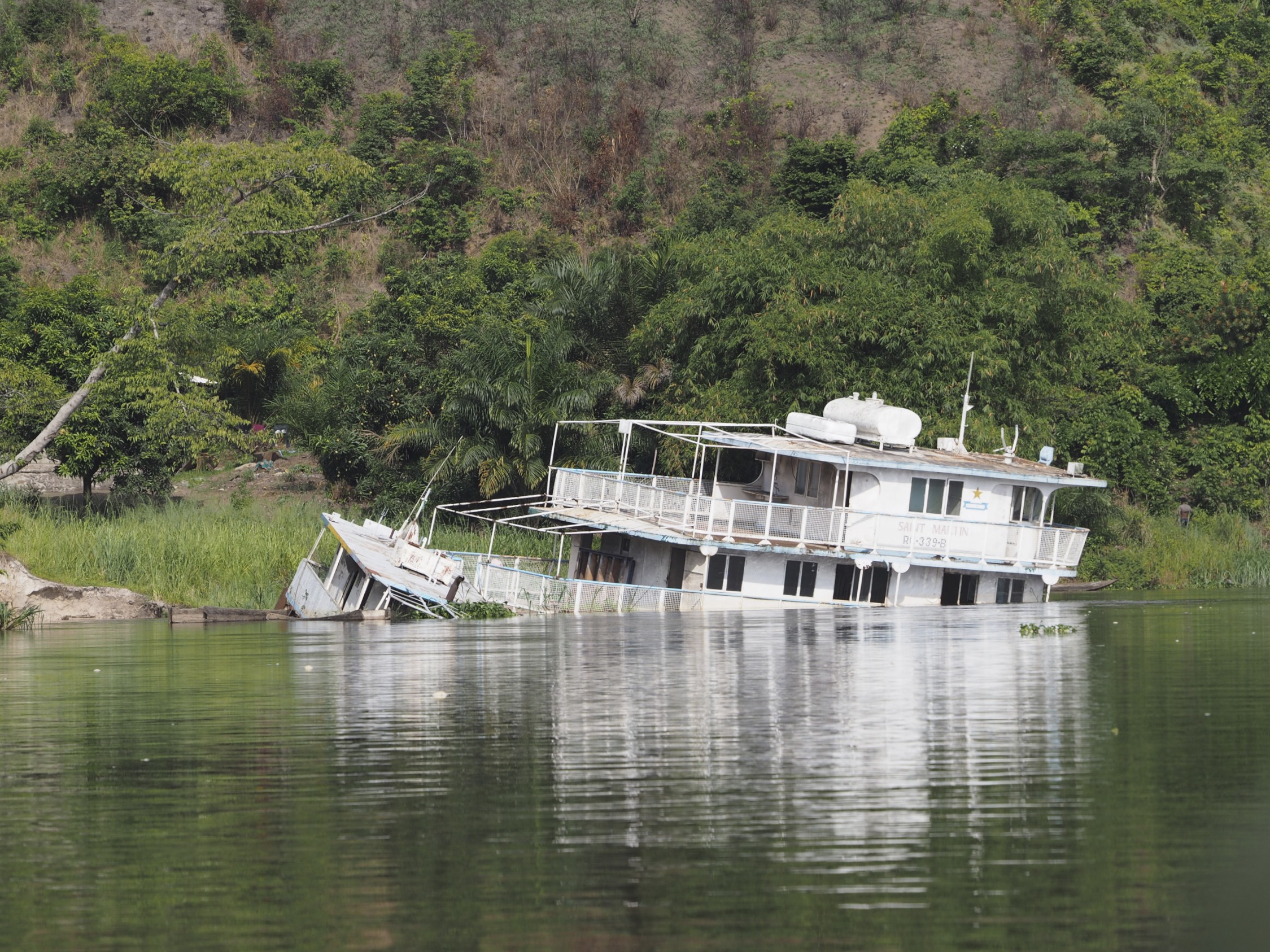
Would the African Queen still be afloat?

The guide was ten minutes late. We took a taxi to the supermarket where we had to buy food for on the boat. Then we took a taxi to the docks. We were walking boldly into the docks when the police picked us up. The police station was very bare. We stood in front of a wooden counter that ran the width of a narrow room, there was a window on our left, no glass just a grill. There was a cage on our right, running the length of the room and about a metre and a half deep. The room was narrow enough for the prisoner on our right to be in conversation via the grill on our left with someone outside. I think he was pleading for someone to post bail.

There were three policemen, we handed over our passports. The largest policeman was in great spirits. Identifying us as Australians he began hooting at us. At the time it made little sense but afterwards I realized he had confused us with New Zealanders and was performing a Haka. A nice touch. Our passports were inspected thoroughly and failed to pass muster. We would have to go see the big boss.

The big boss gestured to some chairs in front of his desk, his office was a room that was bare apart from a bed, a bicycle, his desk and the chairs. Small windows, concrete walls. He inspected our passports carefully … and they failed to pass muster.

The next office belonged to the Chief of Immigration. Also bare, small windows. No bed, perhaps he expected bribes to be in the form of cash. No bicycle. He did have a computer. In a cardboard box, no doubt to be unpacked any day. Our guide explained our intentions. The chief inspected our passports. He explained, at great length, that this was the frontier, we did not have the necessary permit from the necessary bureaucratic entity. We could not board a vessel here. Our guide remonstrated. The chief became angry. Remonstrations became more subdued, anger diminished, time passed, the obstacle remained, the discussion went on. Clearly the exchange of as little as 20 would solve the problem, our problem, but would then pose a continuing problem for the guide who would have to find a small present on every occasion thereafter. Eventually he accepted the chief’s decision and we left.

Outside he explained that we would try another departure point, at Mami Wata, which is quite close to Mikael’s Hotel. He called the boatman on his mobile phone. We took a taxi to Mami Wata’s where we had a beer. After a while the boat turned up. It was not the African Queen, it was a canoe, holes in it had been patched with metal strip. Two plastic garden chairs had been placed amidships for the European guests. It had an outboard motor at the stern, held together by clear sticky tape. And God bless all who sail on her.

OLYMPUS DIGITAL CAMERA

We headed up river.

We explained our intense interest in birds, even little brown ones, with limited success.

The Congo is very broad where Brazzaville faces Kinshasa (once known as Leopoldville) across the Stanley Pool. There are numerous islands and the intervening passages are not deep. The world’s deepest river it may be but it’s the shallows and the rapids that determine where it is and isn’t navigable.

Some of the islands are home to fishing folk. Our boatman was keen to show us his village.

OLYMPUS DIGITAL CAMERA

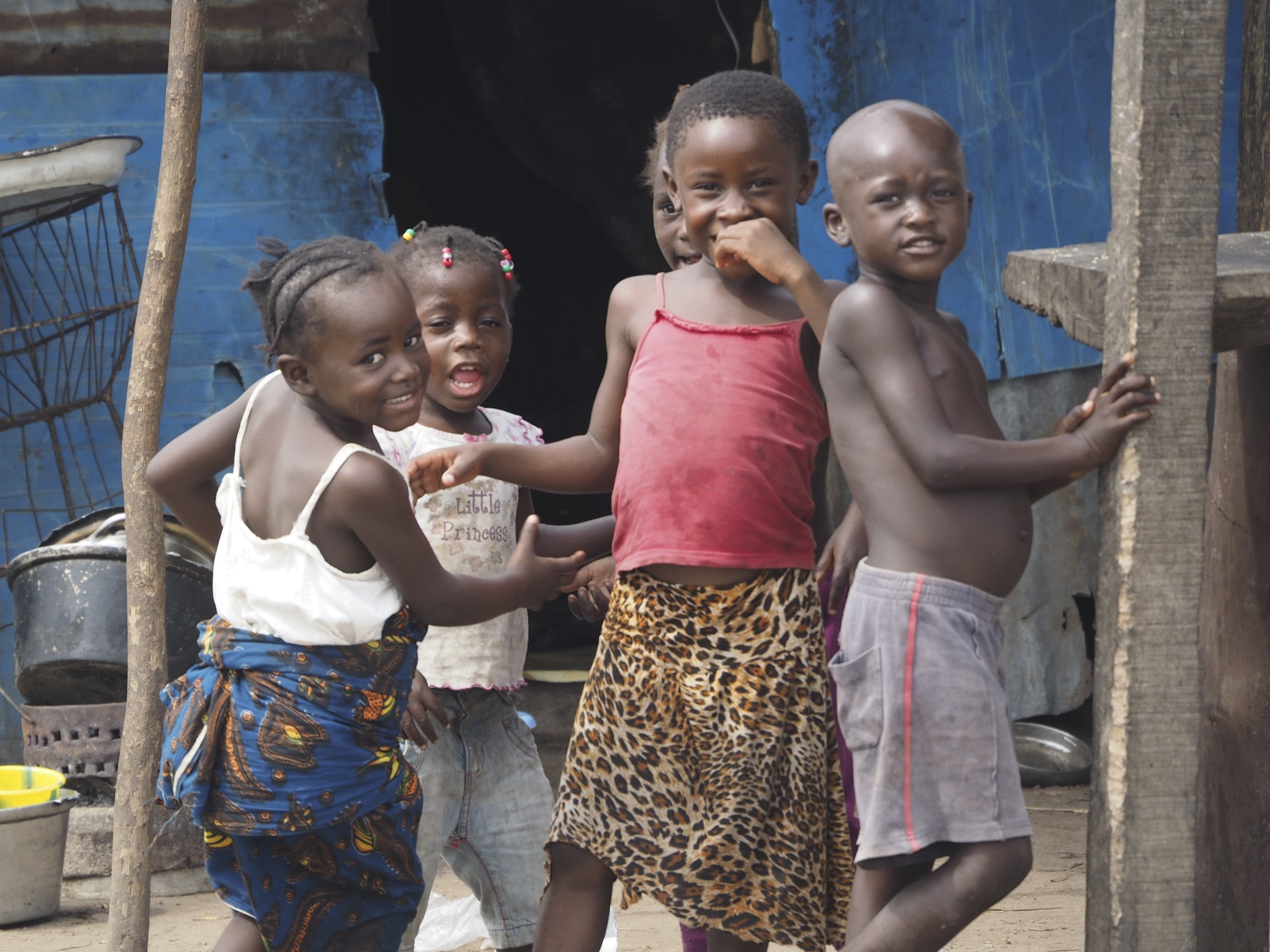
Where Mark captivated the youngsters by discovering a bag of bonbons in his pack …

OLYMPUS DIGITAL CAMERA

In return, our hosts lit a small fire, practically at his feet, and cooked a fish for him to eat.

We explored the river until late afternoon, landed on an uninhabited island, managed to find a few birds along the way. Ultimately we reached our destination, a hotel on an island. The owner, hotelier, chef and bottle washer was clearly surprised to see us … when she was eventually discovered, but yes, if we liked we could stay. It was clean, we each had a bedroom of our own. We shared a bathroom which did have a shower and a flush toilet. We had a lounge where we would also eat. Cool.

There was no running water, which relegated the shower to decorative status only. There was a line of buckets next to the toilet so no problem there. A generator provided electricity in the evening. And the boatman would be back at eleven the next morning. The evening meal was delicious.

Birding on the island was good. Amongst those prepared to pose were Little Bittern …

OLYMPUS DIGITAL CAMERA

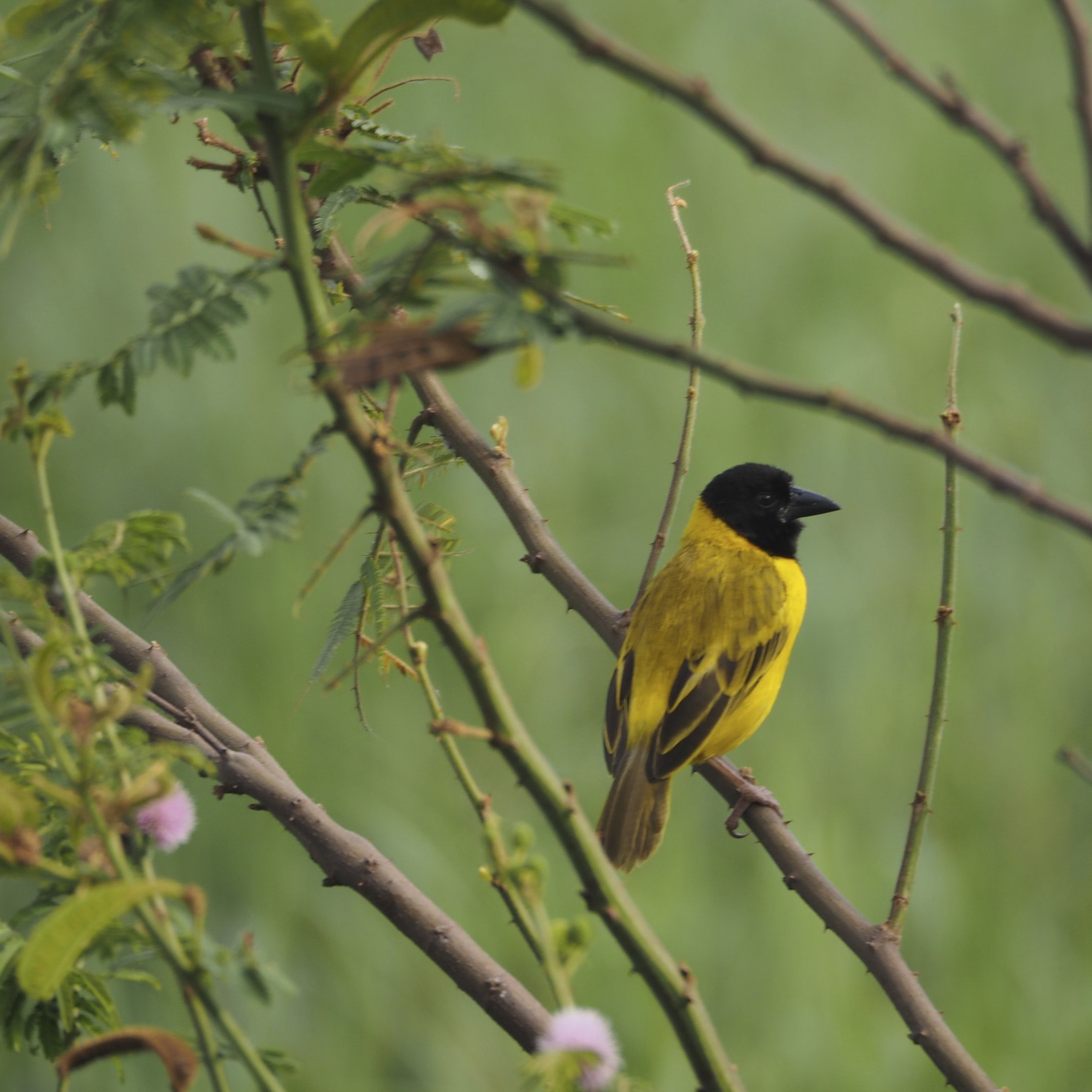
… and Yellow-backed Weaver.

OLYMPUS DIGITAL CAMERA

Daily life passed by …

OLYMPUS DIGITAL CAMERA

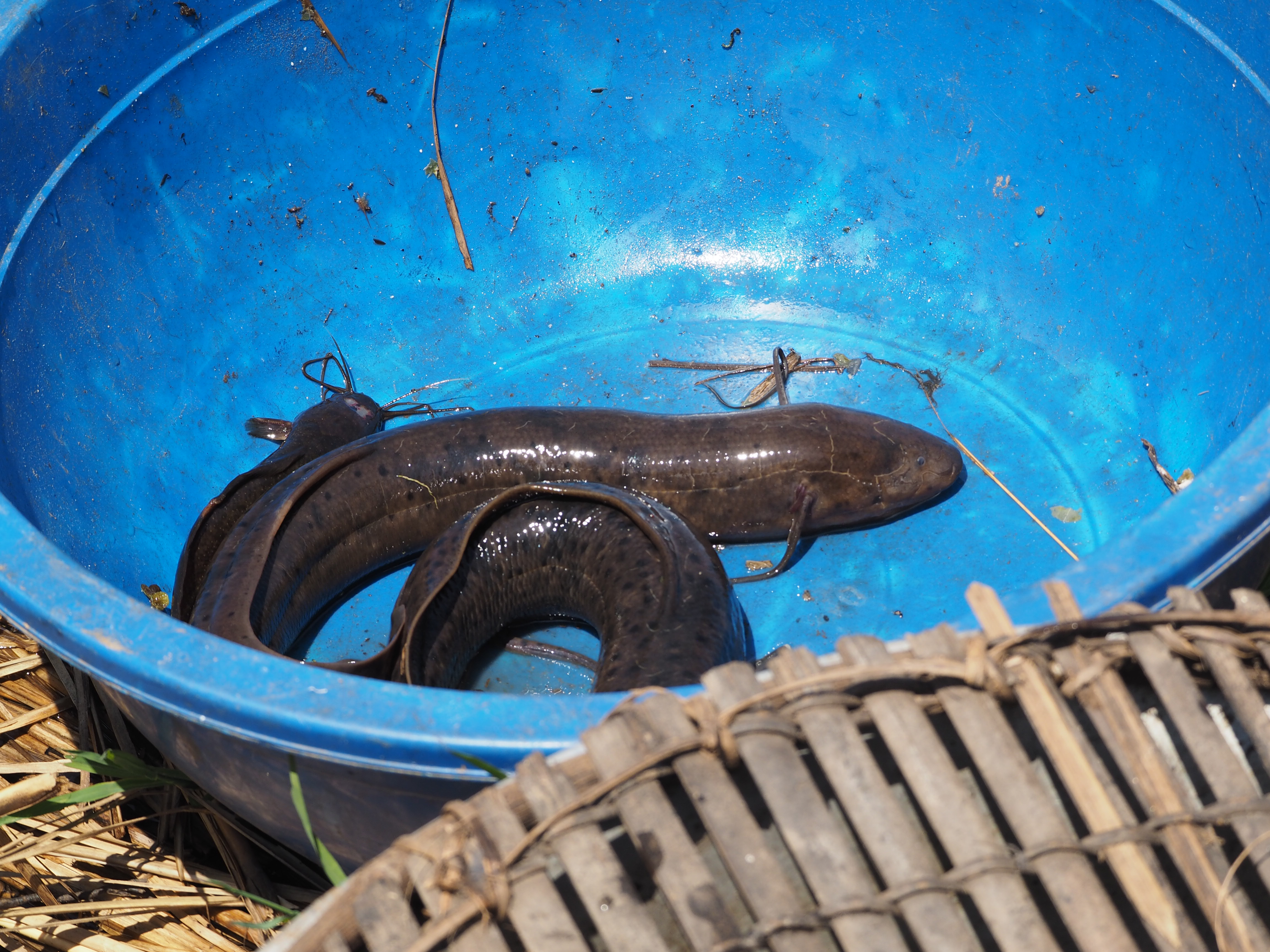
Not long after noon the boat man did turn up and we made our way back to Brazzaville. Along the way we encountered the African Lungfish, sadly awaiting an unpleasant fate.

OLYMPUS DIGITAL CAMERA

All that was left to do was to find some way of getting ashore without being arrested. We headed first to Mami Wata. For some reason, however, after a close inspection no landing was attempted. We then did an impersonation of a drunk driver crawling along in the gutter, up past the ferry terminal, a sniff around the port, hid behind other boats then back down to Mami Wata an hour or so later. Attempts to elicit an explanation of what we were up to met with no success.

We got off finally at Mami Wata where a little money changed hands to smooth our passage. A taxi ride took us back To Mikael’s for our final night.

Australians take freedom of movement for granted. Without it a small tourist business cannot be sure of being able to provide a service, a small enterprise stifled by a corrupt bureaucracy.


The Congo …

The River Congo is Africa’s second longest river (after the Nile) but Africa’s mightiest river in the quantity of water discharged at its mouth. It acquired its name from the Kongo civilisation once situated near the mouth of the river, and it’s given its name to the two modern day countries that it separates, The Democratic Republic of the Congo to the south, capital Kinshasa and the Republic of the Congo to the north, capital Brazzaville. The two capitals face each other across the river, the closest capital cities in the world … unless one includes the Vatican and Rome.

The Republic of Congo was a French colony given independence in 1960. The first president shackled the country to the communist bloc. His rule came to an end in a coup in 1968. President Ngouabi followed and the country became the People’s Republic of the Congo. He was assassinated in 1977. There were two years of an interim government before Denis Sassou Nguesso became president. Sassou was pushed aside in a civil war that began in 1997 but after a few months the Angolan socialist régime invaded and reinstated him. He is still in power. He is a connoisseur of foreign bank accounts and fine French real estate.

On March 4th 2012 a fire started in an army base, in the neighbourhood of Mpila which is close to the docks and a densely inhabited area. It led to a series of explosions that flattened the surrounding housing and two churches in which services were underway. About 14,000 people were made homeless, the dead exceeded 250 and the injured ran into the thousands.

Social infrastructure and health services are shambolic. As of 2010, the maternal mortality rate was 560 deaths/100,000 live births, and the infant mortality rate was 59.34 deaths/1,000 live births. Malnutrition is widespread.

By comparison the Democratic Republic (the former Belgian Congo, then briefly Zaire) is a mess.

We flew into Brazzaville over the river, over the construction site of a new stadium for the 2015 African Games and into the nice new airport.

OLYMPUS DIGITAL CAMERA

OLYMPUS DIGITAL CAMERA

Here we were greeted by the quarantine staff in full protective gear, hand sanitizer was dispensed, our temperature was taken and our recent travel history inspected. The Republic was the location of a particularly lethal outbreak of Ebola in 2003. The response is impressive. Outward travelling passengers get to see sophisticated health advice on the airport screens as they wait to check in.

When in Brazzaville McGee stays at Mikhael’s Hotel. An excellent hotel, if you are there any time soon look out for the head waiter, Francis, the man is a gem.

The following morning it was back to the airport and into a Cessna Caravan for the trip to Odzala Kokoua National Park. Transfers were managed impeccably by Wilderness Safaris’ local staff. Hat tip to Imelda.

Coming next Odzala … but I will be back in Brazzaville for further adventures after that.