The never ending story …

Address by the President of the Royal Society to their Lordships of the Admiralty …

It will, without doubt, have come to your Lordships’ knowledge that a considerable change of climate, inexplicable at present to us, must have taken place in the circumpolar regions, by which the severity of the cold … in an impenetrable barrier of ice, has during the last two years greatly abated. This affords ample proof that new sources of warmth have been opened …

November 20, 1817.

The Arctic Ocean is warming up, icebergs are growing scarcer and in some places seals are finding the water too hot, according to a report to the Commerce Department yesterday  from Consulafft, at Bergen, Norway.

 Reports from fishermen, seal hunters and explorers all point to a radical change in climate conditions and hitherto unheard of temperatures in the Arctic zone. Exploration expeditions report that scarcely any ice has been met as far North as 81 degrees 29 minutes.

 Soundings to 3,100 metres show the Gulf Stream still very warm. Great masses of ice have been replaced by moraines of earth and stones, the report continued, while at many points well known glaciers have completely disappeared. Very few seals and no white fish are found in the Eastern Arctic, while vast shoals of herring and smelts, which have so far never ventured so far North, are being encountered in the old seal fishing grounds. Within a few years it is predicted that, due to the ice melt, the sea will rise and make most coastal cities uninhabitable.

November 2, 1922,  The Washington Post.

Thanks to Rupert Wyndham, via JoNova.

Jolly hockey sticks …

I’m off camping for a few days and unlikely to post before Friday which will give me a chance to see some of our gorgeous avifauna (before it’s all roasted on the wing). That’s the good news. The downside is that I may well miss some very important developments in the climate change debate. A debate that I follow with great interest.

The hot topic is the New Hockey Stick. The old one was a potent symbol for the warmists, it was developed by Mann, it showed a very nice constant climate with a sudden upkick of temperature in the twentieth century, it was published by the IPCC, demolished by Steve McIntyre and it seemed to be carefully not mentioned by the warmists for a while.

The new version emanates from Marcott, Shakun, Clark and Mix in a paper published in Science. The reaction from the popular press was dramatic. Essential reading for anyone interested is We’re screwed: 11,000 years worth of climate data prove it.

Marcott is quoted in the article … “I’m curious to see how the skeptics are going to take this paper.

Some of the smart deniers have had a good look at the science. It seems very shaky. Even more interesting is that this work is the culmination of Marcott’s PhD.  In the PhD thesis we have this graph …

thesis-short1In the Science paper we have this …

figure-1cSpot the difference, dead right, it’s the uptick.

Steve McIntyre, patron saint of the anti-hockey stick league, has been scrutinising the underlying data and the methods of torture it has been subjected to.

I will give you the link shortly, but first you will need to know that …

Alkenones are highly resistant organic compounds (ketones) produced by phytoplankton of the class Prymnesiophyceae.

Coccolithophoroids, for instance Emiliania huxleyi, respond to changes in water temperature by altering the production of long-chain unsaturated alkenones in the structure of their cell. At higher temperatures, more of the di-unsaturated molecules are produced than tri-unsaturated [Prahl and Wakeham]. The molecules are resistant to diagenesis, and can be recovered from sediments up to 110 million years old.

The ambient water temperature in which the organisms dwelt can be estimated from ratio of their unsaturated alkenones (C37C39) that are preserved in marine sediments.

Which makes them useful proxies for temperature. But as well as reflecting temperature a useful proxy must also be accurately dated. If you were to choose your proxies carefully and fiddle with their dates you could get any result you wanted … even a hockey stick.

Counterintuitive …

Let me declare a conflict of interest … I’m a vegetarian. But not a proselytising vego. Where the rain falls you can feed me on just 10% of the arable land required to feed people on meat. Great. But you can’t grow cabbages in the desert. So far as feeding people goes the rangelands can only be used for grazing animals. Australia is mostly desert.

The unabridged version of this talk can be found <HERE>.


All is revealed …

There is an answer to every question, a solution to every puzzle, an explanation for every event. It’s called religion. Science, on the other hand can only answer some of the questions. The difference is in the extent to which you can trust the answers.

The reason you might trust the scientific answers is to be found in the process, it’s public … the methods, the results, the discussion, the conclusion are all out there to be checked. If they are not reproducible they are rejected. There is considerable cut and thrust in all this. Religious folk trust the answers, even though theirs are mostly wrong while true scientists never trust the answers even though theirs are mostly right. The science ain’t ever settled.

If every scientist had to check every experiment in person before accepting the result progress would grind to a halt. This leads to a paradox, for all scientists most science is revealed doctrine, sourced from the gospel of the scientific journal. The worst of mistakes are hopefully avoided by the peer review process. This makes a nonsense of any argument than runs along the lines 70% of scientists agree that …

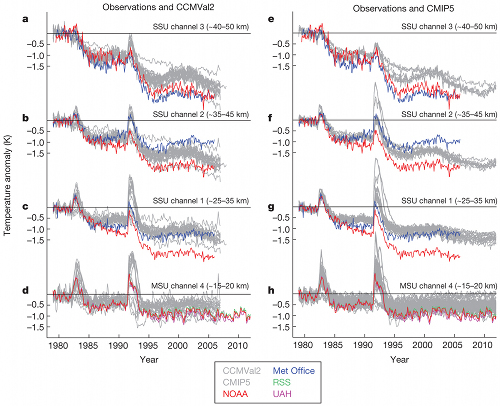
A particularly unsettling example can be found in the paper The mystery of recent stratospheric temperature trends, D. W. J. Thompson et al, Nature 491: 692–697, Nov 2012. The paper is concerned with a data set originally processed by the UK Met Office and later by America’s National Oceanic and Atmospheric Administration (NOAA). The background …

The surface temperature record extends for over a century and is derived from multiple data sources. In contrast, the stratospheric temperature record spans only a few decades and is derived from a handful of data sources. Radiosonde (weather balloon) measurements are available in the lower stratosphere but do not extend to the middle and upper stratosphere. Lidar (light detection and ranging) measurements extend to the middle and upper stratosphere but have very limited spatial and temporal sampling. By far the most abundant observations of long-term stratospheric temperatures are derived from satellite measurements of long-wave radiation emitted by Earth’s atmosphere.

The longest-running records of remotely sensed stratospheric temperatures are provided by the Microwave Sounding Unit (MSU), the Advanced Microwave Sounding Unit (AMSU), and the Stratospheric Sounding Unit (SSU). The SSU and MSU instruments were flown onboard a consecutive series of seven NOAA polar-orbiting satellites that partially overlap in time from late 1978 to 2006; the AMSU instruments have been flown onboard NOAA satellites from mid-1998 to the present day.

The widely accepted, continuous record of temperatures in the middle and upper stratosphere going back to 1979 was based exclusively on SSU data. The SSU data were originally processed for climate analysis by scientists at the UK Met Office in the 1980s and further revised as newer satellite data became available in 2008.
NOAA recently reprocessed the SSU records and published the full processing methodology and the resulting data.
stratosphere_temps-500
Met in blue NOAA in red, and the outputs kind of resemble each other, a bit. Why don’t they match? That’s a mystery. The pair diverge  from about 1985 and grow further apart with time. How did the Met Office handle the numbers? That’s also a mystery, the method was never published and is now lost to human knowledge.
The global-mean cooling in the middle stratosphere, that’s about 25–45 km in altitude, is nearly twice as large in the NOAA data set as it is in the Met Office data set or in the words of  the Nature article: “The differences between the NOAA and Met Office global-mean time series shown in Fig. 1 are so large they call into question our fundamental understanding of observed temperature trends in the middle and upper stratosphere.
So science triumphs again, it’s all fixed now.
Just one problem, it’s the old data set that the climate modellers have used to forecast thermageddon. And that might be just one of the reasons that observed temperature trends stubbornly refuse to comply with the IPCC predictions. Garbage in, garbage out.
You can buy the original paper <HERE> or read another review of it <HERE>.

The south pole …

On 17 January 1912 Captain Robert Falcon Scott led a group of men to the South Pole. There he discovered that Raoul Amundsen had preceded them by five weeks.

The five members of Scott’s party died on the return trip.

These events have been analysed extensively and the most important difference between the two expeditions is usually said to be the mode of transport. Amundsen took the trouble to serve his apprenticeship in the Arctic, learnt from the Eskimo and chose dogs to pull him to the pole.

Scott on the other hand …

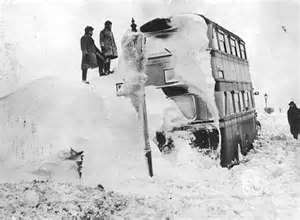
th… chose London Transport.

Well, not true, this is actually a photo from 1947 in England. Before it was fashionable to blame unusually cold weather on global warming, unusually cold weather just happened. Ignorant folks would blame it on the atom bomb. The tale of the exceptional winter of 1947 can be read <HERE>.

Viscount Monkton of Brenchley …

Easily the most interesting peer of the realm since Screaming Lord Sutch, the Viscount has been enthusiastically waging war on the warmists.

On a recent visit to Tasmania one of the warmists Mr Tony Press, chief executive of the Antarctic research centre, dismissed Monkton’s suggestion that there has been no global warming for at least 16 years, accused him of being unscientific and added the charge that Monkton was suggesting that scientists around the world were involved in “massive delusional group thinking”.

You can read Lord Monkton’s letter to the University of Tasmania  <HERE>. If you are thinking of writing a letter of complaint you could find worse models to follow. The vice chancellor’s email address is in the letter, I took the time to drop him a line saying how interested I am in his reply.

Screaming Lord Sutch’s album Lord Sutch and Heavy Friends was named in a 1998 BBC poll as the worst album of all time.

Sutch founded the Official Monster Raving Loony Party in 1983, he contested over 40 elections, after standing against Margaret Thatcher in 1983 the deposit required from candidates was raised from £150 to £500. At the Bootle by-election in 1990 he secured more votes than the candidate of the Continuing Social Democratic Party (SDP), led by former Foreign Secretary David Owen.  The ignominy was such that  the SDP dissolved itself within days.

Several biographies have been written, sadly none were called Sutch ‘is life.