Hotel Colbert …

When visiting Antananarivo McGee stays at the Hotel Colbert.

At least it seemed like a routine by the time I’d checked in for a single night for the fourth time. And a very pleasant routine at that. The rooms were fine, the restaurants were fine, the ambiance was fine, the staff were fine and the location is perfect. I’m told there is an older and a newer wing. I stayed in the newer wing each time and it might be a good idea to request that.

Tripadvisor has this little gem …

When I arrived in my room I felt it was dusty and dark. I had also requested that they do not have any feathers in the room as I am highly allergic. Unfortunately they could not change the pillows as they only had pillows with feathers so they suggested I move to the La Varangue down the road which was a far more acceptable Hotel.

… just a snippet of an extended whinge, I assume by the owner of La Varangue. If not the whinger will have found Madagascar almost beyond endurance.

Next door is the Ambohitsorohitra palace, built by the French, it now serves as a presidential office.

OLYMPUS DIGITAL CAMERA

This is illuminated at night, suggesting some encouragement to look at it, but if you look at it for long during the day you are quickly moved on by a man with a machine pistol.

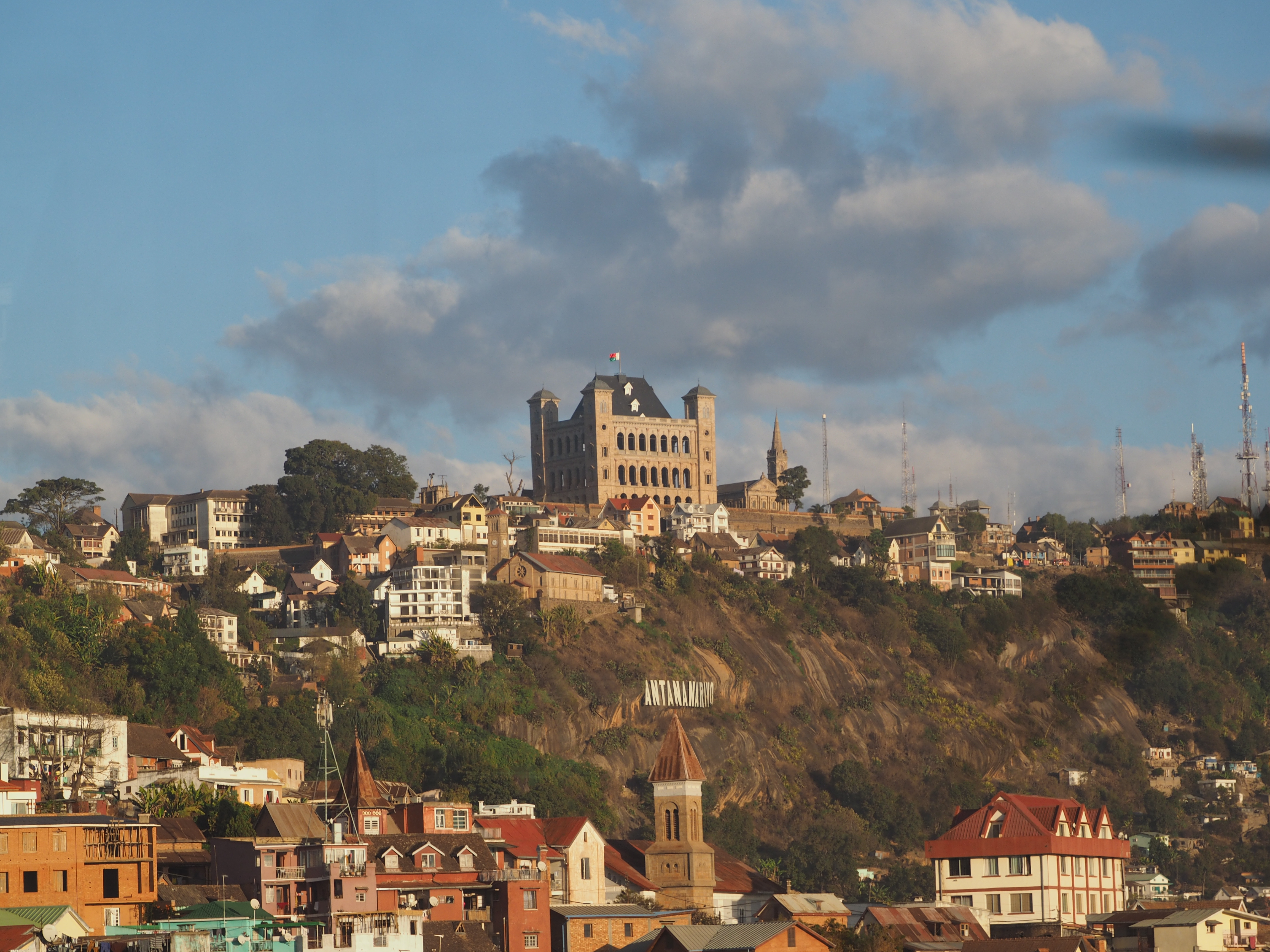
Hotel Colbert is in the middle town which is the commercial centre. From the terrace you look up to the high town which is where the nobility had their palaces, the view is dominated by the Queen’s Palace, the Manjakamiadina, currently under repair.
OLYMPUS DIGITAL CAMERA

Queen Ranavalona l ruled from 1828 to 1861, a time when missionaries from London were introducing new and dangerous ideas and European powers were itching to take yet another colony. She did a pretty good job of absorbing what was useful whilst fending off the colonisers and enforcing the traditional Malagasy values. An edict issued in 1835 made life rather difficult for the missionaries and by twelve months later they had all left town. The cliffs below the palace came in rather handy for an early form of bungee jumping. Those who possessed a Bible, worshiped in congregation or continued to profess adherence to Christianity might find themselves dangling up there. Those who recanted the new fangled faith would be hauled in, those who refused would have the ropes cut.

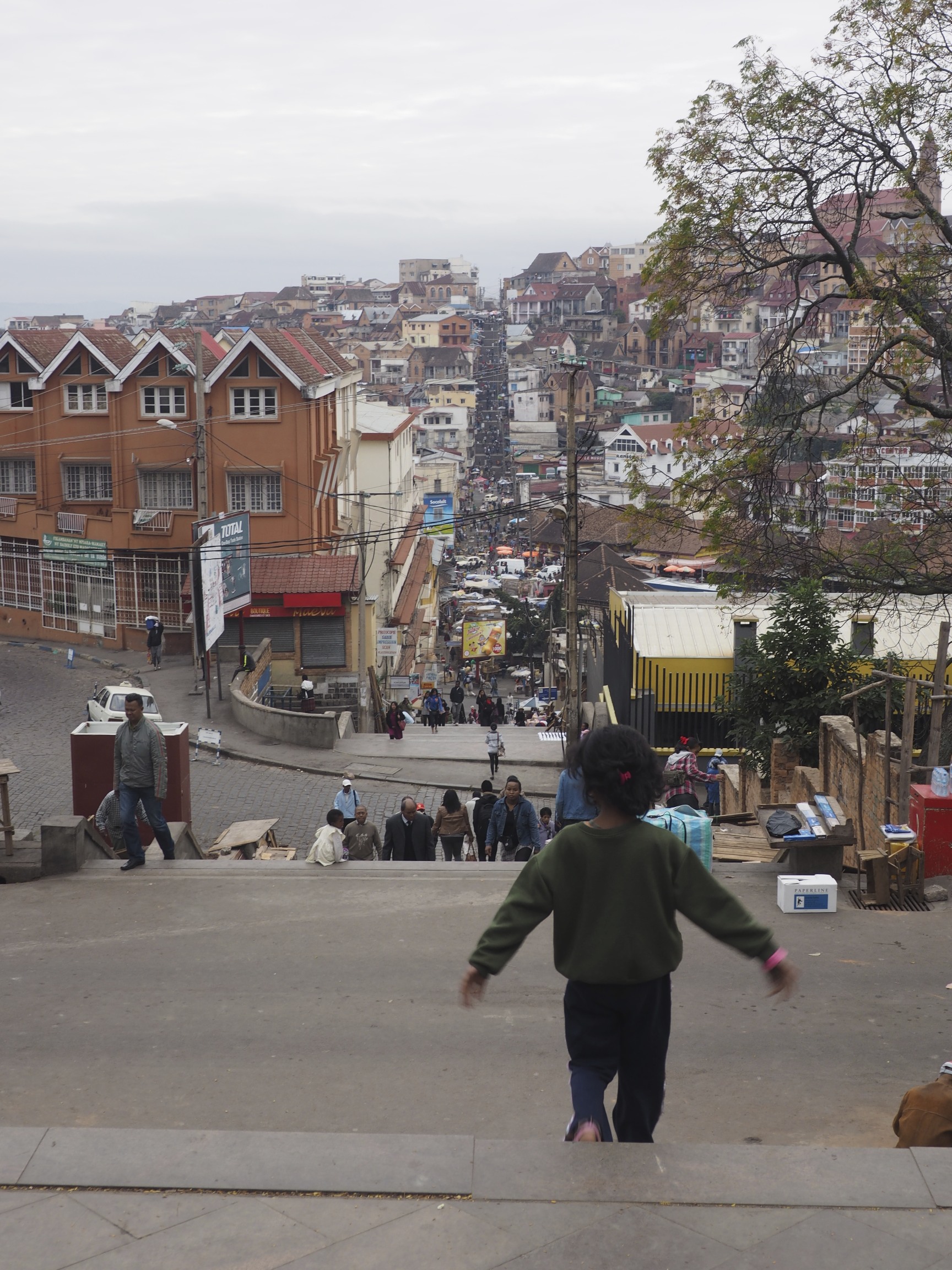
Not far from the front door are the steps to the lower town.
OLYMPUS DIGITAL CAMERA

I enjoyed the Colbert, but I am easily pleased, I’ll even put up with feathers in my pillows. Bearing that in mind let me recommend a couple of restaurants, not that there is anything wrong with the food at the Colbert.

Villa Vanille … if the French left anything useful it was the food, absolutely fabulous, good service a bonus and the trio of musicians were very very good.

La Varangue, cordon bleu in the midst of the weirdest collection of antiques, rated number one in Antananarivo and it wouldn’t surprise me if it deserved it.


Antananarivo …

I left Johanessburg’s sprawling and, it seems, rapidly expanding airport on a South African Airlines flight.

The airport at Antananarivo was quite a contrast. So too were the roads and surroundings on the way into town. Whereas South Africa has multi-lane highways and electronic tolling, even if most drivers are refusing to pay the bills, Antananarivo has a very modest airport and narrow streets. Even though July is the start of the dry season the countryside is green unlike the dusty brown highveldt around Jo’burg.

Both cities are cooler than you would expect for their latitude because both are quite high, Jo’burg 1750 meteres, Antananarivo 1280 metres.

645x1026xemad1501-map.png.pagespeed.ic.Qf_n_AWnNe

Once again, I travelled with Zegrahm Tours, the map, which I shamelessly filched from their website, shows the places we would visit.

One theory is that Antananarivo comes from the Malagasy for the place where far too many ans arrived. It is far more likely that it translates something like the city of a thousand (the strength of the force deployed by King Andrianjaka 1612–1630 to capture the town formerly known as Analamanga), although it is now home to a little over two million. It sprawls over the hilltops in all directions, the intervening valley bottoms are agricultural land mainly given over to the cultivation of rice.

Antananarivo was a major city before the colonial era but was built from wood and thatch.The Malagasy believed that a place to live in should be built from living materials. Outsiders brought in the practice of building in brick and stone from about 1820 and they were used to construct the foreigners small number of churches, schools and factories. In 1869 Queen Ranavalona II lifted the prohibition on the use of brick and stone by the Malagasy and the new materials rapidly replaced wood.

OLYMPUS DIGITAL CAMERA

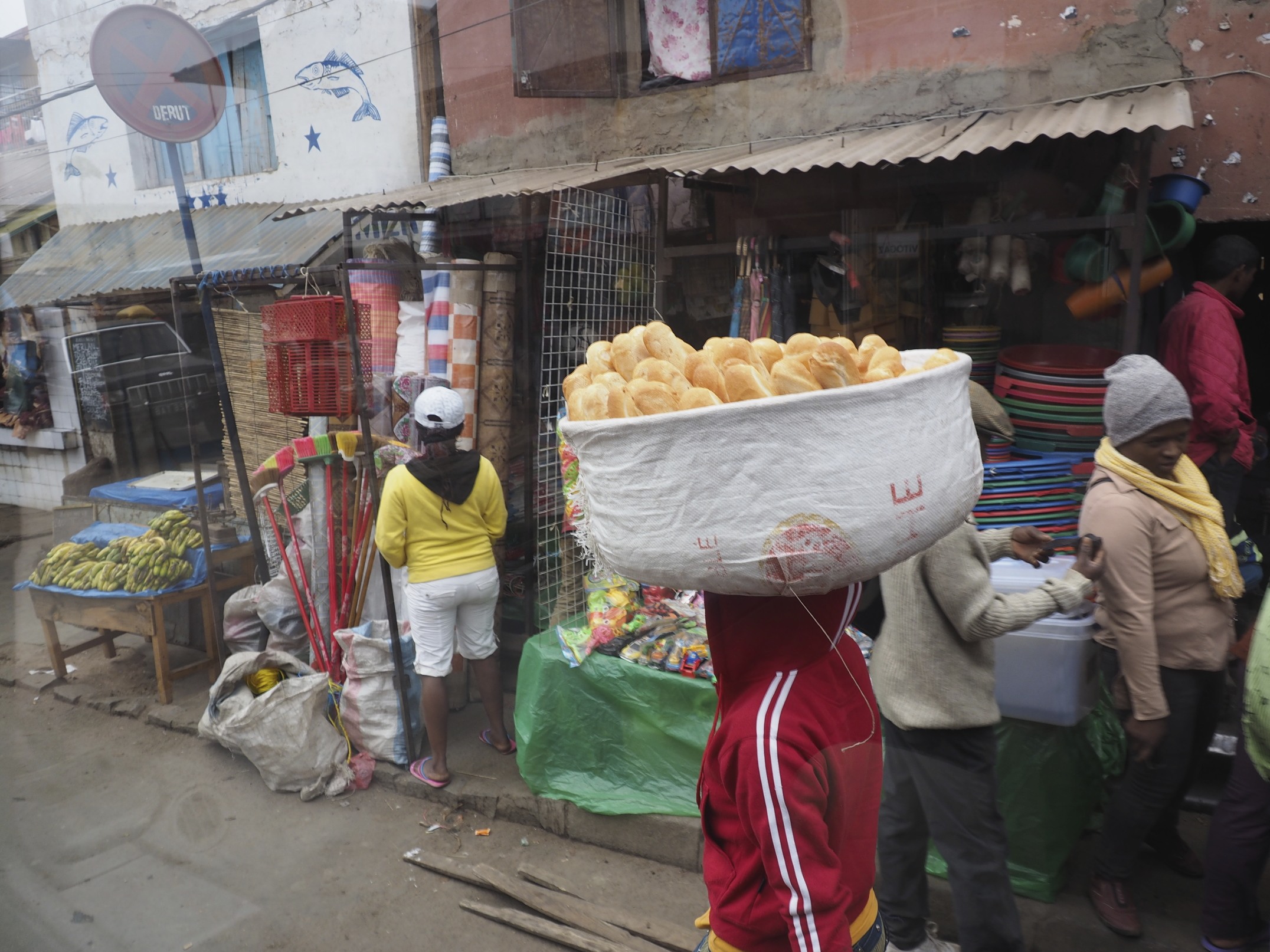
Much of life is conducted on the footpath …

OLYMPUS DIGITAL CAMERA

OLYMPUS DIGITAL CAMERA

Because of the very poor state of Madagascar’s roads the tour would fly to most of its various destinations. Because Antananarivo so dominates the country’s economy this would entail radial flights to and from the capital. So every few days would bring me back to the Big A. Each time I stayed at the Hotel Colbert. More of that next …


Madagascar …

I’m leaving today.

I have been to a lot of out of the way places and the most frequent response from friends and co-workers has been “why?” … but that’s not the case with Madagascar. It seems that everyone has their own inner Madagascar, it may not be the first place on their bucket list, but when you mention it, eyes light up. Is it the movies, is it the Lemurs at the zoo or is it some TV documentary?

If you allow Australia the privilege of being an island as well as a continent then Madagascar is the fifth largest of the world’s islands. It’s about 1500 km top to bottom and about 570 km wide at its widest point. It’s about 420 km west of its nearest neighbour, Mozambique. The central highlands range from about 750 to 1500 metres. The east coast gets the rain, the west and south coastal regions are dry.

Madagascar was part of Gondwana and although it is now close to Africa it parted from the Africa-South America landmass around 135 million years ago. It kept company with India until about 88 million years ago. Its prolonged isolation has given it a very special evolutionary history. If friends and co-workers had said “why?’ instead of “ooh” this would have been my answer – to see the wildlife.

The population is a little over 22 million and on average they survive on about $450 a year.

Human settlement first came from the east some time between 350 BC and 550 AD, making Madagascar one of the last substantial land masses to receive the benefit of people. The founding population is estimated to have been around 60 to 200 individuals based on genetics. They likely arrived by outrigger canoe from Borneo. Subsequent settlement was mainly from subsaharan Africa.

Approximately 90 percent of all plant and animal species found in Madagascar are endemic, including the lemurs (a type of prosimian primate), the carnivorous fossa and many birds. According to Avibase there are 300 species of bird and 108 are endemic. The chameleons are another highlight, the island is home to two-thirds of all the world’s chameleon species and is possibly where they first evolved.

Some of the animal colonists have had better luck than others, the Malagasy Hippos are gone unless I happen to stumble across the kilopilopitsofy, although the Nile Crocodile is worth looking out for (diligently). The Elephant Bird survived until the 17th or 18th century. They stood about 3 metres tall, weighed about 400 kg and laid eggs which could be greater than a metre in diameter.

Now where did I put my passport and the tickets?

I will not be posting until my return so please, call back in about three weeks.