Perinet …

Andasibe-Mantadia National Park is on the eastern edge of the central highlands and is firmly ensconced on the tourist itinerary for a combination of reasons. It can be reached by a good road from Antananarivo, it offers a very good chance of seeing Indri and boasts good accommodation. Most tourists won’t actually make it into the Mantadia section of the park because the road is a monster and is reportedly getting worse for lack of maintenance. Instead they will spend their time either in the Analamazaotra Reserve or at Vakona which has a population of lemurs established on Lemur Island.

The lodge at Vakona (pronounced Vakoona, there is no short O sound in Malagasy) is surrounded by a mature eucalypt forest that could have been snatched from somewhere in the Australian Great Divide. Up the hill, out of picture to the left is a stand of what looks remarkably like Eucalyptus regnans. There are no Lyrebirds but instead Paradise Flycatchers, Crested Drongos, Vasa Parrots and Sunbird-Asitys.

OLYMPUS DIGITAL CAMERA

The Analamazaotra Reserve is secondary forest on the hills with overgrown abandoned fish ponds and rice paddies in the valley. Local guides must be hired and they will repay you by finding Chameleons and Leaf-tailed Geckos that you would otherwise walk right past. During the morning the Indri proclaim their territories by call, which carries a huge distance, when you are close up you can understand why. I found this example on youtube …

I found it very evocative.
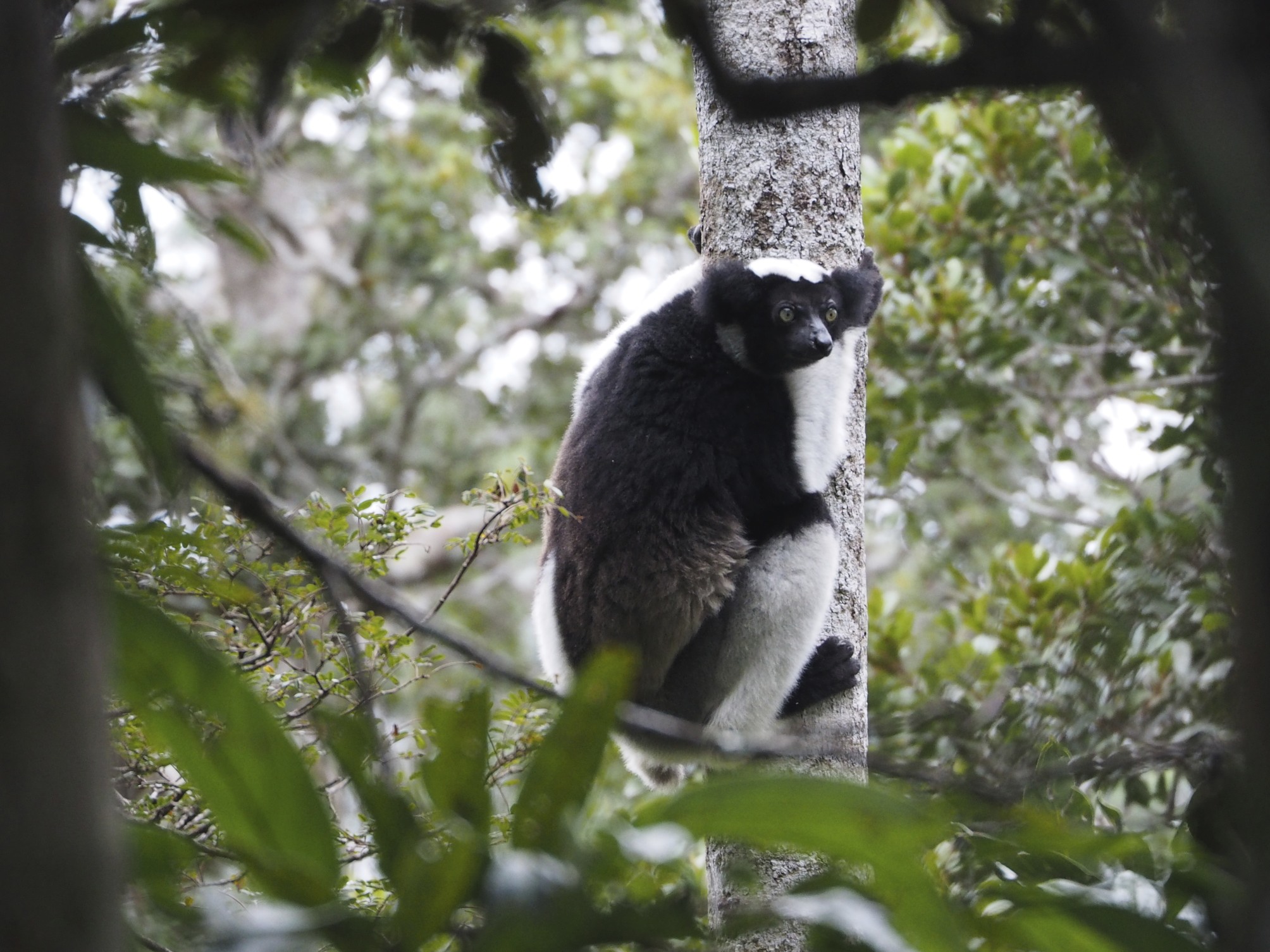
OLYMPUS DIGITAL CAMERA

In the past there were much larger lemurs but the Indri is the largest of the extant prosimians. They live in small family groups consisting of a male and female in a longterm monogamous relationship and their offspring. Females reach sexual maturity between the ages of 7–9 years and then bear offspring every two to three years. They feed mainly on leaves but will also eat seeds, fruits, and flowers. They are critically endangered largely due to habitat destruction.

Andasibe-Mantadia National Park is also home to another ten lemur species including Diademed Sifaka …

OLYMPUS DIGITAL CAMERA

Black and white Ruffed Lemur …

OLYMPUS DIGITAL CAMERA

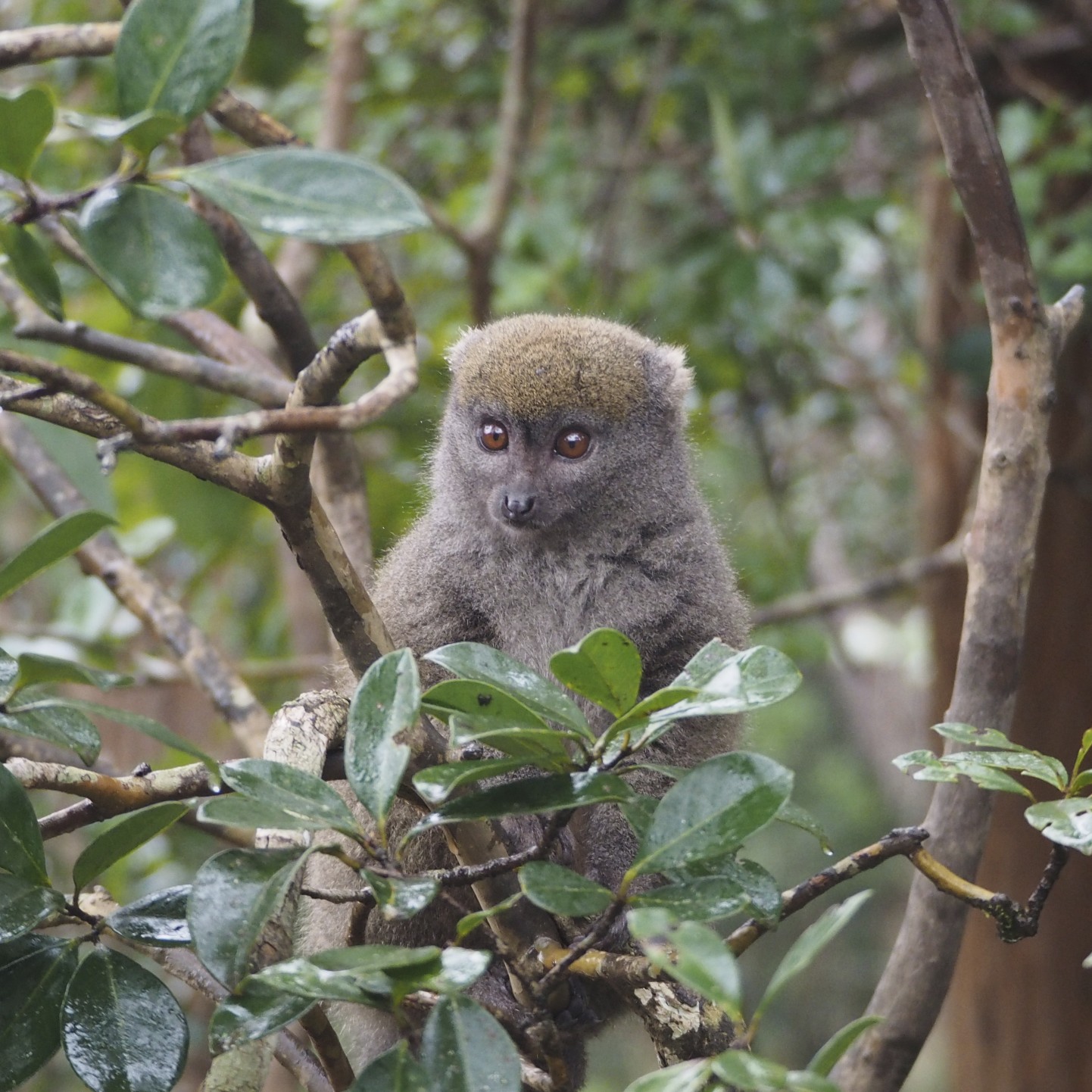
and for an overload of cute, the Eastern Lesser Bamboo Lemur …
OLYMPUS DIGITAL CAMERA


Mandraka …

The largest lemur alive today is the Indri. The easiest place for the visitor to see them is at Perinet. So for us it was back to Antananarivo and then by road to the east.

645x1026xemad1501-map.png.pagespeed.ic.Qf_n_AWnNe

We broke the journey at the Mandraka Nature Farm where we had the opportunity to get up close and personal with a variety of interesting albeit captive creatures.

P1030360

This character is a Leaf-tail Gecko. It was lifted out of its cage and placed on a mossy log. It makes a good introduction because under these conditions you can see them. Finding them in the wild is much more of a challenge as you will see in future posts. You can easily distinguish geckos from chameleons by looking at their feet …

OLYMPUS DIGITAL CAMERA

which are divided into two in chameleons.

OLYMPUS DIGITAL CAMERA

Whereas snakes have no feet.

OLYMPUS DIGITAL CAMERA

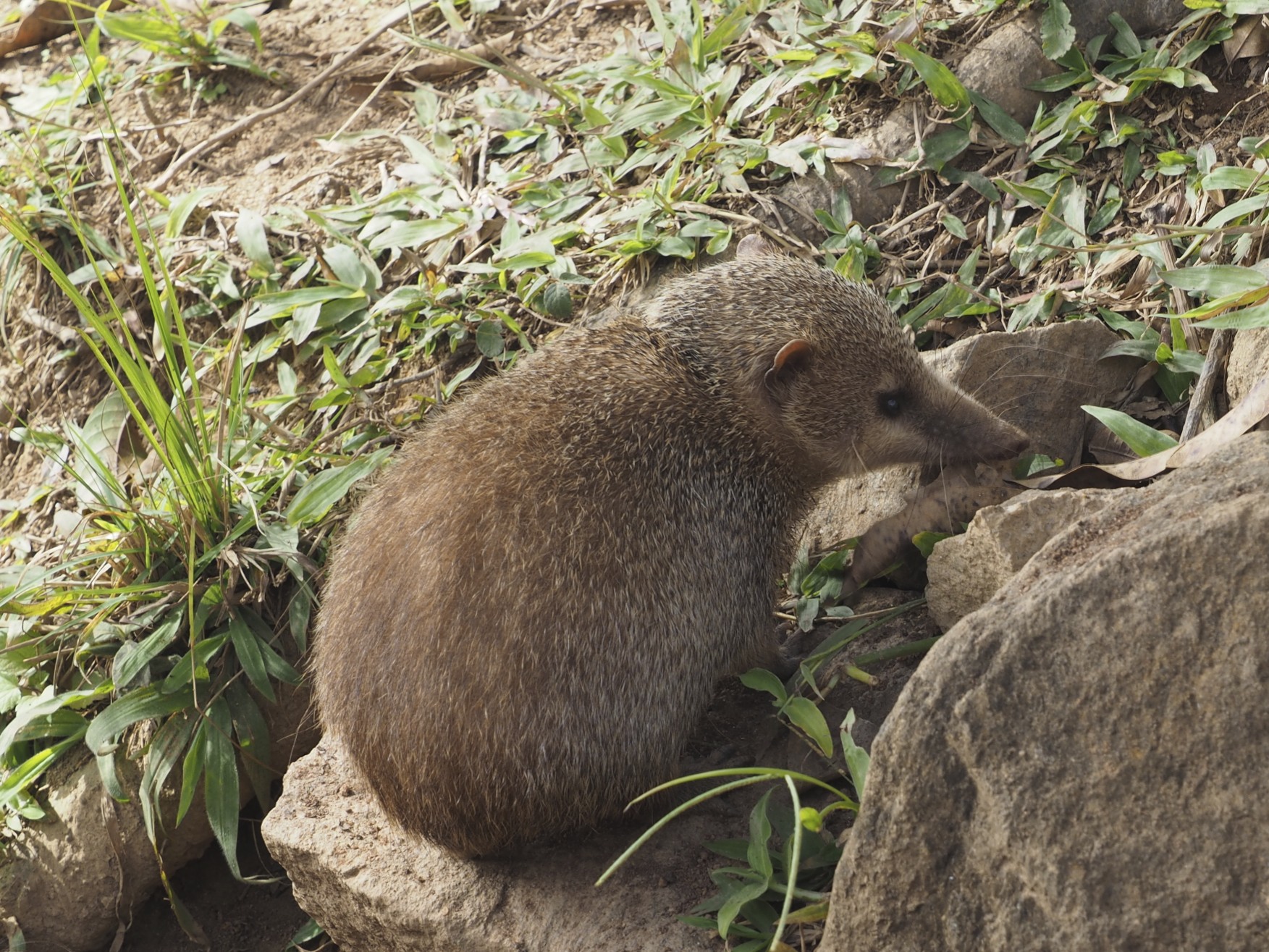
Also on display they had crocodiles, tortoises, some butterflies, frogs, flying foxes and it was the only place where we saw Tenrecs. This little guy is a Common Tenrec.

OLYMPUS DIGITAL CAMERA

Nahampoana …

After a few days at Berenty our long-suffering bus took us back to Fort Dauphin. Along the way we were able to see the Triangular Palms endemic to this region and we also spent a little time in another section of spiny forest.

After a night in Fort Dauphin we visited Nahampoana about 10km north. This is essentially a botanical garden in which native wildlife have found a refuge amongst exotic trees.

OLYMPUS DIGITAL CAMERA

It’s a splendid scene and I’ve done my best to disguise the fact that the Verraux’s Sifakas are sitting in eucalypts. The gardens are well maintained and cover about 50 hectares (approximately 125 acres).

OLYMPUS DIGITAL CAMERA

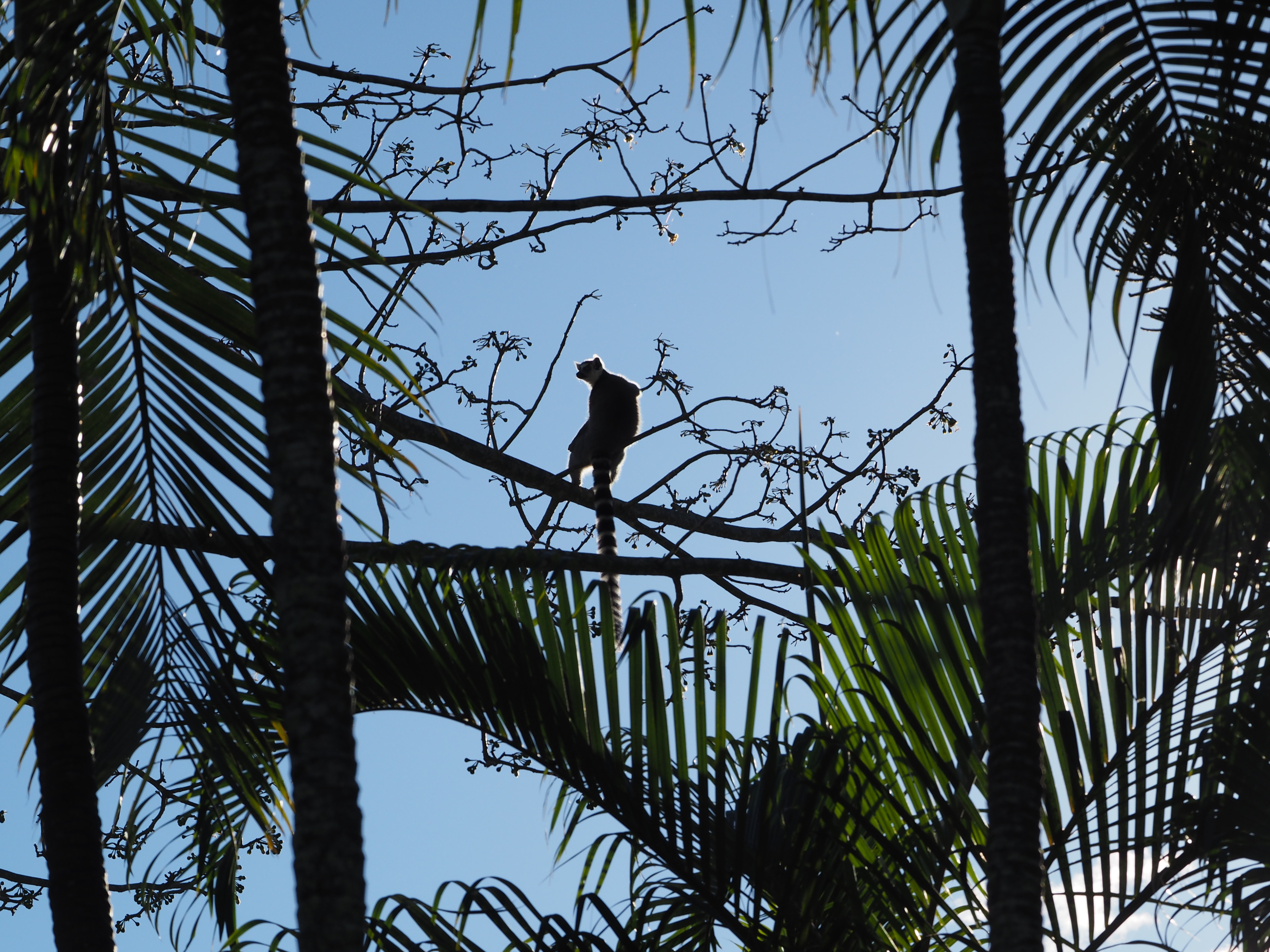
The animals are fairly approachable, above we have a male Collared Brown Lemur and on sentry duty below is a Ring-tailed Lemur.

OLYMPUS DIGITAL CAMERA

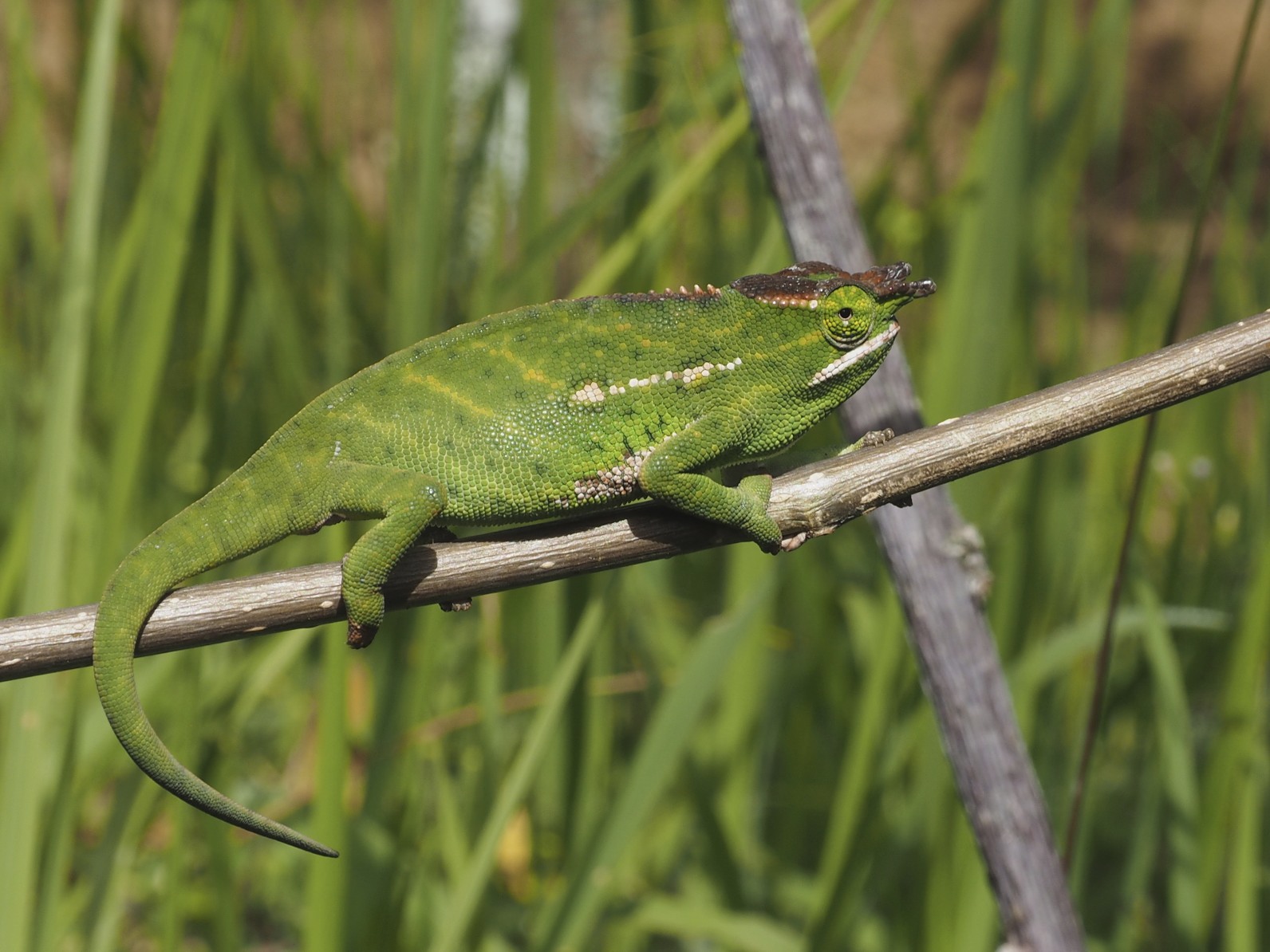
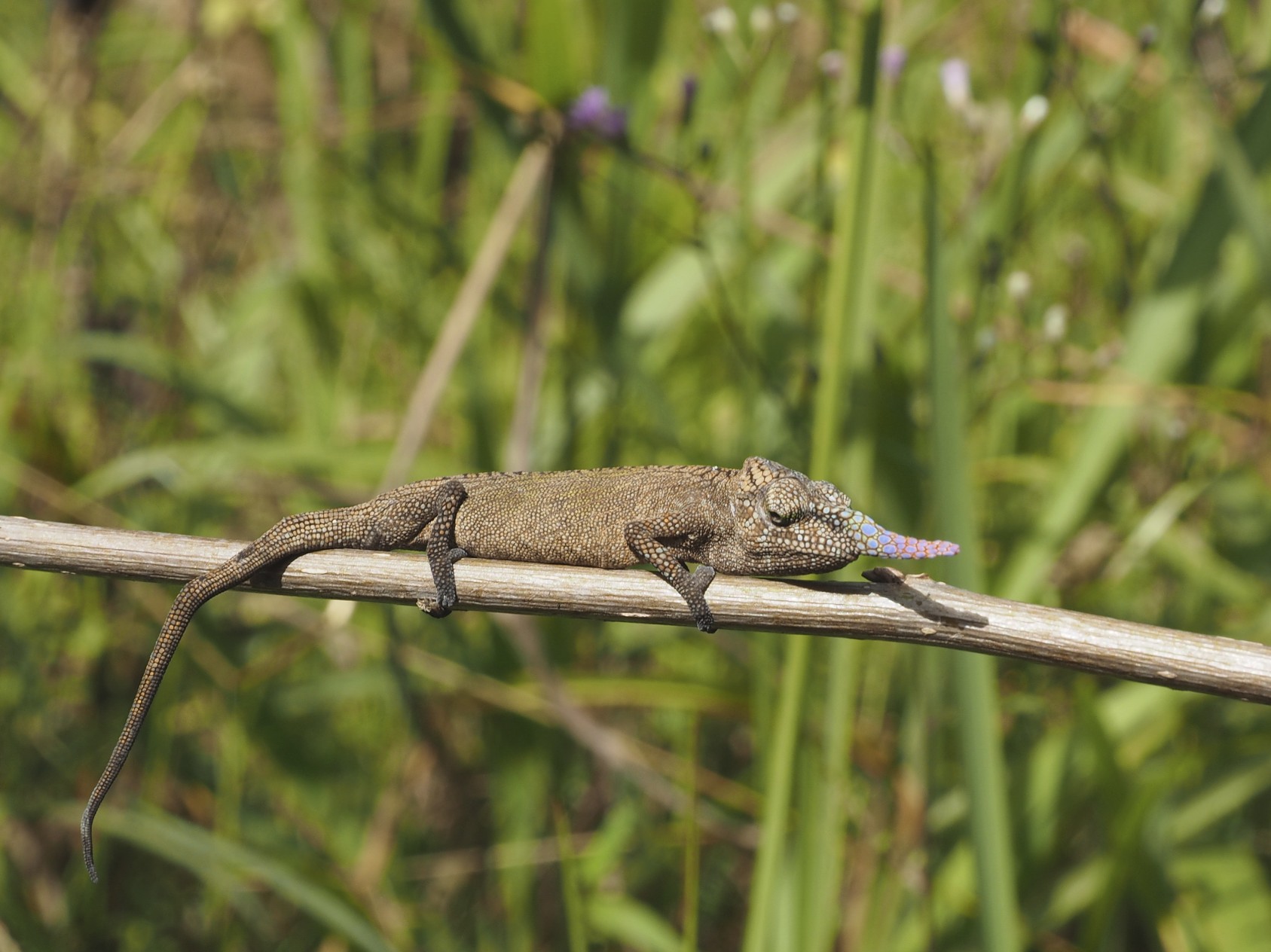
We found a few chameleons, their eyes are capable of the independent movement … you get the most pleasing photos when they take the trouble to look back at you.

OLYMPUS DIGITAL CAMERA

The bird list wasn’t huge but included Lesser Vasa Parrot and our first sighting of Madagascar Blue Pigeon. The gardens hold some Radiated Tortoises and some captive Nile Crocodiles.

Dennis …

Now where was I? Ah yes, Berenty Reserve in the south of Madagascar and by the time we left Berenty we had enjoyed the company of our Malagasy guide for a few days. Dennis had made sure that we got on the right bus, the right plane, made sure we got fed, made sure our bags got to our rooms. In short he had looked after us very well but he had also been our guide in the true sense of the word.

OLYMPUS DIGITAL CAMERA

He had introduced us to the Malagasy world, a world of different customs regarding marriage, the treatment of the dead, fady (taboos). He gave us the chance to see through Malagasy eyes and always with a smile and gentle good humour.

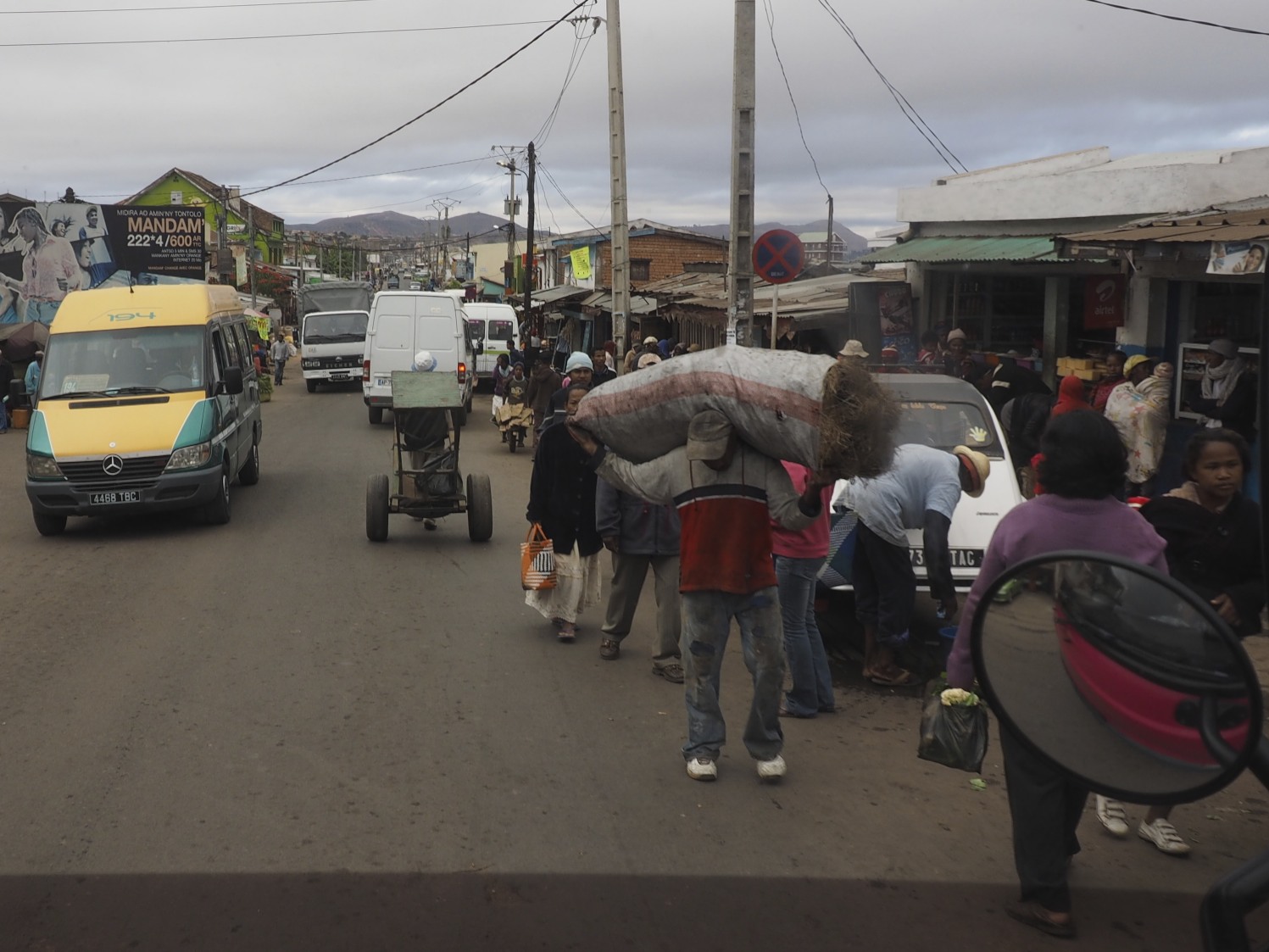
Madagascar life is pretty tough. Most homes have neither electricity or running water. Cooking is mostly done on charcoal, washing is done on the river bank or beside a communal tap. The only power available to most is man power … if you want it somewhere else then carry it or haul it.

OLYMPUS DIGITAL CAMERA

The guy with the sack is carrying charcoal. Hand drawn carts are a common sight.

If someone doesn’t have anything in the bank and little in the cupboard we might say they are living day to day. The equivalent Malagasy saying reveals a deeper layer of feeling … “It is better to die tomorrow than today”.

So what was Dennis’ own story? He was in no rush to tell it but it emerged that Dennis had set out to make something of himself in one area that seemed to offer good prospects by studying English and tourism. How had he financed that? Well, Dennis had sold second-hand magazines to tourists right outside the Hotel Colbert. He had a cousin that worked at the airport who would rescue magazines abandoned on incoming flights and sell them to Dennis. He would tidy them up, do his best to get rid of the creases and head for town. Tourists coming back from the remoter parts would have had no news for a few days and some would buy a magazine.

McGee would never see the pesterers outside the Colbert through the same eyes again.


Promises, promises …

This blog is not a dedicated travel blog although I really do enjoy writing about my journeys and whenever I do the blog picks up a bunch of new followers. This is the case again with the Madagascar series that I have started and will resume. So welcome to those of you that have just come on board. Some of you are from the USA and given that freedom of speech is guaranteed by your constitution you are going to be surprised to find that Australians enjoy no such privilege. It is no where enshrined in our constitution so for us it is a case of eternal vigilance …

It is the common fate of the indolent to see their rights become a prey to the active.  The condition upon which God hath given liberty to man is eternal vigilance; which condition if he break, servitude is at once the consequence of his crime and the punishment of his guilt.” — John Philpot Curran, 1790.

Debate in Australia is often vigorous, sometimes abusive and I think that all to the good. But, with the best intentions I’m sure, a past government thought that with regard to some aspects of our little selves we are so weak, so insecure, such shrinking violets that we must be protected from anything that might cause us offense. We have a public broadcaster that thinks it is fine to put to air a depiction of a critic having sex with a dog and label him, on screen “dog fucker” but …

(1)  It is unlawful for a person to do an act, otherwise than in private, if:

                     (a)  the act is reasonably likely, in all the circumstances, to offend, insult, humiliate or intimidate another person or a group of people; and

                     (b)  the act is done because of the race, colour or national or ethnic origin of the other person or of some or all of the people in the group.

It is the easiest thing in the world to take offense, and being thus offended shut down debate on any subject that touches on race. We have a welfare system that is different for indiginous Australians  than for the rest of Australians. Discussing it might cause offense. Let’s not discuss it here.

The recently elected government led by Tony Abbott promised to rid us of this constraint on free speech. Today it has announced that it will break that promise. I am deeply offended.

Berenty …

After breakfast, fresh croissants of course, we checked out of the Hotel Colbert and headed for the airport.

We had met Dennis, our Malagasy guide, the day before but today we started to get to know him better. His English is good, his smile is almost permanent. I will tell you more about him in due course but today we fly.

645x1026xemad1501-map.png.pagespeed.ic.Qf_n_AWnNe

We fly south to Fort Dauphin aka Taolagnaro – the Malagasy, just like us in Oz, are busy replacing the names bestowed by recent colonists with those bestowed by previous colonists, the flight is delayed and we travel not by the direct route indicated in the itinerary but via Toliara on the west coast. We had been warned that Madagascar Airlines schedules were more provisional expressions of intention than rigid timetables. We got to Fort Dauphin  a couple of hours later than was intended, climbed into a bus and travelled 80kms to Berenty. The journey took three hours, we arrived after dark. The alleged road was shared with trucks some of which had trailers (B-doubles in Australian terms) coming from Antananarivo 1100 kms or four days rugged driving away. It had once been sealed, the remaining tar stood up like table top mountains surrounded by potholes and muddy swamps. I do not wish to be reincarnated as a Malagasy bus.

Berenty Reserve is an island of residual forest in  a sea of sisal plantation. Or even an ocean of sisal. I imagine it was set aside to assuage the conscience of the plantation owners as they annihilated the environment. It is now home to some readily accessible lemurs and a tourist hotspot. The accommodation is excellent and you always know the food is good when you see the locals dining there …

OLYMPUS DIGITAL CAMERA

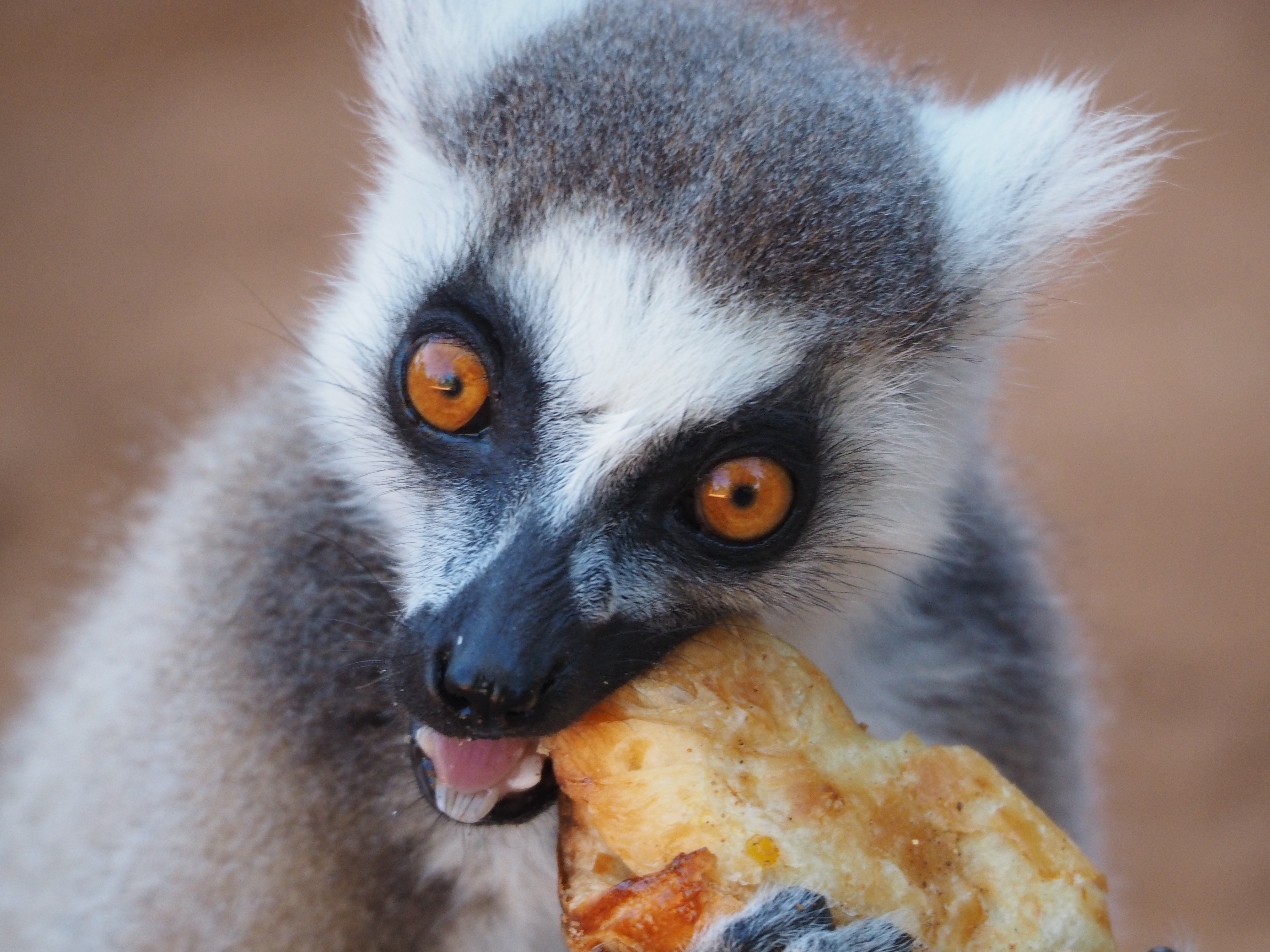
Over the next few days we walked in the gallery forest and in the spiny forest and made the aquaintance of Ring-tailed Lemurs, like the guy with the croissant, and Verraux’s Sifaka,

OLYMPUS DIGITAL CAMERA

and the Red-fronted Brown Lemur.

OLYMPUS DIGITAL CAMERA

We also got to see the White-footed Sportive Lemur and the Reddish-grey Mouse-Lemur and some nice birds.

And lament the loss of habitat. Sisal is grown for fibre which can be made into string or cloth. If you have abandoned plastic bags for the benefit of the environment and take along a sisal bag ponder on the habitat that existed before the sisal plantation was established.


On the street …

As you approach the doors of the Hotel Colbert you are given a warm and enthusiastic welcome. I’m not talking about the staff. By GDP per capita Madagascar is the ninth poorest country in the world. The people that are so pleased to see you are keen to sell you some little cadeau to take home, a musical instrument, an ammonite, a box or even a second-hand magazine. And there are some simply begging, one lady had a baby on her back and primary school age children panhandling for all they were worth.

They will be waiting for you again if you go out. In Australia we are sometimes troubled by the flies. We use the word”sticky” to describe particularly persistent flies. Some of these folk take no for an answer, some are more persistent. My first experience was of a guy who spotted the tourist about a block away from the hotel and wasn’t going to give up whilst I was on the street. Sticky sprang to mind, a good walk spoilt even more than golf.

He was trying to sell me a valiha, a zither like instrument the strings mounted around a bamboo tube. It was the finest little valiha in the universe and mine for a very reasonable price. No matter that I would never get it into Australia, could I not buy it, can you not see that I am in desperate need of a meal, perhaps if I reduce the price …

He circled me as I walked, I several times pulled him from the path of passing cars. The attention was unwelcome, embarrassing, pathetic and eventually beyond endurance. I turned and went back to the hotel. In the last few yards he pointed out the contrast between me who could afford such a nice hotel and himself who could not afford food. Very sticky little pest.

I am an early riser, the following morning I was out before the pests arrived. The streets were already becoming busy, street traders were selling breakfast cooked on charcoal burners. This time I went without a camera. I got little attention.

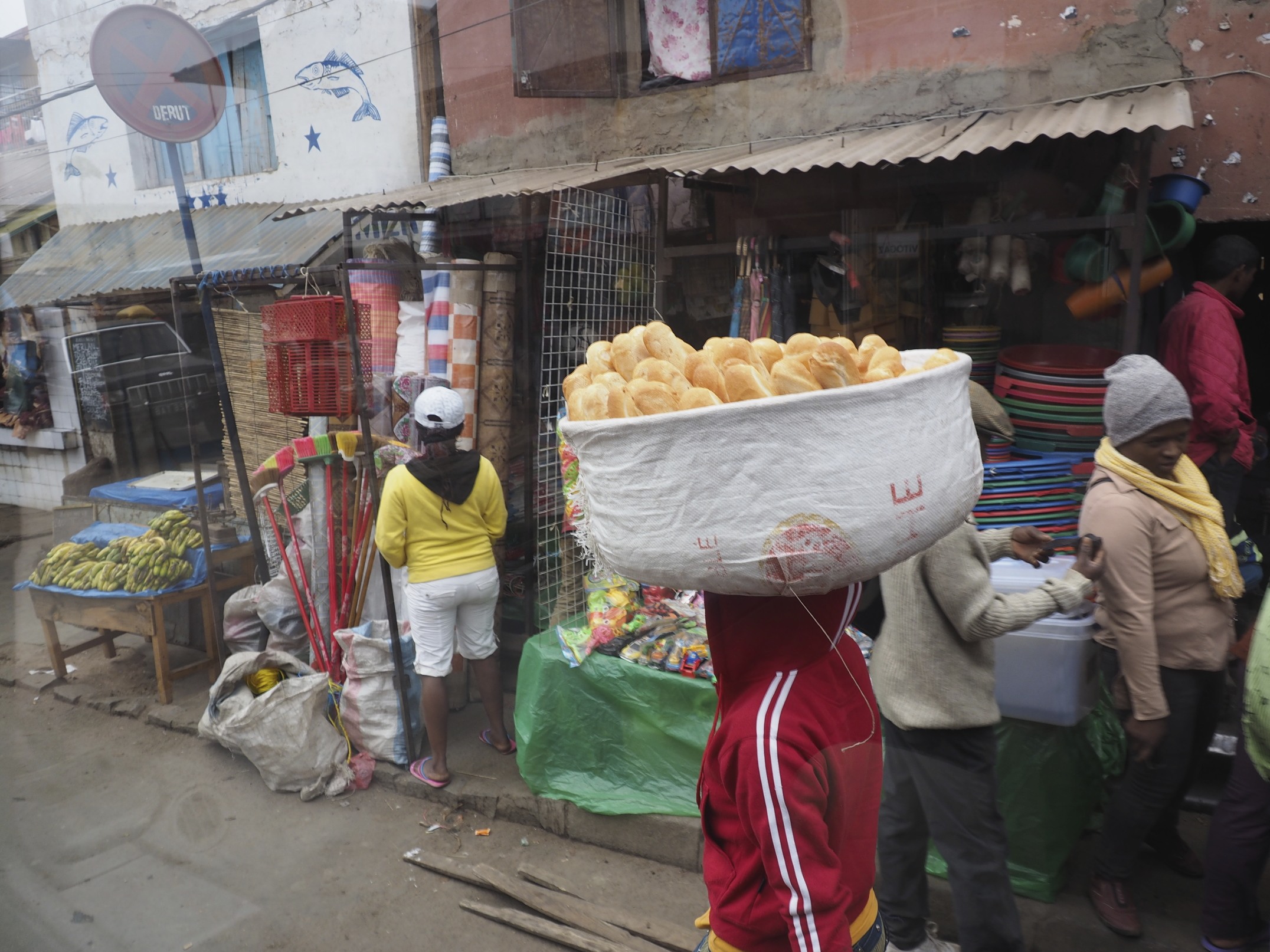
There are shops, even a small supermarket or two in Antananarivo but the local folk do most of their shopping right there on the street at stalls or at the open fronts of the buildings.

I got back to the hotel at six thirty, the lady with the baby and begging children was just arriving.


Hotel Colbert …

When visiting Antananarivo McGee stays at the Hotel Colbert.

At least it seemed like a routine by the time I’d checked in for a single night for the fourth time. And a very pleasant routine at that. The rooms were fine, the restaurants were fine, the ambiance was fine, the staff were fine and the location is perfect. I’m told there is an older and a newer wing. I stayed in the newer wing each time and it might be a good idea to request that.

Tripadvisor has this little gem …

When I arrived in my room I felt it was dusty and dark. I had also requested that they do not have any feathers in the room as I am highly allergic. Unfortunately they could not change the pillows as they only had pillows with feathers so they suggested I move to the La Varangue down the road which was a far more acceptable Hotel.

… just a snippet of an extended whinge, I assume by the owner of La Varangue. If not the whinger will have found Madagascar almost beyond endurance.

Next door is the Ambohitsorohitra palace, built by the French, it now serves as a presidential office.

OLYMPUS DIGITAL CAMERA

This is illuminated at night, suggesting some encouragement to look at it, but if you look at it for long during the day you are quickly moved on by a man with a machine pistol.

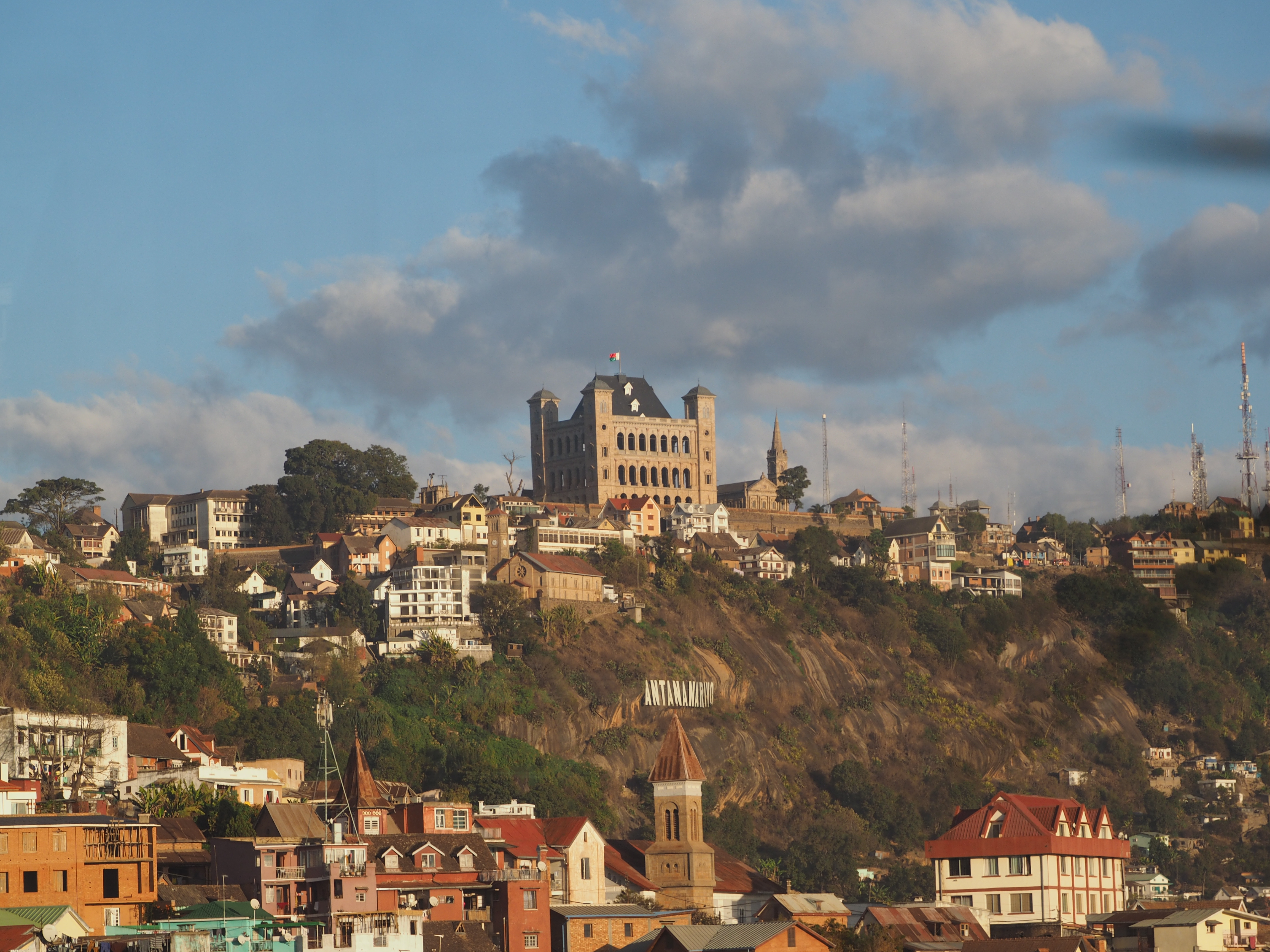
Hotel Colbert is in the middle town which is the commercial centre. From the terrace you look up to the high town which is where the nobility had their palaces, the view is dominated by the Queen’s Palace, the Manjakamiadina, currently under repair.

OLYMPUS DIGITAL CAMERA

Queen Ranavalona l ruled from 1828 to 1861, a time when missionaries from London were introducing new and dangerous ideas and European powers were itching to take yet another colony. She did a pretty good job of absorbing what was useful whilst fending off the colonisers and enforcing the traditional Malagasy values. An edict issued in 1835 made life rather difficult for the missionaries and by twelve months later they had all left town. The cliffs below the palace came in rather handy for an early form of bungee jumping. Those who possessed a Bible, worshiped in congregation or continued to profess adherence to Christianity might find themselves dangling up there. Those who recanted the new fangled faith would be hauled in, those who refused would have the ropes cut.

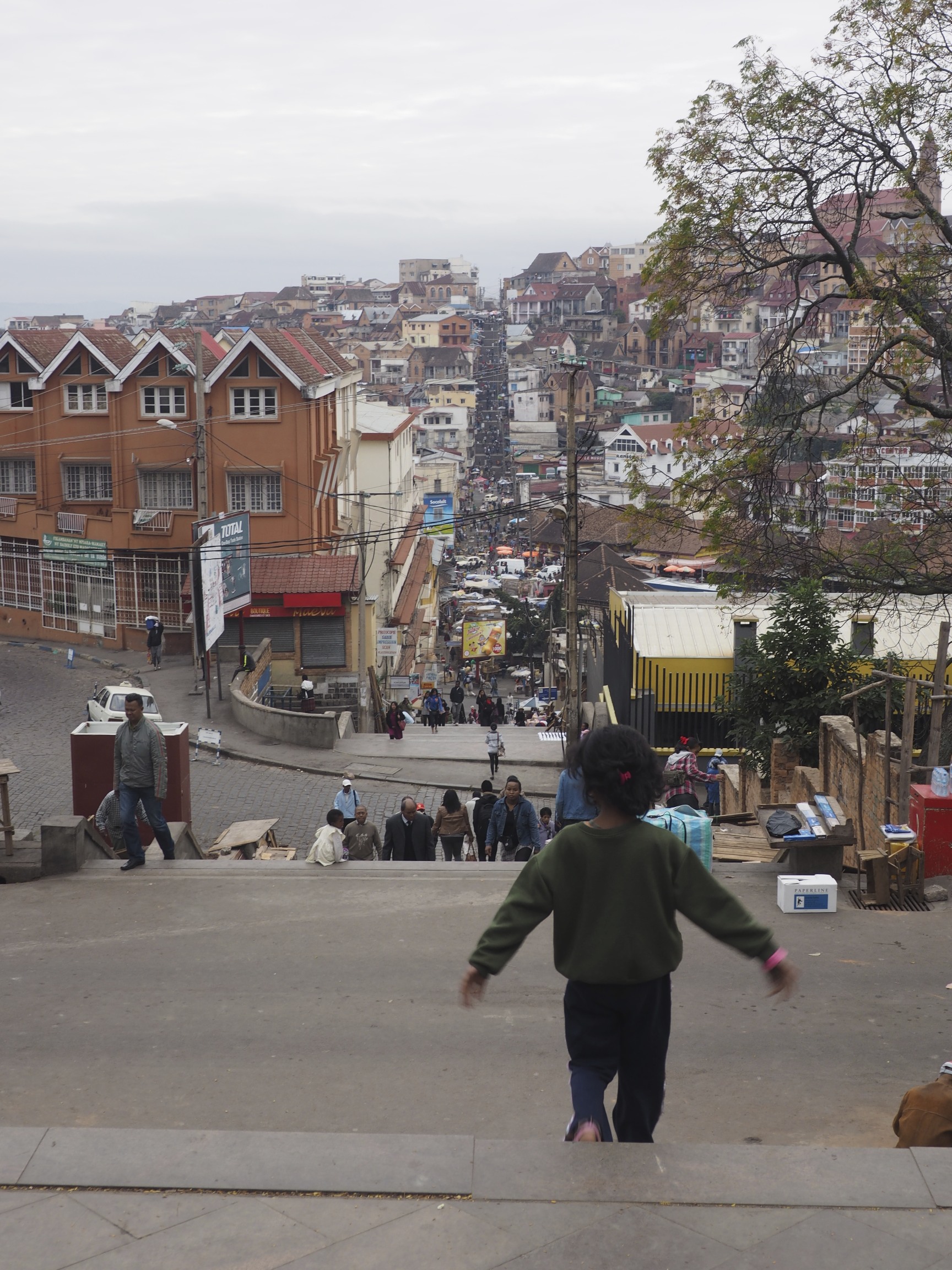
Not far from the front door are the steps to the lower town.

OLYMPUS DIGITAL CAMERA

I enjoyed the Colbert, but I am easily pleased, I’ll even put up with feathers in my pillows. Bearing that in mind let me recommend a couple of restaurants, not that there is anything wrong with the food at the Colbert.

Villa Vanille … if the French left anything useful it was the food, absolutely fabulous, good service a bonus and the trio of musicians were very very good.

La Varangue, cordon bleu in the midst of the weirdest collection of antiques, rated number one in Antananarivo and it wouldn’t surprise me if it deserved it.


Antananarivo …

I left Johanessburg’s sprawling and, it seems, rapidly expanding airport on a South African Airlines flight.

The airport at Antananarivo was quite a contrast. So too were the roads and surroundings on the way into town. Whereas South Africa has multi-lane highways and electronic tolling, even if most drivers are refusing to pay the bills, Antananarivo has a very modest airport and narrow streets. Even though July is the start of the dry season the countryside is green unlike the dusty brown highveldt around Jo’burg.

Both cities are cooler than you would expect for their latitude because both are quite high, Jo’burg 1750 meteres, Antananarivo 1280 metres.

645x1026xemad1501-map.png.pagespeed.ic.Qf_n_AWnNe

Once again, I travelled with Zegrahm Tours, the map, which I shamelessly filched from their website, shows the places we would visit.

One theory is that Antananarivo comes from the Malagasy for the place where far too many ans arrived. It is far more likely that it translates something like the city of a thousand (the strength of the force deployed by King Andrianjaka 1612–1630 to capture the town formerly known as Analamanga), although it is now home to a little over two million. It sprawls over the hilltops in all directions, the intervening valley bottoms are agricultural land mainly given over to the cultivation of rice.

Antananarivo was a major city before the colonial era but was built from wood and thatch.The Malagasy believed that a place to live in should be built from living materials. Outsiders brought in the practice of building in brick and stone from about 1820 and they were used to construct the foreigners small number of churches, schools and factories. In 1869 Queen Ranavalona II lifted the prohibition on the use of brick and stone by the Malagasy and the new materials rapidly replaced wood.

OLYMPUS DIGITAL CAMERA

Much of life is conducted on the footpath …

OLYMPUS DIGITAL CAMERA

OLYMPUS DIGITAL CAMERA

Because of the very poor state of Madagascar’s roads the tour would fly to most of its various destinations. Because Antananarivo so dominates the country’s economy this would entail radial flights to and from the capital. So every few days would bring me back to the Big A. Each time I stayed at the Hotel Colbert. More of that next …