LSD …

Something I’m trying to cultivate an addiction for, Long Slow Distance.

In my cross training days, 30 odd years ago cycling had to be fitted in with running and swimming and was pared back to fit the available time. I tried to do one long ride, one session of intervals and one or two short rides a week. A short ride was usually followed immediately by a run to help get used to the transition between the two activities. Long slow distance was helpful for building stamina without leaving yourself so over-tired that the next session could not be faced. Sadly all my swim sessions were short slow distance, not my strong suit the swimming.

Now that I’m a born again cyclist I’m looking forward to introducing both a long ride and some interval sessions into the routine. With three months of setting down a base during which time three kilograms just went away without dietary modification I’m ready for the LSD. The added bonus is that exercising at a relatively gentle pace will metabolise fat.

Back in the jogging boom of my middle years I came across a rule of thumb for calculating your chances of surviving a long run. If you had a base fitness derived from four or five sessions a week you could expect to cope with a run that was up to three times your average run. You would need to back off on your pace a bit. It worked well enough for me.

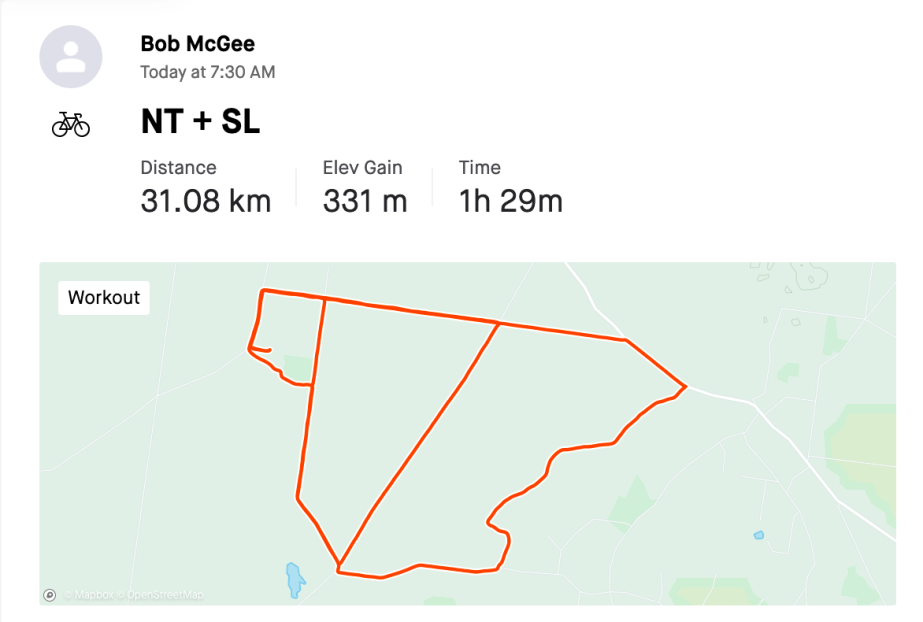
So in working out what my long ride should be I took my typical ride of 20 km and multiplied it by three and scaled it back a bit in deference to my advanced age. I completed the second one today …

Achievements, my goodness, Strava just keeps on giving!

Post exercise recovery is slower in older athletes largely because of poorer muscle repair processes. A very readable article on the subject can be found by clicking <Here>. It suggests that …


  • Masters athletes should consider implementing age-specific dietary protein strategies. Specifically, increasing their post-exercise protein intake to ~0.4-0.6 g.kg-1, and consuming high quality leucine-rich whey (milk-based) protein, particularly if previous training has resulted in muscle-damage.

  • Masters athletes should consider implementing the above dietary protein strategies, namely increased dose of protein at all main meals and post-exercise to optimise daily protein synthesis rates for muscle protein remodelling and thus facilitate adaptation to training.

Going too hard too soon will make you feel lousy and leads to abandoning your exercise routine. With that in mind I don’t intend to start high intensity training (intervals) right away.

It is, however, a good time to scrutinise my diet.
 

Exercise and the Elderly …

The theme of late has been resumption of exercise in an older dude who was recently sedentary. As always I have a need to know that drives me to the books or the internet. It’s easy to find material on getting older people out walking eg <This paper> that details a beneficial impact on the frontal cortex or strength training as in<This one>. Clearly the training effect occurs in older folk just as it does in the young.

When it comes to cycling it is hard to find papers that deal with sedentary older people taking up a cycling regime. Research has focused on comparisons of masters athletes with those at peak performance or with the inactive. The bad news is that performance declines after a certain age. VO2max, the highest rate that we can use up oxygen as we burn our fuel, declines largely because our maximum heart rate declines. Muscle mass is reduced (sarcopenia) and body fat tends to go up. The good news is that these effects are less in those who continue to train. <See here> and <Here> or you can take my word for it!

The battle with age is fought and won. I say won because we are the survivors. The decline in performance is just one of the battle scars. The choice now is between this you or a fitter you. Go for it.

Are you fit enough to get fit? That is a discussion you should definitely have with your doctor. There may be some preparation to do first. Certainly, if you can’t lift your bike off the ground don’t get on it!

Which activity?

Here are some recommendations based on my reading and own experience.

I think cycling is an excellent choice. It’s far lower impact than running but like running can start right outside your front door. The amount of exertion is infinitely variable because you are in charge of the distance and the speed.

I wouldn’t buy a bike right off the bat. I would see if you can’t rent an eBike for a month. The big advantage to that is hills and headwinds can knock the enthusiasm right out of you. You don’t need that. When your speed drops below say 10 km/hr up the level of assistance until the going gets easier then drop it back. Try and ride five times a week, work slowly up to about an hour and then endeavour to get a little further in that time. Never bust a gut. Today’s exercise will do you no good if it prevents you getting out again tomorrow.

Ride somewhere safe. Wear a helmet. Carry your mobile phone.

Towards the end of the month try riding without the motor.

The improvement in the first month is terrific. It’s time to make some decisions. If you got on well without the motor consider a good old fashioned bike. It will be much lighter than an eBike, the transition will not be too hard. If you ride with a partner and can’t keep up or headwinds and hills will spoil your rides get an eBike. There is no shame in riding an eBike you can still put in a big effort and get great benefits.

Why …

What is it that gets a reasonably sane old man and a slightly more sane and somewhat less old woman out of bed and onto their bikes? Lets leave aside, for the moment, full bladders and search deeper. There has been research.

The Sydney 2009 World Masters Games attracted 28,089 participants from 95 countries in 28 events making it the largest sporting competition to that date. Researchers asked them why they did it. You can read the paper <HERE>. 3928 of the athletes gave them answers, males and females being almost equally represented.

The numerous possible answers clustered into four broad responses

  • Health benefit
  • Social enjoyment
  • Personal achievement
  • Psychological benefit

The highest ranked answer overall, ranked 1 among the girls and 3 among the boys was “to socialize with other participants”. One and two among the boys were “to become more physically fit” and “to improve my health” which also ranked well with the girls. Interestingly weight loss and weight control got mentions but did not rank highly. To compete with others was another non contender for chief motivator but was more popular with the boys than the girls.

The conclusion was that if you’re trying to promote sport to a mixed audience stress the social and health benefits, if a male audience then stress the health benefits. Either way lay off the weight issue.

So where do I sit on all that?

In my youth  I tried many sports. When I discovered basketball I was addicted, I just loved doing it. I couldn’t imagine not doing it. I was fiercely competitive, sometimes embarrassingly so. Once that career was done why did I take up running for which I had no special talent and with no prospect of winning a race?

I would certainly have ticked “to become more physically fit” and “to improve my health”. I might have revealed my narcissism with a “to look better.” I would not have given a rat’s arse for “to socialize with other participants”. I was also very conscious in my running days of some spinoff benefits. I enjoyed hiking, skiing and horse riding. I wasn’t in a position to do those sufficiently often that they would keep me fit. Running meant that I was sufficiently fit to enjoy them when the opportunity arose.

Here I am three months into a third phase of sport training, the geriatric phase. My health is the main motivator. Weight is a huge part of that concern. If you ask a bunch of athletes in training if weight motivates them do not be surprised if it’s not a great concern. Most of them don’t have a weight problem. It’s quite a different story if you’re trying to get sedentary folk off their couches . I have a weight problem. You can motivate me with the prospect of weight control especially if it doesn’t involve going hungry.

And fitness, I want to enjoy the rest of my life. I want to be able to climb up from the beach to the car, walk up a hill for the view and lift the grandkids off their feet. There are still spinoffs.

R3R …

The big day.

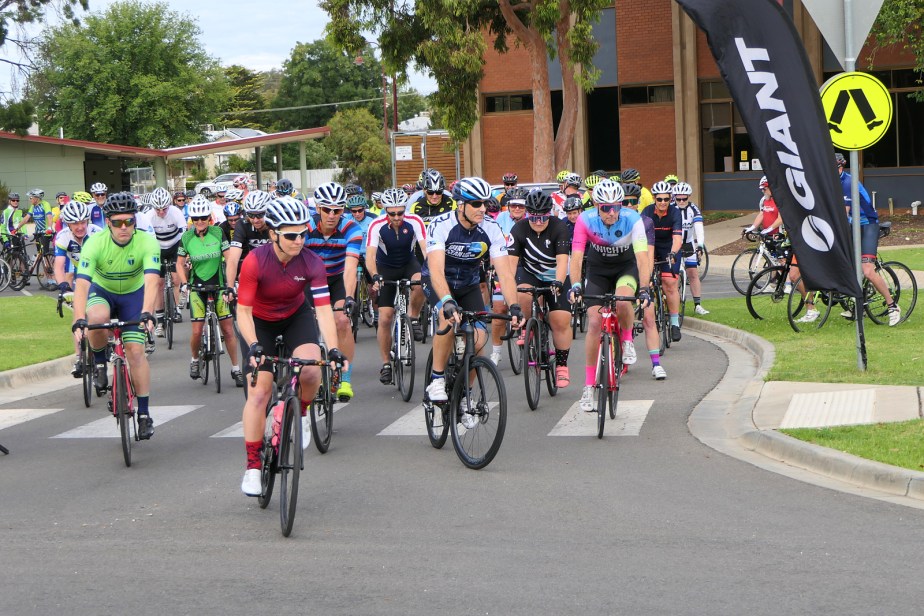
The start

Most of these fit looking people are about to ride 108 km. I on the other hand will wimp it out with a mere 33.

That’s an average speed of 23.9 km/h – in line with expectations. Happy with that. The biggest climb is towards the end; fortunately there was still some gas in the tank.

It felt good to arrive back at the Maryborough Station and I’m sure it felt even better to the real heroes after 108 km …

An Event …

It is at least 25 years since I last entered an endurance event. As I recall it was a 42 km cross country ski race, the Kangaroo Hoppet at Falls Creek. I finished. It may have been 3000th, but I finished. I even had the cheek to sprint past some other poor bastard at the line condemning him to 3000 and 1st or so.

So now that I am a trained endurance athlete having completed three months of cycling about 20 km five times a week I am (or may be) ready for the R3R Charity Ride. It’s tomorrow and it’s not a race (not a race, not a race, not a race …)

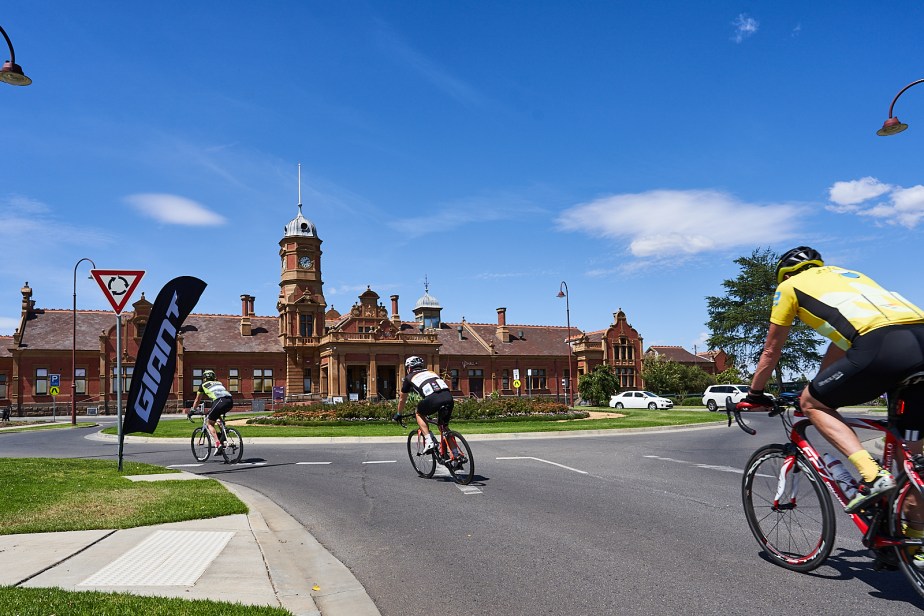
The ride not race is organised by the Maryborough Rotary and sets off from the famous railway station. It is so impressive that Mark Twain described Maryborough as “A railway station with a town attached”. Unless, of course you believe the Twain scholars who tell us that he said no such thing. Even if he didn’t he should have.

If you want to join me you had better hurry up. Go <HERE>.

The route visits the three local reservoirs, hence the name, and the full journey is 108 km. However there is also an R2R – 73 km and an R1R – 33 km. I’ve signed up for the R1R. I know, pathetic.

But I will cut a dash. I am borrowing Gayle’s gloves. They will go on. It’s getting them off that’s the challenge but I’ll have all afternoon. I have invested in cycling shorts so that’s OK. The hi-vis work shirt tops the ensemble off, hopefully hiding the belly a little. Admittedly my fat wheels will put me at a disadvantage compared to road bikes. Nonetheless I do expect to be quicker than some grannies at least those accompanying very small children.

Wish me luck.


Beach Road …

I have a few days in the big smoke so a chance to find out why boys die faster than girls on bikes.

Melbourne sits on the east side of a large bay with only a narrow entrance to the ocean. Beach road winds its way along cliff tops and beside beaches. It’s beautiful and busy and very popular with cyclists. And they are not especially loved by the car drivers or indeed the pedestrians.

I spent two sessions with a clip board and pen sitting by the side of the road. The first session was from 5pm to 6pm on a Friday evening. Rush hour traffic. The second session was on Saturday morning from 8.20 to 8.35.

It might be considered likely that commuters were well represented in rush hour whilst virtually every cyclist on Saturday morning was riding for fun or fitness.

There were so many cyclists in the second session that I was restricted to counting one side of the road only.

So on Saturday morning I counted 241 cyclists passing my nose in fifteen minutes. 216 were male, 25 were female. The other side of the road seemed equally busy so it seems reasonable to double the number. Multiply by 4 to get an hourly figure which brings us close to nearly 2,000 cyclists an hour using Beach Road as a training track. 89.6% were boys 10.4% were girls.

By comparison there were few brave enough to tackle Beach Road during the evening rush hour the previous day. Just 54 passed counting in both directions during an hour of observation and only 2 were female. 96.3% versus 3.7%.

Why was it that 90% of cyclists killed 1999 and 2015 were male? Because there is a big imbalance between the sexes when it comes to cycling. 90% of cyclists are male.

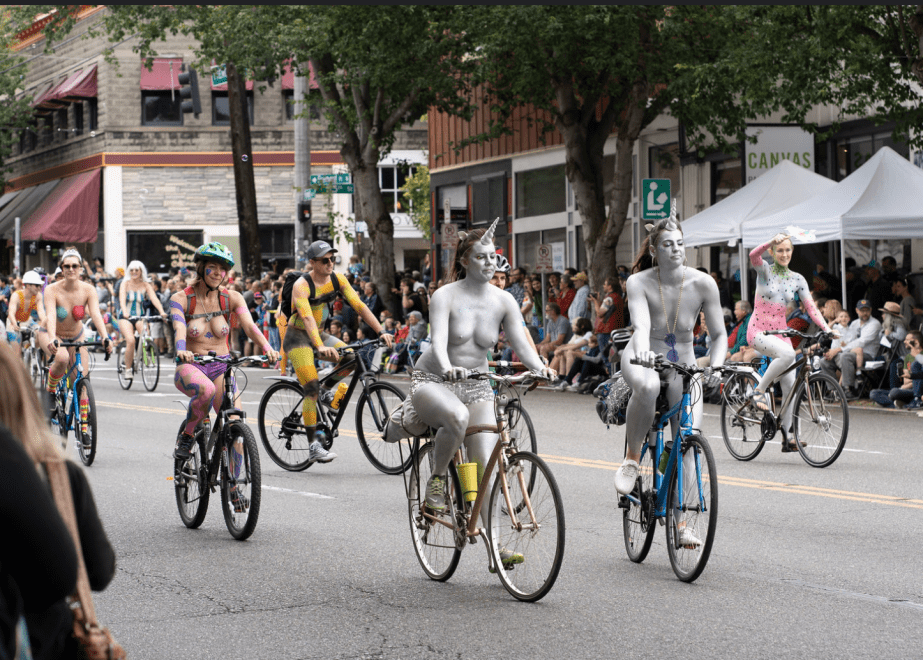
How can this ratio be improved? In an admittedly small sample it does appear that higher female participation rates can be achieved if they are given the opportunity to take their clothes off.


Risks and Opportunities …

Learn to ride a bicycle. You will not regret it if you live. Mark Twain.

Thirty years ago I was scared away from the bike by the risks. Now at age 71 I’m back and so far having a ball.

What are the benefits?

Lifted straight off the Victorian Government Better Health website

The health benefits of regular cycling include:

  • increased cardiovascular fitness
  • increased muscle strength and flexibility
  • improved joint mobility
  • decreased stress levels
  • improved posture and coordination
  • strengthened bones
  • decreased body fat levels
  • prevention or management of disease
  • reduced anxiety and depression.

Improved joint mobility and strengthened bones seem dubious claims. If you can’t put your knees, hips and ankles through a certain range you can’t cycle and they’ll never do anything extra no matter how many times you pedal. The evidence for bone density is mixed – cycling is often praised as weightless exercise you can’t expect too much.

Cycling Weekly (so much more beneficial than cycling weakly) would like to add better sleep, better sex and a better social life to the list.

Yeah, so it’s great. How great?

A study in the UK of 263,450 people with an average age of 53 followed for about 5 years published in the British Medical Journal

… found that cycling to work was associated with a 41% lower risk of dying overall compared to commuting by car or public transport. Cycle commuters had a 52% lower risk of dying from heart disease and a 40% lower risk of dying from cancer. They also had 46% lower risk of developing heart disease and a 45% lower risk of developing cancer at all.

That would appear to be sufficiently beneficial to outweigh the risk posed by riding in traffic at least in the UK but the risks are not negligible.

The Australian Institute of Health and Welfare* looked at hospital and death data for a 17 year period.

In 2015–16:

  • about 12,000 cyclists were hospitalised due to injuries sustained in a crash—this was 1 in 5 of the 60,000 people hospitalised due to injury in a land transport crash
  • nearly 6 in 10 of hospitalised cyclists were injured in an on-road crash (6,900 or 58%), and the rest were injured off-road
  • nearly 6 in 10 hospitalised cyclists had sustained a fracture, with the most common injury being a fractured upper limb

Between 1999–00 and 2015–16:

    • 651 cyclists died, an average of 38 deaths a year
    • of cyclists who died, nearly 8 in 10 were aged 25 and over, and 9 in 10 were male
    • nearly 160,000 cyclists were hospitalised, an average of more than 9,000 each year
    • across all ages, the rate of hospitalisation rose by an average of 1.5% each year
    • the proportion aged 25 and over rose, while the proportion aged under 25 fell

Of particular interest to a 71 year old male is that injuries tended to be more severe in older people requiring longer hospital stays.

The over-representation of males is interesting. Is it that 90% of cyclists are male or are the girls cycling with a great deal more care than the boys?


* AIHW: R Kreisfeld & JE Harrison 2019. Pedal cyclist deaths and hospitalisations, 1999–00 to 2015–16. Injury research and statistics series no. 123. Cat. no. INJCAT 203. Canberra: AIHW.


Strava …

I liked the computer. I liked being able to see that I was going really fast. Downhill I could be really impressed with myself. For the secondary display I usually chose distance covered but on the eBig Tour you can cycle through all the options as you ride. It’s nice to be able check your average speed. Apart from the odometer  the other data is ephemeral. I didn’t keep a record.

The new bike has no computer. I could buy one. I really like the Wahoo ELEMNT Roam which does all the tricks I had before plus GPS mapping. It comes in at a mere $600 but I’ve spent all my pocket money for the year on the bike.

I have a smartphone. There are a number of ways of putting that to use. I have been using the Strava app. You open an account and download the app on your phone. When you’re ready to go for a ride or a run you open it up.

Across the bottom of the screen there are a number of options, the centre one is labelled record. Press it and you are rewarded with a bright orange button. Once you have satellites press the button and set off. Don’t forget to take your phone!

At the completion of the ride press the finish button and you can give your ride a title and description, add a photo, write notes and sync it to the cloud. When you go to your real computer your session will look something like this …

and you can track your workouts in a number of different formats. In addition you can compete against others over road segments.

It’s a combination of training log and social media. You can keep it private, share it with friends or share it with the world.

There are some other features to explore. You can sync heart rate and power monitors. The basic app is free but there is a deluxe version for those whose pocket money hasn’t run out. You can sign up at strava.com and get the mobile app from your friendly app store.

There’s no display to watch during the ride but you can work out your average speed at your leisure.