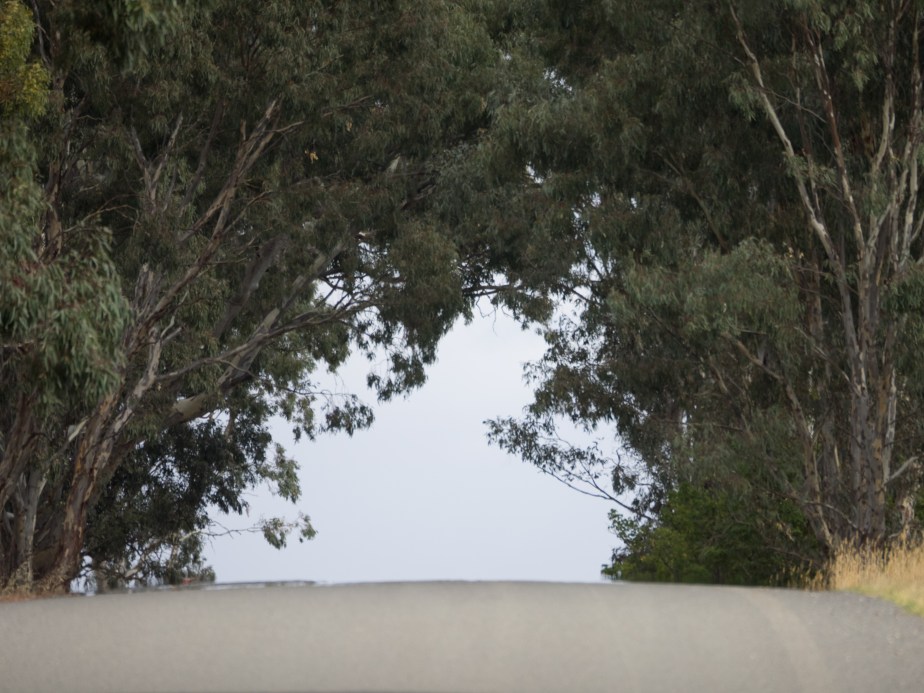
As I’ve been driving home of an evening in recent weeks I have been aware that the sun has been setting a little further north on the western horizon each day. One day, in the not too distant future, it would set right at the end of a local road framed at the end of an avenue of trees. Imagine it right in here …
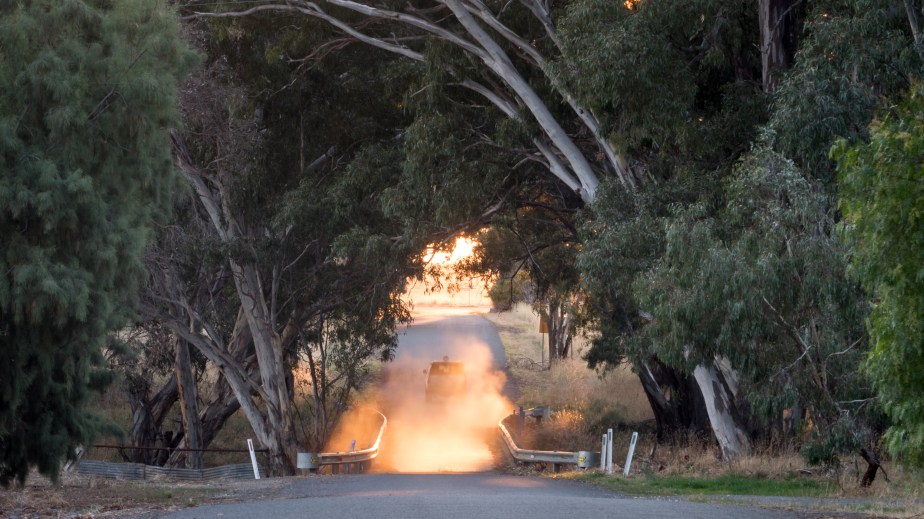
I pulled up The Photographer’s Ephemeris and wound on the clock until April 5 at 6:15 pm. I use this photographer’s aid with some trepidation. Just as certainly as the sun and moon will rise and set at a certain place and time so it is certain that clouds will obscure the event. At least it seems that way. None the less I was there. The sky was partly cloudy. I had chosen my camera position in advance but a couple of hundred metres east of that I saw that the sun was spotlighting a bridge quite beautifully and thought that, even if I got nothing else, this would be a photo. Just to put the icing on the cake a car drove past at a very convenient moment …
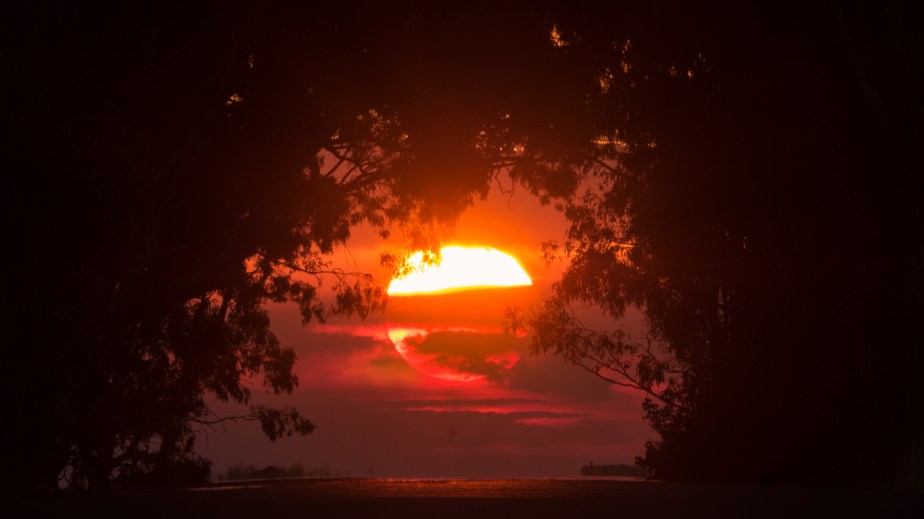
Having captured that it was time to see if my plan would come to fruition …
In January last year I stumbled on the recently painted silo in Brim, a small town in north-western Victoria. I wrote about it in a post entitled A Tale of Two Cities.
It proved a remarkable success and a major disruption to traffic for a while. By June it had spawned the idea of an art trail to attract tourists to a part of the state that is in need of a little love.
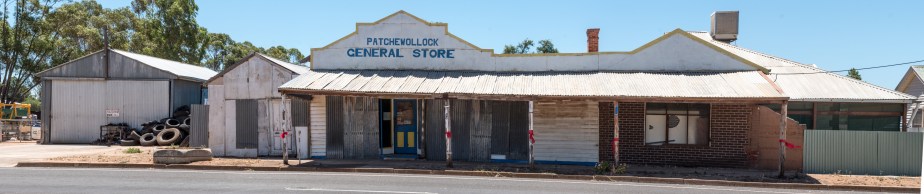
Poor old Patchewollock with its boarded up general store was the next town to receive an artistic baptism …
… by October Fintan Magee was hard at work painting a portrait of local man Nick Hulland.
If you’re tempted to take up silo painting have a look at Fintan in action in a series of slides from the Wimmera Mail-Times.
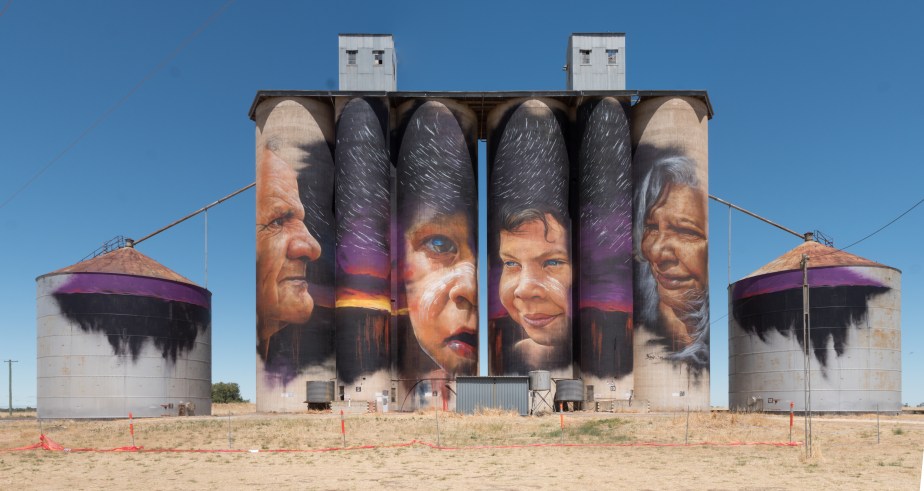
Sheep Hills doesn’t have a boarded up general store or even a working store but it does have a silo which is now beautifully painted by Melbourne street artist Adnate. The portraits are of local indigenous people.
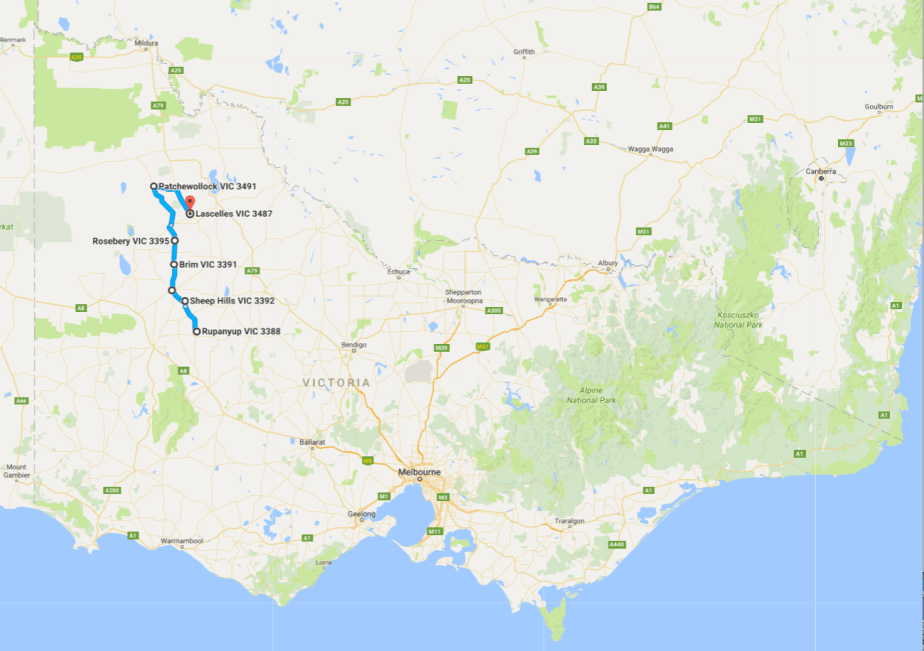
Three more silos are on the drawing board at Rupanyup (starting in March), Lascelles and Rosebery.
The proper pronunciation of Rupanyup is not obvious. Start with the last syllable, forget the u and say Yip. Now for the middle syllable, forget the a and say pun. Put those together Punyip with the emphasis on the pun. Precede that with the Re from republic and you will be able to ask directions to … Re-punyip. It’s about 300km from Melbourne. No good asking directions until you get closer.
Victoria
Sheep Hills is a little off the main road.
The only large(ish) town on the route is Warracknabeal. There is a road house on the highway, shops and accommodation can be found in town.
Warning. If the reason you don’t watch Game of Thrones is the bad language now is the time to leave …
For those of you in the northern hemisphere especially, I started the day with a quick dip in the pool, the family are just arriving for lunch, we’ve already exceeded the forecast 35°C (98°F).
A story from Darwin to touch the cockles of the heart springs …
Duty Superintendent James O’Brien said the woman, who had just moved from interstate, was walking her dogs at a park at Durack, in Palmerston, about 9:00am on Saturday.
“It’s quite a remarkable to happen a day before Christmas,” Duty Superintendent O’Brien said.
“While some of her dogs were running around having fun, one of her smaller dogs was sitting on the edge of the causeway when she noticed a crocodile came up and took it down into the water. <ABC>
She, of course immediately jumped in after it, found it underwater and tossed it out onto the bank. Woman and dog are doing well.
Police described the action as “brave” but not recommended.
Better news than Christmas 1974 …
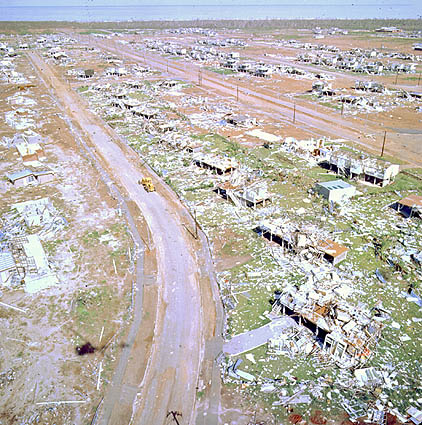
Tropical Cyclone Tracy is arguably the most significant tropical cyclone in Australia’s history accounting for 65 lives, the destruction of most of Darwin and profoundly affecting the Australian perspective to the tropical cyclone threat.
By world standards, Tracy was a small but intense tropical cyclone at landfall, the radius of gale force winds being only about 50 km. The anemometer at Darwin Airport recorded a gust of 217 km/h before the instrument was destroyed.
It was Broome this year on cyclone watch. Yvette didn’t wreak so much destruction but she did dump 226 mm of rain on the airport in just 24 hours. That’s 8.9 inches in the old money.
Meanwhile in Shanghai this gentleman is wandering around in an oblivious crowd thinking his tee shirt says “Christmas greetings from Australia” …
I wonder how many people are wandering around Australia with messages of a similar nature tattooed on their surfaces in Chinese characters. For any one who can read Chinese tomorrow at the beach is the time to look.
Christopher Pyne has announced that the contract to build Australia’s new submarine fleet has been signed. The news has been greeted with approval in almost every quarter. These will be the first submarines, anywhere in the world, to be driven by wind power.
The member for Beijing, Mr Sam Dastyari, has told the house that his political overlords approve of the arrangement. They have been concerned about Australia’s meddling in the South China Sea and see the likely delay in the construction of the submarines as a positive step in the Chinese Australian relationship.
Professor Ove Hoegh-Guldberg meanwhile has praised the far sighted choice of wind power as the locomotive force to drive the submarines. “South Australia has lead the way on energy having set a record for spot pricing and achieved zero emissions in recent months. The new clean submarines may not be fast but they will reduce the incidence of bleaching on the Great Barrier Reef and perhaps save the Arctic ice and the polar bear. It’s a remarkable thing that a state with only 1.7 million people can set new bench marks with such regularity, perhaps it has something to do with all those hyphenated surnames”, he said.
Mr Shorten promised Labor’s support for the project saying that it offered a great opportunity for the steel industry. “The Whyalla steel manufacturers currently have the largest castings of the inside of a furnace anywhere in the southern hemisphere”, he said, “With sufficient subsidies I am sure that they will play a constructive role in this enterprise … once they find a way to get the solid metal out of the furnaces.”
The premier of South Australia will be issuing a press release as soon as power is restored to the government buildings. It is expected to be supportive.
The only voice raised in opposition seems to be that of the Productivity Commission although some rumblings have been heard from the other mendicant state, Tasmania.
The first submarine is expected to roll off the line in August 2116.
It’s a little warmer, it’s light a little earlier. Spring has been creeping up on us antipodeans. And then suddenly it’s a full on assault on the senses. For me it starts with the Rufous Songlark. It doesn’t stick around for Victoria’s frosty winter. I saw plenty recently up in the centre of the continent presumably making their way back south. The first one in my neighbourhood arrived a few days ago and announced its presence with its scratchy, far from euphonious song. You will never be commemorated for singing in Barclay Square but welcome back.
Other arrivals have followed quickly. A solitary Australian Reedwarbler was along the creek looking for some habitat. Yes you are in the right place, there were reeds here last year, they’ve been washed away in last week’s flood. The Dusky Woodswallows are also back and looking for somewhere to raise a family and the woodland was ringing to the sound of the Olive-backed Oriole.
Not far from where I live is Paddy’s Ranges State Park, just on Maryborough’s doorstep. There is a resident there that is very hard to find, the Chestnut-rumped Heathwren. It has a cousin, the Shy Heathwren, which is a positive exhibitionist by comparison. In spring the male makes a small concession to the birdwatcher by singing to attract a mate. For a short time you are in with a chance. So there I was and there it wasn’t.
But the flowers were gorgeous …
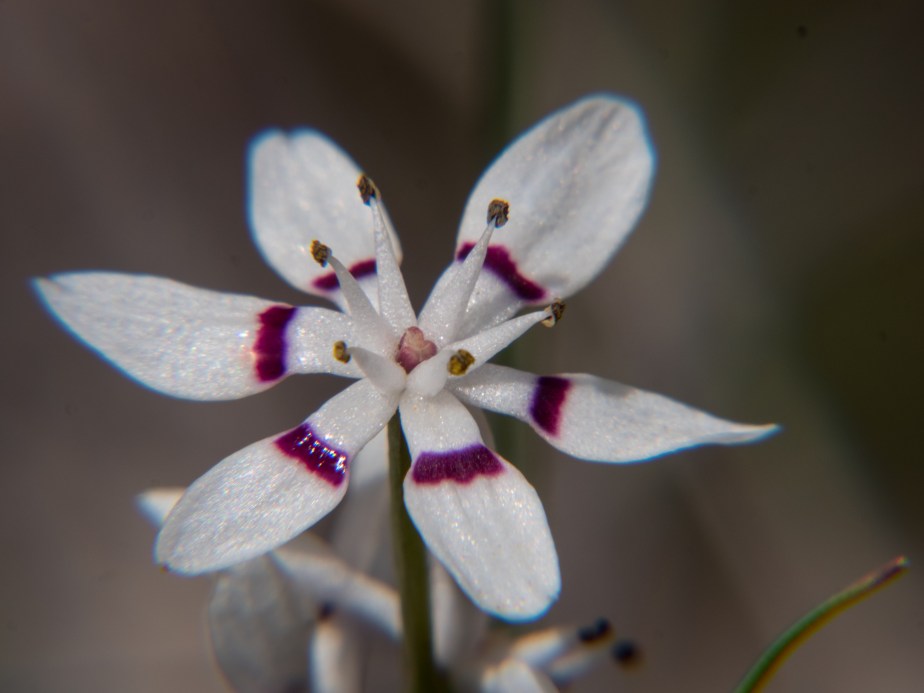
Early Nancy
… tiny but perfect. The Riceflowers are bigger …
Common Riceflower
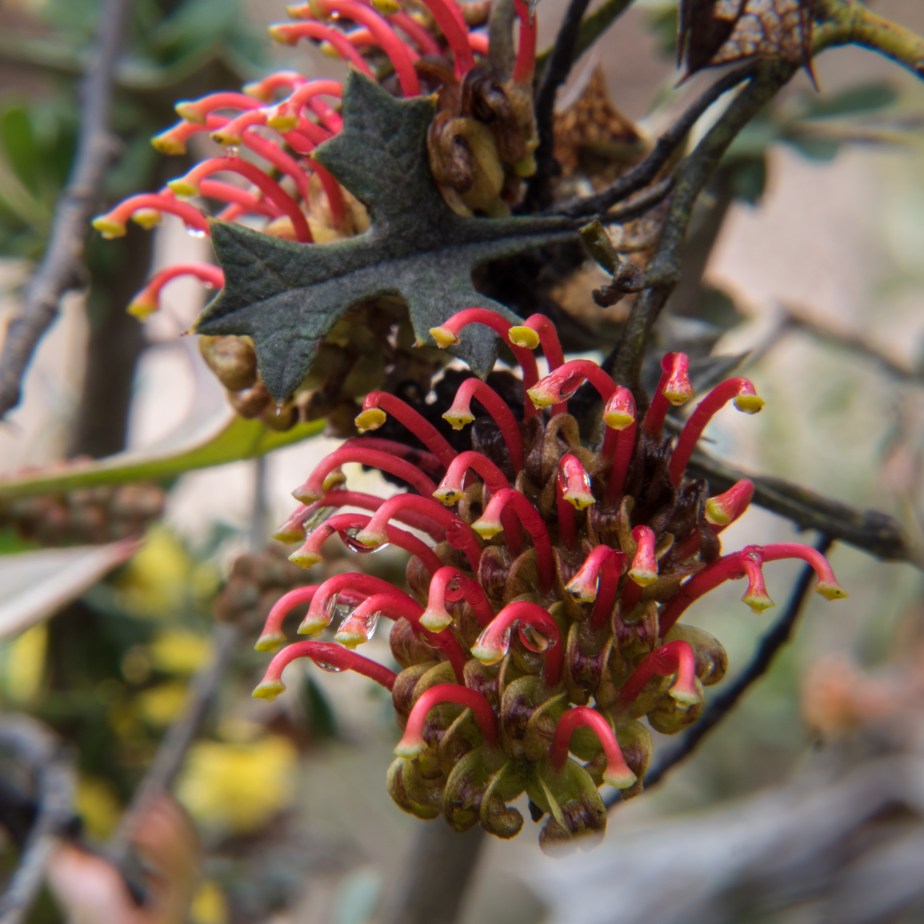
Prefer red? There were two quite different Grevilleas to choose from …
Goldfields GrevilleaCats Claw Grevillea
The Goldfields Grevillea is a threatened species, Paddy’s Ranges is very significant for its survival.
And what would spring be without an orchid or two? Australia has about 100 genera and more than 1200 species of orchid, mostly in the tropics where they tend to be somewhat showy. Here in Victoria we have to be content with rather discrete examples, mostly terrestrial and mostly just in spring.
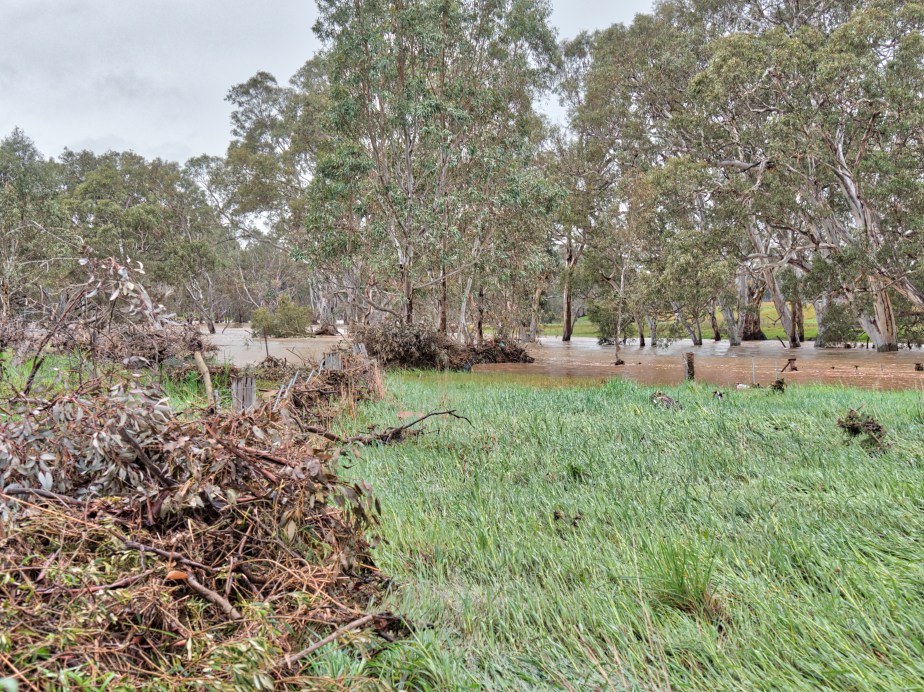
As the water receded the debris lodged in the fences became apparent …
With one exception the fences at right angles to the direction of flow were no longer standing. I’ve spent a couple of days removing most of them. This morning I got around to pulling the rubbish off those that are still standing …
Curled up in the debris was this little guy who wasn’t too happy to be pulled out …
Eastern Brown Snake
After we’d burned the rubbish Gayle headed for the shops to restock the pantry while the dog and I revisited a few of the places I’d photographed the other day …
WetDryWetDry
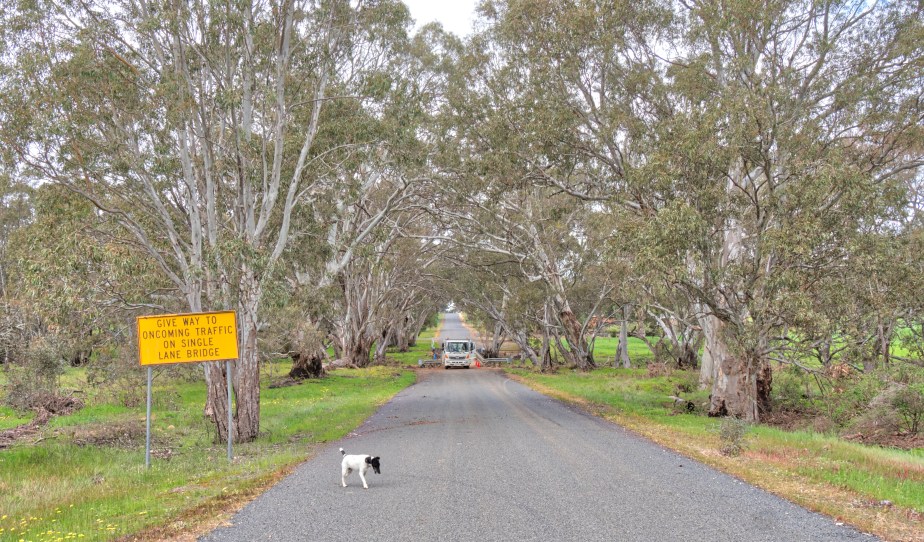
The road crew are hard at work repairing the guard rail.
The weather forecast for tomorrow is most interesting.
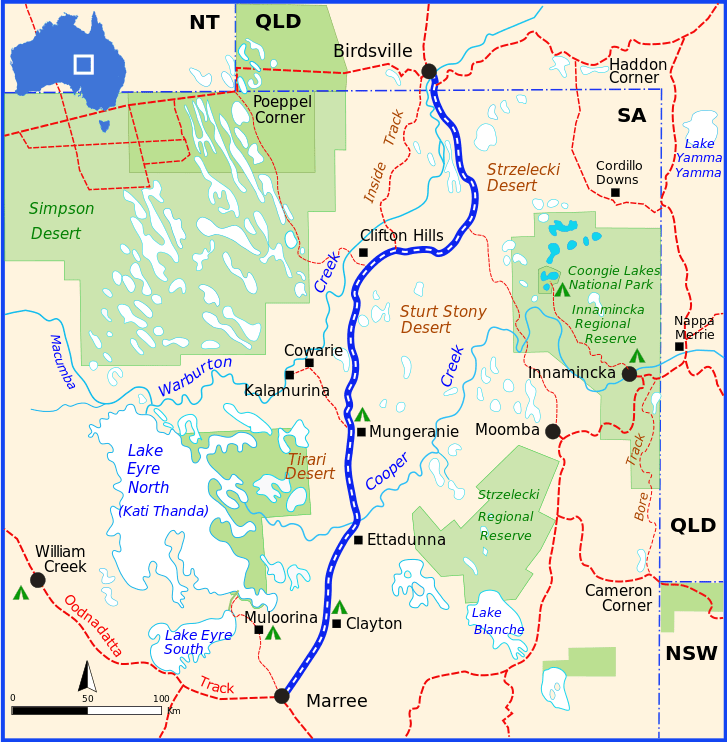
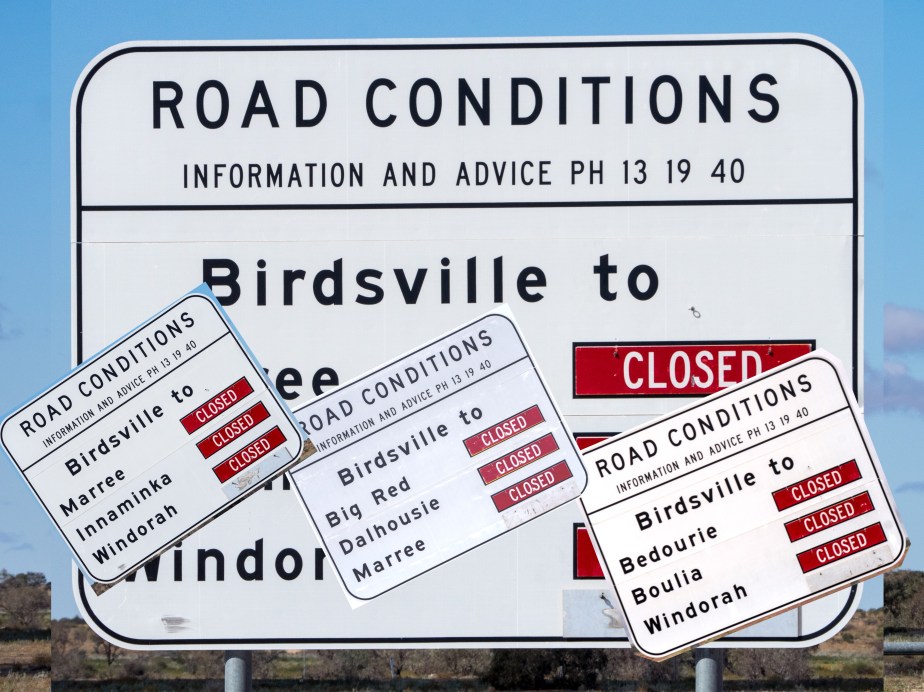
The road from Birdsville south to Marree is the famous Birdsville Track.
When the railway reached what was then Herrgott Springs (now Marree) in 1883 the graziers of the channel country of western Queensland and the south-eastern corner of the Northern Territory had the option of a shorter route to market. The biggest obstacle facing them was about 500 km of desert from the Diamantina River to the rail head. This is seriously dry country, average rainfall is less than 100 mm a year (4 inches). But the Great Artesian Basin lies beneath and by 1916 bores had been sunk every 40 km.
Tom Kruse was the legendary mailman who took the mail and other supplies up the track to the good citizens of Birdsville. A classic film was made about his work in 1954 called “The Back of Beyond“. This played a large part in giving the track a certain reputation which wasn’t improved by a disaster that befell the Page family. They set out from Marree just days before Christmas in 1963 with the object of finding work in Queensland. Their car ran out of petrol, the result of a navigational error combined with gearbox problems that kept them stuck in 2nd gear. At that stage they were fairly close to a windmill and turkey dam. They were able to fill a four gallon drum with water and carry it back to the car.
Two days later they set off on foot and were found dead on January 1st 1964. Their abandoned car, with a radiator full of water, not far from the turkey dam, had been found on the 28th of December. There was a tarpaulin on the trailer that could have been used for shade. Mum, Dad and three kids were buried beneath the Coolibah where they were found.
The track, although still unsealed, has largely been tamed for routine tourist use but it’s still just as bloody hot out there. Take plenty of water, a satellite phone (or HF Radio) and if your vehicle lets you down stay with it.
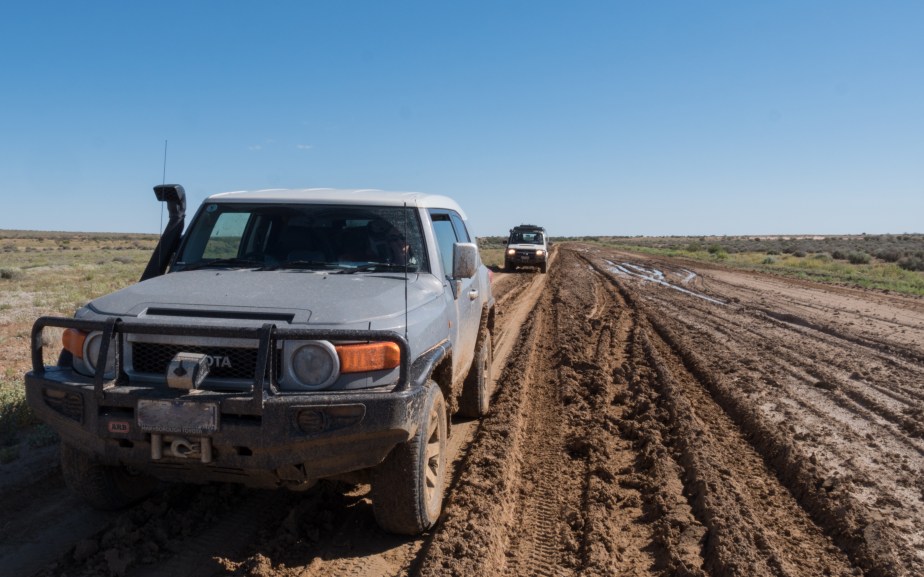
Ironically, the thing that is most likely to immobilise you on the track is rain.
We were among the first to escape from Birdsville when the track reopened. It was still in very muddy condition, deeply rutted and in places quite slippery. We passed a number of stranded caravans and a truck that had been taking consumables to the impending race meeting. It was an interesting morning.
In places it was much muddier than this but it would have been unwise to stop for a photo …
It was our intention to camp at Mungerannie (if you want to sound cool remember that despite the following E, the G is hard like the G in manGo, and it’s got double n unlike the spelling in the map that I filched from Wikipedia ) but the place was very busy as traffic coming up from the south and been unable to get any further. It certainly seemed unlikely that caravans would be travelling on for a few days yet. After a welcome beer we pressed on to Cooper Creek and had a pleasant night under the coolibahs where conversation turned to the fate of previous travellers who had camped on the Cooper. Anyone for some more of this delicious nardoo?
photo – TLG
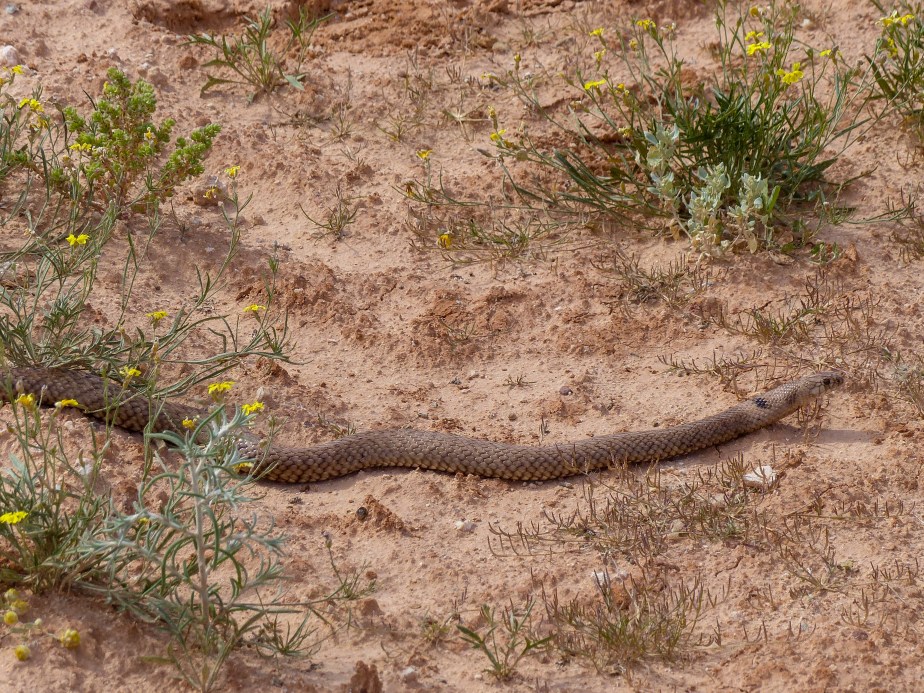
The following morning saw us meeting the locals …
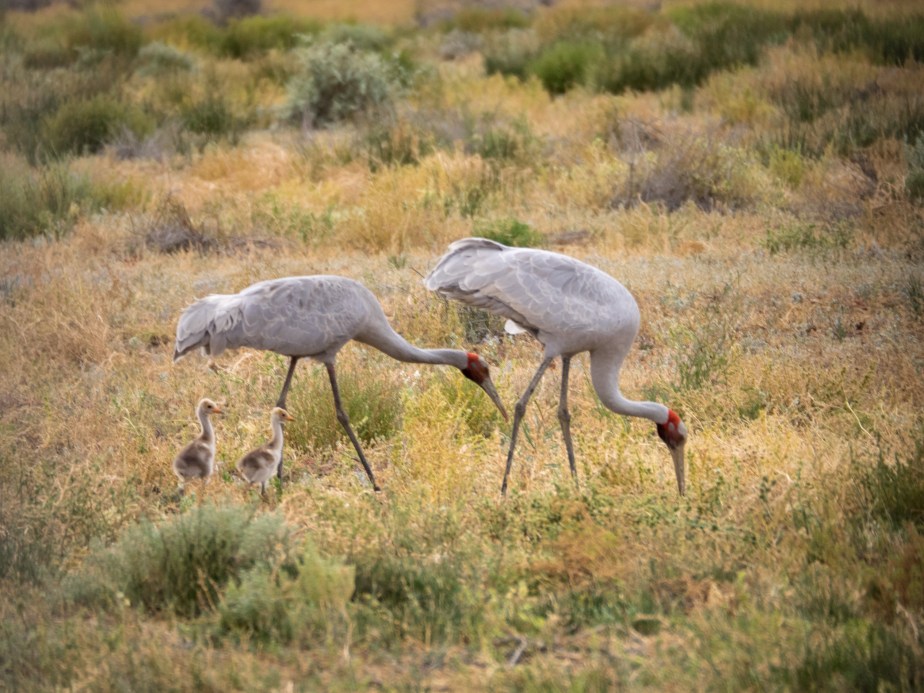
Western Brown (photo TLG)Brolga with chicks
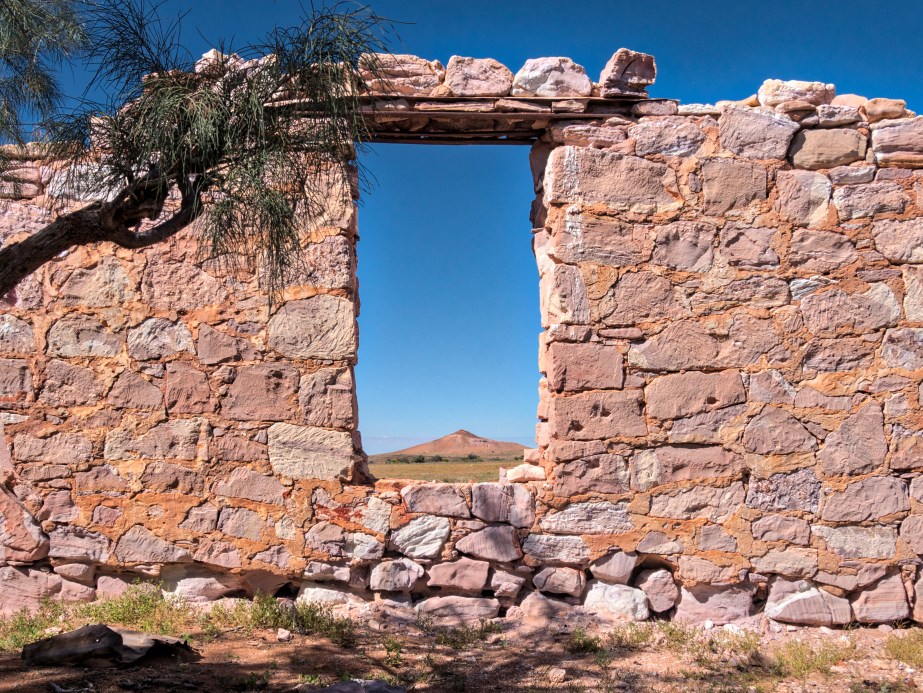
… checking out more of the ruins of Goyder deniers …
Lake Harry
… and soon we reached Marree closing the loop.
The rest of the journey was essentially a repeat of the ride up, only quicker because we were now a little behind schedule.
There I was trapped in Birdsville, less than a month later and 2000 km away here I am trapped in Victoria.
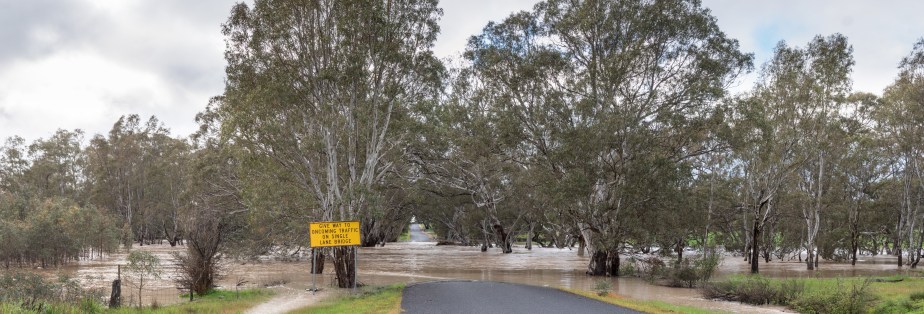
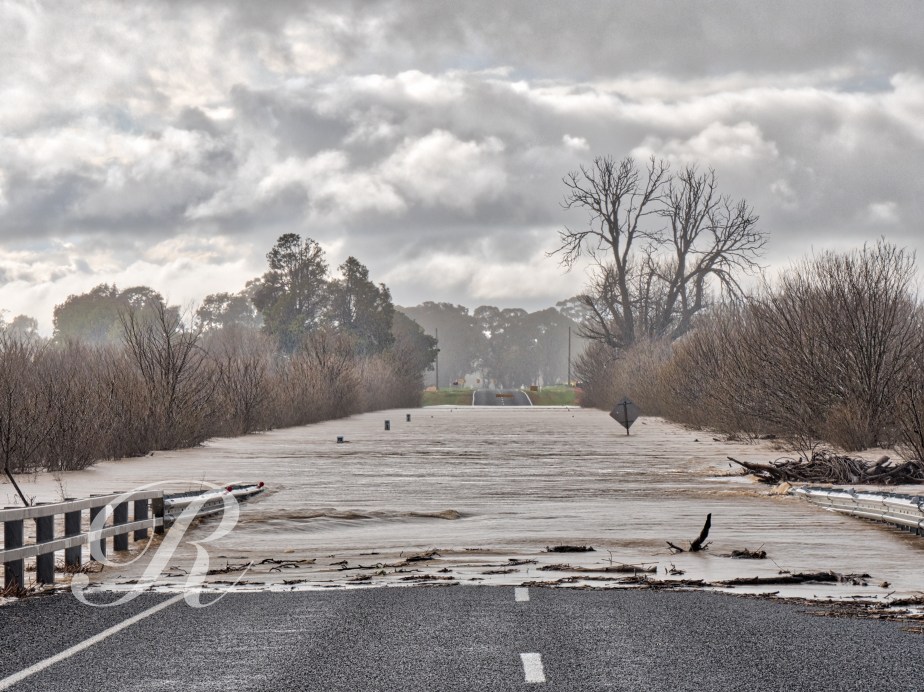
I live on the banks of an inoffensive little creek, I woke up this morning to find it lapping at my back door. I have the choice of a ford and two bridges if I want to go anywhere. The ford would be certain death, the photo of the nearer bridge doesn’t tell the story all that well – you can’t see the bridge! Here’s the other bridge …
The floorboards are still dry, there’s food in the pantry and beer in the fridge. I’m better off than many another …
I have compared crossing the desert to scuba diving. I can’t breathe underwater or find water in the desert but I can strap some tanks on my back and dive or fill a vehicle with the essentials and drive. Birdsville is like a little boat, you can surface and relax, resupply with food, refuel the vehicle, rejoin the life of modern Australia. During the time that this little boat has been anchored here the divers surfacing have changed from drovers to drivers.
Birdsville sits between the channel country and the Simpson. The nearest dune is currently invading the cemetery just the other side of the airstrip, the Diamantina River is 4km from town when it’s behaving itself. It comes to visit occasionally. The main road runs north south.
Way over to the west is Mr Stuart’s road, the main road from Adelaide to Darwin, it towed the telegraph and the railway behind it. Birdsville lies on the Burke and Wills road. What came after them were more explorers trying to find where they’d gone. This is the losers’ side of the desert. For the graziers of the channel country there was a major market off to the south. The principal reason for a road was as a stock route. And at the time the stock route came into being Queensland and South Australia were colonies. Starting in about 1878, Birdsville grew up at the intersection of the road, a river and the colony boundary. It is adjacent to the best spot to cross the Diamantina, often a place occasioning some delay. Where better for a store to resupply the drovers and a border post where import duties could be collected. When the railhead reached Marree in 1883 things really kicked along. In 1900 it had three pubs (droving is thirsty work) and a population of about 300 people. Australian Federation happened in 1901, this brought free trade between what were now states. So the tolls were abolished and the population steadily declined.
In the 1950s the population was down to about fifty.
Birdsville, it seemed was consigned to history. In the cemetery you can find the graves of Wankangaru aborigines born in the desert, white settlers, drovers and Afghan cameleers, whilst the legend of Tom Kruse the man who brought mail and supplies up the 500 km Birdsville Track lives on. The history is rich.
The races are an enduring tradition in Birdsville. They were first run in 1881. The crowds are far bigger now than there were then. The rise of the 4WD vehicle has put Birdsville back on the map. People come from all over to visit Australia’s most isolated town, the population now might be about 100 souls, but on race day expect to see at least 7 000 other people.
The little boat is now anchored here to supply the tourist. There is only one pub these days but you can buy a beer at the bakery! Driving is thirsty work.
Birdsville can be very hard to leave …
… we had to wait three days before we could. It gave us time to take in the sights …
the Bakery … sleepy hollow until the races then unimaginable bedlam. Not only can you get a beer here, Curried Camel Pie figures on the menu. We all found an excuse not to try one, mine was vegetarianism. After breakfast a quick walk to the Royal Hotel, built in 1883 last drinks were served in 1923 when it was converted to a hospital which it remained until 1937.
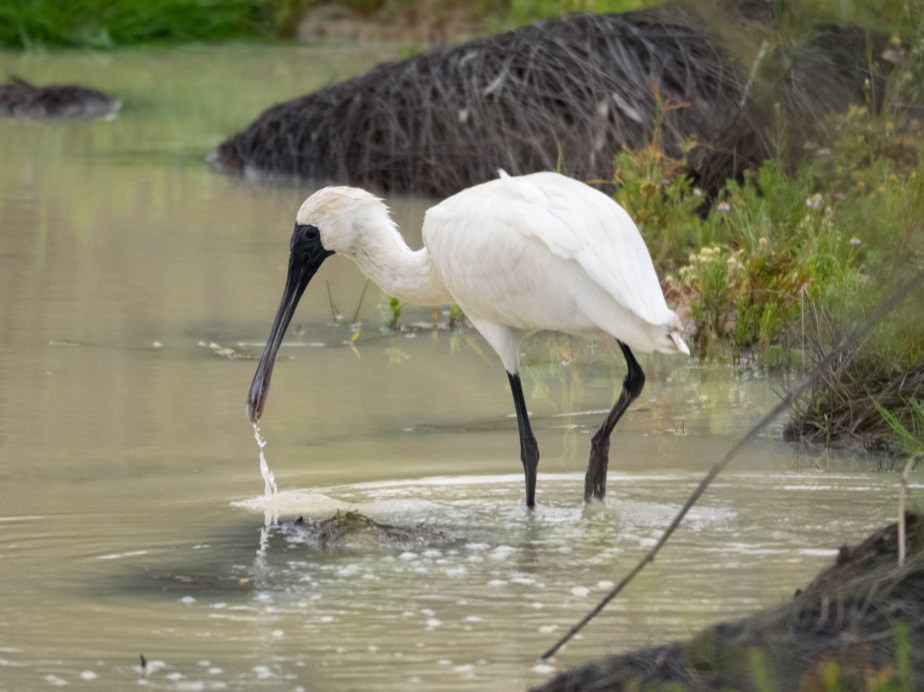
Other essential stops include the Roadhouse and the Visitor Centre.The bird watching around Birdsville is excellent. Between the town and the Diamantina there is the famous billabong, sadly the track to Pelican Point was underwater, not that that bothered the Pelicans. Nor did it bother the Caspian Terns, Kites, Red-backed Kingfishers, Woodswallows in several flavours or Spoonbills …
Black-faced Woodswallow (photo – TLG)
Royal Spoonbill
The race track is out this way as well. Heavy just about summed it up …
photo – TLG
That’s not the river on the other side of the fence, that’s the track.
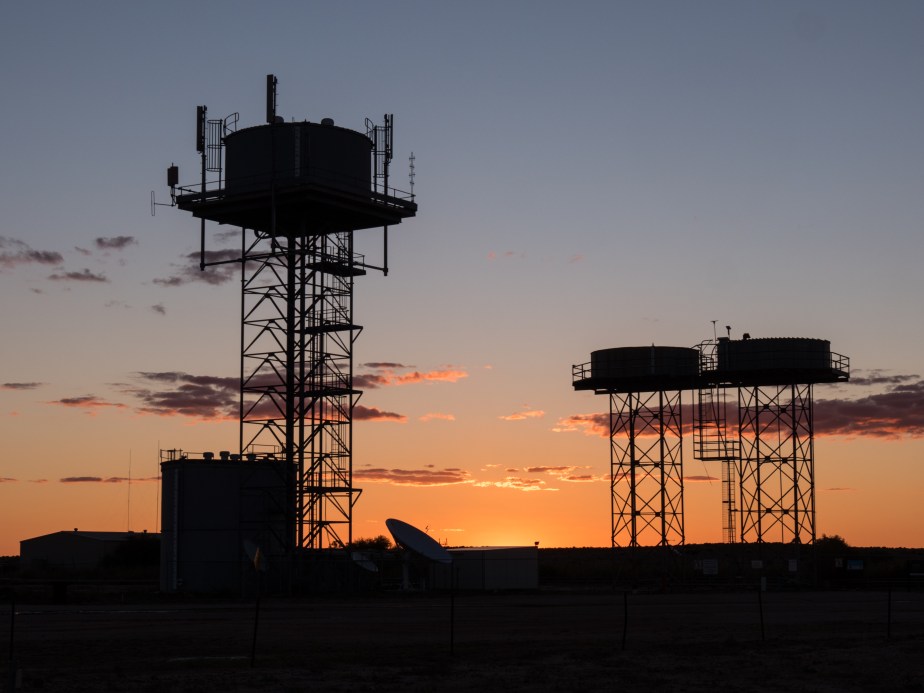
Birdsville’s drinking water comes straight out of the ground. The bore is 1280 meters deep and delivers water at 98ºC. The heat isn’t wasted, it’s used to drive Australia’s only Utility Company owned geothermal power station with an output of 80kW meeting about a third of the town’s electricity needs. Surplus water runs off to the billabong to keep the ducks happy, whilst the rest is stored aloft in reservoirs that look stunningly beautiful for several minutes every day …
And by the time you’ve finished the Cook’s tour you’re ready for a drink at one of my favourite Aussie Pubs … the Birdsville Hotel …















 bobmcgee