After pushing the button on the last post I received this …
This is the road to the Broome Bird Observatory and that’s the warden checking the depth to which it’s flooded. It would indeed be a great adventure and yes it would be illegal. There are big penalties for driving on closed roads. To get to that point from the highway may well have taken you through worse!
The forecast for the next few days is warm and dry. It will soon reopen but it will still be an adventure – 4WD only for a while.
Roebuck Bay is the premier Australian location to see waders. Mostly long legged birds in the order Charadriiformes. At low tide there is a vast area of mud flat housing huge numbers of invertebrates for them to feed on. Some of the species here are resident, living and breeding locally. Many more are long distance migrants breeding in the northern hemisphere and escaping from the snows of winter up there by flying all the way to sunny Australia. For some of these birds it means a 20,000 km round trip every year of their adult lives. For some of them the journey north starts today.
Different species typically depart at characteristic times. The early birds left from about the second week of March. Prominent among those are the Eastern Curlews and the Greater Sand Plovers. We are right in the middle of things now but most of the Red Knots and Red-necked Stints are still out in the bay putting on weight. Peak period for the stints will be next week. Most of the Red Knots will hold on until the first week of May.
I shamelessly filched the graphic from the Broome Bird Observatory website. If you click on it you may be able to read it.
The Broome Bird Observatory is a great place to watch the departures. Get there at about four in the afternoon, head to the beach and stay until about six. Observatory staff will be charting the departees and they will be happy to explain what’s going on. Just say hi.
What they and you are looking for are single species lines of birds forming up on the mud flats. There is much chattering and wing stretching. Then up they go. They may make a couple of orbits and go or a couple of orbits and land again. When they form a big boomerang shape and head north at a higher altitude than for local flights you know they mean business. Or not. Some may come back after a while, sometimes all of them come back. But if you want to make babies sooner or later you’re off.
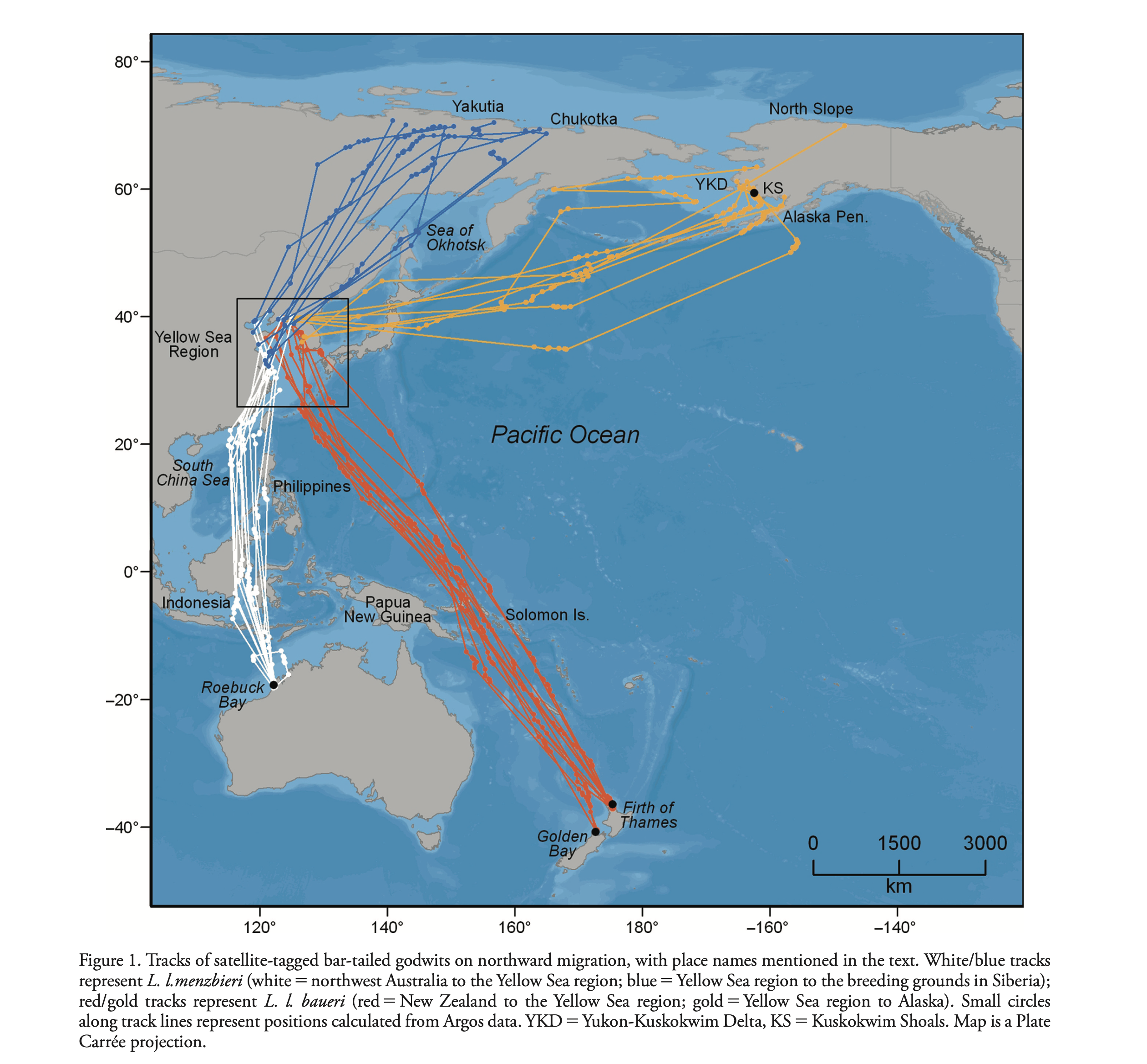
Light a candle for them when you get home. They’ll still be flying after the candle is exhausted. Some will fly non-stop to China, 6,000 km plus, 5 days, no food, no drink, no rest. Some do stop on the way on the coasts of Indonesia, Vietnam and the Philippines.
Birds can be equipped with transmitters so that their progress can be tracked. The transmitters are small but so are some of the waders so we know far more about the big ones than we do the little ones. The next map is pinched from a paper by Battley et al, Journal of Avian Biology 43: 21–32, 2012 and concerns Bar-tailed Godwits on their journey from Roebuck Bay and New Zealand.
The birds spend about a month re-fueling on the shores of the Yellow Sea before continuing to the breeding grounds. Those feeding grounds are absolutely critical to the species survival.
The pay off when they get home makes it all work. The tundra is uninhabitable in winter but in summer is so rich in insect life that the young chicks can feed themselves from almost the moment they hatch.
These are extraordinary journeys. I always feel a little emotional when I watch them go.


 bobmcgee