In a few moments I will be heading for the airport and off to India … for three weeks.
Please visit the site again then and I will regale you with the sights and highlights.
and pray that there's intelligent life somewhere out in space
In a few moments I will be heading for the airport and off to India … for three weeks.
Please visit the site again then and I will regale you with the sights and highlights.
News that a South Pacific island is aiming to eliminate the introduced Common Myna …
Early last century, the myna was introduced to Atiu Island in Cook Islands as a way of controlling insects and other pests in crops and gardens.
But within a few short years, its aggressive behaviour destroyed the local bird populations.
In 2000, the myna was declared to be among the world’s 100 worst invasive species …
By the end of 2012, over 20,000 mynas had been killed, and in their latest update, it was estimated there may be just 62 adult birds left on the island.
62 is enough to reestablish the population so there is a way to go but Common Mynas do have the obliging habit of roosting communally in the non-breeding season.
RT NEWS reports that the Akademik Shokalskiy is on the move.
The ice released the Xue Long earlier.
At this rate the Antarctic will be ice free by about mid February, scientists say.
The stranded Chinese icebreaker, Xuelong, or Snow Dragon, broke through the Antarctic’s heavy ice floes at about 6 pm on Tuesday and was headed for open water, according to Xinhua News Agency.
After being stranded in heavy ice for five days, the ship had broken free by Tuesday evening and was making its way through lighter ice, China Central Television reported on Tuesday.
The vessel, which had been conducting China’s 30th Antarctic expedition before going to the aid of the Russian ship Akademik Shokalskiy, will now continue with its scheduled activities.
The Akademik S remains fast …

The ship of fools is now just the ship, but the Akademik Shokalskiy is still stuck in the ice.
One of its rescuers, the Xue Long is also stuck but happy that it can hold out until it breaks free.
The Aurora Australis is free and has continued on its way towards Casey Station.
The US ice breaker, Polar Star is heading to Commonwealth bay and may assist both the Akademic S and the Xue Long in due course.
The French vessel Astrolabe was also requisitioned for a week to assist in the rescue mission and can now resume its task of resupplying Dumont d’Urville.
This kind of commemorative expedition has no interest from a scientific point of view,
Because of the rescue operations, French scientists had had to scrap a two-week oceanographic campaign this month using the Astrolabe.
The Chinese have had to cancel all their scientific programme, and my counterpart in Australia is spitting tacks with anger, because their entire summer has been wiped out.
(Antarctica has about 80 scientific bases, of which around 40 are permanently staffed and others manned on a seasonal or temporary basis.
Only three bases are inland; the others are on the coast.)
‘If we want these bases to operate all year round, it is essential to resupply with food and fuel during the brief window of opportunity.
Diverting supply ships to rescue tasks ‘imperilled’ this link.
Sigh of relief, the Aurora Australis is in clear water.
Not, however, clear to go on its way, the Xue Long is not certain of its ability to escape the pack so she must stand by to render assistance.
Meanwhile it is rumoured that 98% of main stream media reports don’t mention the mission or as Jo Nova puts it …
In the magical world of media spin, a boat full of mostly Australian climate scientists has turned into a Russian passenger ship stuck in ice. … where media crew on-board take hours to get the news out and everyone pretends this mission was not about promoting climate fear via the BBC World Service. The media contingent is so large on this mission there is not only a BBC journalist, and two Guardian reporters, but it also includes two Fairfax reporters on board the Aurora Australis as well.Never before in modern satellite media communications has it taken so many journalists to say so little, so slowly and so vaguely.
Good news for the passengers, the fossil fuelled helicopter rescue has been safely completed. The crew of the Akademik Shokalskiy remain to look after her but the others are all now ensconced on the Aurora Australis.
This includes, of course, Professor Turney’s children who are vital members of the scientific party, their task being to communicate the awful news of clear and present climate change to school children throughout the world.
The main stream media are doing their utmost to present this fiasco in the least embarrassing light. News.com bring us this …
While scientists expect and observe more extreme weather with man-made global warming, some say it’s not quite fair to blame the Antarctic blizzard that trapped the ship on climate change.
University of Colorado ice scientist Waleed Abdalati, NASA’s former chief scientist, cautioned, like many scientists do, that while researchers can spot a trend in extreme weather, they can’t immediately associate an individual event -like a blizzard – with changing climate.
When scientists do attribute an individual extreme weather event to climate change, it is usually more than a year later after numerous computer model simulations and then published in a peer-reviewed journal.
Also, Antarctica, which is more governed by localised wind circulation and other characteristics, “is kind of its own beast,” Dr Abdalati said.
You can imagine how quickly that line would have been forgotten had the expedition not been thwarted by inescapable evidence of extreme cold.
All that remains now is for the Aurora Australis to reach clear water. The view out the back shows that they aren’t exactly ripping along …
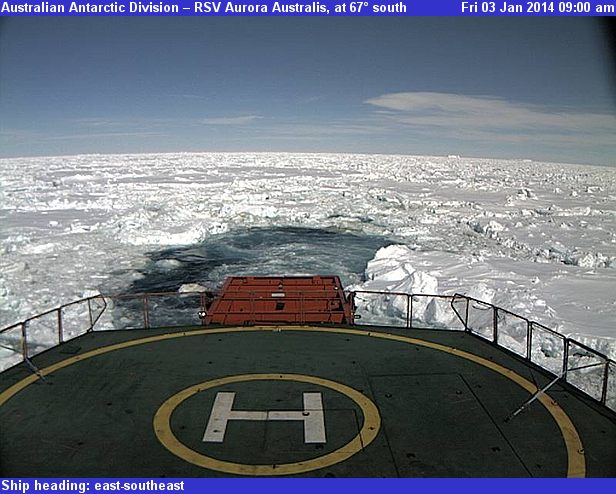
You can check their progress at http://www.antarctica.gov.au/webcams/aurora
Rescue of the “tourists” and the “scientists” is underway. Our ABC reports that the first batch have been airlifted directly to the Aurora Australis, and they managed to bring us that news without once mentioning global warming or the fact that the leader is Professor of Climate Change.
There are real scientific programs in progress in Antarctica. Supplies and personel have been diverted with the Aurora Australis and the other ice breakers sent to assist the Akademik Shokalskiy. Programs that have been long in the planning may well be impossible to complete. For what? An activists junket, a consciousness raising exercise.
And rumour has it that one of the rescue ships, the Xue Long, is now beset.
The main stream media were in there raising our consciousness with great enthusiasm ahead of the debacle. Let’s hear about it now …
… to all my readers, it turns out there are more than two of you, that’s nice.
In fact during 2013 the blog had visitors from 58 countries. Not surprisingly, most visitors were from Australia but the USA and Canada were not far behind.
When it came to comments, though, the Aussies led the way by far, many thanks to those who did, so come on the rest of you, when you visit say hi.
One disappointing feature of this new year is the sad lack of palindromic dates. For the hordes of north american visitors Australia uses the dd/mm/yy format for dates. The first palindromic date will be 4/1/14 in three days time. We have to wait a while for the next one. The last will be 4/12/14 … how many in between and what are they?
On 2 December 1911 Douglas Mawson departed from Hobart as leader of the Australasian Antarctic Expedition. The good ship Aurora landed them in Commonwealth Bay on 8 January 1912. He and two companions set out on a sledging expedition – Mawson was the sole survivor. He arrived back at his base to find that the Aurora had departed. Some of the party had stayed behind in the hope that his party would return. The group had to wait until December 1913 before they could depart Antarctica’s shore.
In 2007 United Nations Secretary General Ban Ki-moon visited Antarctica in an effort to highlight global warming the BBC reported …
Mr Ban – the first UN chief to visit the continent – wanted to see for himself the effects of climate change on the world’s largest wilderness.
After flying over melting glaciers, he told reporters that what he had seen had been both “extraordinarily beautiful” and “disturbing”.
Just a quick look and he was able to see for himself that disaster lay just around the corner. The glaciers are melting.
This year a party led by Professor Chris Turney, calling itself the Australasian Antarctic Expedition 2013, set out to follow in Mr Moon and Mawson’s footsteps and highlight the disaster of increasing temperatures and melting ice. As the ABC reported on Lateline of 25 November …
$1.5 million Australian expedition to Antarctica Professor Chris Turney from the University of NSW is mounting the largest Australian science expeditions to the Antarctic with an 85-person team to try to answer questions about how climate change in the frozen continent might be already shifting weather patterns in Australia.
ABC’s MARGOT O’NEILL: The research stakes are high. Antarctica is one of the great engines driving the world’s oceans, winds and weather, especially in Australia. But there’s ominous signs of climate change.
CHRIS TURNEY: The Southern Hemisphere westerly winds encircle Antarctica, and over the last 20 or 30 years or so, they’ve been pushing further south. Now – so actually in a way it’s almost like Antarctica’s withdrawing itself from the rest of the world…
They thoughtfully took with them reporters for the BBC and the Guardian and initially things were going very much to plan …
Several scout teams had investigated the ice sheet between the ship and the hut in the three days we had been at the frozen continent, however, and their news didn’t look good: a recent warm spell had melted lots of the snow cover on the fast ice, and the route across it was riddled with pools of water covered with thin, easily broken ice.
Clear evidence of melting here … although it had been open water in 1912.
The warm spell did not continue. The ice closed in. The Australian Maritime Safety Authority received a distress call on Christmas morning. The expedition ship was stuck fast. News.com and the Weather Channel brought us the news that very day. I don’t know if they had a reporter on board.
Eventually the Guardian brought the news from its intrepid reporter …
Trapped in heavy pack ice just off the coast of Cape de la Motte for the past two days, we await icebreaker assistance.
There’s nothing like a scoop, eh …
Since then a couple of icebreakers have tried to bust them free. If all else fails they will be helicoptered to safety. Just think of the carbon footprint.
Well, you gotta take risks if you want to do science. But think about it, comparing 2013 with 1912 when weather can be so variable, maybe that wasn’t going to be great science to start with.
Perhaps they should have looked at the data for a number of years …

That’s one difference … more ice this year.
 bobmcgee