A Brief Escape …

The accursed Covid has certainly changed our lives. Gayle and I were not intending to spend the winter in Victoria. Another road trip to the tropics looked good. It wasn’t to be. Nonetheless we are better off than many. Locked in a tower block apartment has got to be a nightmare. Fortunately for us we live in a sparsely populated rural location which wasn’t locked down when restrictions were reimposed on Melbourne.

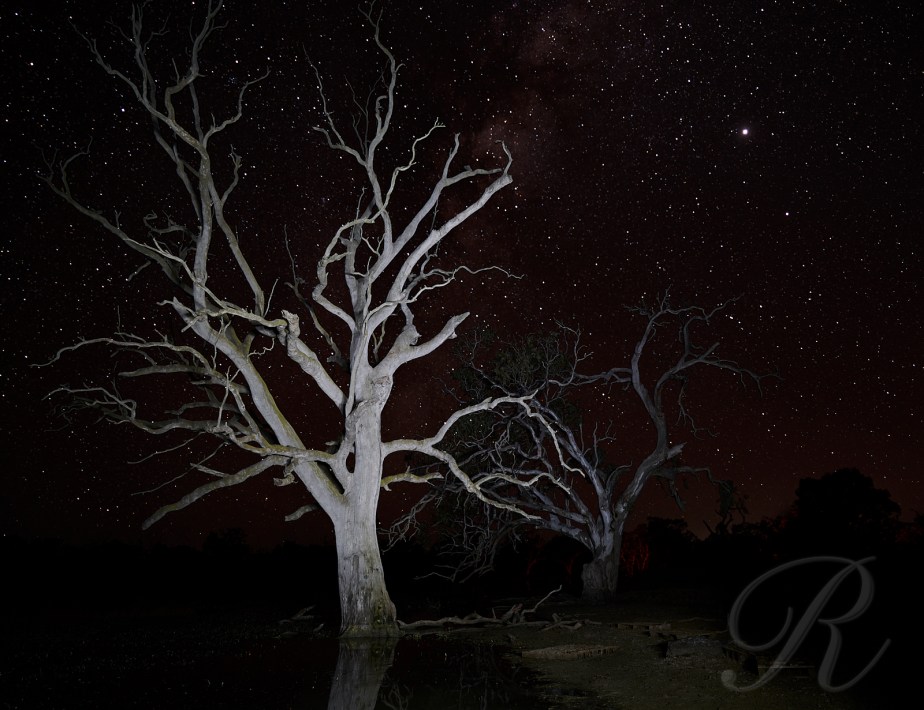
We can’t go far but western Victoria is available and we’ve been keen to go to Woomelang for a look at their little silos. We camped by the lake at Wooroonook the first night. It’s a spot we can reach in little more than an hour. We were blessed with a clear sky, a perfect night for a glass of red by a campfire.

The landscape is pretty well flat but 8km away there is an isolated hill that gives a good view of the surrounding country. The mountain bike and I made it to the top of Mt Jeffcot. The view was splendid and the descent was terrifying.

Strava segments are named by their creator. Presumably this one is not part of a naked bike ride. And for a timid rider like myself you’d want shorts on to hide the fact that you’d packed your daks.

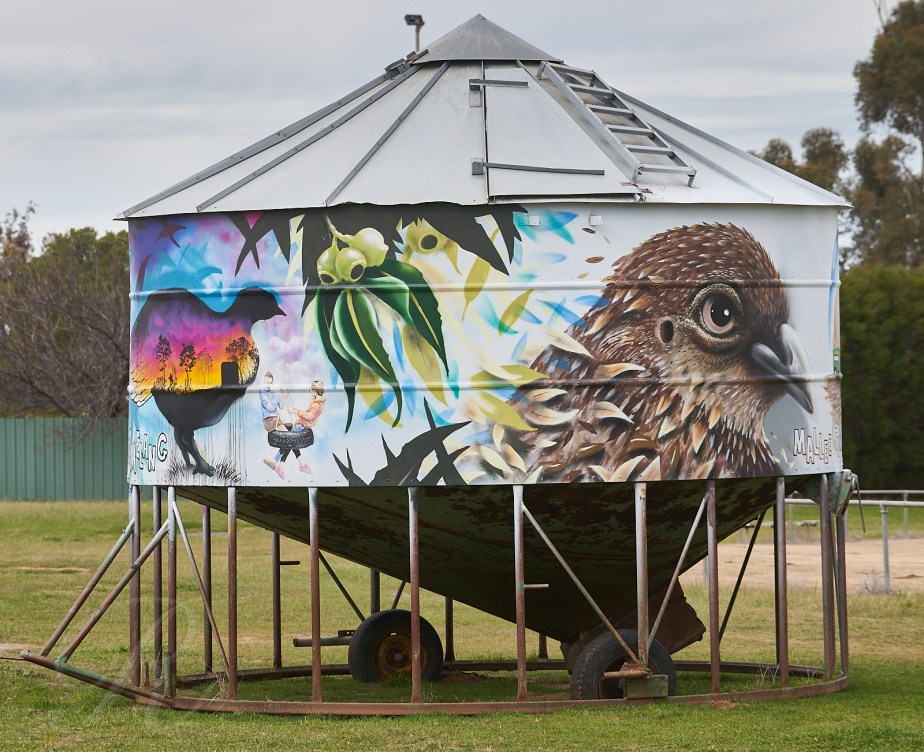
After lunch it was off to Woomelang for some small scale silo art. There are seven portable silos with work by a variety of artists scattered around. This sort of silo is often called a field bin. The artists that were issued with corrugated ones got the short straws. They were definitely at a disadvantage. I was particularly struck by the Western Pygmy Possum and the Mallefowl …

The camp that evening was in Black Box woodland at Lake Albacutya.

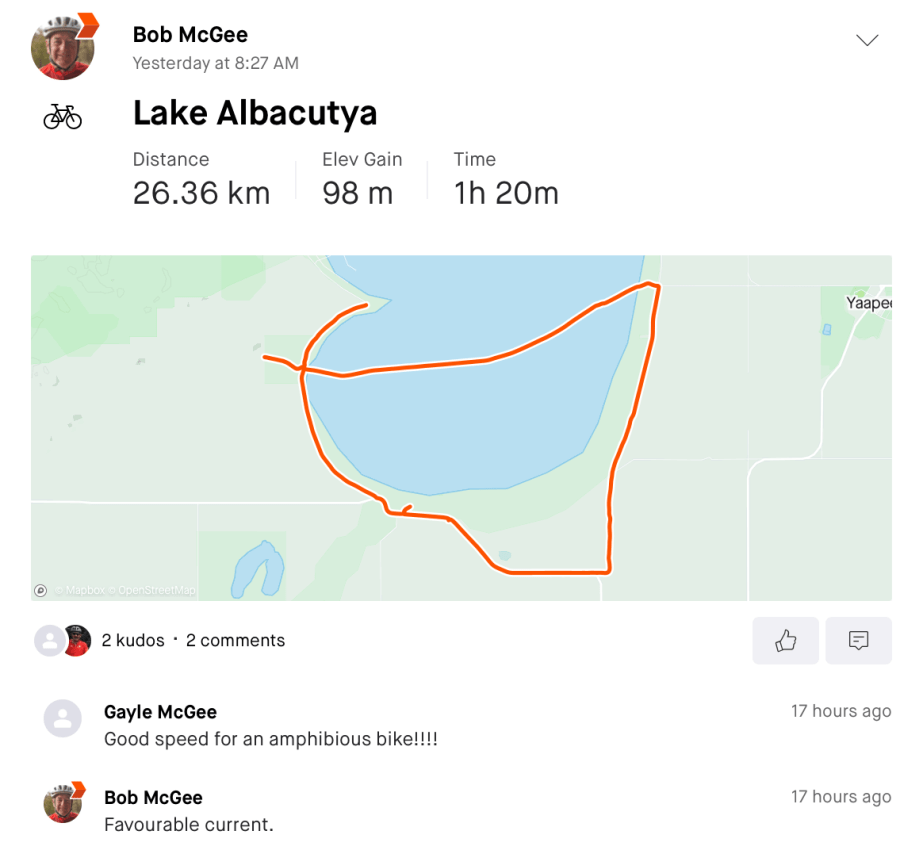
In the morning it was back on the bike …

The lake was dry as it usually is. When the Wimmera River carries enough water it spills through Lake Hindmarsh to Albacutya and then into Wyperfeld National Park. It hasn’t happened so far this century! It does have a nice concrete boat ramp for the next occasion.

A walk turned up some nice birds including Chestnut-rumped Thornbill and Scarlet Robin. My second cuckoo for the “spring” was calling prominently – Pallid Cuckoo.

After that it was home again, home again as a westerly front blew in bringing a gale and some heavy rain.

In the Zone …

Armed with my newly established functional threshold power (FTP) I can set my power zones and use these to guide my training.

The ideal training program stretches the envelope and leads to greater fitness – remember stress, recovery, adaptation. Too aggressive a program tears the envelope. Lack of adequate recovery can make the process inefficient. And the cardinal sin would be not training hard enough.

Behind this there is an assumption of a predictable dose/response mechanism which simply doesn’t exist. In every study of training outcomes, no matter whether the subjects have been recruited from the couch or are trained athletes, the gains vary and may even be negligible. There are, as well, diminishing returns for the highly trained but then they are better placed to deal with the bigger doses.

Training zones help to tailor the dose to the individual.

The continuum from not pedaling  (0 Watts) to pedaling as hard as you can may best be communicated by dividing it into a number of zones. The most popular seems to be that devised by Andrew Coggan utilizing seven levels. Your FTP serves as the anchor point so that the zones have some correlation with your physiology. It is at or close to the point where a graph of blood lactate makes a noticeable increase in slope indicating the beginning of an oxygen debt.

Level

Description

% of FTP

1

Active Recovery

<55

2

Endurance

56-75

3

Tempo

76-90

4

Lactate Threshold

91-105

5

VO2max

106-120

6

Anaerobic Capacity

121-150

7

Neuromuscular Power

N/A

There are other schemes with different names and/or a different number of levels. The notion that there is any significant difference between high level 2 and low level 3 is nonsensical. The state of the athlete (rested, fatigued, hungover) is likely to have a far greater effect on the response than the difference in power output.

In general terms levels 1 through 3 are all day levels – for those with the patience and all day backsides. The time that you can sustain the higher levels falls away rapidly.

Different athletes have different strengths and weaknesses in large part determined by the muscles they were born with. In any workout session the further you are from your FTP the less accurate is the zone as a guide to the likely benefit. This can be addressed by measuring your best power output for a number of time periods and setting zones that better match your current abilities. Too great an obsession with the numbers may not be all that beneficial because departures from the norm are likely to be at the sprint end of the spectrum where workouts are likely to be maximal rather than at a target power.

In summary. The power meter is a measuring device. FTP is a  valid way of calibrating the athlete to work with one. The power zones around it are largely arbitrary, handy for communication between athlete and coach and excellent material to bore your mother with. On your easy days the power meter is a good guide as a number not to be exceeded. On hard days effort is the key, analyse the numbers after the session to check on progress. And every day remember that happiness is not measured in Watts.

Training is Testing…

and testing is training.

The standard work on power meter use is Training + Racing With a Power Meter by Allen, Coggan and McGregor. I had plenty of time to read it while waiting for the meter to arrive. It is comprehensive, it is useful but it is a bit verbose. It stretches to 366 pages although I think I could rewrite it in about a quarter of that.

It prescribes a testing protocol beginning with a 20 minute warm up at endurance pace extended by 3 one minute intervals at high cadence and a further 10 minutes easy riding. Then the real work begins starting with a 5 minute all-out effort followed by 10 minutes easy. Then it’s what you came for – the 20 minute maximum effort.

Rather than collapse by the side of the road a 10 – 15 minute cool down is recommended. The power that can be sustained for 60 minutes is assumed to less by about 5%.

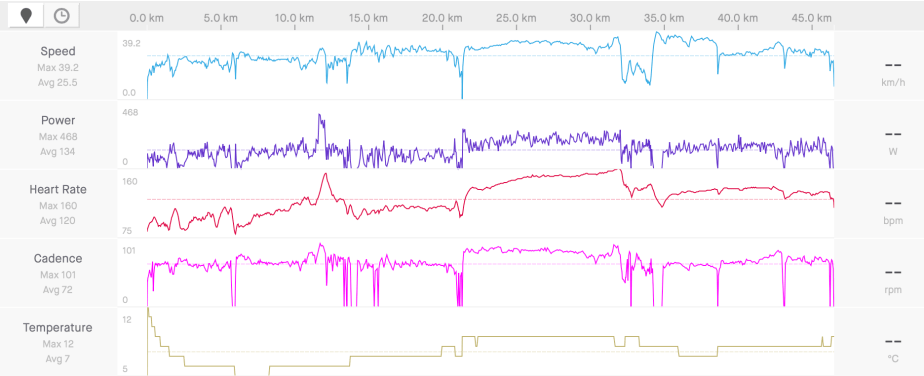
In the lab you could do it just like that. In the real world you need to fit the session to twenty minutes worth of road suitable to the all out effort. It needs to be flat or slightly uphill and it needs to be uncomplicated by turns, crossroads and traffic lights. I chose a circuit that I do fairly frequently. All up I rode 46 km and you may see some resemblance to the protocol …

After slightly more than 10 km of easy riding I reached a Strava segment that I substituted for the 5 minute effort. It is an uphill sprint. I unleashed such power that I managed it in 1.03 minutes a new PR. That’s efficiency.

About 10 km of easy riding later I launched into the big twenty. This included within it another Strava segment which the creator entitled Headwind Hell. There is a clue in the name to why on the majority of occasions I do this circuit in the opposite direction.

For the first couple of minutes I was engrossed by the power numbers. It wasn’t long though before my interest shifted to the clock. At about the 19 minute mark I was reflecting on Allen, Coggan and McGregor’s suggestion that you test your FTP every six to eight weeks thinking that they had to be joking. It was brutal.

I covered 10.63 km at 31.8 kph and the average power output was 206 Watts. Take 95% of that to give an FTP of 196 Watts.The effort was paced reasonably well. Running out of gas was one trap that I was concerned about. Heart rate rises through the effort and there is a peak earlier in the ride during the one minute effort (which wasn’t brilliantly paced).

The entire ride
Just twenty minutes

So 196 Watts – how good is that? A quick trip to cyclinganalytics.com reveals that 90% of male cyclists report higher FTPs. (None of them have anything shorter than a seven inch dick either – he says petulantly).

So how shabby an effort was it? I did mention that it included a Strava segment. Headwind Hell is 8.33 km long and took me 15 min 27 sec which was good enough to put me on the leader board albeit in 10th place.

That left me with a 34 minute ride home which I knocked off at 25 kph – clearly there was a bit more in the tank. Only a few hours later it already seems reasonable to do it again next month – that invites comparisons with childbirth but think of the prospect of 24 FTP tests in the next two years. I need to talk to a woman with 24 children.

This post was amended on 12/07/2020 to correct an error.

FTP …

The evolutionary value of being able to sprint is obvious. Back on the plains of Africa a lion could appear at any time. You couldn’t out sprint the lion but it would suffice to out sprint the person next to you for just so long as it took for the lion to catch its breakfast.

After a little while it would be possible to repeat this perhaps several times. Eventually you would run out of companions or become exhausted. Each sprint would likely be a little slower.

You can’t sprint far but as you cut back on the effort you can increase your range. After about 12 minutes steady running (or cycling) you have settled into a pattern in which the lungs and heart are delivering oxygen to the muscle fibres at pretty much the rate they need to burn adenosine triphosphate (ATP) and bring about contraction. This is aerobic exercise, the stuff that endurance is made of.

Using a power meter you measure how much power your legs can put out for varying periods of time. Handy things to know are what you can achieve in a sprint (bragging rights) for 5 minutes (determine appropriate strategy for hills) and for an hour (a useful guide to endurance).

The maximum power that you can sustain for one hour is your Functional Threshold Power or FTP. It’s the hardest you can go without crossing the line into oxygen debt. With training your FTP should increase, without training it will diminish. It needs to be measured from time to time and will make you feel good when it moves in the right direction.

One way to measure it is to go out and bang away full gas for an hour. You really can’t expect the youth of today to do that though. Plus there are some practical difficulties, finding somewhere to ride for that long without traffic lights and cross roads and that is flat or up hill is a challenge in itself. There are alternatives.

The method I favour is a flat out 20 minute effort. FTP is taken to be 90% of your achievement.

The video below shows how a couple of more impressive cyclists go about testing on an indoor trainer and some discussion with an eminent sports physiologist.

If you watched it you will recall that the FTPs came in at

Blake 247 Watts

Si       342 Watts

to which we can add

McGee 196 Watts

which we can regard as either pathetic or evidence that I might be an even better sprinter than Blake. I confess it’s the former but look at it this way it was a first effort that leaves plenty of opportunity for improvement.

To find out, in excruciating detail, how I went about it, how it felt and how much I’m looking forward to doing it all again stay tuned. I’m sure you can hardly wait.

This post was corrected on 12/07/2020.

The Power and the Training …

A Google search on the term “training principle” yielded “About 301,000,000 results (0.48 seconds)”. The sheer volume means I won’t be reading them all but I’m also put off by a hint that the science may not be settled …

and the very next result was for the four principles in case you were wondering why four had been omitted.

One of the principles (or one of the pitfalls) must be more is better so let’s have a look at seven courtesy of teamusa.org

Individuality

Specificity

Progression

Overload

Recovery

Adaptation

Reversibility

A quick precis will suffice for some of these. We all respond differently to training. You get better at what you practise – swimming makes you a better swimmer it has little benefit for your football ability. Stop training and the benefits fade and disappear. That disposes of individuality, specificity and reversibility.

Which leaves Progression, Overload, Recovery and Adaptation. These are the three core principles, yes, I know, maybe that’s why the number varies so much. The process goes something like this. Apply a training stress. Recover. Adapt. Repeat with a greater training stress.

Just as it’s  fine line between pleasure and pain it’s a fine line between training and over training, increasing the stress too rapidly leads to injury or exhaustion and the exercise program falls in a heap. Adequate recovery is an essential component of a successful training program and sometimes the hardest to endure.

If you’re offended by my reduction in the number of principles we can restore it to seven by adding the law of diminishing returns. The well trained athlete has got a lot more work to do to make progress than the beginner.

Enter the power meter. It gives an accurate measure of the training stimulus. It makes it possible to increase the load by sensible amounts. It also provides a means of limiting the stress to enable adequate recovery. If the keen cyclist gets carried away every ride they may fail to progress because they are always too fatigued to up the effort when required. The trap is often summed up as going too hard in the recovery sessions and not hard enough in the hard sessions.

Today is a rest day. My next task is to measure my capabilities and establish my FTP and training zones. I will explain …

The Power and the Glory …

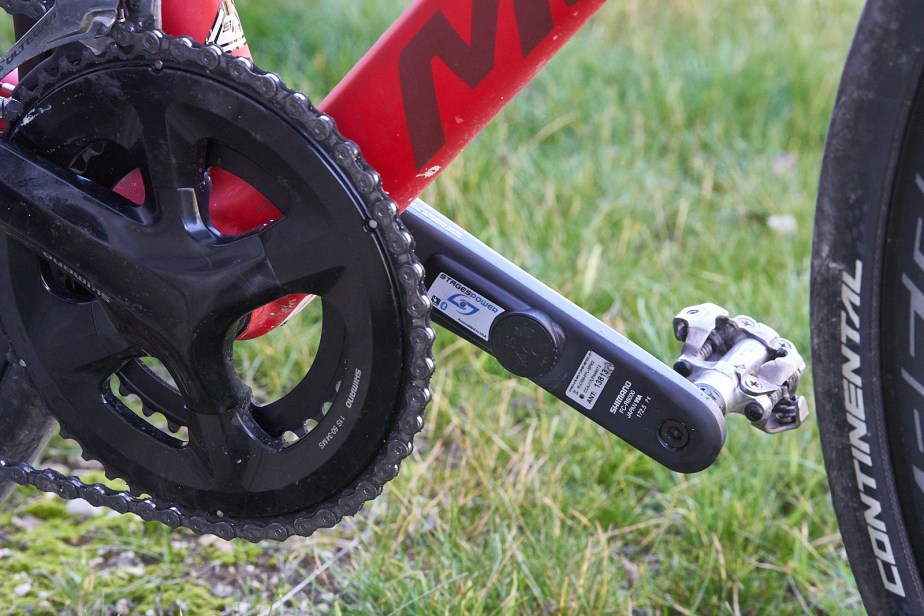
The Power meter arrived.

It is not a thing of great beauty but it does make the bike go much faster. The mechanism by which it achieves that is simple. It measures the power output of the rider. That finds its way onto Strava where all the world can see it. Therefore the rider works harder so as not to appear a wimp. As a consequence the bike goes faster. QED.

It is the round thing half way along the left crank arm.

It is a Stages Left power meter. This is pretty much the cheapest way to measure power. It goes without saying therefore that it’s not the best but it will suffice until next year’s Tour de France.

A power meter is a strain gauge. They can be put in different parts of the drive train for example in the spider that holds together the chain ring, the cranks or at the rear hub. Perhaps the optimum place is one in each pedal which has the advantages of measuring the output of each leg separately and being easily transferred from bike to bike. Using a single crank measures the output of a single leg and entails the assumption that the two legs are equal which probably isn’t exactly true. However I always use the same left leg so the metric can be compared usefully from ride to ride.

So what exactly does it do?

A quick revision of terms and units in mechanics will come in handy. Work is basically weight through distance. For example Robert and his bicycle through 50 km. It takes a certain amount of energy to accomplish the work. The units that energy is measured in is the joule. A handy way of quantifying work is the number of joules required to complete it.

Robert and his bicycle can travel slowly or a bit more quickly, The work done is the same. Power is the rate of doing work or put another way – all those joules divided by time and the answer is in Watts.

A power meter measures the rate of doing work in Watts. Your speed will vary when going up hill or down, with the wind or into it. The power meter will still tell you how much effort you’re grinding out whereas your speedometer will not.

The Stages Left comes mounted on a crank arm which replaces the original. If anyone would like to purchase a left Shimano Ultegra crank I have one for sale. Setting it up to work with my Wahoo Elemnt Bolt bicycle computer could not have been easier. Insert the battery in the power meter. Using the Wahoo app on the phone introduce the two bits of high tech. Download the Stages app and zero the power meter. Go for a ride.

One of my first impressions as I set it up was that the battery cover was a very flimsy piece of plastic. Without it the rather expensive meter won’t work. This could be an issue. However it’s still in place after a couple of hundred kilometers. Maybe they thought of that.

The next step is to put it to profitable use. Stay tuned … but for now some wise advice from Dr Oliver Bridgewood.

Mixed Messages …

The morning rides have been a bit on the chilly side. I had a close brush with frostbite just the other day, well cold fingers anyway. Flame Robins have deserted the high country for the winter and have been moving through this district in recent days, always a welcome sight. Winter is also the time when we see more Crimson Rosellas and Grey Currawongs.

But here we are only just past the winter solstice and some of the birds are singing from a different hymn book entirely. Just west of Dunolly in recent days I have encountered a Fan-tailed Cuckoo emitting its mournful whistle and yesterday I was swooped by a couple of Magpies, one in desultory fashion and one with great enthusiasm. The latter made contact with my bike helmet a couple of times. I knew there was a good reason to wear one.

We are, of course, talking about the Australian Magpie Gymnorhina tibicen not the original Eurasian Pica pica.

Frostbite … ?

It was a chilly one this morning. The grass was crackling under my feet and the puddles were frozen as I got the bikes out of the garage.

Readers from elsewhere in the world may have the notion that Australia is a land of never ending sunshine and warmth. Not so. South-east Australia even has some ski resorts. The Victorian goldfields are on the inland side of the Great Dividing Range away from the moderating influence of the sea. We have some knockout frosts. The last couple of mornings -2° C.

Having said that, though, it’s the cloudless nights that produce the lowest temperatures. Cloud cover helps to hold the warmth in. Snow (below 1000) meters is therefore unusual.

Plugging away at 25 kph into a 5 km headwind made the fingers numb after a while. I haven’t solved the problem of the appropriate gloves yet – I’m on to my third pair presently. Do avoid neoprene it doesn’t keep out the cold but sure does a good job of keeping in the sweat. Anyway, the mind turned to consideration of frostbite. Is the wind that is generated by the forward motion of the bike sufficient to turn an uncomfortable experience into a dangerous one?

Once home again and thawed out I consulted the internet. I found a couple of windchill calculators that talk metric after a fashion. One at calculator.net can be persuaded to accept metric input. It then calculates a metric answer and also a Fahrenheit answer which you can look up in a nice graphic.

Another at  romseyaustralia.com is very informative but having got your answer you consult a table to discover the likely outcome for your fingers and toes which is not quite as intuitive as the graphic. It was at this site that I learnt …

Twelve volunteers (six men and six women) participated in the clinical trials. These consisted in four walks, at 4.8 km/h, on a treadmill in a refrigerated wind tunnel at the Defence and Civil Institute of Environmental Medicine in Toronto, Canada: one walk at each of -10, 0 and +10 deg C, plus a “wet trial” at +10 deg C during which participants received, every 15 seconds, a light one-second splash of water in their faces. During each 90-minute walk, the volunteers were walking while facing a wind of 2 metres per second (m/s) for 30 minutes, followed by 30 minutes at 5 m/s, and 30 minutes at 8 m/s (or about 4, 10 and 16 mph, respectively). Sensors were fixed to participants’ forehead, cheeks, chin and nose, as well as to the inside of one cheek, to measure skin temperature and heat loss. The results from these trials were used to determine the various thresholds for frostbite, as seen on the new wind chill chart.

The new wind chill equation is now in use in both Canada and the United States. Therefore, there is now a consistent wind chill formula across North America.

Where would we be without volunteers?

Should you distrust the calculator and prefer to compute your own here’s the formula …

Twind_chill = 13.12 + 0.6215*T – 11.37*(v0.16) + 0.3965*T*(v0.16)

If you were surprised to discover that Australia has ski resorts you probably won’t be surprised to discover that my fingers and toes were in no danger whatever. At -2° C. the wind would be uprooting trees before it caused sufficient chilling to freeze my extremities. Hypothermia, though, is another issue.

Colbinabbin …

More silo art, the paint has barely dried.

Colbinabbin is about 160 km north of Melbourne and about 54 km from the nearest large town, Bendigo.

The artwork is by the Benalla artist Tim Bowtell and it is a splendid accomplishment. It celebrates local history from the Colbo Picnic of the early 1900s through the days when steam was king to a tractor pull from the 1980s.

For the photographer interested in where the light will be coming from the artwork faces south.

Colbinabbin is situated in north central Victoria. It’s the home of the Colbinabbin Football and Netball Club, AKA the Hoppers and it has a shop or two. Parking and visibility of the art is excellent. It’s a terrific project that I’m sure will do the town some good.

Keep Living Fast …

If you are overweight or obese your chances of dying of any cause are raised.

From – Body-mass index and all-cause mortality: individual-participant-data meta-analysis of 239 prospective studies in four continents. Lancet. Aug 2016.

If you were one of the nearly four million people in this study the best weight to be was the one that put your Body/Mass Index under the red arrow. As it goes up or down so too do your chances of dying. It’s a J curve.

If you are young and obese you have the most to gain from losing weight. It is not easy but some succeed. You can give it a go or you can shriek about fat shaming and stuff another ice cream in your face.

If you’re obese and really lucky you may be metabolically healthy. It’s true for a minority. On the other hand some people of normal weight fall prey to those ills we associate with obesity, the dreaded metabolic syndrome. It does rather complicate the decision regarding the ice cream.

But wait it gets worse.

If you are a baby boomer or, my goodness, even older there are a number of confounding issues. Declining muscle mass being replaced with fat can bring all the disadvantages of obesity at a normal or not greatly elevated BMI. Add to that the fat distribution – middle aged spread tends to go around the middle where it does more harm than subcutaneous fat. You may be in more trouble than you think … or less.

I’m still exactly the same height I was lying about when I was 18 but some people have shrunk. This would increase their apparent BMI even if they haven’t put on a gram in the meanwhile. (Do I get extra consideration for bow legs?).

Next thing to consider is the obesity paradox. If BMI is plotted against all cause mortality in the elderly a different picture emerges than the one above. A higher BMI can appear to be protective. The simplest explanation for this is that death is fairly common in this age group and is often preceded by a period of wasting. Alternatively it may be because those most susceptible to the ills of obesity have already been eliminated from the cohort.

So if unintentional weight loss clouds the picture is intentional weight loss safe or not?

Intentional weight loss, even when excess fat mass is targeted also includes accelerated muscle loss which has been shown in older persons to correlate negatively with functional capacity for independent living. Sarcopenic obesity, the coexistence of diminished lean mass and increased fat mass, characterizes a population particularly at risk for functional impairment …. Miller & Wolfe.

Failed weight loss in a sedentary population invites the worst of both worlds – lose fat and muscle regain only fat. Weight loss in the elderly regardless of intentionality also  carries an increased risk of subsequent hip fracture.

No surprise then that health care professionals are divided on whether weight loss should be recommended to their elderly patients.

This little essay draws heavily on a review paper by Gill, Bartels & Batsis.  Their conclusion is fairly positive …

The number of older adults is projected to increase substantially in the coming decades and addressing obesity is essential for the health of this rapidly growing population. Though the “obesity paradox” has contributed to a lack of attention to addressing obesity as a major health problem in older adults, weight loss and improved fitness in obese older adults has been shown to improve function and multiple health indicators. Though physical activity and diet alone can improve outcomes, randomized controlled trials showed better outcomes when they were combined. The process of activity prescription should be patient-centered in order to develop a plan that is relevant to the older adult’s goals and achieve the overarching purpose of improved quality of life.

If you’re no spring chicken and thinking of shedding some weight it’s worth a read. A chat with your doctor would also be a good idea. Diet and exercise beats either alone.

My choice was to start cycling coupled with resistance training and a low-carb diet taking care to keep the protein intake up. All appears to be going well, the hips are still intact (you’d need oxy-acetylene equipment to get through one of them).

Previous failure has taught me that it ain’t over until the fat lady is singing about how much weight she’s lost but cycling is low impact compared to running and the keto diet involves little will power compared to calorie restriction diets. Confidence remains high.