Renting My Life …

I rent this domain. Add a subscription to WordPress for hosting the blog. Add a subscription to my internet service provider. I fled from Lightroom to Capture One to avoid a subscription. Phase One no longer upgrade my program but they offer a subscription. Sometimes it seems like I rent my life from someone else.

It may only be the cost of a coffee and a doughnut at a time but add all the opportunities together and they could easily add up to a nasty case of obesity.

I recently gave up obesity in favour of riding a bike. In the process I discovered Strava and an easy way of tracking my training. It comes in two flavours – plain vanilla and subscription. Plain vanilla did everything I felt the need for … until today.

That things were going to change had made it to my consciousness via Bike Radar and Global Cycling Network and a notice on Strava itself. Co-founders Mark Gainey and Michael Horvath were careful to get the spin they wanted on the news. The components of the change that were emphasized were that Segments and Route planning were largely going to go behind a paywall. We were assured, however, that there would always be a free Strava and that it would be good enough to serve as a worthwhile introduction to the program.

There were three ways ways to review your training, on the Dashboard, the Training Log and the Training Calendar. The Log provides the easiest way to compare week against week, the Calendar is the easiest way to find out where you are for the month. It always struck me as odd that the daily rides in Calendar didn’t have the distance in numerical format. That deficiency in the Calendar makes the Log the most useful means of long term comparisons.

The Log disappeared behind the paywall this morning.

Without the Log a free Strava doesn’t really cut it. Not that Strava has a duty to provide me with a free anything. It has been a pleasure to use, it is not full of annoying adverts and it has not made a profit. Good value for the consumer but not a long term business model to invest in.

So it’s time to consider renting another little slice of life or do I just start a spreadsheet? When I fled from Lightroom I realised that whilst I owned a lot of good photos finding the ones I was looking for had suddenly become a problem. The changes in Strava make me realise that I don’t even own my own training diary.

Colour Fast …

There is a new steed in the stable. It’s red.

The task of choosing a road bike has come to fruition. It’s a beautiful red Merida Scultura.

It doesn’t tick every box on my shopping list but I think it ticks enough. Most importantly it was less expensive than a spa which was a competing interest (at least as far as Gayle was concerned). The price was at that point on the curve where extra bang was going to cost rapidly increasing extra bucks. And it has the benefit of being red.

For the fanatic let me tell you it has a carbon frame and forks, the Shimano Ultegra group set and disc brakes. I would have liked DI2 (electrical) rather than mechanical gear shifting but it was unavailable for this frame in my size. The covid19 crisis has played havoc with the supply chain.

I thought it would go better with pedals so I put some on. I find it a little odd that bikes come without pedals these days but it makes sense given the different cleat systems in use.

It’s been on the road twice now for a total of just over 100 km. I am relieved to report that it is noticeably quicker than the mountain bike. Not sure I can live with the saddle though.

I will be fitting a Stages L power meter but it’s on back order!

I switched the tyres from 25C to 28C to help out on the gravel. Every ride from home has to start and finish with a bit of rough riding from here to the bitumen.

So far I am ecstatically happy. Did I mention that it’s red?

Lessons of the Third Age …

Gayle’s Uncle Kel is a bike rider. I last caught up with him two or three years ago when he passed through Maryborough on the Great Victorian Bike Ride. That’s a multi day event that takes a different route each year. Completion is quite an achievement at any age let alone for a nonagenarian. Kel is 95 now and still riding. I’m hoping he will find the time to contribute a guest blog at some point.

For my parents  and most of their generation physical activity at an advanced age was virtually unthinkable. Sports rarely lasted beyond school age. Old age began at retirement. The boomers saw things differently and perhaps for the first time since the agricultural revolution a good proportion of them participated in exercise for an extended period. First we had the jogging boom and then the triathlon boom and now we’re chugging into retirement but not quite ready to accept old age. It’s the Third Age, a concept that’s been around since about 1990, a period of health, leisure, personal fulfillment and independence. Amen.

The Fourth Age, of course, starts where the healthspan stops. Just as your body weight is part good – bones, muscles, brain – and part just baggage your lifespan consists of a healthspan plus a period of frailty and dependence.

The most pertinent lessons of the Third Age are :-

  • It’s better than what comes next.
  • It’s worth the effort to extend it.

Mens sana in corpore sano is not a new concept. The modern translation could easily be “Use it or lose it”.

So how will the elderly body respond to the indignity of unaccustomed exercise?

Abstract

Muscle dysfunction and associated mobility impairment, common among the frail elderly, increase the risk of falls, fractures, and functional dependency. We sought to characterize the muscle weakness of the very old and its reversibility through strength training. Ten frail, institutionalized volunteers aged 90 +/- 1 years undertook 8 weeks of high-intensity resistance training. Initially, quadriceps strength was correlated negatively with walking time (r = -.745). Fat-free mass (r = .732) and regional muscle mass (r = .752) were correlated positively with muscle strength. Strength gains averaged 174% +/- 31% (mean +/- SEM) in the 9 subjects who completed training. Midthigh muscle area increased 9.0% +/- 4.5%. Mean tandem gait speed improved 48% after training. We conclude that high-resistance weight training leads to significant gains in muscle strength, size, and functional mobility among frail residents of nursing homes up to 96 years of age.

Even in the fourth age the muscles still respond. The authors of the study go on to say …

The major finding of the study is that a high-intensity weight-training program is capable of inducing dramatic increases in muscle strength in frail men and women up to 96 years of age. The increase in lower-extremity strength ranged from 61% to 374% over baseline,with subjects demonstrating a threefold to fourfold increase on average in as little as 8 weeks. Because muscle strength decreases by perhaps 30% to 40% during the course of the adult life
span it is likely that at the end of training these subjects were stronger than they had been many years previously.

Shame they didn’t start sooner. The institution where that research was conducted now offers its residents Restorative Exercise so if you’re in the vicinity of Boston, Mass and looking for somewhere to spend your dotage hit the link.

I once passed a caravan with a mission statement on the back …

From Here to Dementia

The Last Great Adventure

May the journey be a long one.

Rules 5 And 9 …

I rode this morning.

This despite the fact that the weather was execrable. I took note of the wind direction and headed straight into it. I generally like to do a circuit but today it was there and back. Go hard. Go home. I couldn’t see any reason to have the rain blowing in from the side of my glasses. When I cleaned up after the ride I had to wash the mud spots off my helmet as well as the bike!

I was so impressed with myself that I mentioned my heroism in an email to a knowledgeable person and got this rather cryptic reply …

When considering whether to ride or not in weather like todays, I typically refer to rules 5 and 9:
https://volerfactoryteam.com/2010/12/28/the-rules-from-velominati/

Naturally I followed the link.

RULE 5:
Harden The Fuck Up.

RULE 9:
If you are out riding in bad weather, it means you are a badass. Period.

There are 82 rules in all and some are very funny. Well worth a look. Rule 12 is especially pertinent at the moment …

RULE 12:
The minimum number of bikes one should own is three. The correct number is n+1, where n is the number of bikes currently owned. This equation may also be re-written as s-1, where s is the number of bikes owned that would result in separation from your partner.

In other news the pedals have caught me out at last. The other day whilst riding with Gayle I was obliged to wait for her to catch up. Since my bladder was uncomfortably stretched I thought I would put the time to good use and headed off road to a suitable looking tree against which I expected to lean. It wasn’t that I’d forgotten to unclip, I just didn’t intend to. Unfortunately I underestimated the resistance from the ground adjacent to the road and ended up a bike length short of my objective. Gayle arrived just in time to see me and bike describe a quarter circle until my left shoulder the ground. No harm done.

And remember …

RULE 10:
It never gets easier, you just go faster. To put it another way, “Training is like fighting with a gorilla. You don’t stop when you’re tired. You stop when the gorilla is tired.”

So Use It …

Resistance Exercise Training (RET) is good for you.

Muscle mass begins a slow decline from about 30 years of age, accelerating into old age and resulting in sarcopenia for most older people. There is a fair amount of strength in reserve at the beginning of this process but ultimately there may not be enough to cope with daily life activities. Falls and fractures are bad news for the frail elderly.

Good news – old muscles respond to training in just the same way as young ones. For a review of the science regarding RET in older folk see <HERE>.

Key Messages

  • Strength (resistance) training is effective in elderly persons and can be undertaken without notable adverse effects.

  • Strength (resistance) training is subject to a dose-response relation. Higher intensities yield greater effects than low or medium intensities.

  • Strength (resistance) training in elderly persons aims to increase muscle mass (hypertrophy) on the one hand, and on the other hand, promote neuronal adaptation (intermuscular and intramuscular coordination).

If you have despaired at the mythology surrounding diet or cycling be ready to ignore an even greater torrent of nonsense regarding doing weights. High reps, low weights for stamina, low reps very high weights for strength, medium reps medium weights for bulk. It’s all frog shit.

The reality is that the results depend on the intensity and your genes. Light weights and many reps until exhausted will have the same result as heavy weights and few reps until exhausted. The key is the exhaustion. Near exhaustion is very nearly as effective and has a few advantages!

Recovery and avoiding over-training are the other side of the coin. The science to back up these last few paragraphs can be found in a review paper by Morton et al. Their key recommendations include choosing weights that lead to volitional fatigue, three times per week with a total of at least 10 reps per muscle group and not more than 15 sets per muscle group.

And that leaves plenty of scope. I favour beginning with compound exercises such as squats and lat pull-downs, heavy enough so that 10 to 12 is the limit, 2 or 3 sets, followed by 1 set each for whichever individual muscles best serve your vanity. Don’t waste too much time on the biceps it’s the lats and deltoids that make the upper body!

Assembling the Weapon …

The posh name for it these days is Resistance Exercise Training or RET for short. When I was a lad we just called it weight training and it is sometimes referred to as strength training. I have indulged in it for some big chunks of my life sometimes by going to the gym and sometimes by means of a home gym.

One of my sons has a basic set up that he uses to good effect. When I decided to halt my slide into decrepitude I started to make use of his equipment. And then came Covid-19 and the lock down. I decided to buy some equipment of my own. Me and every other like minded person. I hit the web and found a lot of sold out signs but eventually I found machines for sale.

An outfit called Gym and Fitness were happy to take my order and of course my money and promised to pack and ship my machine within days. I enjoyed a state of happy anticipation for about a week. The excuses then started. They were really busy. How awful for a business. Their sales software wasn’t linked to their inventory software. How stupid for a business to be selling machines it didn’t have. The third version was that they never actually stocked this machine in the first place relying on the suppliers to ship it once the order was received. They really don’t belong in business.

They refunded my money. By that stage it was really hard to find a machine but eventually I found the Celsius GS2 from Rebel Sports. Delivery took a while but eventually a number of battered cardboard boxes on a broken pallet made it to my door. The machine had evidently had its first workout in transit. Fortunately the damage was only to the cosmetics.

Putting it together was the next challenge. The instructions for the frame were pretty good. Finding the parts was the hardest bit but of course that got easier as the job progressed. Fitting the cables was a different story. I think a different team had written the instructions for that phase. The instruction booklet showed the cables in a different configuration than they were supplied but there were only five and eventually they were sorted out.

The machine is working well. The cables run smoothly and a good variety of exercises are possible.

The Secret Weapon …

Now assembled in one corner of the machinery shed …

One of the Youtubers I follow is Dylan Johnson a cycling competitor and coach. He is a big fan of strength training to help you go faster on your bike.

But he’s just a whipper snapper. Joe Friel in Fast After Fifty is another advocate for the weights. But then from my perspective fifty year olds are also whipper snappers. This guy though seems qualified …

Weight training is one area where researchers have been keen to take older couch potatoes and put them to work. Strength training has major benefits in daily life activities, mood and cognitive abilities and reduction in falls. All of which serve to extend healthy life. But we are aiming higher than that – we want to ride fast.

Dylan has told us why. In the next video he tells us how. I’ll get started as soon as I recover from putting the bloody thing together.

The Shoes …

I have been riding in some old sneakers. Real cycling shoes have very stiff soles so that the force you put on the shoe is in turn put on the pedal with no losses in the process. They also have the means to fix the shoe to the pedal until such times as you want to put your foot on the floor.

That is ideal. Unless you want to walk in them, which you might want to do when you’re mountain biking or taking part in cyclo-cross style activities. In those cases you’d like some flexibility and some grip for a steep muddy surface.

The last time I used real bike shoes the toes were strapped into contraptions that we fondly referred to as rat traps. You don’t see those any more. These days shoes are married to pedals by a system derived from ski bindings. Cleats fixed on the shoe click into place in the pedals and stay there until you swing your heel laterally to unclip. Forgetting to unclip leads to your shoulder heading towards the ground at 9.80665 m/s2 (32.1740 ft/s2).

In ideal circumstances the furthest you walk in your road bike shoes is from your bike to the barista. Cleats and pedals are broad, shoes are stiff and flat. Mountain bike shoes range from stiff to flexible and have a bit of a heel. Cleats are narrow so that they can be recessed into the sole. Mountain bike shoes are incompatible with road bike pedals and vice versa.

Does this mean that the well-rounded cyclist with both a mountain bike and a road bike must have two sets of shoes? Do I need even more trouble with the wife? Fortunately not. Pedals are unconcerned whether they are attached to road bikes or mountain bikes so a reasonable compromise is within reach.

The terrain I tackle on the mountain bike doesn’t normally require me to walk therefore a stiff mountain bike shoe is the go. It has the added benefit of protecting the cleats from the cafe floor when I buy the road bike and venture into town.

I toured the bike shops of Ballarat and settled on the Bont Riots.They are made of carbon composite  and can be heat molded. The retention is by a velcro strap and the Boa quick fastening quick releasing system.

Bont is a little Aussie company. I feel good about that and I don’t need to feel like I’ve made a sacrifice. So far the company trophy cabinet holds :-

59 World Track Championship titles.
3 UCI World Road/ TT champions.
12 x Olympic Gold Medals.
A TDF title (Sir Bradley Wiggins).
1 x Paris-Roubaix win.
2 x Tour of Swiss.
3 x Ironman World Championships.
3 x 70.3 World Championships.
2 x UCI BMX World Championships (Caroline Buchanan).
Numerous Grand Tour Stage wins, classics and countless stage races.
If you add silver and bronze you could probably triple those figures.

I’m sure they can barely wait for me to add a top 1000 finish in next year’s R3R.

One quibble with the design. As you insert your foot the tongue tends to recede into the nether reaches of the shoe. A tag on the front of the tongue would make that easy to prevent.

They have now made approximately 63,680 revolutions on my pedals and are as comfortable as my old sneakers.
Buying Speed …

Being old enough to know better must be something that comes to different people at different ages. I doubt that my life expectancy is so great that it will ever come to me.

As a saxophone player I know the temptation to buy a better sound. I also know, from experience, that having made the investment you sound just like you. The horn that you’re trading in can, in the hands of a better player, sound better than you will on the horn you’ve just bought. A well maintained instrument and a great deal of practice is the starting point. Once there the law of diminishing returns will deliver small gains for large outlays.

So, I’m a cyclist now. I really must buy some speed!

What for? Will I race again? Maybe. Will I win? No. Come on, McGee, why is it that your money is burning a hole in your pocket?

It’s that bloody charity ride., the R3R. Maryborough has a 108 km ride that tours the three local reservoirs. I completed the training wheels version (R1R) recently at 22 kph on my shiny new mountain bike. Given a year to prepare how much better can I do?

I could certainly do it quicker on a recumbent bicycle or even slower on a unicycle but either of those would seem eccentric. Five hours in the saddle of my mountain bike is an option but if I chose the right tool for the job it could be considerably less.

Choose the right tool. That is an excellent choice of language. Gayle is well in tune with the notion that you must have the right tool to get the right result. I’ll work on that.

Fat tyres and forgiving forks are certainly the right tools for our local riding. We live on a gravel road and the corrugations round here are cruel. We are nicely placed to ride through some very pretty forest tracks and listen to the birds.

But the race, sorry, charity ride is on bitumen. If I’m going to take a chunk out of that five hours there are a number of places I might find it …

  • More training
  • More weight loss
  • A lighter and …
  • more aerodynamic bike
  • appropriate gear ratios
  • bike shoes
  • road craft

The road bike is on the shopping list. The things to take into consideration are endless. In order to keep some sense of proportion I’ve decided that it will not cost more than our last car! Somewhere on the curve of diminishing returns is the Goldilocks bike. The choice is delicious and totally immune to buyer’s regret … That doesn’t happen until after you’ve parted with the money.

Where Dreams Go To Die …

As mountaineers ascend the world’s highest peaks they know that above 8,000 metres they have entered the death zone. At this level oxygen is so scarce that the human body can no longer acclimatise. Indeed the highest permanent human habitation is a fair bit lower – La Rinconada in the Peruvian Andes at 5,100 meters.

Time in the death zone is at a premium, the climber must achieve their goal and descend. To remain long is to die.

So it is with my weight loss diets. Somewhere between 5,000 and 8,000 grams my body ceases to acclimatise. Progress ceases and the journey downhill begins. The summit beckons, I linger hoping that I will find the strength to continue but alas it was never to be.

In this I am not alone …

A search was conducted for weight-loss-focused randomized clinical trials with >or=1-year follow-up. Eighty studies were identified and are included in the evidence table.

… A mean weight loss of 5 to 8.5 kg (5% to 9%) was observed during the first 6 months from interventions involving a reduced-energy diet and/or weight-loss medications with weight plateaus at approximately 6 months. In studies extending to 48 months, a mean 3 to 6 kg (3% to 6%) of weight loss was maintained with none of the groups experiencing weight regain to baseline. In contrast, advice-only and exercise-alone groups experienced minimal weight loss at any time point.  Franz et al.

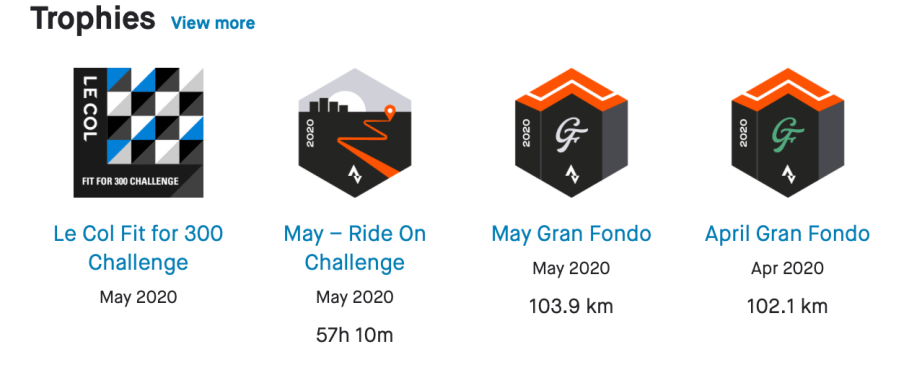
I started cycling five months ago. The distance covered each week has slowly increased. Last week it passed 200 km for the first time. The one long ride each week has also increased. The longest so far is 80 km. A kilogram a month melted without conscious dietary modification over the first three months. I have now been on a low carb high fat diet for two months and a further six kilograms have departed.

Is my diet in the death zone?

It doesn’t feel like it. My trousers are walking around looking for a decent bum to fill them, my belt is distraught at the loss of the companion that for so long bore its imprint  but I feel good. Per ardua ad astra. Carpe diem. Et cetera.

The greatest challenge is ahead.