August …

The odd Wood Duck is wandering around the Victorian Goldfields with a trail of little Wood Ducks in tow. Little Ravens are gathering nesting material. The nice days of late winter really are nice. Spring has served notice of its intentions.

The winter visitors are leaving. Over in Newstead 45km away Geoff Park  reports the departure of the Flame Robins. They are heading for the hills now. It was a good year for them over there. We have had none overwinter on the McGee country estate this year and few in the neighbourhood but I did run into a flock on the move through Paddys Ranges State Park the other day.

Other birds are also on the move. It’s a good time to turn up species that are just passing through. They all add to the fun. Cuckoos will soon be here. The bad days are still wintry, however, and the last couple have let us know that it’s too soon to plant anything that is not frost hardy.

The other day I was surprised to find a solitary Barcoo Bantam rushing past as I worked (no, slaved) in the garden. It was a first for the property list. Their correct name is Black-tailed Native Hen. They are denizens of lignum swamps and have a knack of turning up out of the blue after rain even in places that have been dry for years. One on its own is unusual so I have no idea why it was passing through. Other parts of Australia though are in serious drought so it may not be the only refugee we see. Another influx of Budgerigars would be nice.
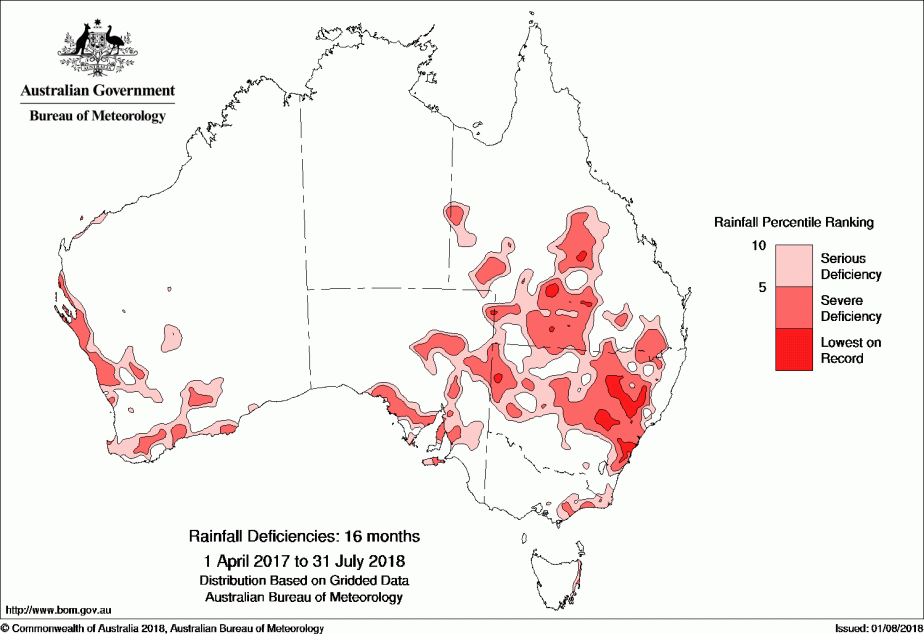
And bear in mind that most of the western half of the continent is desert anyway.

Our dryish part of Victoria is in better shape. The estate is pretty much on the average for winter rain, our tanks are full (we can shower and wash our clothes, drink water in stead of wine) and the paddocks are green. If it keeps up there will be a good crop of hay. The view westwards yesterday tells the story …

Was it about to rain? Indeed it was, but only briefly.

In a couple of weeks time I will be driving through the heart of the drought. I’m sure the photos I take there will be in stark contrast to this one.


Endangered …

Sadly a Polar Bear was shot dead on Svalbard last week.

photo AP

The German Hapag Lloyd Cruises company, which operates the MS Bremen, told The Associated Press that two polar bear guards from their ship went on the island and one of them “was attacked by a polar bear and injured on his head”. The polar bear was then shot dead “in an act of self-defence” by the second guard, spokeswoman Negar Etminan said.

The injured man was evacuated to Longyearbyen where he was treated for non-life threatening injuries.

Big Picture …

Another silo beautified, this one in a more urban setting. It is the old cement works overlooking Fyansford on the outskirts of Geelong, Victoria. The artist is Rone who has done great things in New York and London and has come home to Geelong for this project. The subjects are local folk. From left to right we have Corinna Eccles, a Wadawurrung elder, Cor Horsten who worked at the site for 35 years and Kelly Cartwright, an athlete who won gold in the long jump and silver in the 100 metres at the London Paralympics in 2012.

bobmcgee.live

Windy today …

Here is the wattle emblem of our land

you can stick it in a bottle

or hold it in your hand.           Bruce (Monty Python).

The driveway on the country estate was lined with wattle trees which gave a splendid display of yellow as winter faded. They are short lived trees and the seasonally gaudy phase of their existence came to an end ten years or so ago.

I replanted with Red Ironbark which are coming along nicely. The wattles were allowed to stand proud but leafless, nice perches and productive of insects. My feathered friends have appreciated them.

It was windy today …

We had a visitor at the time. They discovered the wreckage blocking the drive as they tried to leave.

Soon fixed.

HO7 the Curlew …

I met this individual on my recent travels.

He or she is a Eurasian Curlew, Numenius arquata, and I encountered it in the Odiel Marshes, Huelva, Spain just across the river from where Christopher Columbus set off on his first voyage to the new world.

I say individual for a reason. One Curlew looks a lot like another, if you’re interested in life span or movements of birds from a particular area you need to mark individuals. The common method to do this in the past was with a metal ring. This guy (in the non-gendered sense) has one on the left leg. To read it though one has to catch the bird. The advent of coloured flags has meant that anyone with binoculars or a camera can identify the bird easily in the field.

In recent years a Eurasian Curlew was seen on Eighty Mile Beach in Western Australia. The Australian Wader Study Group are active there, in fact I have banded birds with them there myself. Ever the optimist I entertained the hope that this one might be it.

I reported my sighting through the International Wader Study Group (sightings@waderstudygroup.org) and in the fullness of time received the information that this particular Curlew was banded as a first year bird at Poscien, Mazowieckie, Poland 10 months earlier. It was reported 50 days after banding in Irun on Spain’s north coast where it stayed for at least a month. It was first reported in Huelva on the south coast six months prior to my seeing it. In all seven sightings had been submitted. This is a much more efficient means of following a bird than relying on recapture.

So far in its short life it had flown at least 2,800 km. May it fly many more.

Point Danger …

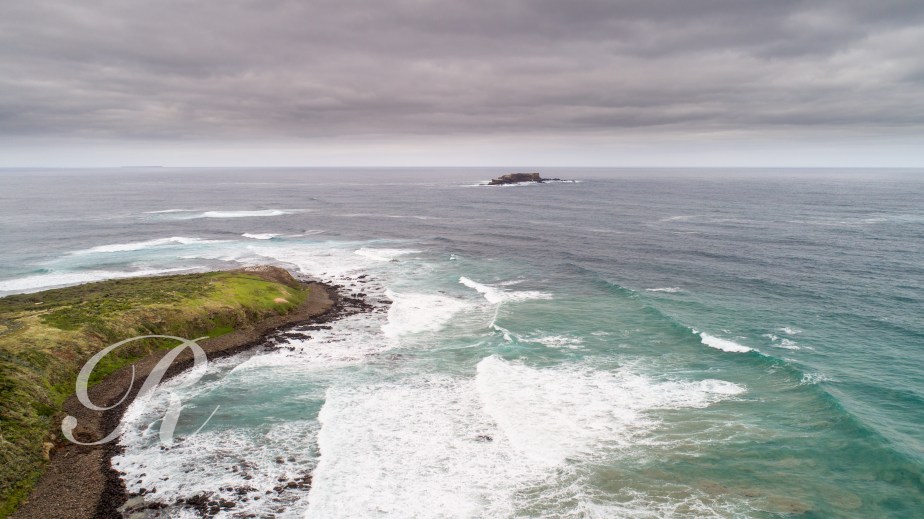
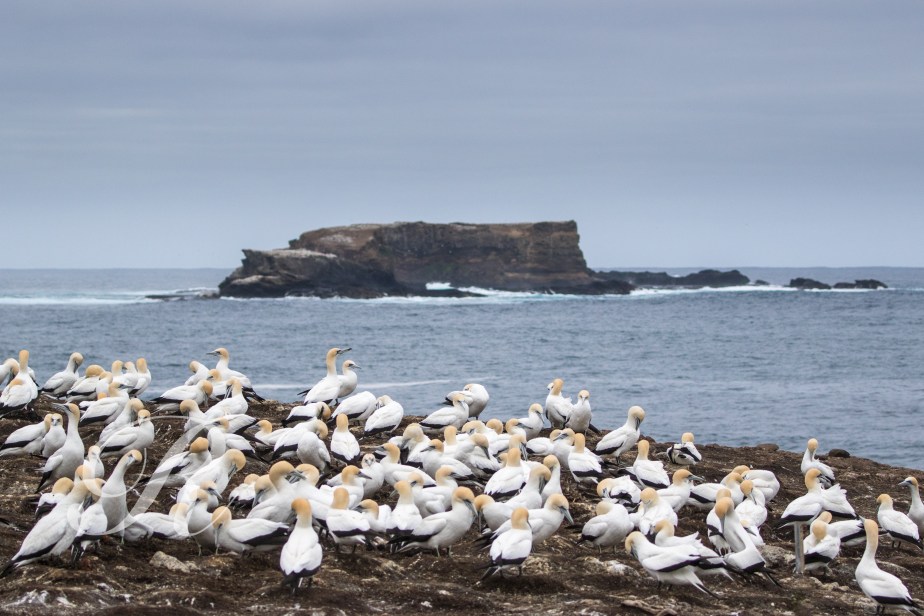
Not far from Portland, Victoria, there is a major nesting colony of Australasian Gannets safely out of reach of foxes on Lawrence Rocks.

Point Danger and Lawrence Rocks

Whilst the rock is safe from terrestrial predators real estate is at a premium. In 1996 some adventurous Gannets gave it a go on Point Danger. It wasn’t a great success but humanity stepped in, fenced the area and there is now quite a colony, the only colony on the mainland.  It depends for its success on a tall outer and an electric inner fence. Maremma dogs were trialled as guards but were not a great success.

At the weekend I was lucky enough to be invited into the enclosure.

Australasian Gannet colony

You can get a good telescope view of the colony from a viewing platform about 125 metres from the birds and you can get a little closer by following the perimeter fence around to the left. But if you are lucky enough to be granted access you can get to about 25 metres away.

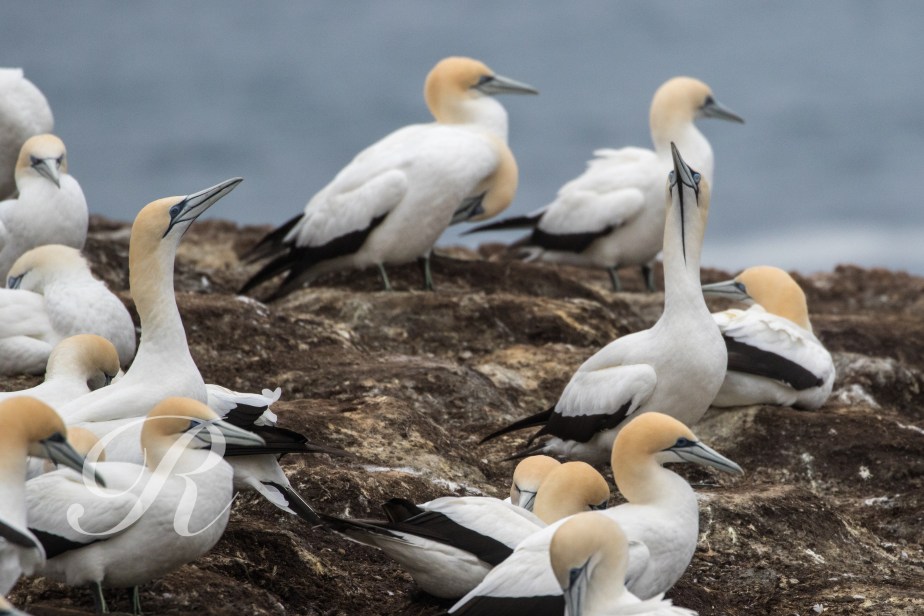
Australasian Gannet

As you can see from the photos it was a great opportunity. And this isn’t the breeding season. That runs from October to February corresponding with the Bonney Upwelling when ocean currents bring nutrients that trigger a boom in the food chain from the bottom up, a good time to be feeding youngsters.

When you get close to a Gannet colony part of the fun is spotting the one that doesn’t belong. When I visited the Lambert’s Bay colony of Cape Gannets the big news was one Australasian Gannet among thousands of the locals. Likewise at Point Danger the visit was all the sweeter for finding a Cape Gannet in the crowd …

Cape Gannet among the Aussies

The Cape Gannet is the one on the right showing off its long gular stripe. On the Australasian Gannet the stripe is much shorter. You can just make it out on the guy on the left also pointing his bill up.

There are some other differences that help distinguish the Cape, it has an all black tail whereas the Aussie has a black centre and white outer tail feathers. Their call is also harsher. There is no substitute for getting up close.

It must have been me …

As I said earlier there was something missing from the trip but before I go there let’s recap …

Polar Bear, Ursus maritimus, and glacier
Polar Bear, mother and cub
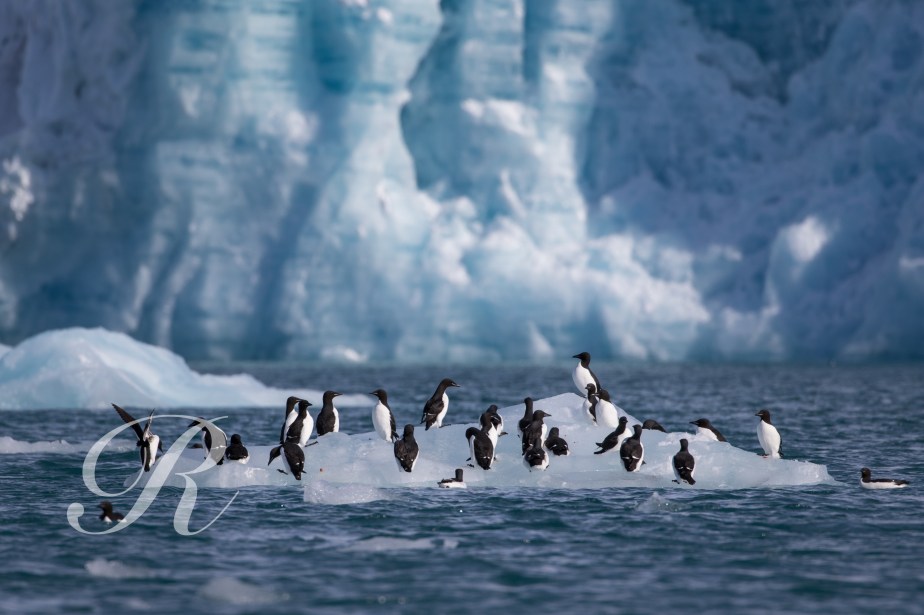
Brünnich’s Guillemot
Walrus

The weather and the sea were pretty kind to us. One night the sea did redistribute our possessions around our cabins but mainly because we had been lulled into complacency. It had been so calm that we had stopped securing things for the night.

The Norwegians have a saying

ikke dårlig klær, bare dårlig vær
which rhymes very nicely in the original and translates as “There is no such thing as bad weather, just bad clothing”. For our Zodiac trips we wore one piece flotation suits provided by the ship that definitely kept the weather out.

But I digress. Something, I hope, was missing.

It is axiomatic that …

  1. There is an arsehole in every group that you travel with
  2. The individual in question is absolutely oblivious to the fact that it’s them

so it follows that … If you can’t work out who it is … It’s you.

So was it me or were we uniquely blessed? My companions had all made a significant contribution to conservation but it seemed to me that none were fanatical. There was no maniacal twitcher, no demoniacally possessed wildlife photographer. Everyone was engaged, intelligent and possessed of a sense of humour. No one wimped out because it was cold, and at times it was very cold. No one wanted to leave a polar bear because it was tea time. It was a great group to share a great experience with.

So my thanks to you all. I hope our paths cross again.

I have added a new album to the gallery. When you have a moment I’d be thrilled if you took a look. Click on the button over to the right where it says Gallery or if you are reading this as email click <HERE>!


Fluke …

It was the last day of our voyage. We were heading back to Longyearbyen. It had been a very successful expedition. Two very sharp-eyed local guides had found us eight different individual Polar Bears and we’d had the opportunity to spend many hours in their company. We had seen Walruses by the dozen and had close encounters with other seals. We visited bird cliffs and watched Reindeer and Foxes. Pete Oxford Expeditions had delivered everything on the packet and more.

Pete has a childlike engagement with the natural world. He is enthusiastic, energetic but I would not have chosen the word excitable until this happened on our port side. He yelled “There she blows”, so loudly it was a wonder the whales were not frightened away.

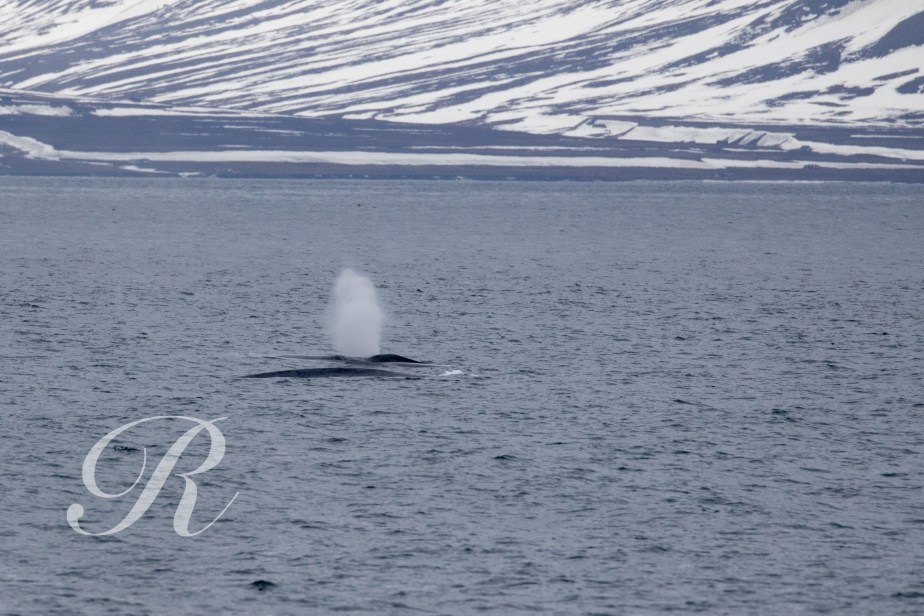
Blue Whale, mother and youngster. We had learnt by marine radio that there had been sightings and now we were lucky enough to find them near us. Early in the trip we had seen some Belugas at a distance but they had paid us no mind. This duo seemed to enjoy our company and swam along side us for a while.

One Captain Pool made a voyage to Svalbard in 1612 and reported that the sea was so full of whales that it was almost necessary for the ship to break its way through. Whaling commenced in earnest soon after. Initially it was shore based. As numbers declined it was necessary to take to the high seas and it was relentless …

“So little by little they wipe out the whale until they are all gone – and the winter take back its undisturbed control of the land” (Nansen 1920).

Norway continues to hunt whales but it restricts the numbers and takes only Minke Whales which are not endangered. Blue Whales are increasing in numbers but there is a long way to go before ships will have trouble finding a way through the crowd.

Eventually they tire of us and make a deep dive …

I am left with tears in my eyes.