Run …

OLYMPUS DIGITAL CAMERA

We were moving slowly and quietly along the bank of a dry river. In the river bed there was a gathering of elephants of all ages. They were drinking from small pools that had been scraped in the fine gravel or waiting their turn. We made a fairly close approach to one group. Elephants have poor eyesight but good hearing and smell. As Leon Varley puts it in his webpage

To approach a single elephant on foot is worth a hundred sightings of elephant from the back of a vehicle. When you’re afoot everything is of significance. Wind direction, terrain, vegetation, how the animal is behaving. To walk in Africa is to be part of Africa.

The group in the river bed was on our right the wind was from the right. The bank was lightly wooded with Mopane just like the photograph above. It limits visibility but one can walk through it fairly easily. Off to our left a male elephant caught our scent, trumpeted and charged. It came through the Mopane scattering the bushes. Four puny humans turned and ran. Because of our starting position the two tourists were bringing up the rear. Obeid, the tracker, was magnificent. After a few steps he stopped and stood his ground with his hand gun raised. “Run” he urged as we passed him. Leon led the way.

In the gravel of the river bed progress was slow, I was thinking that four large flat feet would find it rather easier than my two size nines. Then behind us Obeid burst into gales of laughter and called us to stop. He beckoned us back. I could think of a number of better directions to take but Leon was keen to see what the story was. Obeid was excited, his usually good English was unable to keep pace with the retelling. So in a mixture of English, Ndebele and charades we were treated to the story of the elephant that charged, snapped the small Mopane like match sticks but finally hit a tree that withstood the onslaught. Only just, it was now standing at a crazy angle with the bark missing from a large area on one side. The force had caused the elephant to lose its footing and stumble. When it picked itself up it decided it didn’t need to charge any more. Obeid’s grandchildren will hear this tale and thanks to him so will mine.

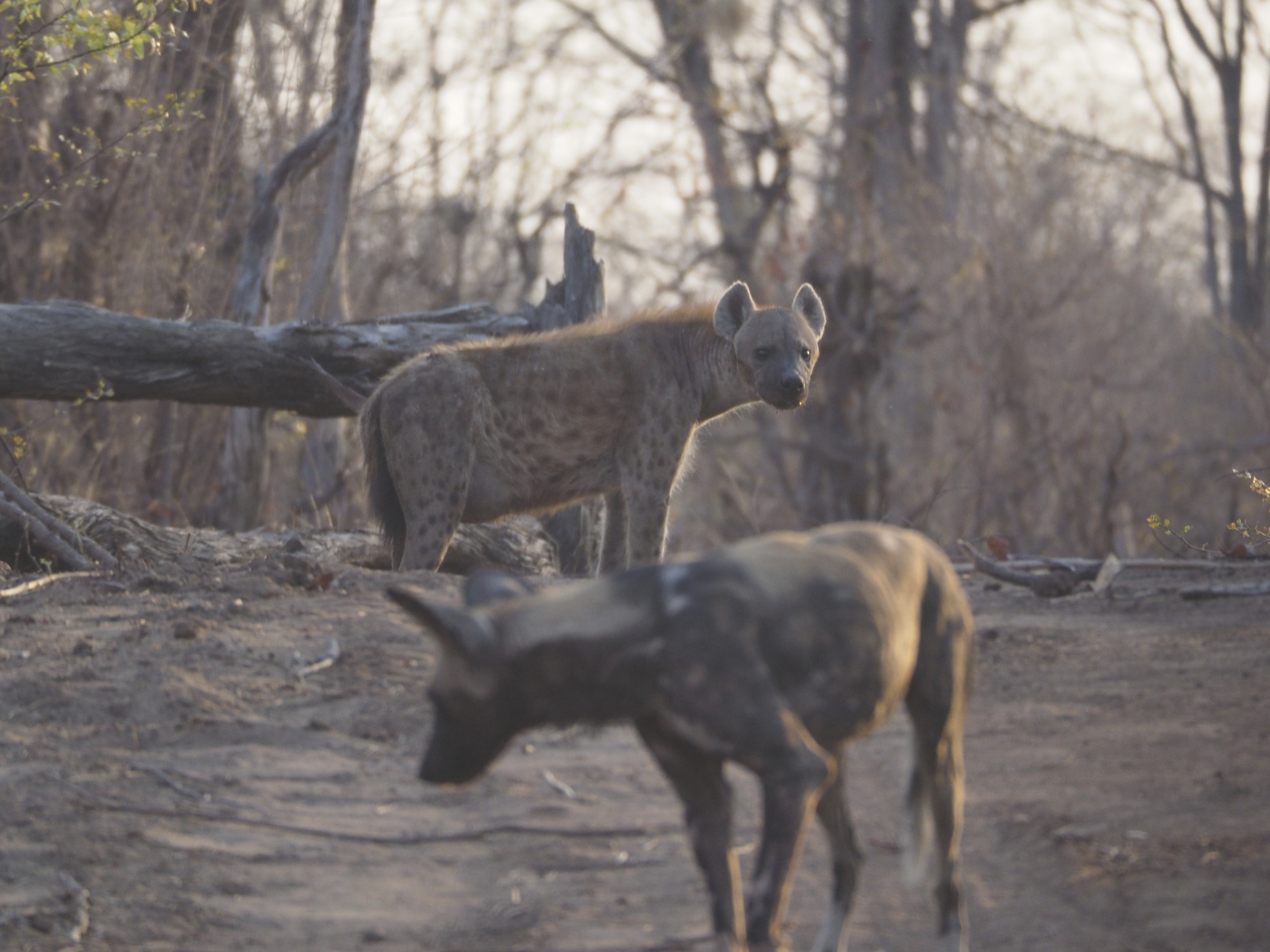
It was a big day for wildlife. We had already seen Spotted Hyena and Wild Dog and later in the day we would encounter a pride of Lions.
OLYMPUS DIGITAL CAMERA

It was late morning and getting very hot. The lions were asleep in long grass. We were blissfully unaware of each others presence. We were moving almost silently. Obeid pointed out some tracks, Leon said “Lion”. Twenty metres away five lions got the shock of their lives and scattered in random directions. For a moment two were heading straight for us but realised their error immediately. And they were gone. All over before the scene could be processed, no chance for a photo.

Don’t run …

There is something very special about Africa, the cradle of mankind, the hint of danger, the landscape, large fierce animals. Life is so real … and so fragile.

My companion on this occasion is Mark*, a professional biologist whose work in Australia mainly concerns wildlife monitoring. He is a joy to travel with, he is fascinated by everything, whinges about nothing and can shed light into every corner of the natural world.

First step was Hwange National Park in Zimbabwe and a Leon Varley Walking Safari.

OLYMPUS DIGITAL CAMERA

The accommodation was a base camp on the edge of a cliff. Leon picked us up in Victoria Falls and was keen to get the three hour drive done before dark so that we could appreciate the importance of not wandering over the cliff. We would not have been the first to do so.

The following morning we went for our first stroll. Leon gave the safety briefing …

All the big five are here and they can all do you serious harm or kill you.

Don’t run unless I tell you to run, especially with Lion. Your instinct is to run, theirs is to chase. I’ve had to shoot three lions in the last 24 years, twice it was because someone ran. I’m not going to do it again, run and I’ll let nature take its course.

If I do tell you to run, keep me between you and the animal and stay on your feet. Follow direction.

Most charges are mock charges, except for buffalo. If a buffalo charges it’s coming all the way …

If we come across poachers get down on the ground and stay there until I sort something out.

Obeid, the tracker leads the way. He is armed with a hand gun. Leon follows with a bolt action rifle across his shoulders, it has a cartridge in the breech and two more in the magazine. Then comes Mark, I’m in the rear. There is an old saying about not needing to outrun the lion, just your nearest companion. I look around and for the first time in my life come to the conclusion that I’m the slowest in the group.

The route took us through Mopane woodland to a lake which we then skirted to where we were picked up and taken to camp for lunch. It was the very end of the dry season, if the country had a tongue it would have been hanging out. The Mopane can grow into a fairly substantial tree putting the leaves out of reach for all but giraffe. The elephants seem determined not to let that happen. Large areas of Mopane were broken off or of no great age, bringing the browse line down to a level that smaller animals can reach.

The bushes in the foreground are Mopane just coming into leaf.

OLYMPUS DIGITAL CAMERA

A large herd of Cape Buffalo are also heading to the lake. They are quite strung out, the females and young make the pace and get the best of the feed. The males bring up the rear, over time the poorer feed causes them to lose condition and drop off the back. The front of the herd is well ahead of us, we can’t beat it to the lake. Nor can we pass through it. Since we need to get from the right flank to the left we must pass behind it. Cautiously, because that’s where those grumpy old men are. Of the large animals only hippos kill more people than buffalo, elephant follow in third place. You can’t entirely forget about the carnivores but do show respect for the vegetarians.

Along the way Leon pauses to give us the good oil on the life and death of elephants …

OLYMPUS DIGITAL CAMERA

At the lake it’s all happening, as well as the buffalo there are elephants, impala, chacma baboon, warthog, impala, crocodiles, hippos and four people on foot. Welcome to the real Africa, stay alert, think about where the wind is taking news of your presence, watch how the animals are reacting and have a nice day.

We had walked about 12 km for the morning by the end of which it was becoming very hot. Lunch was basic but good. At 3pm we headed off again for a further 8km or so. This was the pattern for the next few days. The dining tent was pitched at the cliff edge, from its shade we could watch a water hole that the local wildlife had scraped in the bed of the dry creek below, not a moment of daylight need be wasted.

OLYMPUS DIGITAL CAMERA


* Name changed to preserve his privacy.

The journey …

The final destination is a hole in the ground … so enjoy the journey for itself.

OLYMPUS DIGITAL CAMERA

I am off to darkest Africa, that magical continent where humanity first gazed on the rising sun. On my return I invite you to read all about it. Until then …

The Road goes ever on and on
Down from the door where it began.
Now far ahead the Road has gone,
And I must follow, if I can,
Pursuing it with eager feet,
Until it joins some larger way
Where many paths and errands meet.
And whither then? I cannot say.

Clown …

The Guardian reports …

French police are on high alert after fake clowns caused panic across France in a spreading phenomenon that has led to violence and a response by vigilantes.

Fake clown? You mean the real ones aren’t wearing makeup.

Maybe it’s different for cheese eating surrender clowns.

Spinning faster than windmills …

Filched from Steven Hayward, Power Line

International climate talks are a sideshow designed to keep politicians and bureaucrats busy, and the shallow, superficial climate campaign happy and engaged.

Climate-Talks-cartoon-Morten-Morland

News out of Europe yesterday is that the EU has adopted an ambitious greenhouse gas emission reduction target, calling for a 40 percent reduction in GHG emissions by the year 2030. But the announcement was larded with lots of talk of “flexibility” and contains so many contradictory elements that it is clear this is not serious. My favorite condition is this one:

A 27% renewable energy target that is binding at an aggregate European level but voluntary for individual member states.

In practice what this means is: Let Germany do it. They’re dumb and rich enough to keep subsidizing this nonsense. And why not? Germany is sticking it to the rest of the Euro-zone economies with its de facto domination of the Euro currency, which is adverse to the economic interests of the poorer southern European nations. If I were a Greek, Portugese, or Spaniard, I’d want to stick more windmills up Germany’s arse too.

Such cynicism …

A hero’s welcome …

It is a dreadful thing to take a human life. It was this man’s duty to do so.

I think  you can see from the video he takes no pride in it. He now has to live with it.

If it were not for his actions any one of those applauding him might now be dead.

Defence of freedom and democracy is no easy matter.

A panicked populace …

So much soothing music.

Within the week I shall abandon my sheltered work station and make a foray into darkest Africa. If I make it back you will hear all about it in due course. Among the places I will be visiting is the Republic of Congo. You will remember that there are two Congos separated by the Congo River. I’m off to the smaller one to the north. The other one used to be Zaire and is now the Democratic Republic of Congo (DRC). In June 1976 a haemorrhagic fever broke out in Sudan, in August a second outbreak occurred in Zaire. The virus was later isolated and named Ebola after a river close to the site of the Zaire outbreak.

The 1976 event affected 602 people, 151 died in Sudan, 280 died in Zaire, a mortality rate of 72%.

Ebola revisited the DRC in 1995 (254 dead) and in 2003 it appeared in the Republic of Congo killing 128,a death rate of 90%. There were further cases in the DRC in 2012. There have been outbreaks in Uganda. Currently the largest outbreak of all is threatening the people of Guinea, Liberia and Sierra Leone. It has recently been contained in Nigeria.

These last countries are in west Africa, reassuringly for me, the capital of Liberia is  5,000 km by road from Brazzaville in the Republic of Congo (or a seven hour flight).

Viruses are essentially little packets of genetic material. They find their way into living cells, hijack the process of protein manufacture within the cell so that it churns out lots of copies of itself and usually packages them for export. They are obligate intracellular parasites. Therefore if they are not infecting humans full-time they need to be hiding in other organisms. The ebola viruses are a little group of closely related viruses, they contain RNA. They are lethal to primates so the reservoir is not likely to be in Gorillas or monkeys. Fruit bats and dogs are high on the list of suspects. Endothelial cells are their main target especially in the liver. These are the cells that line the inside of blood vessels.

Incubation occurs in 2 to 21 days. The first symptoms are like the flu. Fever is usually greater than 38.3 °C,  often followed by vomiting, diarrhea and abdominal pain. Shortness of breath and chest pain may occur next along with swelling, headache and confusion. In about half of cases the skin may develop a maculopapular rash (a flat red area covered with small bumps). Five or so days into the process vomiting and coughing up of blood as well as voiding blood in the feces may occur. For the majority death will follow within 16 days from the onset of symptoms. Those who survive start to show signs of recovery in the second week of the illness.

As recently as July this year Nature’s Declan Butler could tell us that Ebola does not pose a global threat.

… to become infected in the first place, a person’s mucous membranes, or an area of broken skin, must come into contact with the bodily fluids of an infected person, such as blood, urine, saliva, semen or stools, or materials contaminated with these fluids such as soiled clothing or bed linen. By contrast, respiratory pathogens such as those that cause the common cold or flu are coughed and sneezed into the air and can be contracted just by breathing or touching contaminated surfaces, such as door knobs. A pandemic flu virus can spread around the world in days or weeks and may be unstoppable whereas Ebola only causes sporadic localised outbreaks that can usually be stamped out.

Since then the disease has made it to the US and Spain and transmission has occurred in both places. Reassuring noises from the ill-prepared CDC have not prevented alarm or transmission. Indeed, given the number of affected healthcare workers in Africa and out of Africa, it seems to me that ebola has a greater capacity for spread than so far suspected.

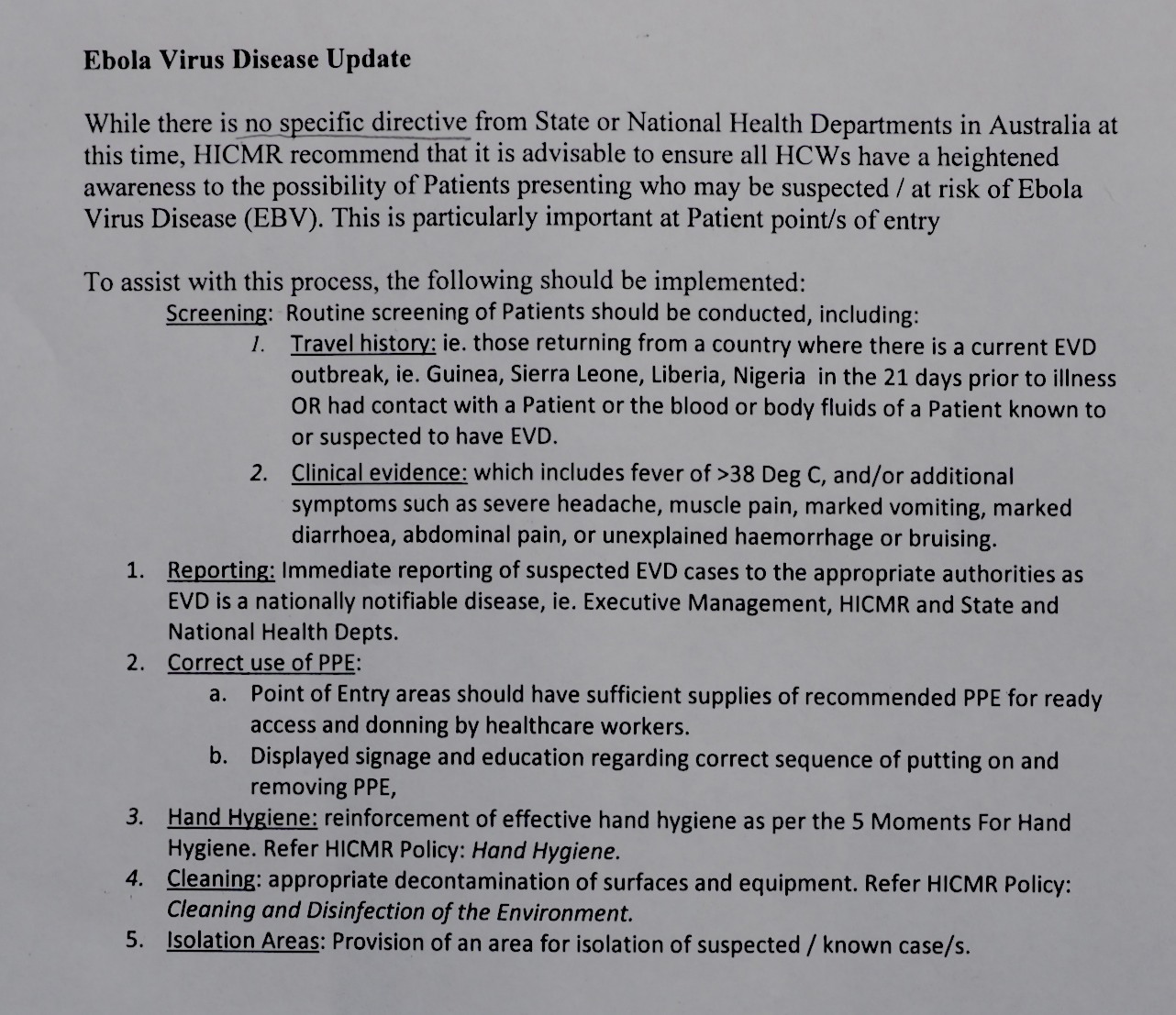
One of the hospitals I work at has begun to prepare itself (for my return?). It issued a memorandum a week ago.The Quality, Risk and Business Manager informed us …

OLYMPUS DIGITAL CAMERA

A week later a quick look around the point of entry was not reassuring. There is a crowded waiting area between the front door and the first staff member, there was no personal protection equipment to hand, nor illustrated signage on how to put it on or take it off. No area had been designated for isolation nor is there an area that could be accessed without passing close to waiting patients or other staff.

Visitors to Africa or Texas can take a few precautions …

  • Avoid contact with sick people and the recently dead
  • Don’t handle bushmeat
  • Wash your hands thoroughly and often
  • Don’t pat the dogs

… and don’t lose sight of the fact that Malaria will kill more than 600,000 people this year.

Spurred into action …

Up very early this morning to drive from Melbourne to the country mansion.

ABC News Radio accompanied me as far as the Great Divide. A little advert for itself assured me of the ABC’s complete lack of bias. I was so pleased to hear that because I was beginning to think that there might be a pronounced lean to the left in the ABC ranks.

The big news however was to do with Professor Barry Spurr of Sydney University. The ABC was most exercised because it seems the good professor called Nelson Mandela, Archbishop Desmond Tutu and Prime Minister Abbott dog fuckers. Can you believe that? Dog fuckers. Utterly beyond belief …

Hang on I stand corrected, Professor Spurr called Tutu a witch doctor, close I guess, Mandela a darky, tactless but accurate, Abbott an abo-lover, terribly rude. And it was in fact the ABC itself that called some middle-aged white guy a dog fucker. Terrible this name calling.