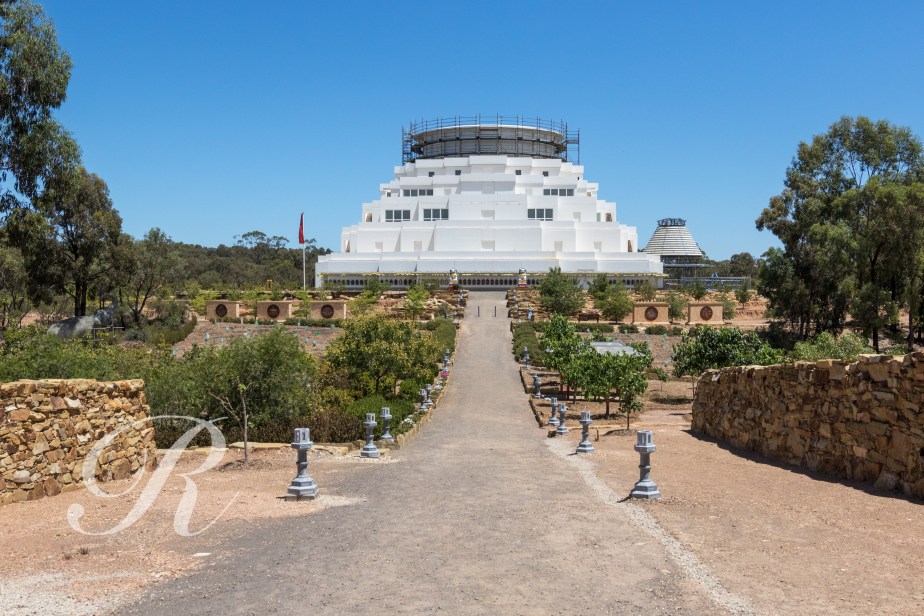
It’s about a 20 minute drive from the bats of Bendigo to the Great Stupa of Universal Compassion. When it’s completed it will be the largest stupa outside of Asia and will provide a place of pilgrimage and comfort to Buddhists of all traditions. I’ve been dropping by to watch its development over the last few years.
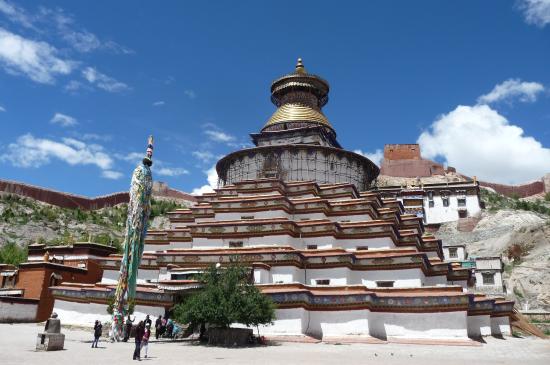
It is the same design and size as the Gyantse Stupa (Kumbum) in Tibet, 50 metres square at its base and nearly 50 metres high.
the original (filched from TripAdvisor)
The Dalai Lama visited and blessed the stupa in 2007.
The stupa is home to many gorgeous objects but perhaps the best of all is a statue of the Buddha carved from a single 18 tonne boulder of jade.
The boulder originated in Canada, the carving was undertaken in Thailand. It was completed in 2008 and then went on a world tour visiting 125 cities across 20 countries where nearly 12 million people have seen it. Many have waited for hours in queues sometimes several kilometres long. It came home last May and now has pride of place inside the stupa.
This is how it is today …
The Great Stupa of Universal Compassion
I was fortunate enough to be given permission to put the drone up.
The assemblies on the ground to the right of the building will be going on top. If you compare it with the Gyantse Stupa you can see that another square story has to be added first.
The plan is for a pair of cranes to lift the top into place sometime in August. I hope to be there.
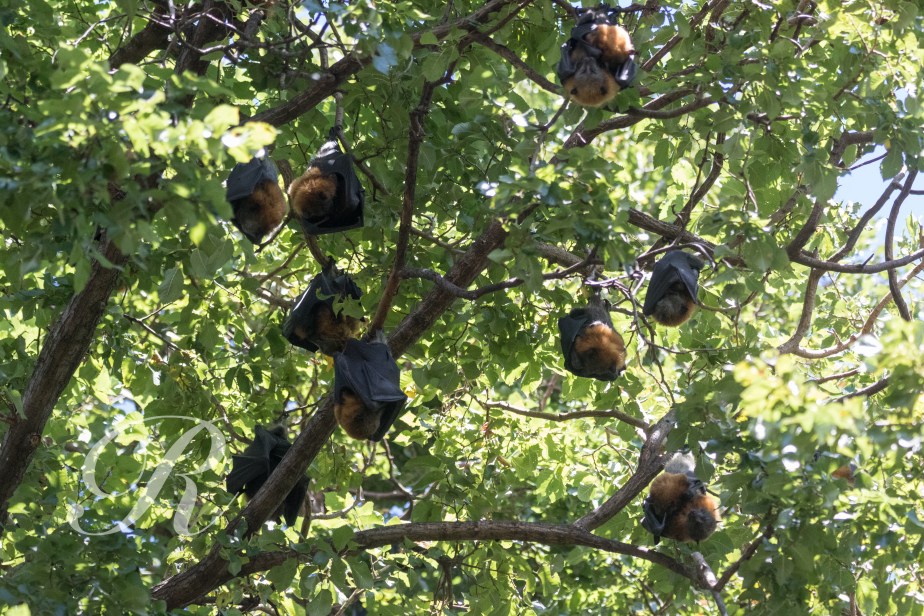
Bendigo was a boom town in the gold rush days developing rapidly and rather splendidly after 1850. It is the fourth largest town in Victoria with a population of more than 95,000 people. Last time I was there I arrived late in the afternoon with the intention of some night-time photography (see The Bright Lights of Bendigo). As I scouted around I was surprised to find a colony of Grey-headed Flying Foxes in Rosalind Park in the city centre. I made a mental note to return and get some photographs.
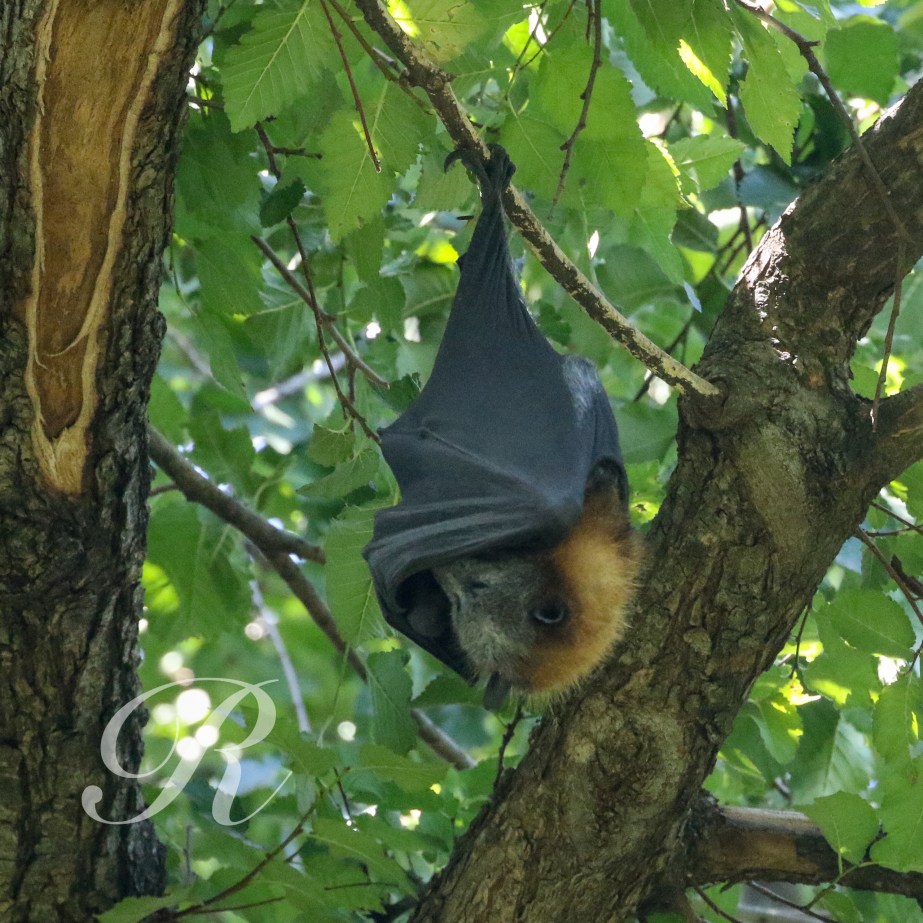
Grey-headed Flying Fox
Bats are the only mammals capable of sustained flight. They are a very successful group with more than 12,000 species forming the order Chiroptera (from the Greek χείρ – cheir, hand and πτερόν – pteron, wing). They are the second largest order (behind the Rodentia).
They can be divided into two groups. The microbats are typically insectivorous and use echolocation. They have a near universal distribution being found on all continents except Antarctica. Flying Foxes and their allies are large and restricted to the warm parts of the world. They don’t use echolocation. Their diet consists of succulent fruit, nectar and pollen. The fruit is crushed in the mouth, the juice swallowed and the pulp rejected.
The taxonomy has, of course, been much disputed. That Flying Foxes and microbats have different origins and developed flight independently was once a popular theory. The evidence now seems to support evolution from a single ancestral population that had taken to the air in pursuit of insects.
Flight has the great advantage of mobility at the expense of high energy requirements. Bats solved the problem of flight differently than birds making them even more maneuverable in the air and far less capable on the ground.The wing has a leading edge from the shoulder to the hand and then extends as a membrane that extends to the hind leg and may include the tail. The hind leg has also assumed the duty of hanging the animal from a perch.
Because their hindleg is somewhat tethered bats as a rule cannot take of from the ground (Vampires and the New Zealand Short-tailed Bat may be the exception). However they climb quite nimbly, head first, and once a few feet off the ground can take off losing a little height initially.
Australia has four species of Flying Fox and four more close allies. They are restricted to the northern and eastern forests. The Grey-headed Flying Fox Pteropus poliocephalus is the largest of them (typically 600 – 800 grams but a few as much as a kilogram) and the only one to form permanent colonies in Victoria.
They choose humid shady places for their communal daytime roost and fly out as much as 50km at night to feed. Presumably they have been summer visitors to Victoria for centuries. Europeans have planted ornamental figs and orchards of fruit trees that have induced them to stay. From 1986 there has been a permanent colony in the Botanical Gardens in Melbourne and since then a few colonies have formed at other sites. The Bendigo colony began in 2010 where there are about 2000 bats in summer with about 200 staying over winter.
My sojourn at the seaside basking in the cool weather was over. Back at the farm it had continued hot. The list of visitors to the water point continued to grow in my absence.
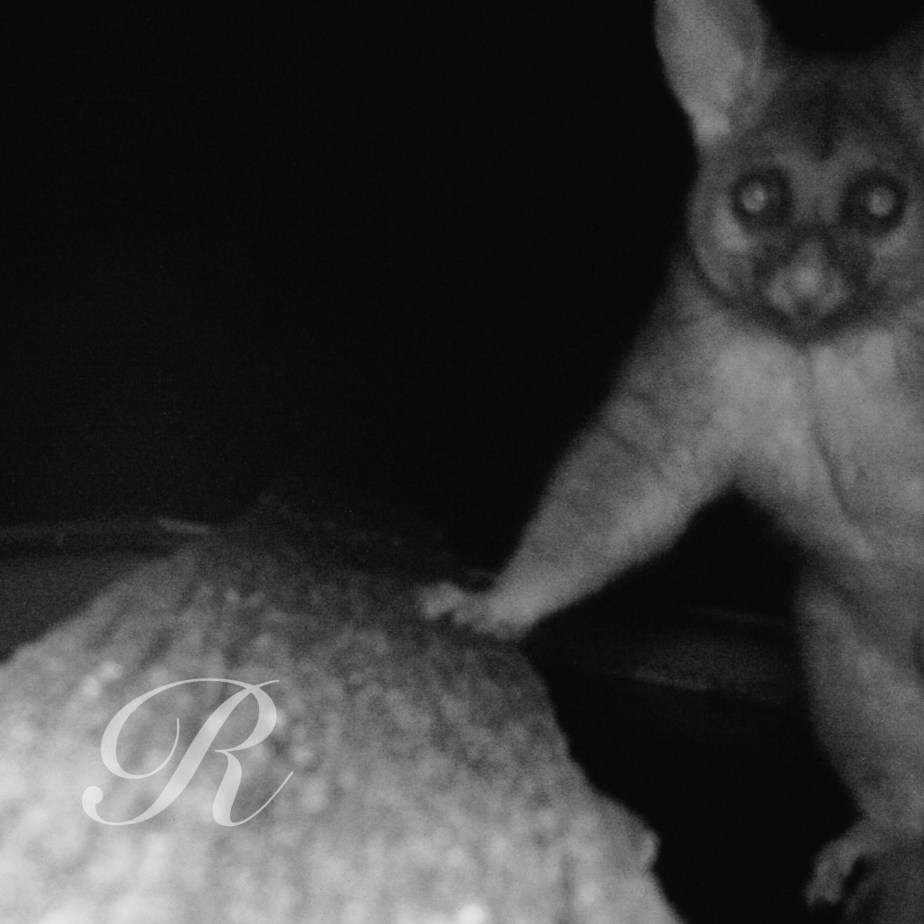
We once had a Brushtail Possum come down the chimney. We could hear it stuck in the flue and summoned the chimney sweep to push it down into the wood stove which I hasten to add was not alight. My reward for rescuing it was a bite on the finger.
They’re not all bad news though. At least they save me from eating any of the fruit we grow. And fortunately they don’t eat the grapes. It’s the birds do that.
The strip of coast running from Melbourne west along Victoria’s coast is both splendid and accessible. I am particularly fond of Port Fairy at the western end but lets not get parochial. Anglesea and Aireys Inlet also have their assets a major one being Margaret Lacey. She has recently produced a very beautiful book on the birds her of patch. The photography is superb.
The region has a variety of habitats and Margaret gives the reader very useful information on where to find them all. You should buy the book! It’s well worth the $55. You can get it <HERE>. Mention this page and the postage will be free. Actually the postage is free.
Anyway, while I was there I ran around trying to emulate her …
Singing Honeyeater
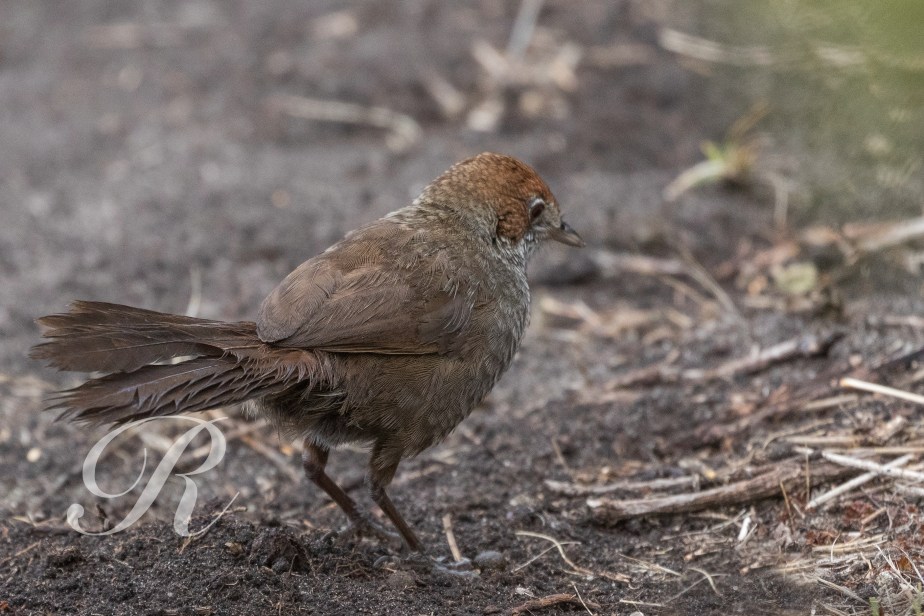
Birds with limited distribution are always very special. The Rufous Bristlebird is only found along a coastal strip from Torquay west to the mouth of the River Murray in South Australia (except around Port Fairy!) It is a denizen of coastal heath and dense stands of Coast Wattle. It’s a skulker and can be very elusive. I have seen it in varying places but the success rate at Aireys Inlet is exceptional. Look for it on the footpaths to the west of the lighthouse early or late in the day.
It runs from Torquay to Allansford a distance of 247km. It is splendid from Anglesea to Cape Otway and spectacular from there to Peterborough. Driving it east to west allows it to come to an appropriate crescendo like a well written piece of classical music. You could drive it in a day … but don’t.
The Great Ocean Road
Construction began in September 1919 and was carried out by servicemen returned from the First World War. It was open as far as Lorne by 1922 as a toll road – two shillings and sixpence for a car, 10 shillings for a wagon with more than four horses. Passengers paid one shilling and sixpence, many tried to avoid this by walking along the beach around the toll point.
Presently there is no toll payable but that may not last!
The full length of the road was opened in November 1932.
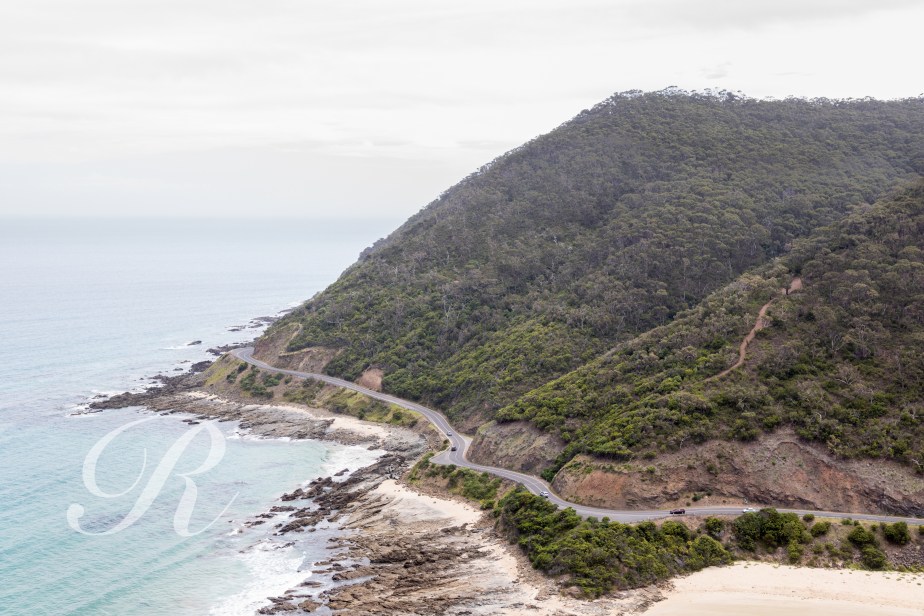
Great Ocean Road from Teddy’s Lookout, Lorne
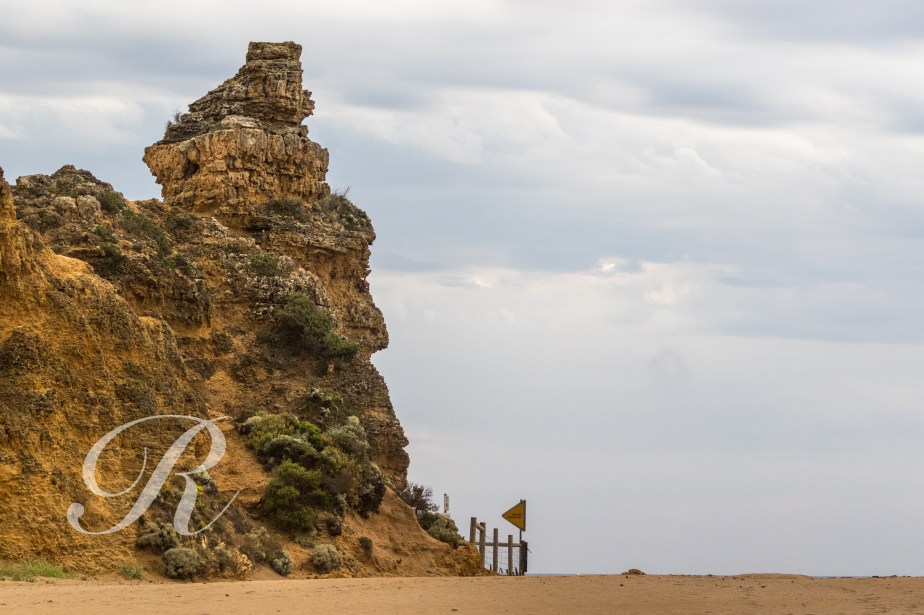
A pinnacle still attached to land …
at Aireys Inlet
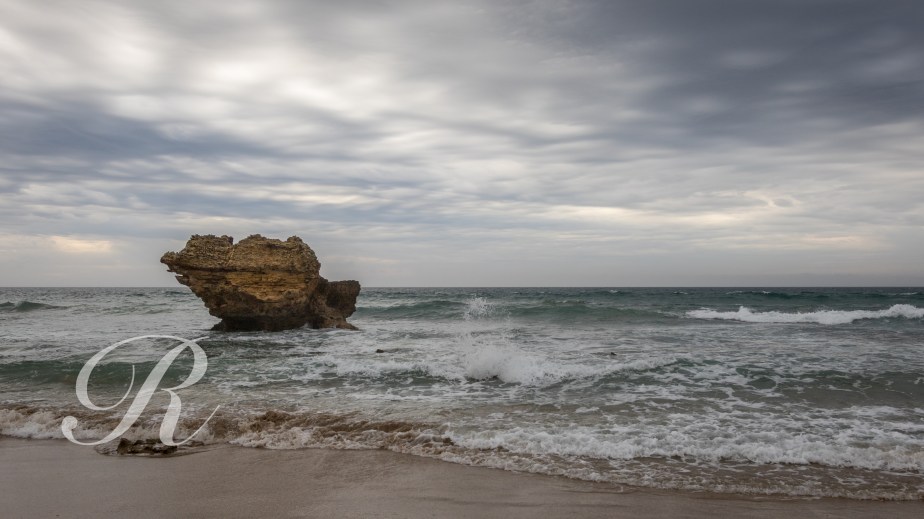
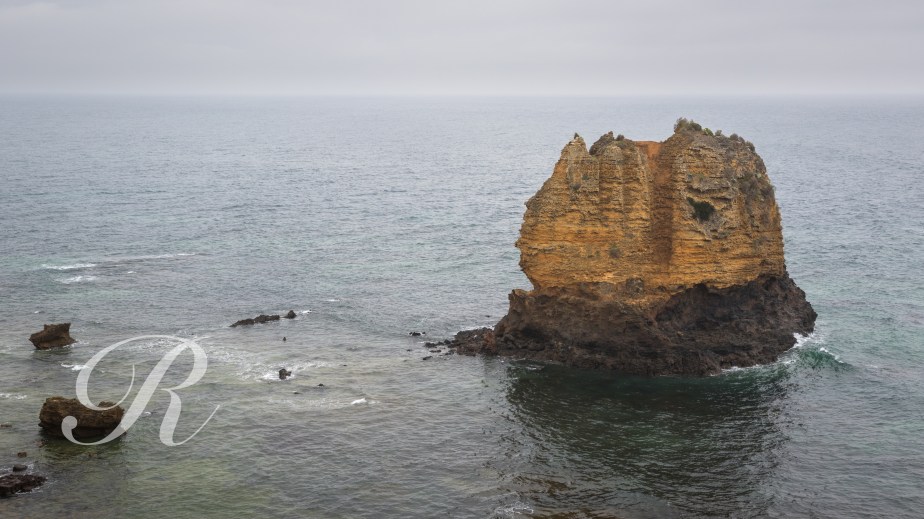
and a rock that isn’t …
Split Rock, Aireys Inlet
The coast as far as Cape Otway is called the Surf Coast beyond the cape it is called the shipwreck coast. Ship wrecks haven’t been as common since they switched from wind power to more reliable sources of energy.
My advice to the traveler is
remember to drive on the left side of the road
try to avoid the summer school holidays Christmas to early February
don’t rush, spend a few nights on the road
along the surf coast make sure to detour inland to visit the Otways forests and some of the waterfalls
take a detour to the light house at Cape Otway – always worth it but in winter there is the added possibility of a whale passing by
beyond the cape concentrate on the magnificent limestone stacks and cliffs at London Bridge, Loch Ard Gorge, Twelve Apostles, Bay of Martyrs
when it’s done treat yourself to a couple of nights in Port Fairy the nicest town anywhere on Victoria’s coast.
The hinterland of the Great Ocean Road is the Otway ranges. These are low mountains that formed in the rifting process that broke up Gondwana. The ranges were once clothed in forest and quite extensive remnants still exist in the Great Otway National Park.
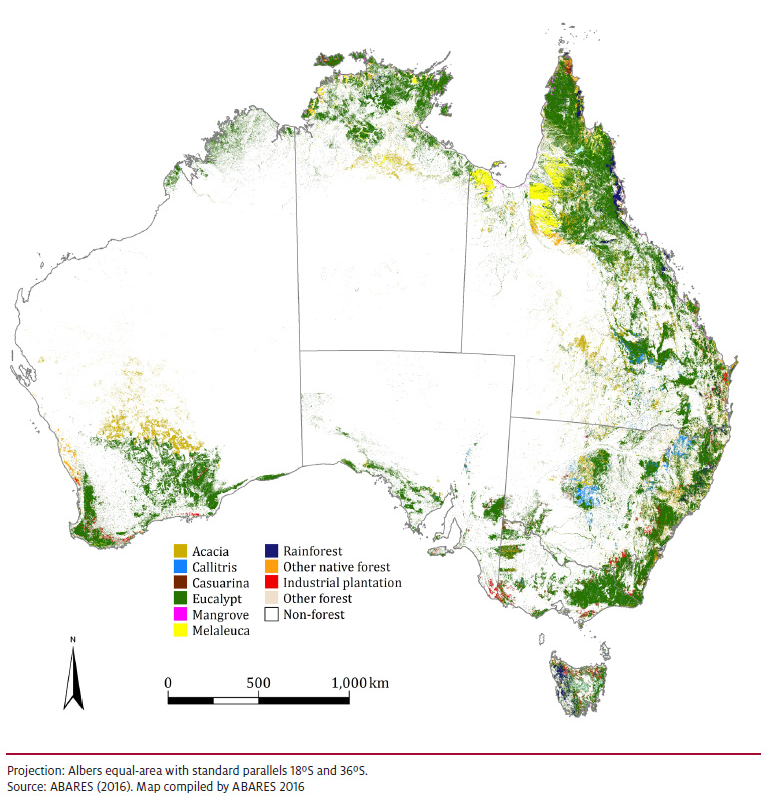
Forests have everything to do with rainfall. If we look at a map of Australian Forests we find them concentrated down the east coast, across the wetter tropics and in the south-west. A rainfall map or a population density map look broadly similar. The white patch ranges from semi-arid to desert and shows how dry a continent Australia is.
I borrowed the map from the Department of Agriculture and Water Resources. You should have a look <HERE> if you need further information. Perhaps because Australia has relatively little forest the definition used is particularly generous. If there are trees that shade a fifth of the ground it’s a forest. Real forest, tall trees with extensive canopies such as we find in the Otways constitutes only a fraction of what’s shown on the map.
Rainfall in the Otway Ranges from 700 to 1400mm (27 – 55ins). If you lived there you’d have to mow your lawn every week not just a few times in the spring like I do.
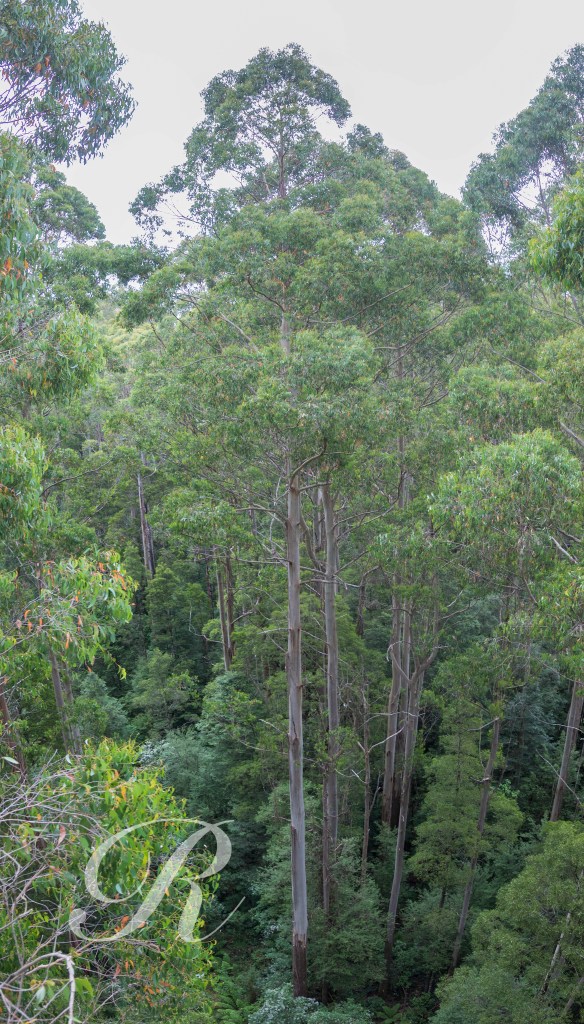
The forest types include wet sclerophyl characterised by the magnificent Mountain Ash Eucalyptus regnans and temperate rainforest characterised by Myrtle Beech Nothofagus cunninghamii. This is the furthest west that you will find rainforest in Australia. Throw in some ferns and the odd waterfall and you have a very pretty spot for a picnic … watch out for the leeches.
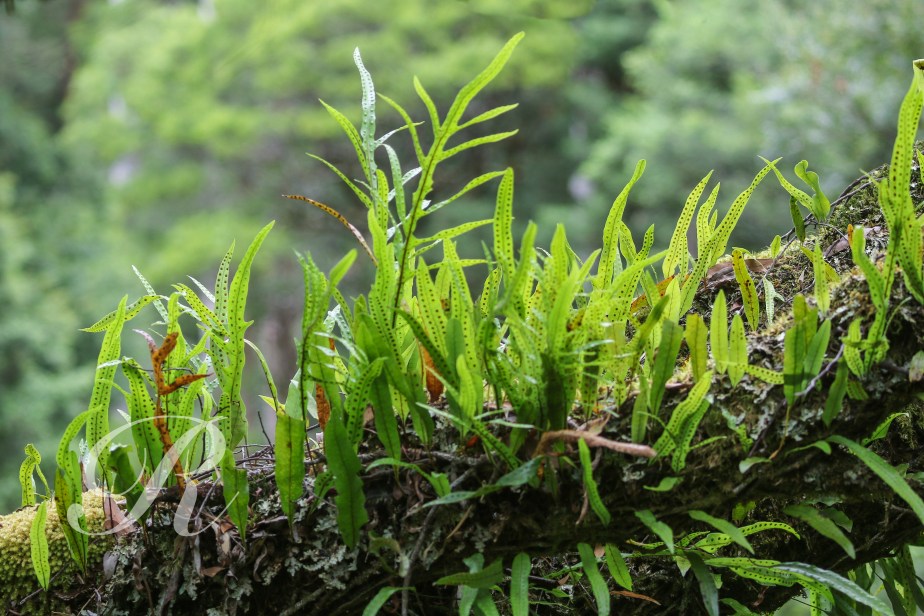
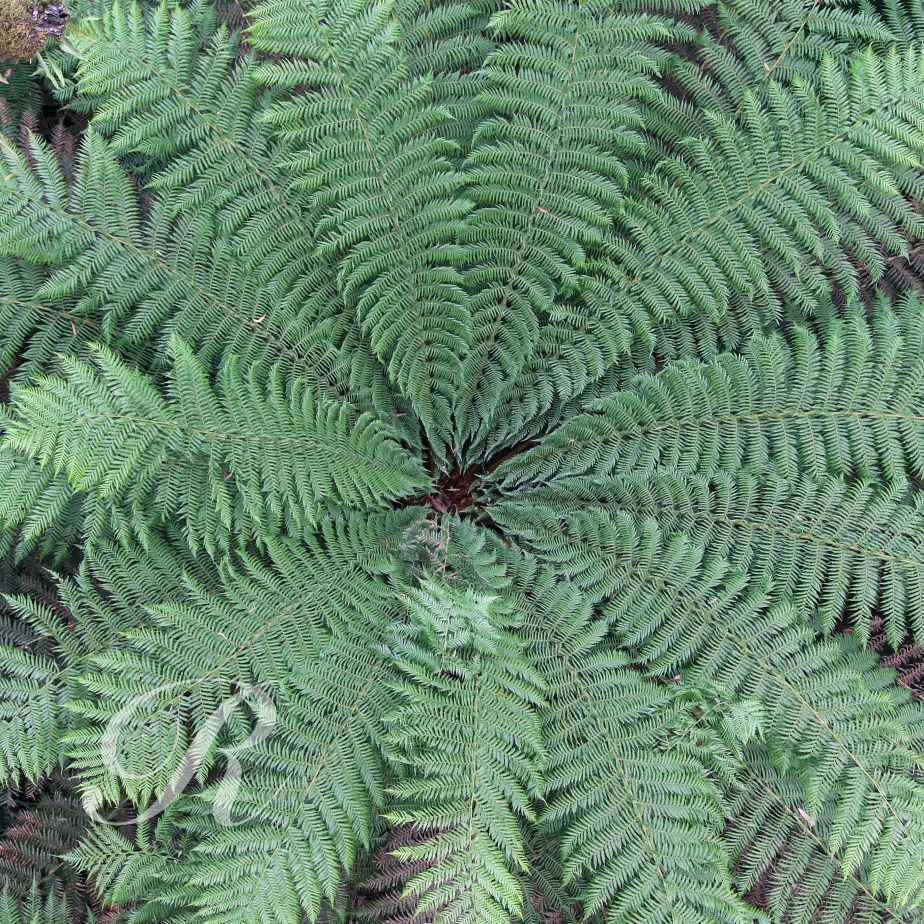
Eucalyptus regnans Mountain AshKangaroo Fern
Australian King Parrots and Crimson Rosellas may well join you at the picnic table while Gang Gang Cockatoos stay a little further back. The habitat is perfect for Lyrebirds and Pilotbirds but they won’t be joining you. They haven’t made it across the gap from the forests west of Melbourne. Nor has the Sooty Owl but this is the place to look for the elusive Grey Goshawk.
I have enjoyed a few days in Anglesea on Victoria’s coast. The sea imposes a moderating influence on the weather. It was a cool and pleasant interlude while at home it was hot. Adding to my personal sense of moderation was the pleasant company and generous hospitality of the very good friends I was staying with.
Anglesea is towards the eastern end of the Great Ocean Road. If you’re traveling east to west it’s where the journey starts to be interesting. The road is Victoria’s premier tourist attraction and although I have mixed feelings about it there is no doubt that it is both visually splendid and worth a fortune to the state’s economy.
It’s been in the news a bit lately because, woe be upon us, erosion. The media have been discussing the impending crisis in terms of climate change and sea level rise. Thousands of tourists travel thousands of miles to see the effects of thousands of years of erosion. Sea stacks, arches, steep cliffs are all the result of erosion. And we’ve just started making a fuss about … erosion.
The Great Ocean Road
Coasts can be classified in several ways one way is to divide them into coasts of submergence and coasts of emergence. There are nice examples of both in the map above. To the right is Port Phillip Bay. At the height of the last glaciation the Yarra River ran across a plain and discharged into the ocean at the heads. As the sea rose the plain was inundated providing Melbourne with a large bay to sail around looking at a coast of submergence. For most of its length the Great Ocean Road skirts a coast of emergence.
Emergent coasts are a result of local tectonic uplift of the land surface or a fall in the elevation of sea level because of a reduction in the water volume of ocean basins. Quite often, emergent coasts have rocky coastlines with cliffs and nearly flat platforms that extend inland where older coastal plains have been tectonically raised and are now elevated above the modern land and water interface.
Another way of classifying coasts is as erosional or depositional.
In places where there is an abundance of wave energy or ocean currents and/or a lack of sediment available for deposition, erosion of the coast will be the dominant mechanism of change. Quite often, erosional coasts are narrow and characterized by resilient rocky shorelines that are exposed to high energy waves and supply relatively little sediment to the adjacent shore.
Where deposition dominates the land is advancing, where erosion dominates the land is in retreat.
One of the features people go to see is the Twelve Apostles.
Twelve Apostles in 2003 – Wikipedia
There were never twelve but there’s one fewer today.
These stacks are formed of limestone that was laid down under the sea about 23 million years ago. The region was subsequently uplifted. The seaward edge of the uplifted land has been undergoing erosion ever since. At the height of the last glaciation, 21,000 years ago, sea level was about 125m lower than at present. (And has been as much as 2m higher in the intervening period.) The cliffs and stacks we see today have been carved out by the Southern Ocean since then.
The sea may have a moderating influence on the temperature but it can have a savage impact on the land. That bulge in Victoria’s coast and the Southern Ocean are not in equilibrium. The sea will continue to eat that coast regardless of further sea level rise.
The water trough, originally for a pony that I inherited, has been quite busy. Not surprising since day time temperatures have been in the mid 30’s.
The camera trap was out three days and nights. Apart from more than 2000 images devoid of an animal it took photographs of nine species of bird and three species of mammal.
The birds have all been daytime visitors. The cast in order of appearance …
Willy Wagtail
Striated Pardalote
Raven sp (probably Little)
Crested Pigeon
House Sparrow
White-winged Chough
Superb Fairywren
Long-billed Corella
Australian Magpie
So nothing out of the ordinary and a subset of the many species that I’ve seen having a drink there over the years.
Mammals have mostly been Eastern Grey Kangaroos, several every night. A Hare made a couple of day time visits. And there has been one visitor I would rather not have seen …
Feral cats threaten the survival of over 100 native species in Australia. They have caused the extinction of some ground-dwelling birds and small to medium-sized mammals. They are a major cause of decline for many land-based endangered animals such as the bilby, bandicoot, bettong and numbat.
I’ve resurrected an old trail camera. Last night I set it near a water point on the farm and captured some images of Eastern Grey Kangaroos coming to drink. The images are very low resolution which can be forgiven to some extent for infra-red images at night. Sadly the day time images are even worse. I may have to invest in a new camera.






 bobmcgee