Big Red …

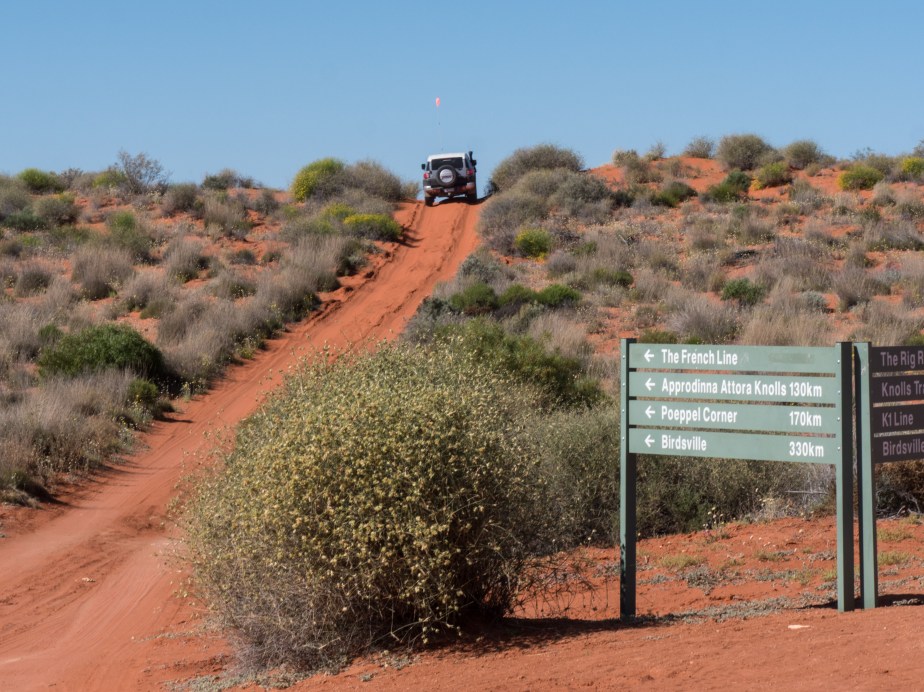
Big Red is 40 km west of Birdsville, about 30 metres high and famed in legend and song. It is the focus of an annual concert and a car rally. Many a 4WD wannabe takes the run out there from Birdsville  to try out their truck. Coming from the west it is, by some counts, dune number 1113.  You first see the top of it over this ridge …

One dune away ...
One dune away …

and when you get closer it looks like this …

Big Red
Big Red

On that particular day the tracks on the left ended with steep churned up sections, the tracks further right were easier. The place to celebrate is on top …

McGee on the Real McCoy

and then 40 klicks further on …

p1100577

It was just another dune.

Eyre Creek …

There was a bit of a breeze and the next rain band wasn’t expected until the evening. There was nothing to gain by rushing off, better to let things dry out a little. We took the time to enjoy the locals enjoying their new lake …

photo- TLG
Crimson Chat (photo- TLG )

And we took our opportunity to smell the Gidgee Trees. I found them not as bad as their reputation. Their leaves though are poisonous to stock (and presumably people, don’t eat the Gidgee).

When we got to Eyre Creek there was practically no water in it. When it floods it’s because of heavy rain over a much wider area and the result can be a river up to 30 km wide that can take months to subside. That’s not to say there was no challenge, the flood plain was a quagmire especially on the western side. So we slipped and slid with many a sideways moment for several kilometres. We were thrilled to be on the eastern bank …

TLG

Big Red here we come …


A change in the weather …

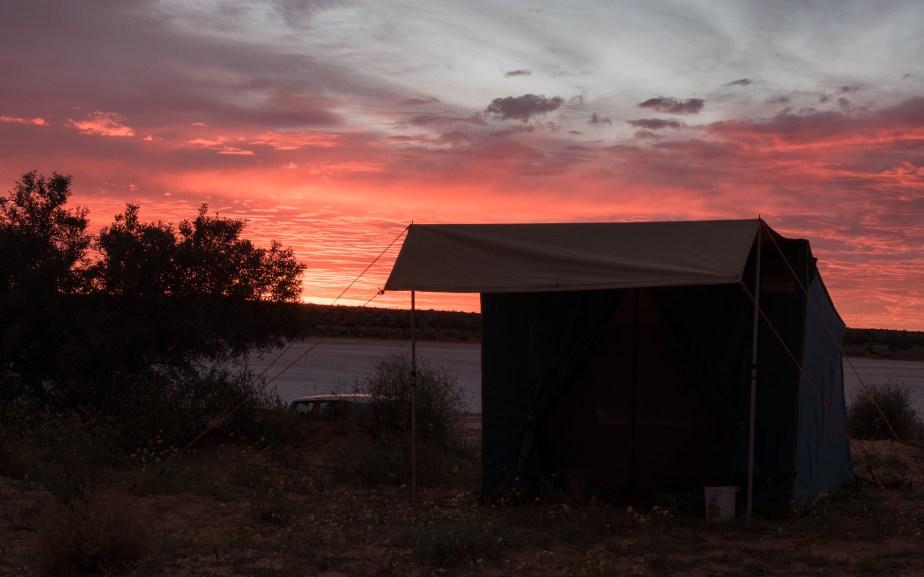
There was a magnificent sunrise and no ice on the cars. Cloud had kept some warmth in.

We packed up and drove up the west side of Lake Poeppel, crossing the salt encrusted surface near the northern end. Light rain settled the dust.

Having made our northing we headed east along the QAA line towards the Queensland border. One desert but three states and three different regulatory authorities. In South Australia we’d travelled through the Witjira National Park and then a Regional Reserve, in the Northern Territory we appeared to be on vacant Crown Land. At the Queensland Border we entered the Munga-Thirri National Park.

The QAA line is initially similar to the French Line, rolling dunes. The dunes are quite high and the swales quite broad often with a clay surface. The amount of vegetation seemed to be slowly declining.

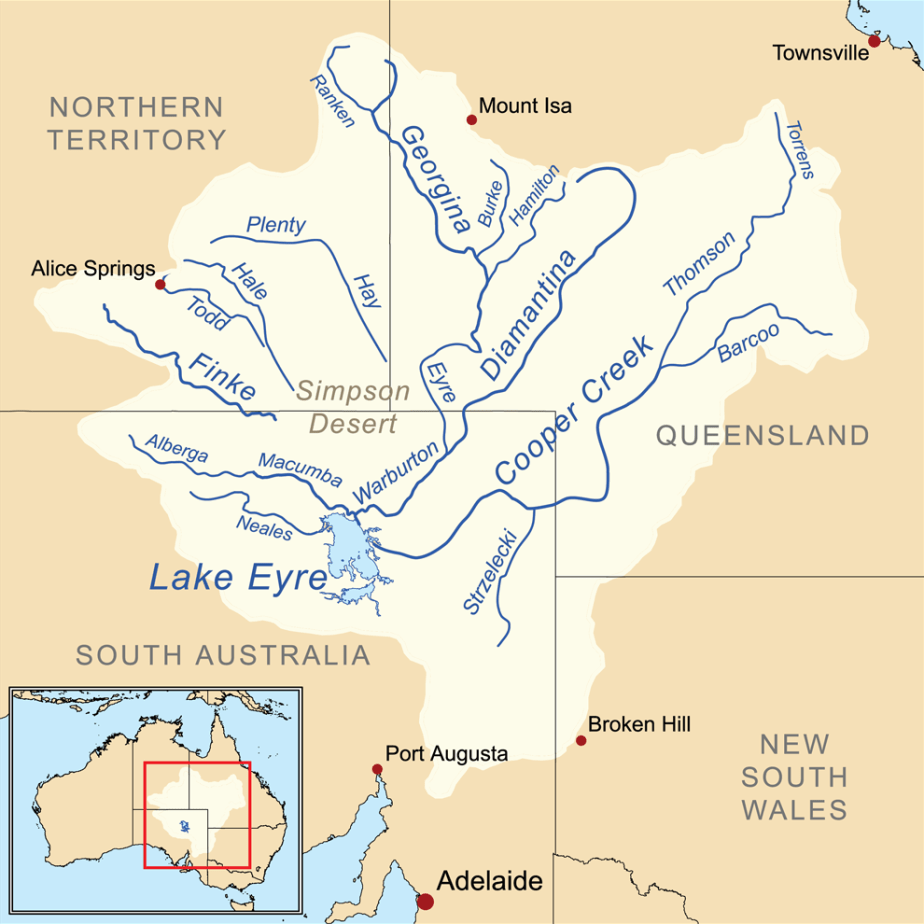
We had a decision to make regarding our camp site. Beyond Munga-Thirri lies Adria Station. After leaving the National Park there would be nowhere to camp until Eyre Creek. Off to our north-east lie the three major rivers of the channel country, the Georgina, Diamantina and Cooper. Georgina joins with Burke and Hamilton to become the Eyre Creek, this is the driest of the three. Some years water flows down these channels into Lake Eyre, some years there is no flow at all. When we set off we knew that the Warburton was flooded and that Eyre Creek was dry.

lake_eyre_basin_map

We could smell the impending rain. The big question was would it be enough to bring us to a halt? There were three options

  • a mad dash for Birdsville
  • a longish day to the far side of Eyre Creek
  • short drive, camp in the park

One of the highlights of the trip was still ahead of us, the most famous dune in the universe – Big Red. We had no wish to rush this. The mad dash was rejected.

A camp in the park would be on sand. Wet sand is absolute luxury compared to mud. The black soil along the creek would only be fit for hippos after just a couple of millimeters of rain. And surely there would only be a couple of millimeters, big rain events are usually summer phenomena …

We camped just inside the park.

One of the locals was also happy to smell the roses ..

bobmcgee.live

By evening it was cold and raining heavily. Overnight there was a very impressive thunderstorm. My guesstimate is we had 25 mm of rain. We piled out of our tents in the morning to a landscape full of little lakes.

bobmcgee.live

photo -TLG
photo -TLG

We got the weather forecast by satellite phone. They’re was much more to come and the Eyre Creek flood plain ahead of us. This was going to be interesting.


Turning the corner …

Towards the eastern end of the French Line the dunes get higher and further apart. The swales are more likely to be clay and salt lakes make their appearance. This is Lake Tamblyn, named by Colson after his school teacher.

L Tamblyn

Before long we reached the intersection with the Knolls Track where there is even more obvious evidence of change … trees.

Gidgee

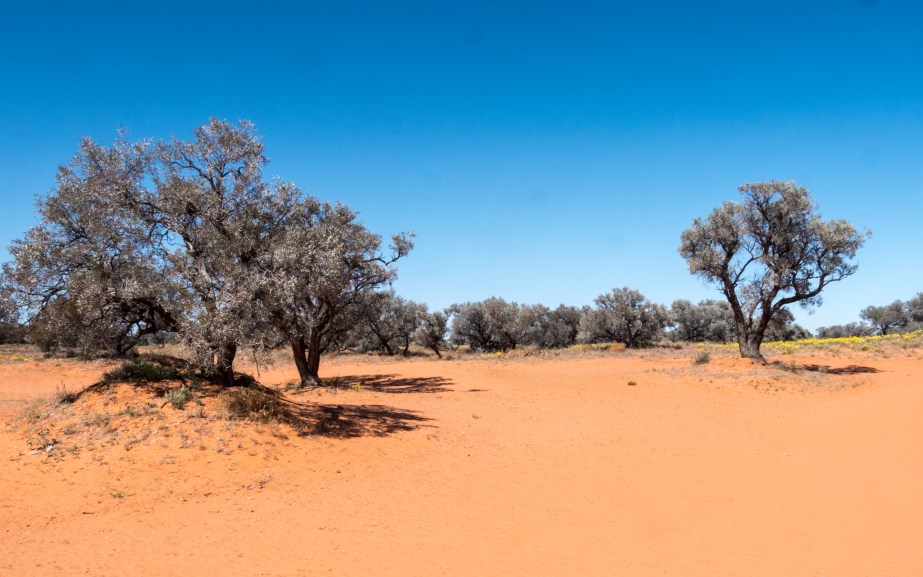
These are Gidgee trees, Acacia cambagei, said to emit an offensive odour when wet, variously described as like boiled cabbage or town gas. The weather this day was fine but we would have our chance to savour the smell before the trip was over.

At the intersection there is a rough and ready plaque celebrating the efforts of the surveyor David Lindsay who passed this way in January 1886. These days he would be fined up to $1000, the nanny state closes the desert for the summer.

Our next landmark was Poeppel Corner. Once just like any other spot in the desert but now a magnet because it is the entirely artificial place where South Australia, Queensland and the Northern Territory collide. Mal and Kelly and sundry others had preceded us and left an indication of their IQ …

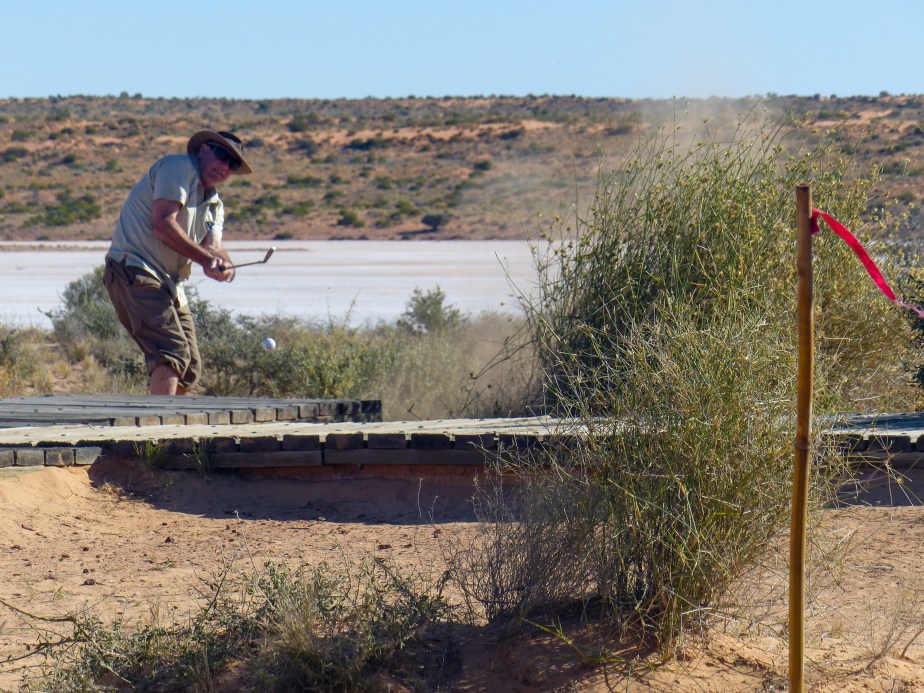
Poeppel woz ereJust imagine, you could chip a golf ball from South Australia, through the Territory to a hole in Queensland and someone has been kind enough to provide the opportunity … but you need to be a left-hander.

photo TLG
photo TLG

Whilst there are three main routes across the desert they are by this stage reunited for the last push to Birdsville. To avoid a crowded campsite we took ourselves to the western side of Lake Poeppel for the night. Sunrises are so much better in the Northern Territory …

LP Sunrise

The French Line …

We had come here to enjoy the desert not conquer it. We’d knocked off the 1900 km to Hamilton in four days, an average of 475 km a day. For the next six days we would average just 88 km a day. This would keep us driving for as much as four hours a day but give us plenty of time to stop for anything that sparked our interest.

French Line

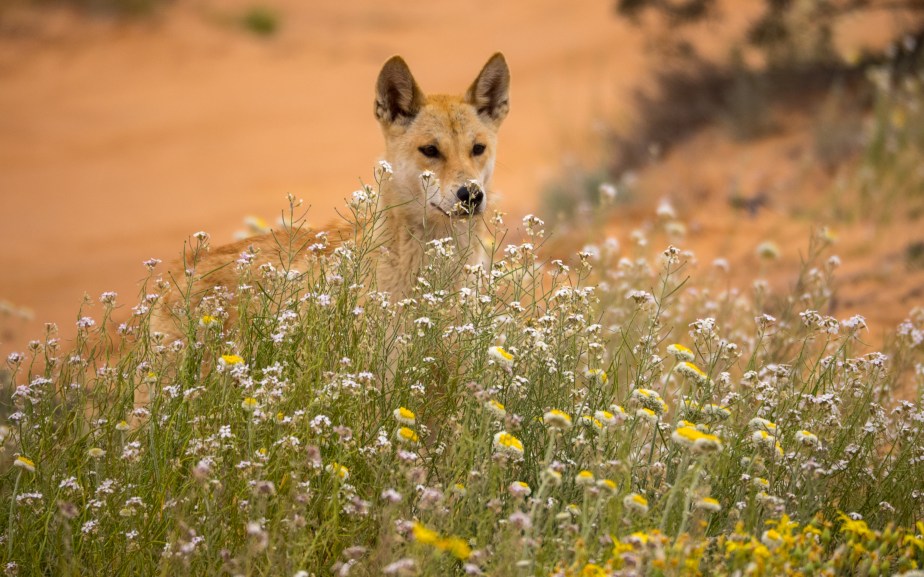
The desert was carpeted in wild flowers. I was surprised at how densely vegetated it was. Birds and reptiles were well represented but we saw little in the way of mammals. There were plenty of camel tracks and some camel droppings … by the way, these look like horse shit designed by a committee. To that can be added one House Mouse and a dingo.

For all its awesome reputation driving the French Line west to east presented no great challenge. Concentration was required, you needed just enough momentum to ease you over the crest, too much would rearrange the contents of the vehicle unnecessarily. There was often a moment when all you could see was the bonnet and the sky. When the road came back into view it wasn’t guaranteed to be straight ahead.

The dunes trend SSE-NNW and continue parallel for many kilometres, some as much as 200 km unbroken. This pattern is seen throughout the deserts of Australia. The height and spacing between the ridges have an inverse relationship. Where there are 5-6 ridges in a kilometer, the height is around 15 meters. Where there are one or two ridges per kilometer the height jumps to 35–38 meters. Dunes on the west of the desert are mostly small but they increase in size as you head east. The eastern faces are not only steeper, they are also longer. (No you don’t get further and further below sea level, you climb quite gently across the interdune space before reaching the next challenge.) Where dunes are close together the surface in between mostly remains sandy but where they are widely spaced the surface is often clay – much more of a challenge than sand when wet.

In places the track is scalloped, this effect is blamed on the drivers who fail to lower their tyre pressure and those who insist on towing camper trailers although I think injudicious use of the brakes on the downhills is just as much to blame. On steep faces the scallops are out of phase, your left wheels go in as your right wheels come out, it feels like riding a camel. On lesser slopes they are side by side. Either way the wave length is the average length of a vehicle.

During the second night a cold front passed through. It brought no rain but the wind drove sand into everything. I woke with sand in my sleeping bag, even some between my teeth.


Regal Birdflower
Regal Birdflower
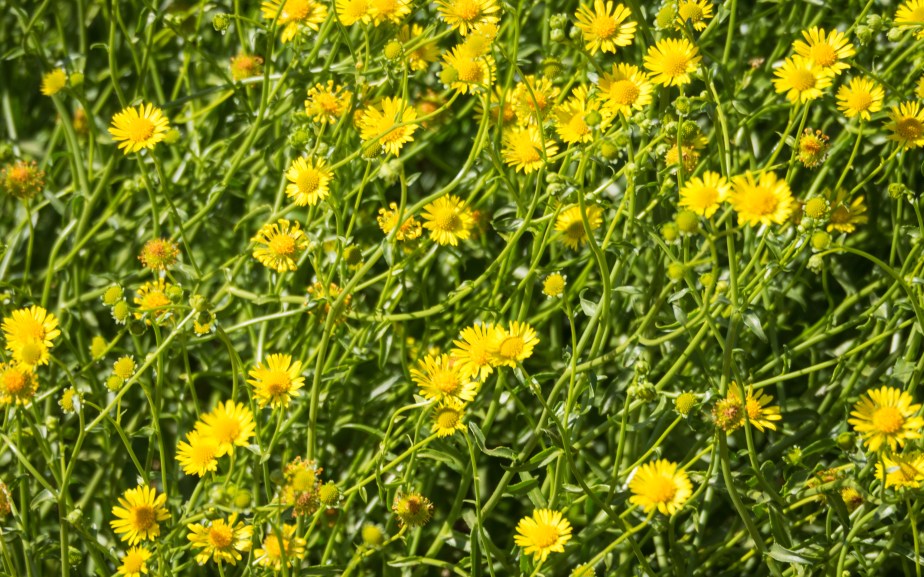
Fleshy Groundsel
Fleshy Groundsel
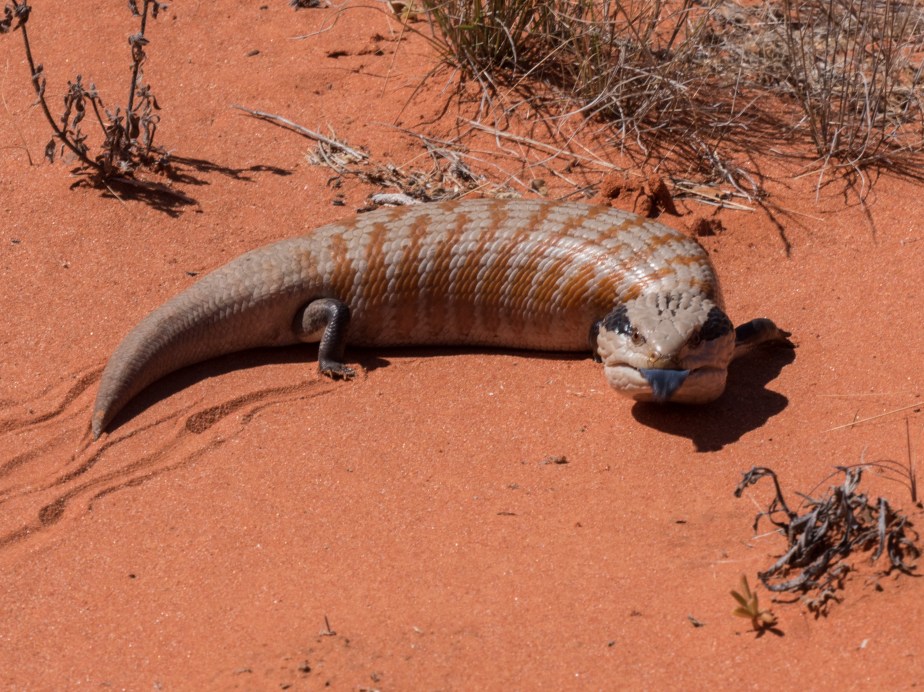
Central Blue Tongue
Central Blue Tongue
Central Netted Dragon

The desert has a stark beauty. Visiting is a little like scuba diving … we don’t have the means to live there but we can take what we need to enjoy it for a short time and come away looking forward to the next time.

Moon rise over the saltbush
A full moon rises over the saltbush.

Sand …

To see a World in a Grain of Sand
And a Heaven in a Wild Flower 
Hold Infinity in the palm of your hand 
And Eternity in an hour
                                      … William Blake

The road beyond Dalhousie Springs had not been graded and had a challenge for every season, clay pans for the wet, dunes for the dry and stones to puncture the tyres at any time at all. The corrugations were ferocious – we were carrying hard-boiled eggs that were actually peeled for us by the vibrations. Vehicle contents were redistributed freely – note to self, screw top lids are a really good idea. They would have saved scooping up the sugar off the floor of the car.

At Purni Bore it all changes. No more stones, corrugations become far less arduous. This is the start of the sandy desert. Time to drop the tyre pressures to 18 – 20 psi.

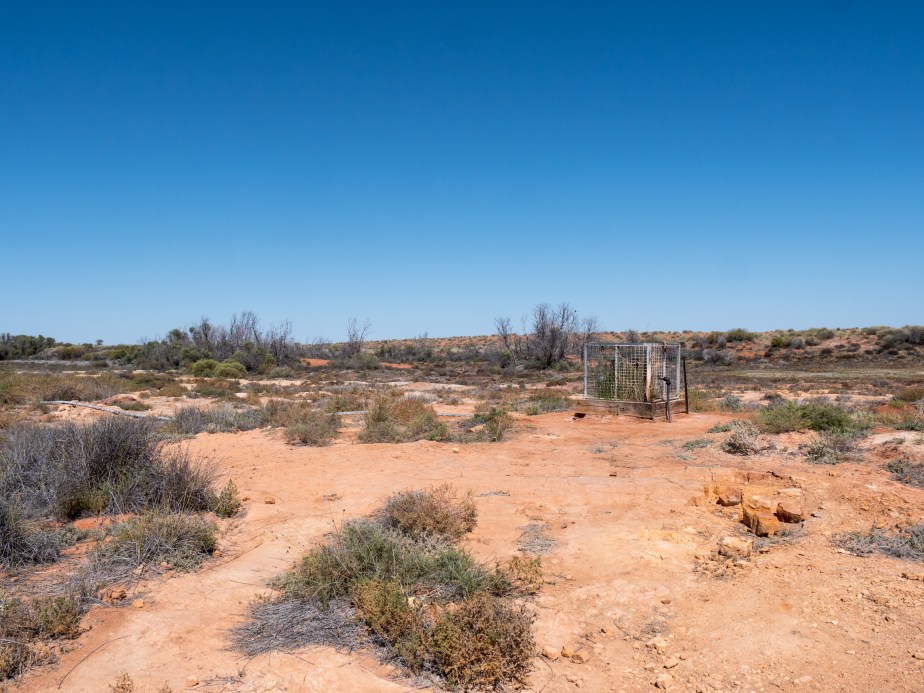
Purni Bore
Purni Bore

Soon we leave Witjira National Park and enter the Simpson Desert Regional Reserve. Before long we are cresting the first dune on the French Line. The first of many, you could count them, but be aware, if you get confused tradition dictates that you go back to the beginning and start over.

Intersection

Camping restrictions are eased. We can now camp anywhere within 50 metres of the road.

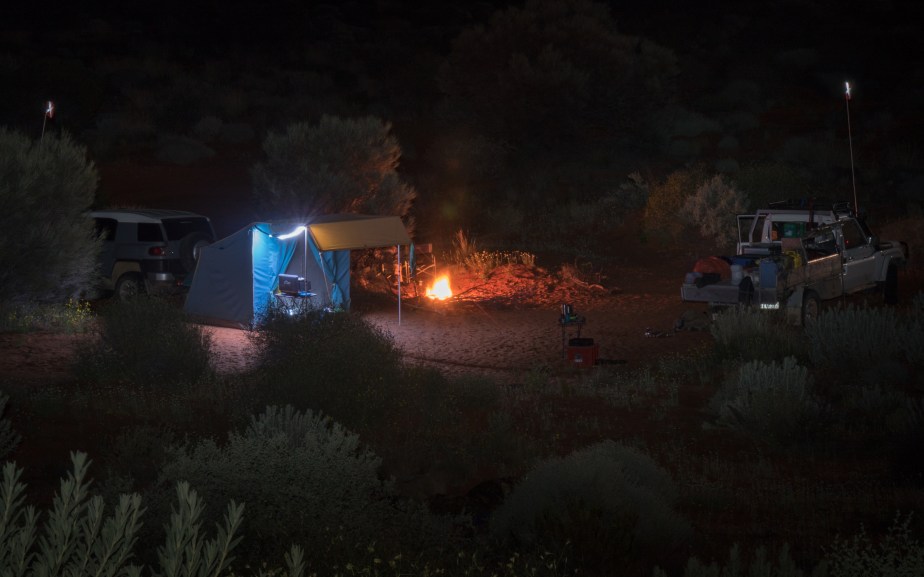
Desert Camp

by Night


The Great Inland Expedition 2016 …

It started as a thought bubble, why don’t we drive across the Simpson Desert?

According to the frequently erroneous Wikipedia, the Simpson is the world’s largest sand dune desert, with the world’s longest dunes. It covers 176,500 km2 (68,100 sq mi) and the dunes range in height from 3 metres in the west to around 30 metres on the eastern side.

There are no made roads and no fuel stations. The tracks are well-defined, even sign-posted in places, but you must take them just as you find them. The prevailing wind is from the west. This has a profound effect on dune morphology, the west face of the dunes has a slope of 10-20° whilst the eastern face has a slope of 34-38°. West to east seems a good idea for a beginner.

There are a number of routes to choose from. Of the two most popular, the French Line is reputed to be harder than the Rig Road. So the Rig Road seems another good idea for a beginner. We chose the French Line.

Last fuel on the west can be either Oodnadatta or Mount Dare Station the next, on the east, is at Birdsville (taking the QAA Line from the end of the French Line) or Mungerannie (taking the Warburton Track). Mount Dare would have been a little out of our path but shortens the distance a little. The longest of the possibilities is Oodnadatta to Mungerannie at about 750 km.

A solo trip seems foolhardy for a beginner so I invited some friends along. Two high clearance 4WD vehicles were set up for the gig, an FJ Cruiser (petrol) and a Landcruiser series 70 ute (diesel). Both have electric winches, radio and a shovel – the first self rescue item to turn to in sand. There was one satellite phone. And of course, the sand flags. We would carry some extra fuel.

We would be travelling in the tracks of countless aborigines and many other Europeans including Mrs Middleton’s little boy, Johnny; and Bill from Cunnamulla who did it twice on his bike. The first white explorer to see the Simpson was Charles Sturt back in the 1840’s. It was in the way of his attempt to travel north to the geographic centre of Australia. He was unimpressed …

We had penetrated to a point at which water and feed had both failed … The spinifex was close and matted, and the horses were obliged to lift their feet straight up to avoid its sharp points. From the summit of a sandy undulation close upon our right, we saw that the ridges extended northwards in parallel lines beyond the range of vision, and appeared as if interminable. To the eastward and the westward they succeeded each other like the waves of the sea. The sand was of a deep red colour …

In 1880, Augustus Poeppel, a surveyor with the South Australian Survey Department made an incursion from the east along the 26th parallel, the Queensland/South Australia border, and marked the point where they meet the Northern Territory. He placed the tristate junction a little too far west, in the middle of what is now Lake Poeppel. It has since been moved to its correct position and is called Poeppel’s Corner.

Development on each side of the desert occurred quite early. Edward Meade Bagot took up the lease on Dalhousie Station on the western fringe in 1873. Birdsville, on the eatern fringe,  dates from about 1881 initially as Diamantina Crossing but quickly renamed. The Birdsville Post Office opened in January 1883.

David Lindsay, a formidable explorer, joined the dots. In January 1886, the height of summer, he set out from Dalhousie on the west side of the desert with Paddy – a Wangkangurru Aboriginal man and Charles Bagot, the pastoral lessee of Dalhousie Station and headed east into the Simpson Desert. He visited and documented a series of nine Aboriginal wells and travelled to the Queensland/Northern Territory border. Considering the country further eastwards to be “discovered” and also considering Mr. Bagot’s health, he backtracked to Dalhousie.

In 1886 Warburton, properly Peter Egerton-Warburton (1813-1889) penetrated from the south. He explored the area around the north shore of Lake Eyre searching unsuccessfully for Cooper Creek but found a large river which was subsequently named the Warburton River. He traced this north to the Queensland border. We hoped to follow his track south from Poeppel’s Corner but his river just happened to be in flood.

The name Simpson Desert was coined by Cecil Madigan, in honour of Alfred Allen Simpson, an Australian industrialist, philanthropist, geographer, and president of the South Australian branch of the Royal Geographical Society of Australasia. Mr Simpson was the owner of the Simpson washing machine company. Madigan made an aerial reconnaissance flight over the desert in 1929, which proved that the desert was composed of numerous parallel sand dunes, with no evidence of permanent water.

Ten years later Madigan crossed the desert by camel and celebrated being the first across the entire desert in the very readable Crossing the Dead Heart.

He was not, of course, the first, in fact not even the first European. That honour goes to Ted Colson who had traversed the full width of the desert in both directions three years earlier.

On 27 May 1936 after a season of good rains, Colson set off from Mount Etingamba 53 miles north of Bloods Creek with a lone aboriginal companion Eringa Peter. He carried provisions for two months, a compass and maps and travelled due east following the 26th parallel. Facing approximately 140 miles of unknown country, they subsequently traversed over a thousand sand ridges. He named some hills near the western side after his wife Alice, and a dry salt feature Lake Tamblyn after John Tamblyn his school master. His course took him to Poeppel’s Corner then on to Birdsville which they reached on 11 June, and set out for the return journey three days later. He had missed the corner post on the outward trip (by only 300 yards), but found it on the return journey and took photographs as it was still in good condition a little over 50 years after its placement. They arrived back at Bloods Creek on 29 June 1936, after 36 days and almost 600 miles of travel.

The first crossing by car was by Reg Spriggs with the wife and kids in September 1962. They took 12 days to travel from Andado Station to Birdsville in a short wheelbase Nissan Patrol. The following year French Petroleum commissioned a seismic survey which involved bulldozing a route a little to the south of the Spriggs’ – the French Line.

So, the plan …

 Inland 2016


You can click  on the map to enlarge it.


From here to FNQ …

Australia starts right at my doorstep.

It’s a huge place with many facets. The parts that most interest me are the natural ones, the more remote, less tamed places. To see these places you need a reliable vehicle and portable accommodation. So you buy your 4WD and ensure that it has a long range fuel tank, you mount a bull bar at the front to fend off the kangaroos. On goes the winch that will pull you out of the mud surrounding your axles. The suspension is improved and the body raised. The best camping equipment is purchased, tested, refined and ready to go.

Then you realise that you’ve only got two weeks holiday so you fly to your destination, rent a stock standard 4WD and stay in motels.

Here’s a picture of our stock standard vehicle stuck in a creek in the Kimberley …

No winch, but fortunately a wench that could cook, food for a fortnight and, as you can see, plenty of water. We were there for a little more than a day.

It happened back in 2002 that a young friend of mine had just finished his PhD and had not started work, therefore time rich, income poor. He drove my car from Melbourne to Cairns. I flew up and put my two weeks to good use with all the equipment my heart could desire. We even got to use the winch.

He is now a professional biologist and I am recently retired. My turn to drive from Victoria to far north Queensland. He flew up to Townsville.

Over the next few days I shall relate the adventures of the winch, the wench, the biologist and the senior citizen as they travelled to the rainforest and the desert in search of the wildlife of good old Oz.

The journey north


Caution, R plater …

This might seem familiar to one or two people who know me …

Even more important than being drunk, however, is having the right car. You have to get a car that handles really well. This is extremely important, and there’s a lot of debate on this subject – about what kind of car handles best. Some say a front-engined car; some say a rear-engined car. I say a rented car. Nothing handles better than a rented car. You can go faster, turn corners sharper, and put the transmission into reverse while going forward at a higher rate of speed in a rented car than in any other kind. You can also park without looking, and can use the trunk as an ice chest. Another thing about a rented car is that it’s an all-terrain vehicle. Mud, snow, water, woods – you can take a rented car anywhere. True, you can’t always get it back – but that’s not your problem, is it?

Update

My dearly beloved asked if the author (P. J. O’Rourke, 1978) had travelled with me.

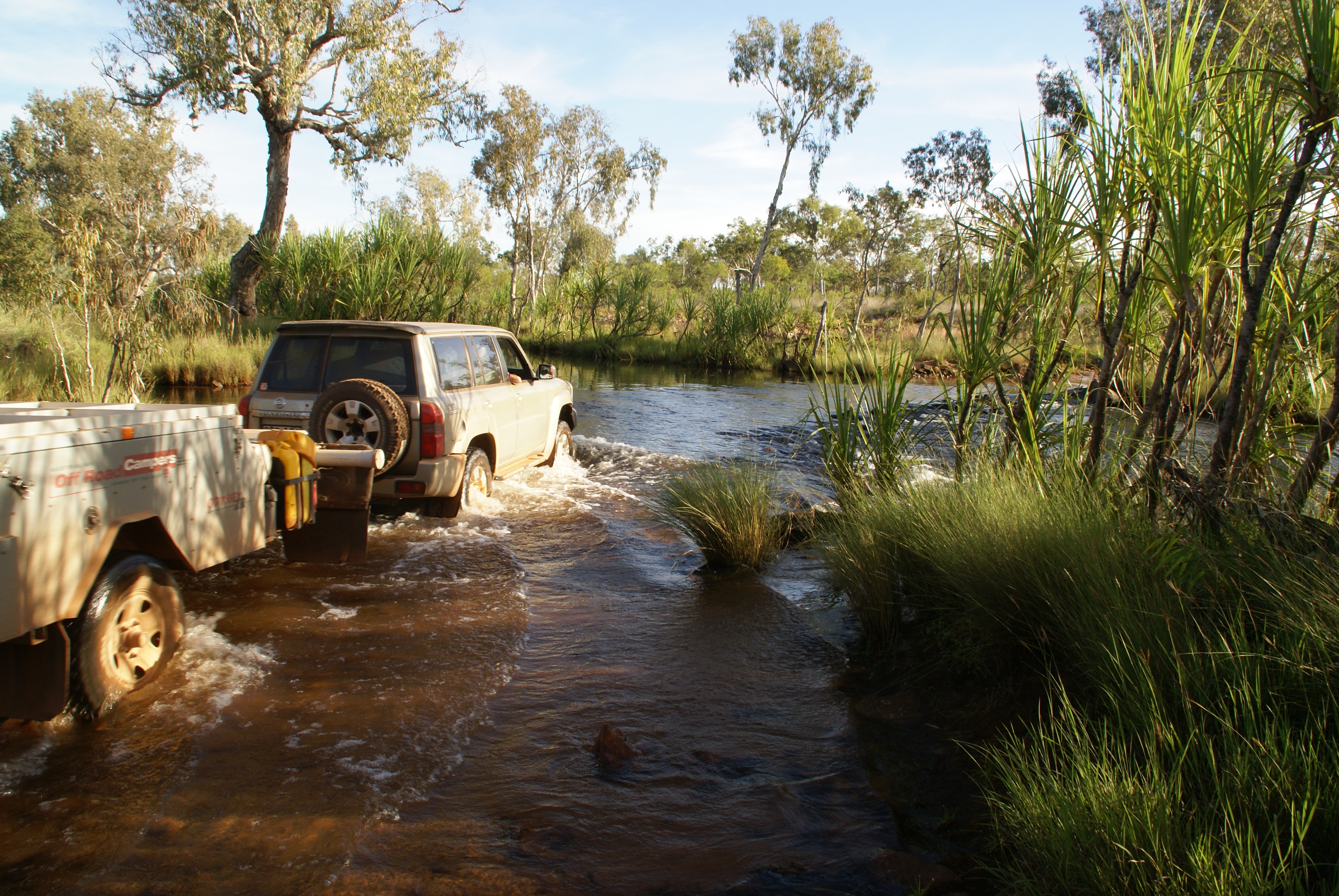
River crossing …

This is the King Edward River, the river that might have stopped us getting to the Mitchell Plateau.

King Edward River

It hadn’t rained for over a week by the time we got to see it. Nonetheless, the driver of this vehicle had a good look and walked the track his wheels would take before he went across.

In  the 4WD videos river crossings are undertaken with a splash and a big surge of water. That’s the way to get a good spectacle. If you’re running on diesel with no snorkel your air intake is no higher than your headlight, water in the engine equals immediate failure, a time and money eating retrieval and expensive repairs. If you’re running on petrol your electrics are vulnerable. Especially when the bank is steep, go in nice and slowly, just as the vehicle starts to climb you smoothly increase the revs and ask it to lift you out.

River X

If you are towing a camper trailer the change in angle is too much to ask of a simple ball hitch, especially when there is a rock or two that can have the car leaning one way and the trailer leaning the other. There are a number of devices that allow for extensive rotation in all three planes. I have used a Treg hitch without problems. It’s also worth having a look at the Hitchmaster.

<NEXT>.