The hinterland of the Great Ocean Road is the Otway ranges. These are low mountains that formed in the rifting process that broke up Gondwana. The ranges were once clothed in forest and quite extensive remnants still exist in the Great Otway National Park.
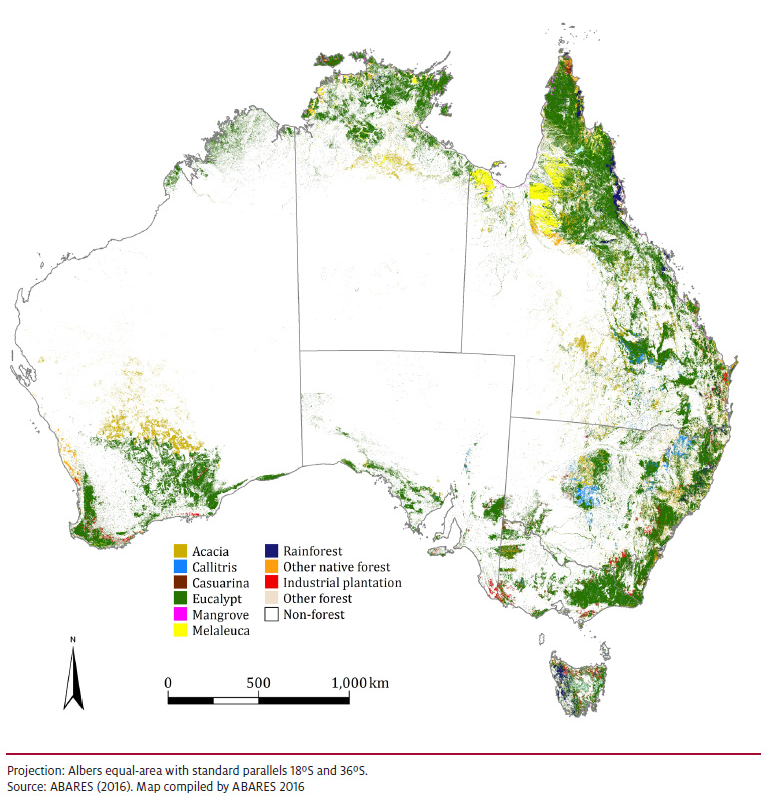
Forests have everything to do with rainfall. If we look at a map of Australian Forests we find them concentrated down the east coast, across the wetter tropics and in the south-west. A rainfall map or a population density map look broadly similar. The white patch ranges from semi-arid to desert and shows how dry a continent Australia is.
I borrowed the map from the Department of Agriculture and Water Resources. You should have a look <HERE> if you need further information. Perhaps because Australia has relatively little forest the definition used is particularly generous. If there are trees that shade a fifth of the ground it’s a forest. Real forest, tall trees with extensive canopies such as we find in the Otways constitutes only a fraction of what’s shown on the map.
Rainfall in the Otway Ranges from 700 to 1400mm (27 – 55ins). If you lived there you’d have to mow your lawn every week not just a few times in the spring like I do.
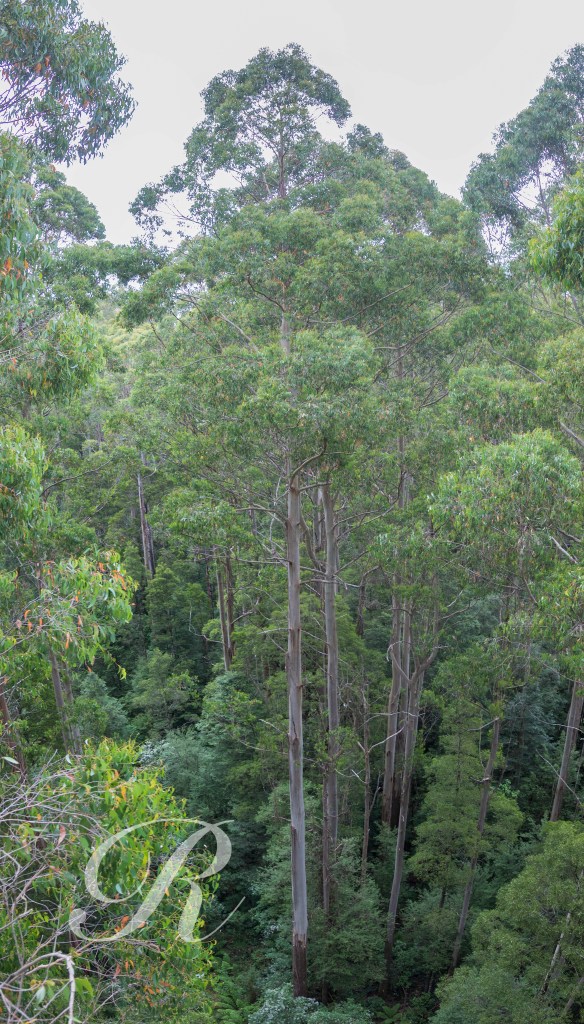
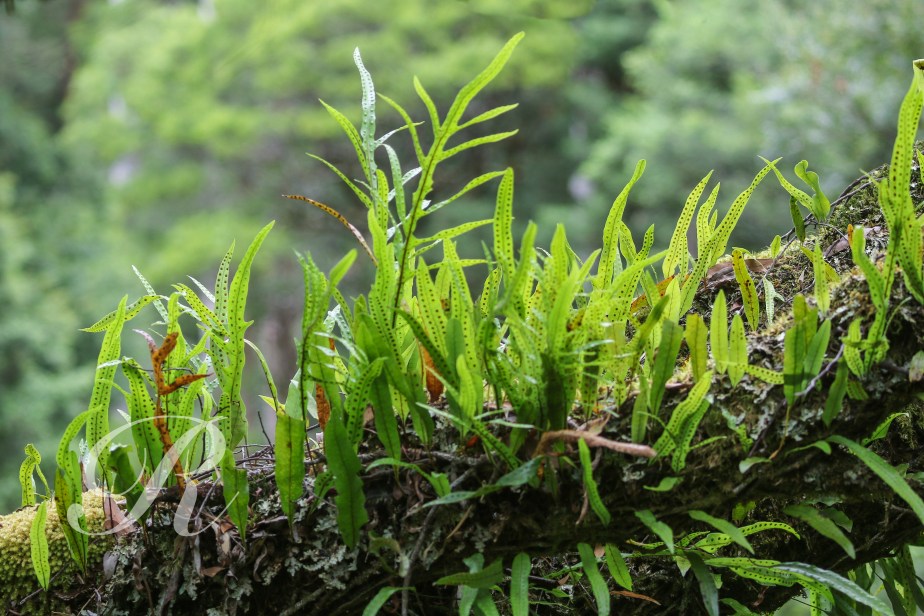
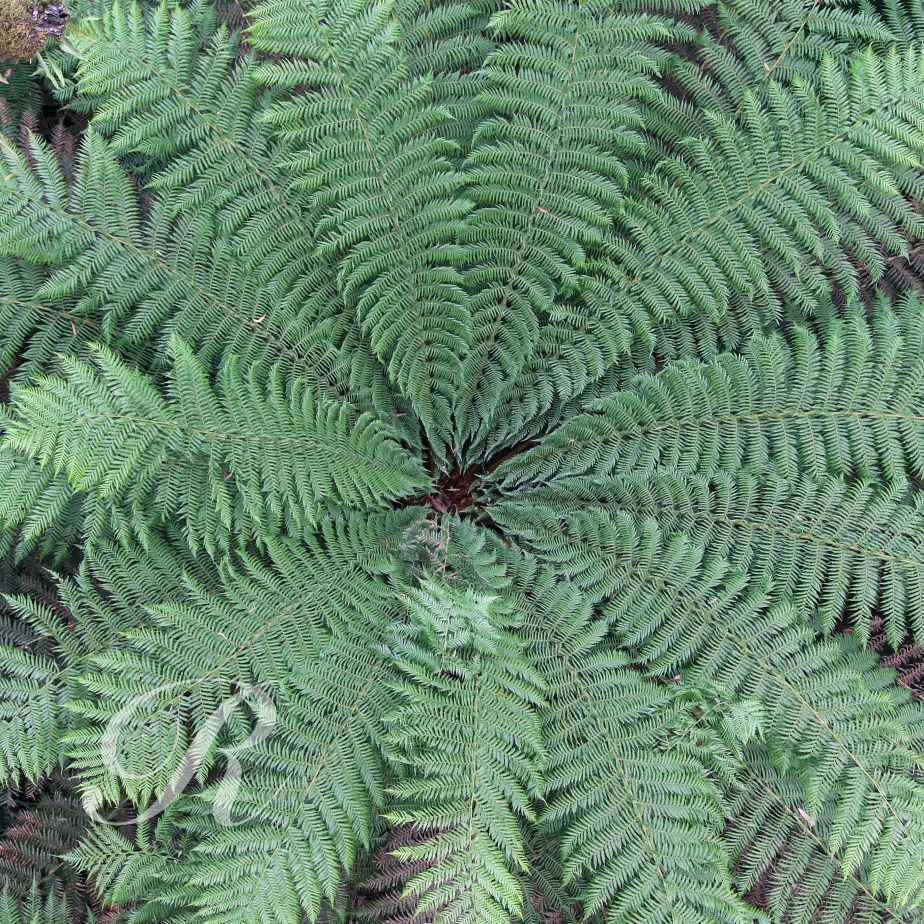
The forest types include wet sclerophyl characterised by the magnificent Mountain Ash Eucalyptus regnans and temperate rainforest characterised by Myrtle Beech Nothofagus cunninghamii. This is the furthest west that you will find rainforest in Australia. Throw in some ferns and the odd waterfall and you have a very pretty spot for a picnic … watch out for the leeches.
Eucalyptus regnans Mountain AshKangaroo Fern
Australian King Parrots and Crimson Rosellas may well join you at the picnic table while Gang Gang Cockatoos stay a little further back. The habitat is perfect for Lyrebirds and Pilotbirds but they won’t be joining you. They haven’t made it across the gap from the forests west of Melbourne. Nor has the Sooty Owl but this is the place to look for the elusive Grey Goshawk.
I have enjoyed a few days in Anglesea on Victoria’s coast. The sea imposes a moderating influence on the weather. It was a cool and pleasant interlude while at home it was hot. Adding to my personal sense of moderation was the pleasant company and generous hospitality of the very good friends I was staying with.
Anglesea is towards the eastern end of the Great Ocean Road. If you’re traveling east to west it’s where the journey starts to be interesting. The road is Victoria’s premier tourist attraction and although I have mixed feelings about it there is no doubt that it is both visually splendid and worth a fortune to the state’s economy.
It’s been in the news a bit lately because, woe be upon us, erosion. The media have been discussing the impending crisis in terms of climate change and sea level rise. Thousands of tourists travel thousands of miles to see the effects of thousands of years of erosion. Sea stacks, arches, steep cliffs are all the result of erosion. And we’ve just started making a fuss about … erosion.
The Great Ocean Road
Coasts can be classified in several ways one way is to divide them into coasts of submergence and coasts of emergence. There are nice examples of both in the map above. To the right is Port Phillip Bay. At the height of the last glaciation the Yarra River ran across a plain and discharged into the ocean at the heads. As the sea rose the plain was inundated providing Melbourne with a large bay to sail around looking at a coast of submergence. For most of its length the Great Ocean Road skirts a coast of emergence.
Emergent coasts are a result of local tectonic uplift of the land surface or a fall in the elevation of sea level because of a reduction in the water volume of ocean basins. Quite often, emergent coasts have rocky coastlines with cliffs and nearly flat platforms that extend inland where older coastal plains have been tectonically raised and are now elevated above the modern land and water interface.
Another way of classifying coasts is as erosional or depositional.
In places where there is an abundance of wave energy or ocean currents and/or a lack of sediment available for deposition, erosion of the coast will be the dominant mechanism of change. Quite often, erosional coasts are narrow and characterized by resilient rocky shorelines that are exposed to high energy waves and supply relatively little sediment to the adjacent shore.
Where deposition dominates the land is advancing, where erosion dominates the land is in retreat.
One of the features people go to see is the Twelve Apostles.
Twelve Apostles in 2003 – Wikipedia
There were never twelve but there’s one fewer today.
These stacks are formed of limestone that was laid down under the sea about 23 million years ago. The region was subsequently uplifted. The seaward edge of the uplifted land has been undergoing erosion ever since. At the height of the last glaciation, 21,000 years ago, sea level was about 125m lower than at present. (And has been as much as 2m higher in the intervening period.) The cliffs and stacks we see today have been carved out by the Southern Ocean since then.
The sea may have a moderating influence on the temperature but it can have a savage impact on the land. That bulge in Victoria’s coast and the Southern Ocean are not in equilibrium. The sea will continue to eat that coast regardless of further sea level rise.
The water trough, originally for a pony that I inherited, has been quite busy. Not surprising since day time temperatures have been in the mid 30’s.
The camera trap was out three days and nights. Apart from more than 2000 images devoid of an animal it took photographs of nine species of bird and three species of mammal.
The birds have all been daytime visitors. The cast in order of appearance …
Willy Wagtail
Striated Pardalote
Raven sp (probably Little)
Crested Pigeon
House Sparrow
White-winged Chough
Superb Fairywren
Long-billed Corella
Australian Magpie
So nothing out of the ordinary and a subset of the many species that I’ve seen having a drink there over the years.
Mammals have mostly been Eastern Grey Kangaroos, several every night. A Hare made a couple of day time visits. And there has been one visitor I would rather not have seen …
Feral cats threaten the survival of over 100 native species in Australia. They have caused the extinction of some ground-dwelling birds and small to medium-sized mammals. They are a major cause of decline for many land-based endangered animals such as the bilby, bandicoot, bettong and numbat.
I’ve resurrected an old trail camera. Last night I set it near a water point on the farm and captured some images of Eastern Grey Kangaroos coming to drink. The images are very low resolution which can be forgiven to some extent for infra-red images at night. Sadly the day time images are even worse. I may have to invest in a new camera.
For reasons that are hard to fathom in hindsight, early European settlers in Australia thought it a good idea to introduce some creatures from home and elsewhere. They should have known better, the World’s first recorded rabbit plague occurred in the first century BC
… in the Balearic Islands. The citizens implored Emperor Augustus to send the Roman army to save them from the ravages of rabbits that had overrun their islands. The Greeks had already experienced similar happenings with hares, which they had released on islands throughout the Aegean Sea. The Fauna of Australia.
The introduction of the Rabbit to Australia is a fairly well-known folly. Released in Victoria in 1858 it had occupied 4 million km2 within 60 years despite the erection of thousands of kilometres of fencing meant to contain it. The economic and environmental damage that it continues to do is staggering.
Did I say folly? That might be an understatement, not that the experience prevented more crazy introductions. The Cane Toad wasn’t released on an unsuspecting environment until 1935.
The Brown or European Hare isn’t quite so famous. They are said to be vastly outnumbered by rabbits in Australia but around home at present I see hares just as often as rabbits. I can sit on the back verandah and watch them boxing. They were introduced from 1837 onwards … it took several goes before they successfully took off, indeed it wasn’t until the 1930’s that they reached plague proportions with gun clubs mobilised to protect cereal crops and tree plantations, sometimes killing thousands in a day. Their population seems to have stabilised since then.
They don’t burrow. During the day they sit quietly on the ground relying on their camouflage until you get quite close. Then they’re off at a sprint. I’ve never set out to photograph them, their introduced status makes them second class citizens and they would in any case pose quite a challenge. This photograph came about while I was patiently waiting for some White-browed Babblers to venture into range. Another human wandered into the scene flushing the hare towards me (and scaring the more desirable targets away).
Hare
In the literature Australia’s introduced Hare is variously referred to as Brown Hare and given the scientific name Lepus capensis [Linnaeus 1758] or as the European Hare Lepus europeaus [Pallas 1788]. In the international literature you can find Lepus capensis with the common name given as Cape Hare.
If we head back to the presumed source …
There are two species of hare in the UK, the mountain hare and the brown hare. Brown hares are thought to have been introduced to the UK by the Romans about 2 000 years ago, but originated in central Asia.
and the scientific name given for Brown Hare in this article is L. europeaus. and it’s not a UK native to start with but much loved nonetheless. Whilst hares have second class citizen status here in the UK the Hare Protection Act (1911) prevents the sale of adults or leverets between 1st March and 31st July. I guess if you’re hunting them in that period you have to keep them in the freezer until June!
In fact the task of sorting out europeaus and capensis is not an easy one. Humans have had a culinary interest in them since ancient times and have shifted them around the scenery with no regard for taxonomists. The experts are still arguing as to whether they are one species or two. And when they’ve sorted that out there are at least thirty other species in the genus to fight about.
So much for splitting hares, what’s the difference between rabbits Oryctolagus cuniculus Linnaeus 1758 and hares Lepus whateverus?
The splendid Fauna of Australia section 45:Leporidae is an absolute mine of information. Whilst both are in the same family Rabbits are large small mammals whilst Hares are small large mammals. This is far more interesting than it sounds. Small mammals demonstrate …
little parental care … high metabolic rates, short generation times, high rates of increase and (are) more likely to fall victim to predators. This group is severely affected by environmental change and burrowing … is common among its members.
That describes the Rabbit whilst large mammals …
are less affected by environmental events and have life histories based on outrunning predators or hiding; burrowing is uncommon.
and that describes the hare.
In the Holarctic fauna Hares are the only mammals in that size class. If it wasn’t for them there would be a clear gap between large and small mammals.
If you’re just trying to tell them apart Hares are larger with longer ears that have black tips. Recipes could probably be used interchangeably.
Birds of prey make their living in different ways; Kestrels are fond of mice, Peregrines are fond of pigeons, Brown Falcons are fond of snakes. Hunting technique are appropriate to the creatures hunted.
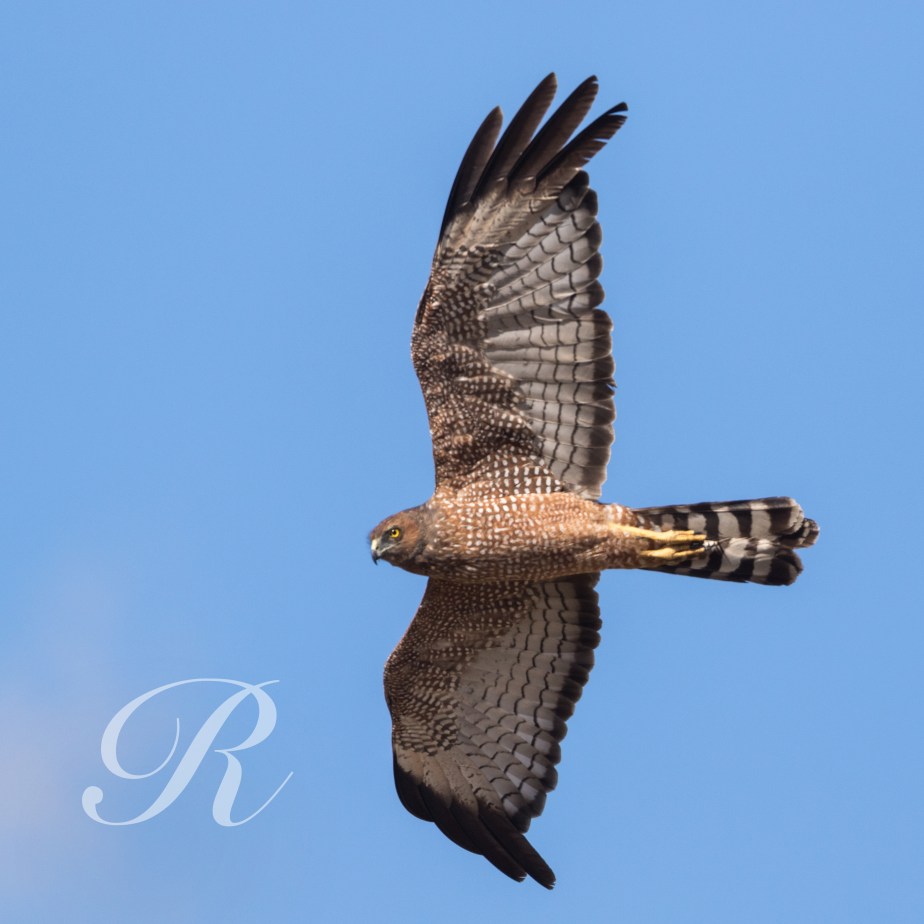
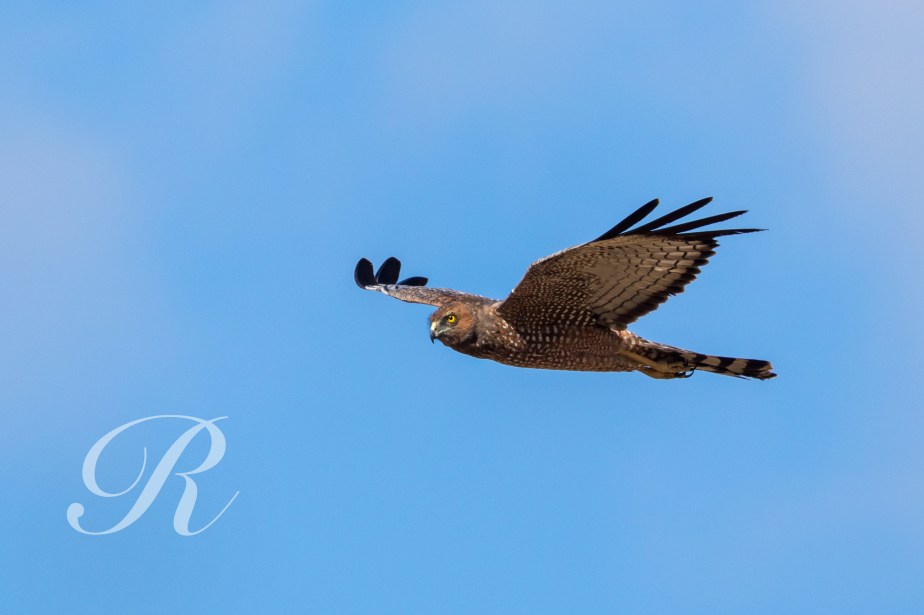
Harriers go about their business fairly low over open country with wings upswept. In Australia we have a couple of members of the guild, Swamp Harrier and Spotted Harrier. One prefers wetter habitats the other drier habitats.
The dry plains around my home seem ideal for Spotted Harrier but for all that they are only occasional visitors. I was looking for quail when I encountered this one, so was he probably.
Spotted Harrier
When looking for mice in the grass slow flight is an advantage. Kestrels and Black-shouldered Kites can hover. They are both smaller birds, there is only so much energy in a mouse and hovering is expensive. The equation works for the small birds but hovering is too expensive for harriers to undertake except very briefly.
So slow flight it is. The upswept wings contribute to lateral stability, very helpful when flying close to stall speeds. If a wing stalls it drops relative to the other wing and the bird as a whole side slips to the affected side. Under these circumstances the lower wing develops more lift than the upper wing and tends to restore the bird to level flight (at a slightly lower altitude).
The upward angulation of the wings is called dihedral and it can be seen in this photo of our gliding harrier …
A welcome cool change came along in the afternoon dropping the temperature by 15°C in an hour. Strong winds brought raised dust which presented us with a gorgeous sunset.
Meanwhile 2,600 plus kilometres north-east Cyclone Penny has both cleaned up her image and intensified in strength. It is expected to weaken before making land fall.
Today has been much cooler. But that won’t last long
The last couple of days have been days of laziness and overindulgence. Christmas is like that. They have also been hot … high 30’s. At five thirty last evening it was 38°C (100.4°F). Today we are expecting it to top 40° for the first time this summer.
With that in mind an early walk seemed like a much better idea than a later walk and for my enterprise I was rewarded …
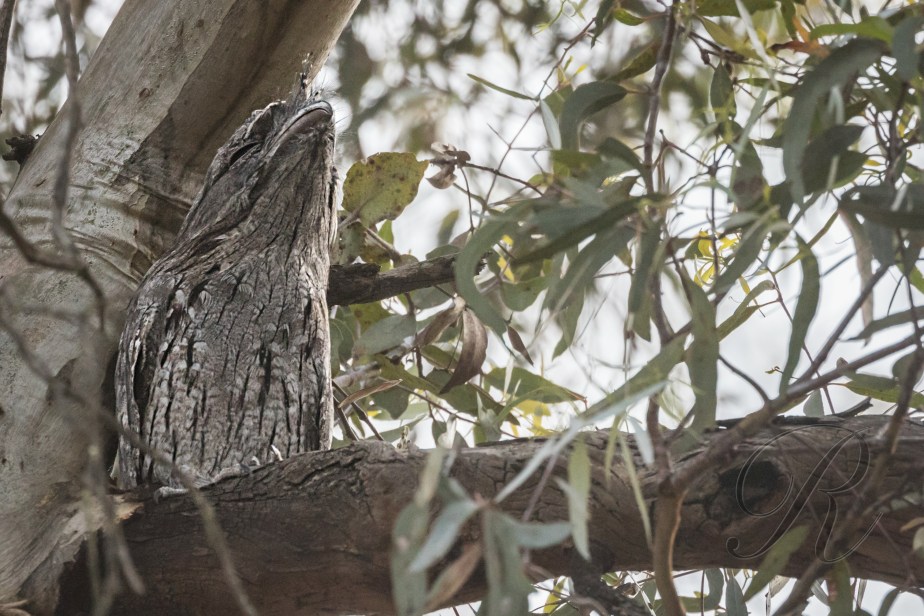
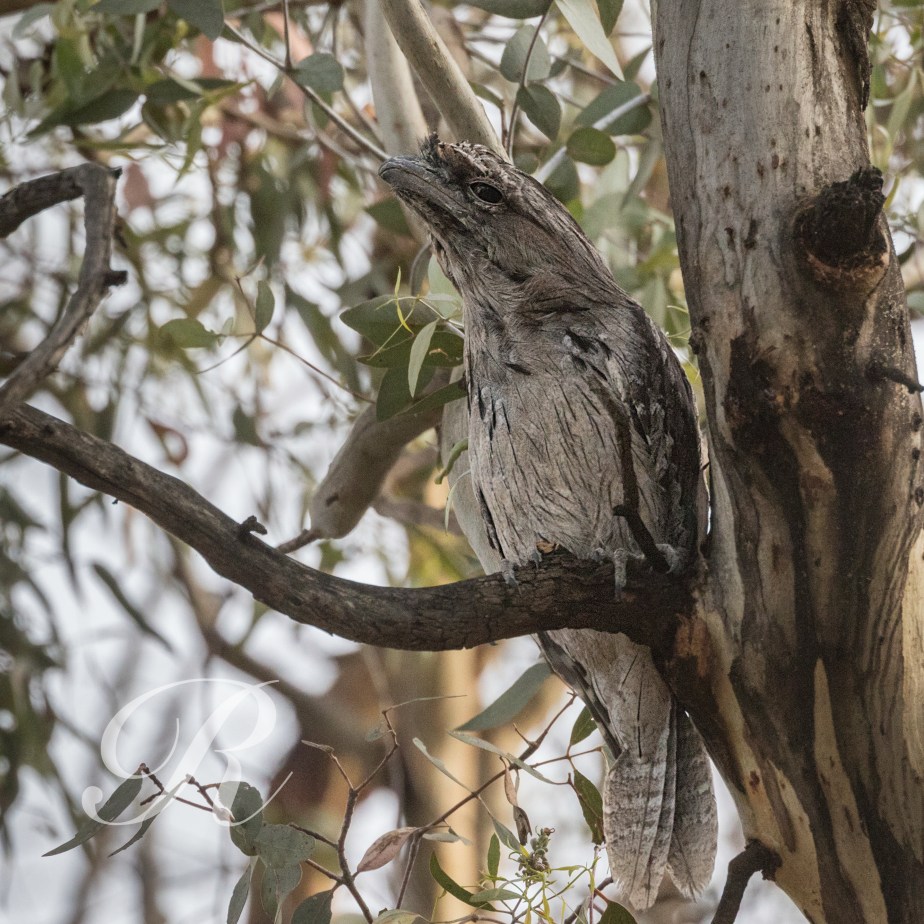
Tawny Frogmouth
Tawny Frogmouths are nocturnal. I quite often see them after dark hunting insects along my driveway.
During the day they roost in a tree and their plumage is so treelike that you can walk past them without a clue that they’re there. They tend to use the same place regularly so once you have a roost you can expect to see them whenever you wish. The only local roost I’ve been aware of is on someone else’s property and although the invitation has been extended I don’t like to visit with a camera in hand so I’ve reserved that for visitors who share my interest.
There is a small bushland reserve close to home. I walk through it several times a week. It’s anyone’s guess how many times I haven’t seen these guys but this morning I found them. I’d already thoroughly depixellated the first one before I saw the second one just a few metres away …
Tawny Frogmouth
When they’re relaxed they are rounder and dumpier. When they feel in danger of being discovered they stretch out like these and do their stick imitation.
It will be interesting to see if this is their regular roost.
So this African sojourn comes to an end. As always when I’m writing about travel I have picked up new subscribers. Welcome to you, it’s nice to know that there are people out there, but what have you got in store now?
My neck of the woods is the Goldfields region of Victoria, Australia. It has a rich history and is rich in wildlife. People travel long distances to see Australia so stick around and I’ll show you what I can of it.
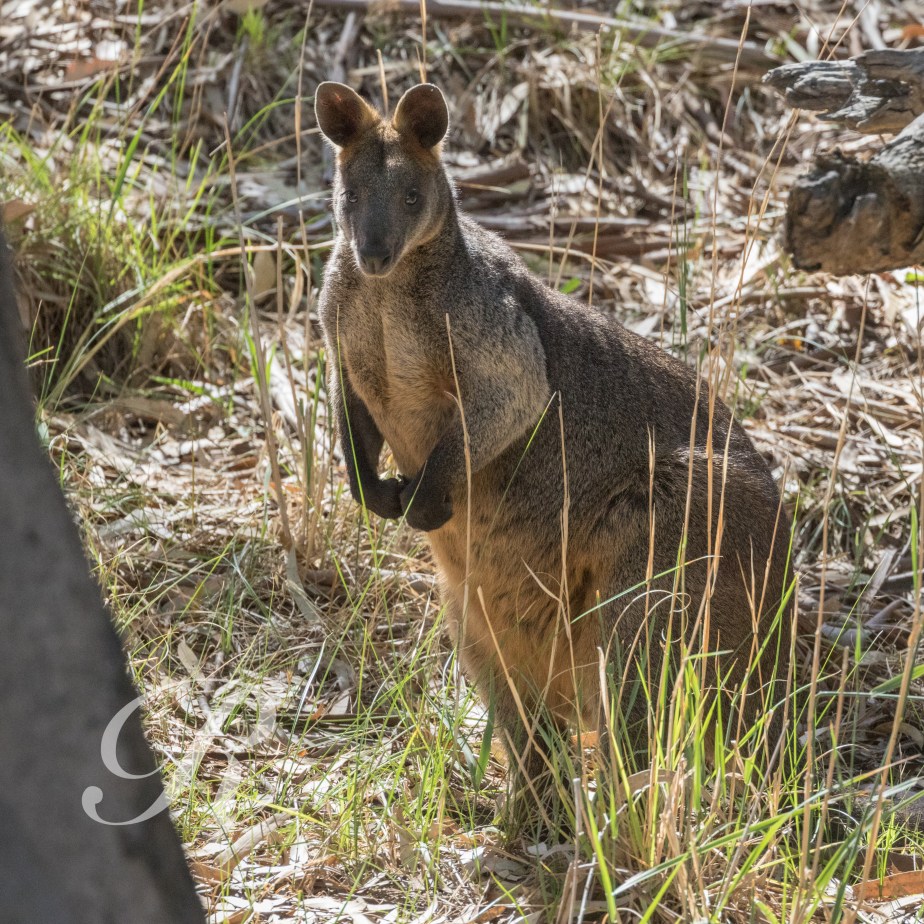
This may not be as exciting as an elephant about to charge the side of the vehicle but I took it this morning about 200 metres from my house.




 bobmcgee