The Mighty Murray …

Victoria lies in the south east of the Australian mainland. The colonies around it were given a degree of definition when Victoria was just the Port Phillip District of New South Wales. Tasmania, then van Deiman’s Land was separated from NSW in 1825 and was given virtually all the Bass Strait Islands even most of those that you can see from our most southerly point. Jibbed. (Tassie was renamed in 1856). South Australia happened into existence in 1834. Its eastern boundary was defined as the 141°E meridian (but a curious thing happened).

When Victoria was mooted the formula for its northern boundary was to start on the east coast at Point Howe, draw a line to the source of the nearest tributary of the Murray and then follow the left hand river bank until bumping into the South Australian border that already existed. Easy. So NSW got all the river, jibbed again, a Victorian needs a NSW fishing licence to fish from Victoria’s bank and where is the top of the bank in a flood, or where it has been altered. Wars have been fought over less. Anyway everyone knows that Victoria has none of the river.

And that popular view is wrong, South Australia’s turn to be jibbed. When their eastern border was surveyed between 1846 and 1850 it was set two minutes too far to the west. The mistake was discovered in 1868. Victoria was unwilling to give up the little slice of SA it had received by luck. The case ran for quite a while until the Privy Council ruled in favour of Victoria in 1914. For 10 km of river Victoria is on the left bank and South Australia is on the right and for that 10km the border runs right down the middle of the river. Ten kilometres of half a river is better than none. If you have a Victorian fishing licence you can use it here!

Even though Victorians have very little stake in it, it remains a mighty river 2,508 kilometres (1,558 mi) in length. It is joined by the Darling and together they drain about one seventh of Australia’s total land mass.

There is one little bit of the Murray that is of considerable interest to the Victorian birdwatcher, the Barmah Forest is the only place in Victoria where the Superb Parrot, essentially a denizen of the inland slopes of the Dividing range of NSW, deigns to cross the border. If you want it on your Victorian list you have to go to Barmah. If you will give me a few minutes I will search the internet and see if I can filch a photo of one …

277201

Once again it’s Graham Chapman that I’ve parasitised, I hope he will forgive me, it may help my cause if you visit his splendid site.

I spent a couple of days there just before Christmas. The Superb Parrot eluded me. The Yellow Rosella came to say hello. They are common in the Red Gum forest along the Murray and don’t wander far from there. Officially they are a subspecies of the Crimson Rosella but they rarely interbreed in the wild.

Yellow Rosella

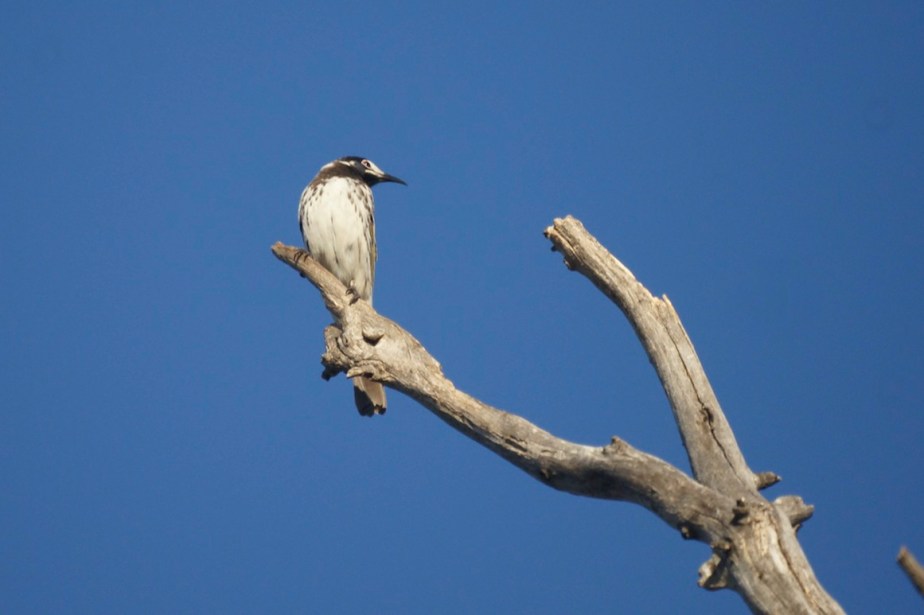
Noisy Friarbirds share the same tastes in habitat. Some are resident but their numbers are boosted by a summer influx across the river.

Noisy Friar

I camped right on the bank. A pair of Azure Kingfishers were feeding three youngsters. They soon became fairly comfortable around me. It would not have been safe to leave sardines on the table.

Azure Kingfisher

A few minutes walk away I came upon this guy.

Koala

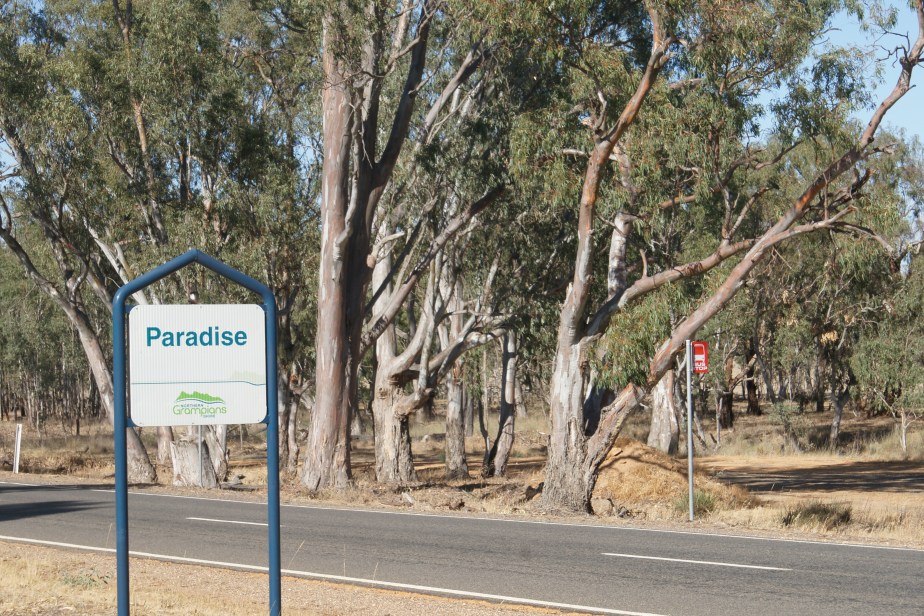
Not far from Paradise …

In summary of the recent trip. The Prado and I covered 8,820 km (5,512 miles). The binoculars were turned on some 271 species of bird, one of which they had never seen before. They were also trained on some of Australia’s quite unusual mammals including both Tree Kangaroos, Platypus and Spectacled Hare Wallaby.

Round Trip

Getting home to the drab and mundane, the humdrum, the ordinary might be a challenge, if a word of that were true. But it’s not, I have Platypus in the creek at the bottom of my back paddock, this guy was waiting for me a few metres from my front door …

EaGyK

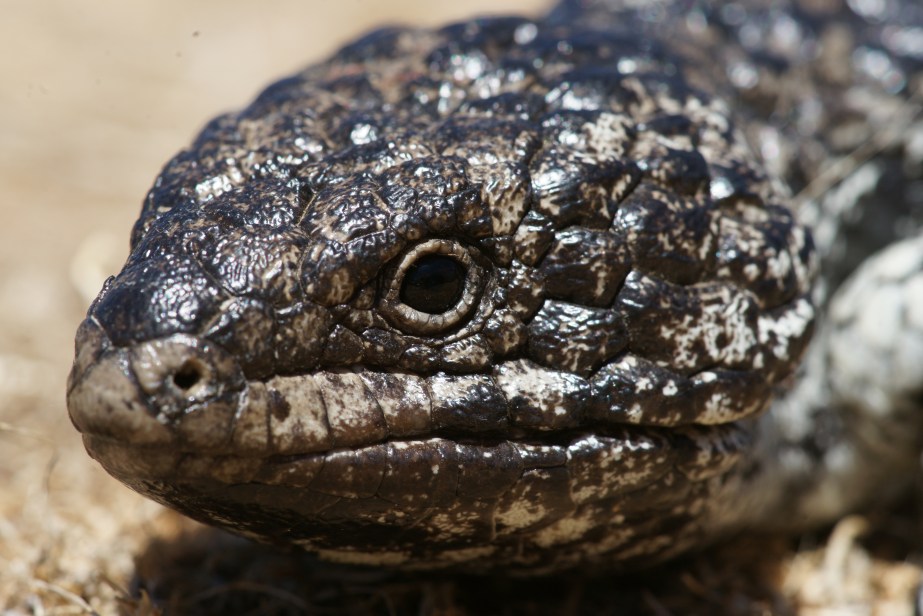
This one was out on my driveway enjoying the summer sun …
Shingleback

I live not far from Paradise and I can get there by bus.

Near here

Industry …

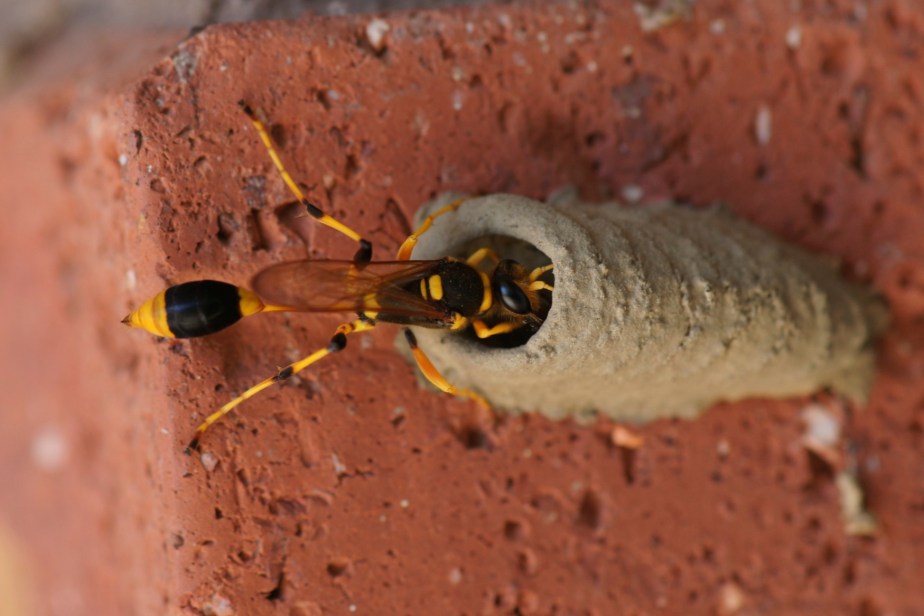
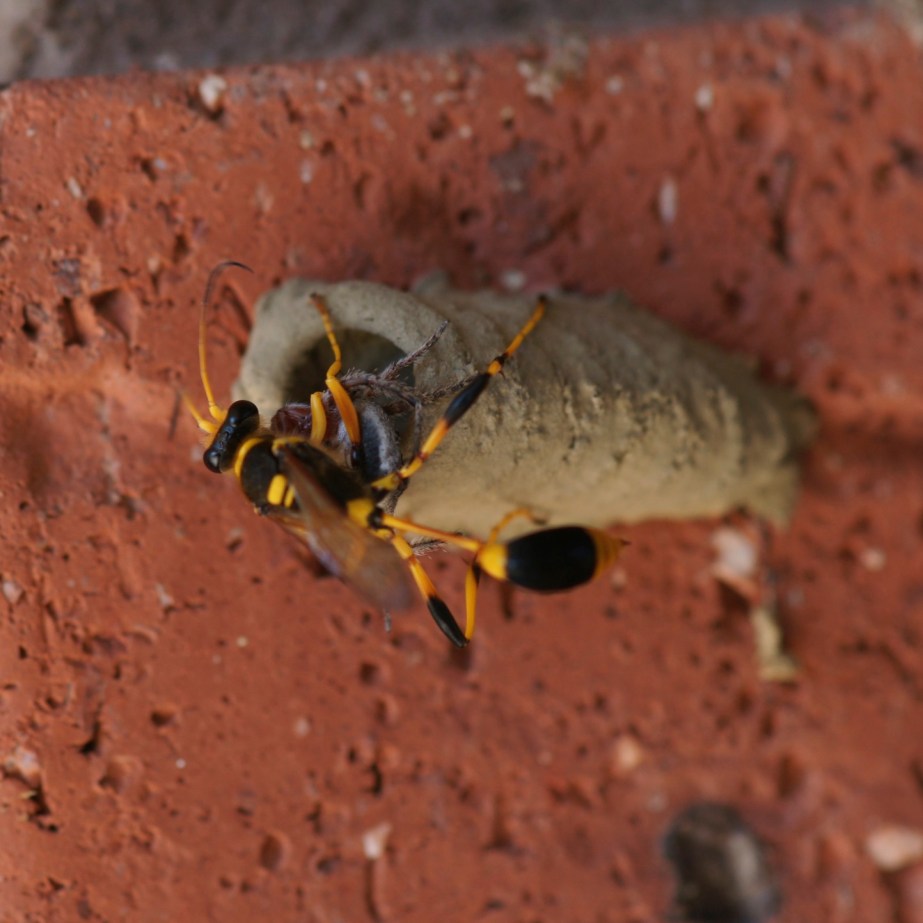
Since my house was built a number of extensions have been made, and not all by the owner. I have been watching a very busy lady make a few over recent days. Here she is.

PWat W

She starts by building a mud tunnel. She has several on the go. The next step is to find a nice juicy spider which she paralyses. It looks as though it weighs as much as she does.

PWPoW

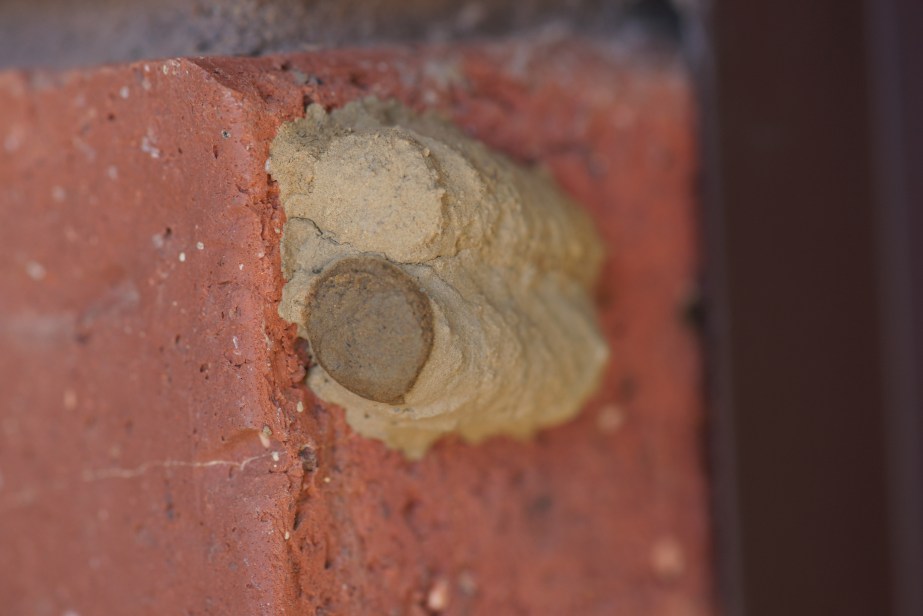
Several spiders are deposited in the tunnel. She then lays an egg in there and seals up the entrance. Here’s an adjacent pair of tunnels so recently sealed that the mud is still wet in one.

P W 2

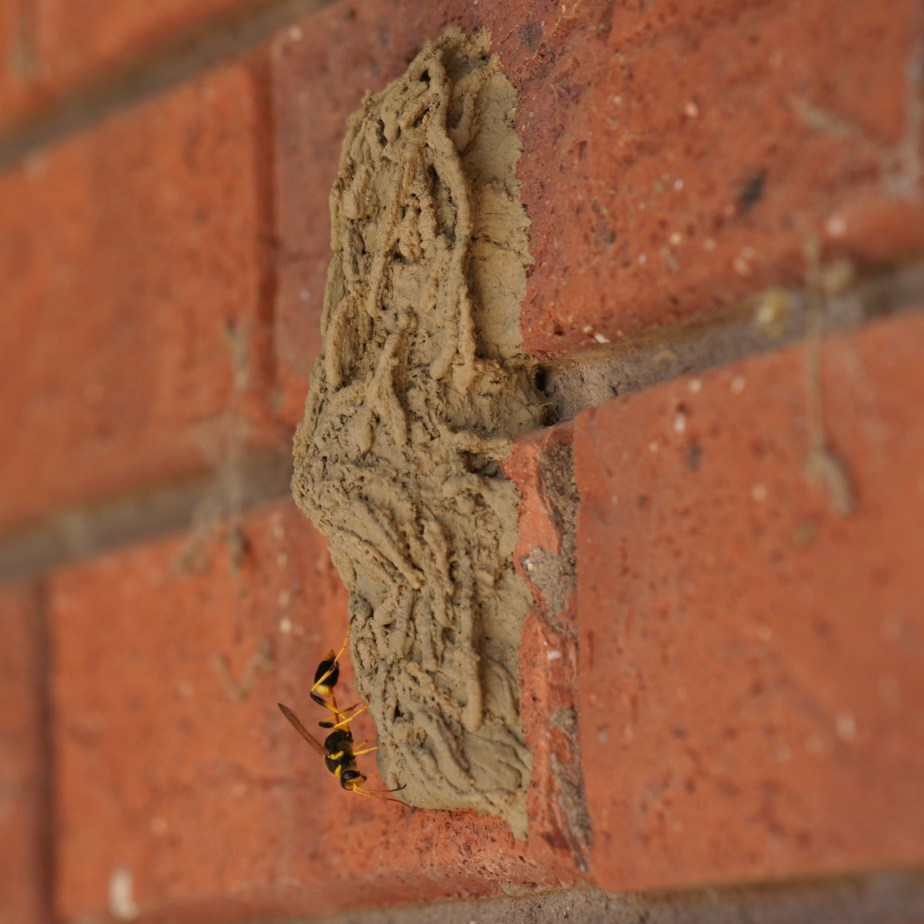
She goes on adding to this until she has a cluster two deep and four or five down. Then the whole thing is encased in a final render.

PWft

When the egg hatches the larva feasts on the paralysed spiders, a gruesome fate for the spider but one that neatly bypasses the need for refrigeration to keep it fresh.

My tentative diagnosis for this creature is Sceliphron laetum, the Mud Dauber Wasp. Apparently they pack a powerful sting but rarely attack. They are found throughout Australia and New Guinea.


Fort Grey to Menindee …
In one day we travelled the ground that Sturt had needed more than six months to cover, travelled further than William Wright’s resupply mission had in three months.

We took time out to poke around the rocks outside Tibooburra where we found this Euro guarding his patch …

Euro

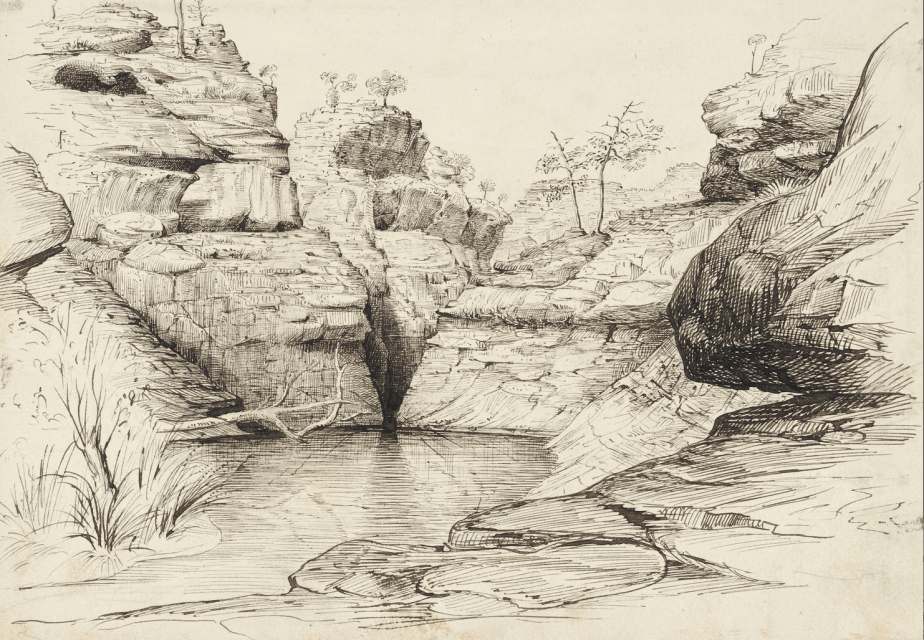
… and then headed south through the mining town of Broken Hill. Clearly a town whose street planners could not imagine anyone traveling beyond it. Every road in seems to peter out in a maze. Then down the Silver City Highway. We drove past the turning to Mutawintji where Becker had sketched the waterhole. Burke had taken a dislike to Becker and had done his damnedest to cause him to give up but Becker stayed on and sketched until his strength and then his life was lost.

Mutawintji - Becker


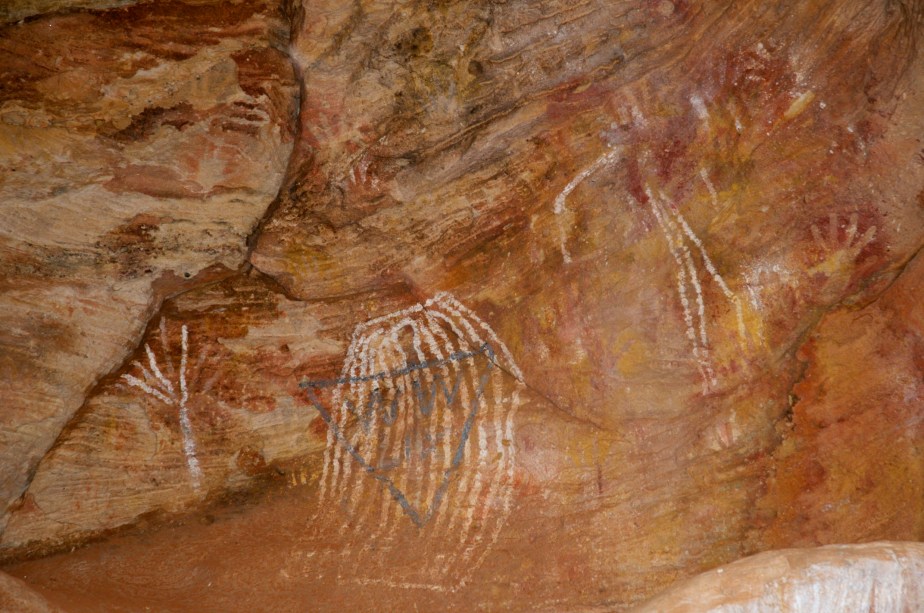
William Wright left his initials here. He was scapegoated in the enquiry that followed the Burke and Wills debacle. There were good reasons for the delay in setting off on the resupply effort but the effort itself was undistinguished. It’s hard to feel much sorrow for a man who would do this …

WW

We spent the night on the banks of the Darling in Kinchega National Park, we visited the homestead where William Wright was once the manager, we went to Lake Cawndilla where Sturt and his men, including the indomitable Stuart camped. We drove through Menindee where Burke, Wills and company had drunk at Thomas Paine’s hotel.

And the next day we drove back to Victoria.

The First …

A new calendar game starts.

You are in the game on January first. To stay in the game you have to add at least one species of bird to your year list for each day elapsed. A big day on the first makes you safe for a while. If you fall behind the days elapsed you are out. The last one to go out is the winner or by reaching 366 (it’s a leap year) there could be any number of winners.

My total last year was 386. An insignificant achievement when compared to Sean Dooley’s 703 in 2004. Sean wrote a book about that year called The Big Twitch. I get an acknowledgement in the book, not, I suspect, because of my enormous assistance but rather so I would buy the book. It worked.

This morning I was out of the house at 6 am. It was 24°C (75°F) already and would become hot and windy. It’s been a dry old time. One of the local hot spots is, by coincidence, Dooley’s Road. It backs on to the Maryborough (Victoria) sewage treatment plant and has some much abused remnant vegetation and I visited the sewage ponds as well. Plus some local box ironbark forest. I chalked up 50 species including Crested Shriketit, Little Eagle and the elusive Freckled Duck. No point staying out after noon. Safe until mid February. The Crested Shriketit has a viscous little hook on the end of its bill that it uses to tear away bark to get at the insects underneath …

Crested Shriketit

Playing the game with mammals wouldn’t get me through January but I did see Eastern Grey Kangaroo and Swamp Wallaby. Many prefer the name Black Wallaby for the Swampie on the grounds that it has no preference for swamps which is very true, but nor is it black. The scientific name is Wallabia bicolor, the two coloured wallaby. Also untrue, it’s dark brown with rufous around the ears and a whitish stripe on the face, the tip of the tail is often white. The poor creature stands in need of an appropriate name.

Swamp Wallaby

By all means join the game. Wherever you are in the world. Post your tally in the comments, I look forward to hearing from you.

Time for me to get back to the thrilling account of my trip through the desert …


Sturt …

At Cameron Corner it would be possible, if you can bend it like Beckham, to stand in South Australia and kick a ball slightly east of north that traveled into New South Wales, crossed into Queensland and then curved west back into South Australia. Or you could just have a beer at the Corner Store, a pub standing all alone in the desert.

When you cross the border into New South Wales you enter the Sturt National Park.

Charles Sturt left Adelaide in August 1844, travelled north to the Murray River, followed it to the junction with the Darling and then followed that north east. When he left the river it was to head north to Lake Cawndilla, close to modern day Menindee subsequently made famous by Burke and Wills. Sturt thought the river banks would suit graziers well and was proven right quite soon after his return.

From there the going became a lot tougher. His party made progress by scouting ahead until a suitable body of water was found and then taking up the main party with its livestock. Eventually they reached “a romantic rocky glen of basalt” on which Sturt bestowed the unromantic name of Depot Glen. The country was drying out quickly in the heat of an unusually dry summer. The water behind them was gone and there was none to be found ahead. They were obliged to stay put for six months. Exploratory trips were made and, knowing that the devil finds work for idle hands, Sturt had the men build a cairn on a nearby hill. Mr Poole died of scurvy at the Glen. The cairn became his memorial and the hill is now Mt Poole.

When the rains came Sturt took some of the stronger men and continued north west. He established a second depot in a spot that he called the Park. He left men here with instruction to build a stockade and a stock yard. Sturt made three sorties from here discovering and naming Cooper’s Creek on one, and penetrating into the heart of the Simpson desert on another. He had given instruction to David Morgan “to prepare and paint the boat in the event of her being required.” She was never required.

The stockade became known as Fort Grey, it stands by Lake Pinaroo which fills about once a decade and holds water for a few years. It provided Sturt with good feed for his livestock. It was our campsite for a night. These days it is grazed by Red Kangaroos …

Lake Pinaroo

But for some years graziers eked a living out of the land here. This steam engine brought water up from a bore out on the lake bed …

Bore head

A Central Netted Dragon visited us in the camp site …

Central Netted Dragon

Sturt was one of Australia’s finest explorers. As well as a national park he has a university named after him (from which I have a graduate diploma in ornithology) and Sturt’s Desert Pea.

Desert Pea

and this fine example made quite a splash …

Desert pee

Pub to Pub …

As beautiful as the waterhole on the Diamantina was, we could think of a far nicer place to get a drink.

Noccundra Hotel

When we strode into the Noccundra Hotel we were greeted by a huge dog with its forepaws on the bar. Its head was held on a quizzical slant as if to say, “What’ll it be?” It seemed a little early for a beer so I asked it for a ginger beer. The licensee emerged stage left and supplied the bottle. The dog evidently needed a bit more training.

The pub licensed since 1882 is the entire town. Fortunately it also sells diesel and unleaded petrol. If you were short of food it would be worth while asking what they could sell you from their stock.

It stands close to the Wilson River. The first time I went there it was very close, the river having overflowed its banks. This time it was in its normal place a couple of hundred metres away. Given the choice of a beer or any amount of water from the creek, spare a thought for Andrew Hume. He found himself in jail for horsestealing, his get out of jail card was the claim that he had met a survivor of the missing Leichhardt expedition living with aboriginals way out in the west of Queensland. In 1874 he was given the chance to substantiate his claim. Two of his party of three perished of thirst just to the west of Noccundra. Maybe he should have served his sentence.

The road south from here leads to the dingo fence where you can pass through the Warri Warri Gate into New South Wales. About half way to the border and less than 50 km off to the east is  Bulloo Lake. This is where the Burke and Wills resupply party led by William Wight lost three men. They were three months out from Menindee and had covered just 450 km. Stone, Purcell and Becker died, the remainder of the personnel were in bad shape. This was the furthest point for the party although Wright rode on with Brahe to have one last look for Burke and Wills at the Cooper.

We continued the pub crawl by taking a right turn north of the border and heading out to Cameron Corner. It’s the point where Queensland, South Australia and New South Wales meet. John Brewer Cameron banged a wooden post in here on the 30th September 1880. Given his middle name it is entirely apposite that someone decided to build a pub here. By tradition one drinks three beers, one from each state. Start with a Coopers, get that chore out of the way whilst your thirst is at its greatest.

If it were not for the accidental intersection of lines on a map it would be just a lonely place in the dunes left to the wildlife like this Brown Falcon …

Brown Falcon

Cordillo Downs …

We tore ourselves away from the Birdsville pub and headed south east. The Cordillo Downs Road leads into the heart of explorer country, the dig tree of Burke and Wills, Fort Grey of Sturt. Hallowed ground. Our route was a little indirect since we were aiming to inspect as many black soil crevasses as we could but our first objective was to get beyond the creek crossings between the Cadelga Out-station and Cordillo Downs station. There were thunder storms all around us, showers had preceded us and more were coming.

Although the creeks running into the desert are usually dry the occasional rains are enough to bring life giving water into what seems a sterile landscape. The creek lines are marked by trees, in between there is mostly no vegetation.  Once we had crossed the last of the channels we camped on the gibber (pronounced with a hard G as in get not like a J) and woke to a glorious blue sky.

Gibber

This is Sturt’s Stony Desert …

The stones, with which the ground was so thickly covered as to exclude vegetation, were of different lengths, from one inch to six, they had been rounded by attrition, were coated with oxide of iron, and evenly distributed. In going over this dreary waste the horses left no track, and that of the cart was only visible here and there. From the spot on which we stopped no object of any kind broke the line of the horizon; we were as lonely as a ship at sea, and as a navigator seeking for land, only that we had the disadvantage of an unsteady compass, without any fixed point on which to steer.

The creek line intrudes into the top right of the photograph and here we found Bourke’s Parrots and these little guys …

Budgies

… before we pressed on to pass the largest woolshed in the southern hemisphere. It was built of local stone in 1883. It’s not a case of how many sheep to the acre more a case of how many acres to the sheep. These days the sheep have given way to cattle. The last time a bale of wool was pressed here was about 1942.

Our objective that day was the Diamantina River which we crossed at a point where it fans out into a multitude of channels, mostly dry, with a maze of lignum swamps in between. We camped close to one of the billabongs …

Diamantina

After crossing the Simpson Desert by camel, Cecil Madigan also camped by the Diamantina, not at this spot but one rather like it …

It was cloudless and calm. I lay in my bed on the bare ground above the steep bank, just beyond the thin line of trees that edged the waterhole. The moon was high, but its light was already paling and the shadows were gone. Orion still rode the skies, but the glorious morning star in the east was heralding the approach of the bold sun. The sky still held the dark blue of the night, but towards the east it changed to dove grey, then light grey and finally to a strip of tangerine that lay low on the horizon.They were not the brilliant colours of sunset clouds, but the most delicate hues of the sky itself. The black trees were silhouetted against these lovely tints. Gradually the stars faded and the mystic moonlight withdrew as night crept silently away, and objects took their true shape and distance in the hard light of day. A squawk was heard here and there in the trees, and soon the clouds of cockatoos came to life and filled the morning with their harsh screeching, tearing away the last soft veils of night as the sun came up.

The desert has a truly awful beauty but it’s water that brings it life.

Of Camels and Cars …

Dromedary

The Victorian Exploring Expedition known to posterity as the Burke and Wills Expedition was the first in Australia to make significant use of camels. They proved to be very suitable for use in the arid zone and went on to play a fascinating role in the early days of settlement. But the camels imported for that adventure were not the first in Australia or the first used for exploration. That honour goes to Harry.

Four camels were purchased at Tenerife in the Canary Islands and shipped to Adelaide. Three died en route, Harry was the sole survivor. On the 12th October 1840 Harry became the first camel in Australia.

In 1846 John Ainsworth Horrocks set off astride Harry to find new agricultural land near Lake Torrens in South Australia. Harry was not a well behaved camel and had soon inflicted injuries on one of the goats taken along for food as well as on the man who was supposed to cook the goat, but that was just the beginning. On 1 September Horrocks was preparing to shoot a bird on the shores of Lake Dutton. The kneeling camel moved while Horrocks was reloading his gun, the gun discharged.

Horrocks wrote two letters after the accident. The first was to his family and the subscribers to the expedition apologizing for its early termination. The second relates the chain of events that led up to the accident. The letters can be seen on this South Australian Website, and to think that people criticise doctors’ hand writing. Although, in defence of Horrocks it should be said that the discharge had blown off the middle finger of his right hand before entering his left cheek and knocking out some of his upper teeth. He died from his injuries. Harry was executed for his crimes.

Saddles came with the camels. They were traditionally stuffed with vegetation. Many of the exotic weeds of Australia’s arid zones were introduced that way, including the Paddy Melons.

Since there were few people in Oz that were experienced in the handling of camels cameleers were also imported, many from Afghanistan. They, too, played a fine role in developing the arid zones. The train that links Adelaide with Darwin was named the Ghan in their honour. That is a trip that should be on my bucket list, yours too, you can book online.

Cadelga Outstation

Cars are more reliable than camels and these days have largely replaced them. Although they are not without their problems.

The biggest problem in the arid zone is rain. Heavy rain can render your 4WD immobile. There is little you can do if you are caught out but wait. Therefore make sure you have plenty of food and water for any outback trip and some means of communication that is not dependent on a mobile phone tower. Satellite phone is first choice although HF radio will still answer the purpose.

Here comes the rain

I have found country pubs to be valuable sources of beer and also to be very accommodating with weather forecasts. At Innaminka one time the bar staff advised me to either leave immediately or camp near the pub. If I didn’t make the bitumen that day I wouldn’t be going anywhere for a week. They hoped I would stay. Information centres in outback towns will also print you off a weather forecast although they’re not so good with the beer.

The best defence against mechanical failure is proper maintenance before leaving home and your radiator needs to be protected from animal strike by a robust bullbar. Leave word of your intended route with a friend. Drive according to the condition of the road. Should you become stuck despite all this then stay with your vehicle.