From the Tiwi Islands to Darwin was an easy overnight cruise. We had an appointment with the pilot for first light.
The travel company that managed the cruise was Zegrahm Expeditions and, as always, they added a great deal of value to the product. The cruise director made sure that we had the opportunity to extract the max and he was well supported by guides who really knew their stuff. They included Chris Done who had been the regional manager for the state’s Department of Conservation and Land Management, Terry Done, a marine biologist, Shirley Campbell, anthropologist from ANU and Brent Stephenson, a first rate ornithologist.
The ship was part of the Coral Princess fleet, first class facilities and a wonderful crew.
Off the ship early and flying late; what to do? Go birding.
The only disappointment of the day was finding a new fence around the Palmerston sewage ponds, you can no longer see the birds that it attracts. Yet another sewage pond falls by the wayside, every one of them a sad loss.
The Tiwi Islands are in Australia’s Northern Territory about 100km north of Darwin. There are two large inhabited Islands, Melville and Bathurst and nine small uninhabited islands. The largest settlement is Wurrumiyanga on Bathurst Island with a population of about 1500. From there Melville Island is a short car ferry ride away.
The Tiwi are aboriginal folk that have a different language and some significant cultural differences from their neighbours in Arnhemland, the nearest part of the mainland. Local Government is the responsibility of the Tiwi Land Council, an outsider needs a permit to visit. This is true of a number of areas under aboriginal control. As an Australian I always find it odd that I need a permit to walk down an Australian street, a Tiwi Islander doesn’t need one to walk down my street. But hey, I had one, and the Tiwi guides made us very welcome.
Wurrumiyanga is a tidy little town of well maintained houses and gardens. We had the opportunity to visit three art galleries, the museum and the church. Along the way we got to see kids at a school that could have been anywhere in Australia.
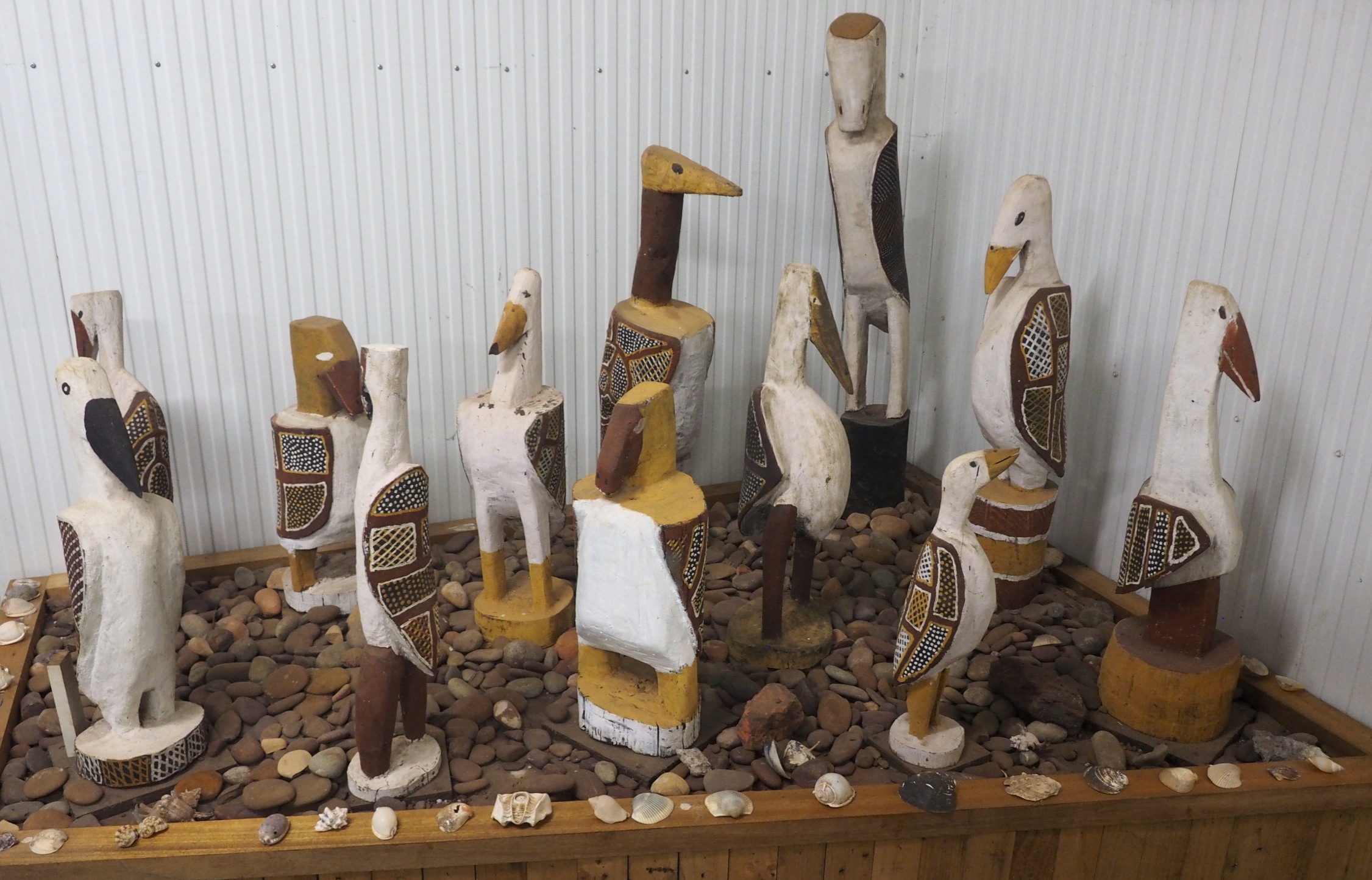
The strongest feature of the local art was, I thought, the carving which often featured birds. Here are some housed in the museum but there were many fine examples for sale.
Carving has its greatest significance in the Pukumani which are carved for the dead. The Pukumani poles are carved by men selected by the deceased’s family but not closely related. They are placed by the graveside in a ceremony that takes place two to six months after burial.
Some of the beautiful designs are also committed to fabric by a technique similar to batik.
As well as their indigenous culture two outside religions have been adopted … Aussie Rules football and Catholicism.
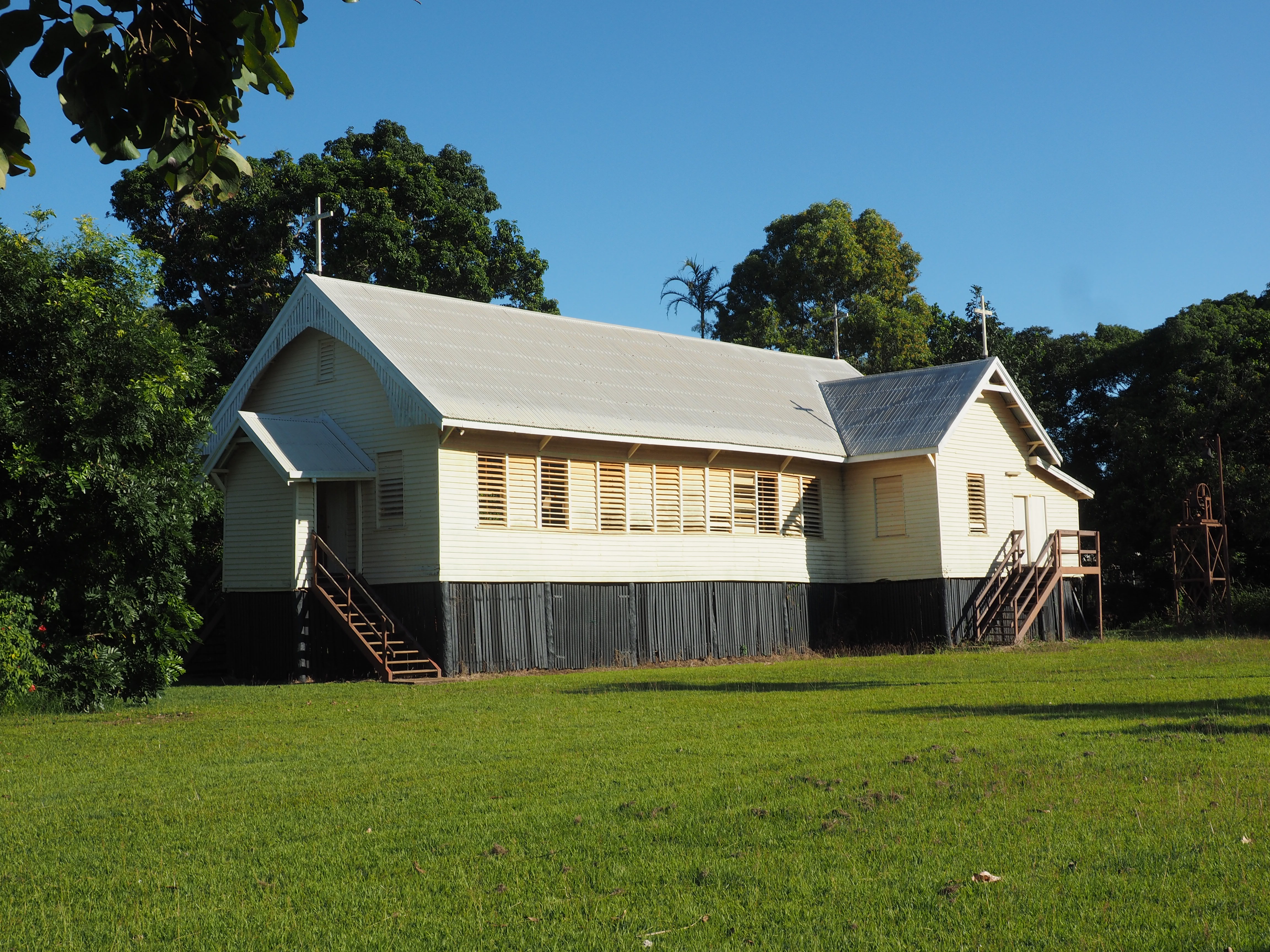
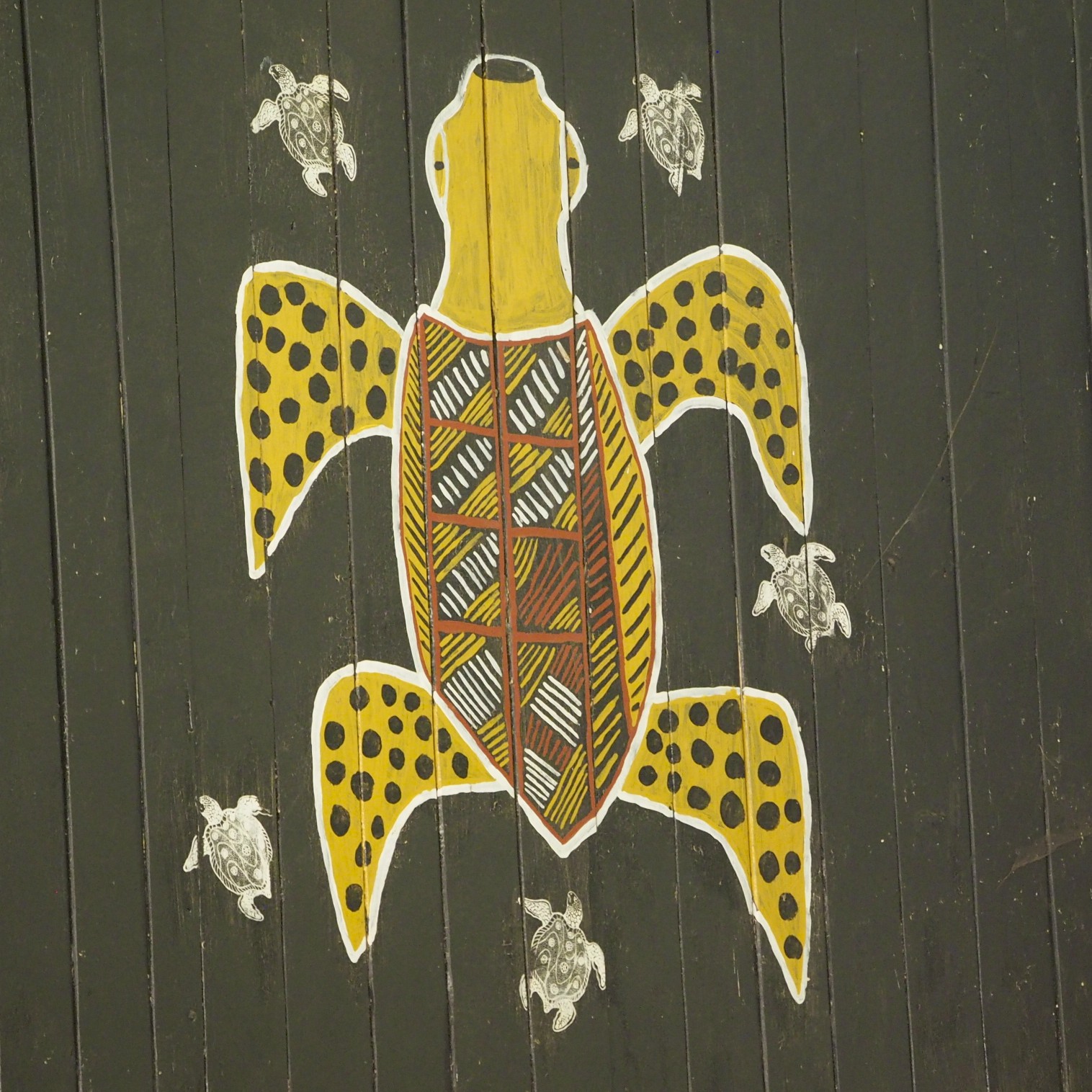
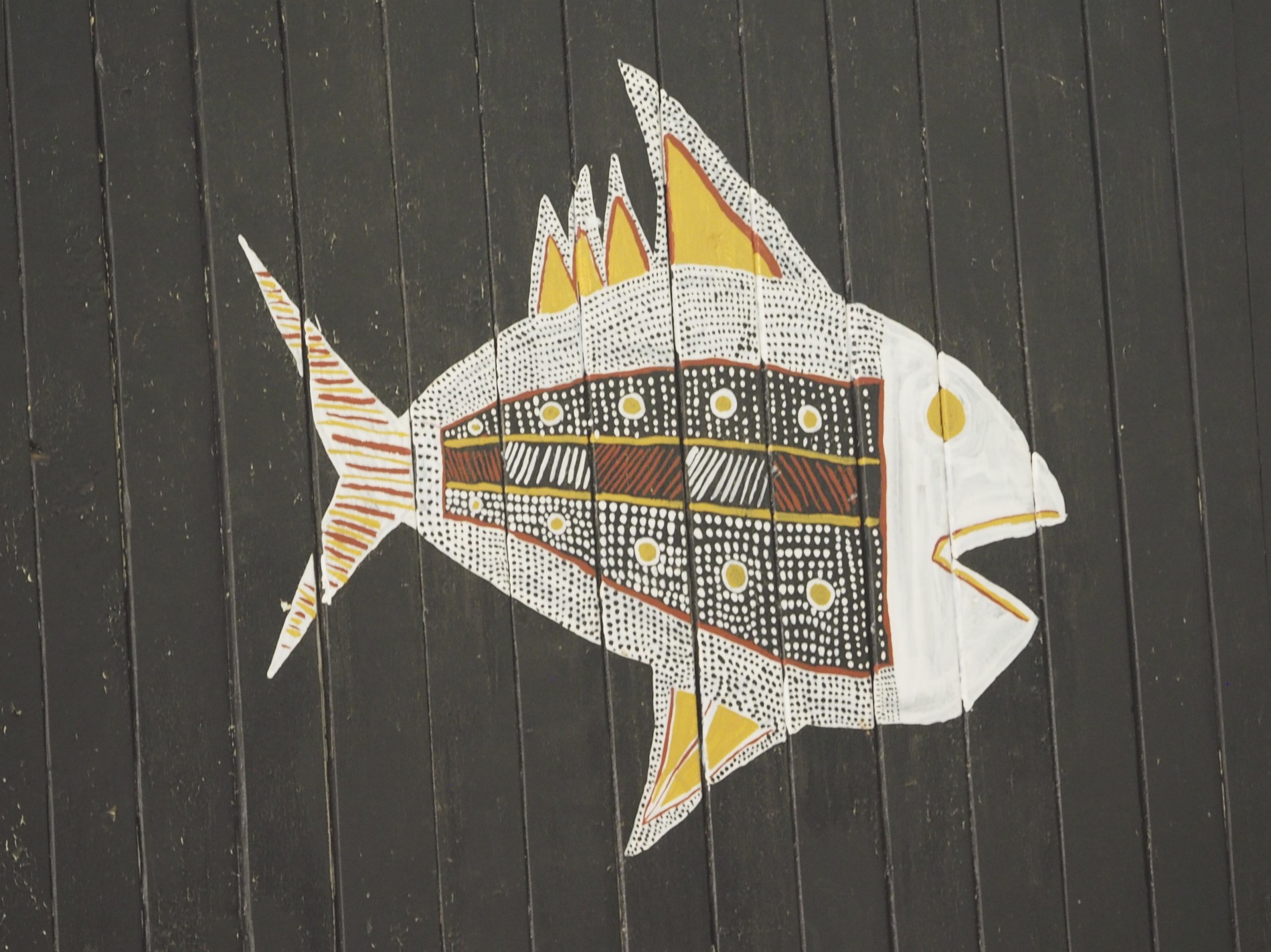
Catholicism came first, Father Gsell founded the mission in 1911. The Church is rather lovely with the interior decorated in the local style.
Panels behind the altar …
Standing next to the church is a little radio shack. From here Darwin was warned of impending bombing raids during the Second World War. Local people also captured a Japanese pilot during the war as well as assisting in the rescue of some friendly combatants.
Combat these days is on the footy field. The Tiwi have taken to Aussie Rules with a passion, about a third of the population are active participants in the local league and some of the great AFL names learnt the basics right here, including Michael Long and Cyril Rioli.
The last activity on the agenda was tea and some traditional dancing. Here is one of our guides ready to impart some culture …
I hope that it’s obvious to anyone who has read this far into the trip that I get a great deal of pleasure from this sort of travel. But if I had to say what is the most important component of it all I would say the wildlife. And if pressed to be even more specific it would be the birds.
My hope was that I would get a look at the Kimberley Honeyeater, it would have been the only likely chance of a new species for my Ozzie list. It was not to be, I will have to go again. I’m glad to have done the cruise but next time it will be 4WD again, it is far more productive in wildlife encounters … of every sort except hopefully crocodiles.
But before leaving the Kimberley let me share a little more of the flora and fauna that I caught up with.
Caspian TernLesser Crested Tern
Native Hibiscus
But the cruise ain’t over yet, we now have to turn the corner and cross Bonaparte Gulf en route to the Tiwi Islands. The gulf, commonly known as Blown Apart Gulf, has an ugly reputation.
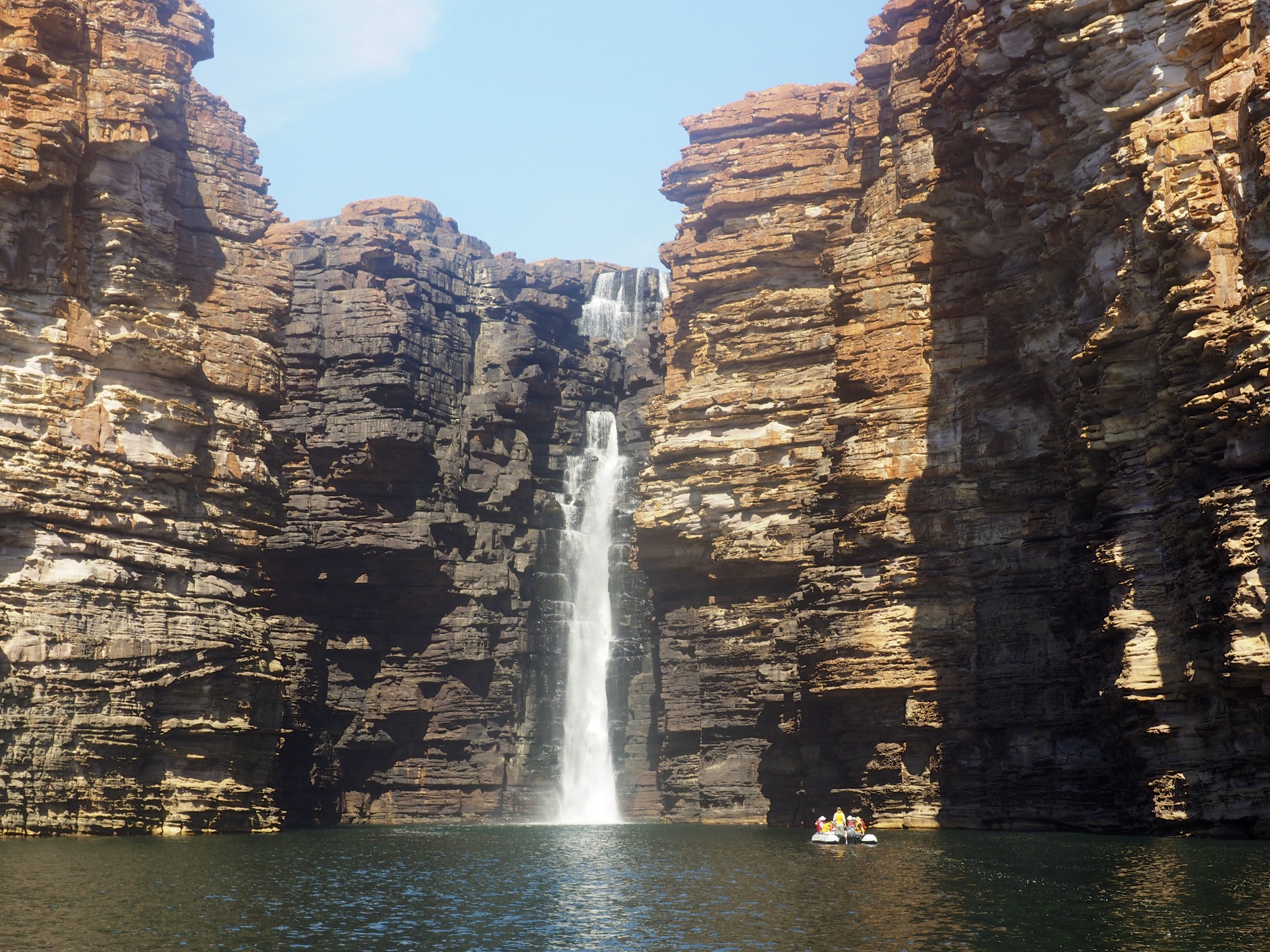
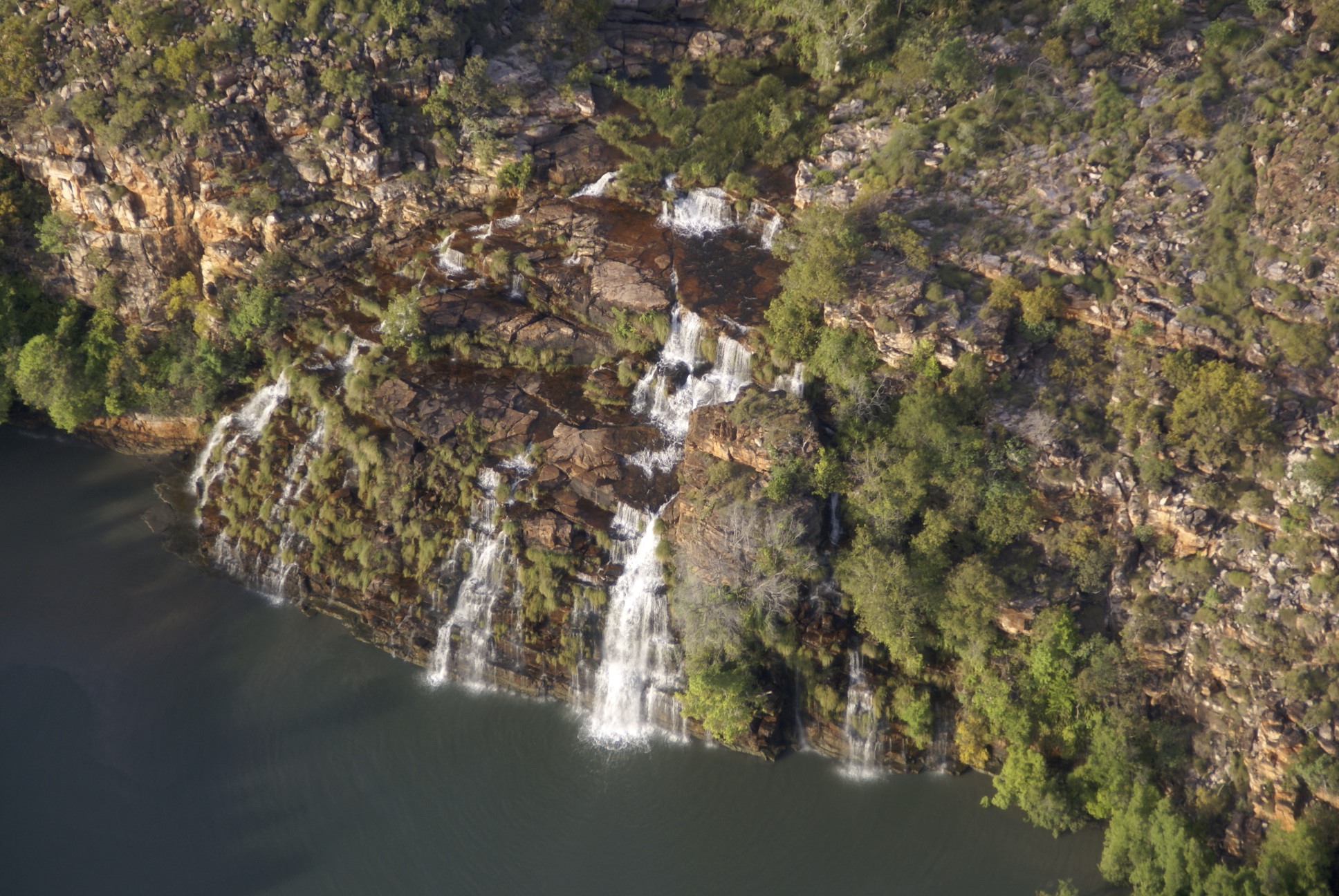
The Kimberley cruise was rapidly approaching its end but there was one last splendour to see, the King George Falls. These tumble from the top of 100 meter high cliffs into tidal waters of, neatly enough, the King George River.
Not named after that King George who lost America to the unwashed rabble living there but King George V who gave us the house of Windsor. Prior to 1917 the Royal House was called Saxe-Coburg but the activities of his first cousin, Kaiser Wilhelm II of Germany was attracting some opprobrium so he changed his name.
As well as taking a zodiac cruise directly under the falling water we also climbed a steep path to the top.
The catamaran down below was a Seawind 1200 and at that moment I could not imagine a more perfect fit between place and mode of transport. Sit me there and pass me a beer.
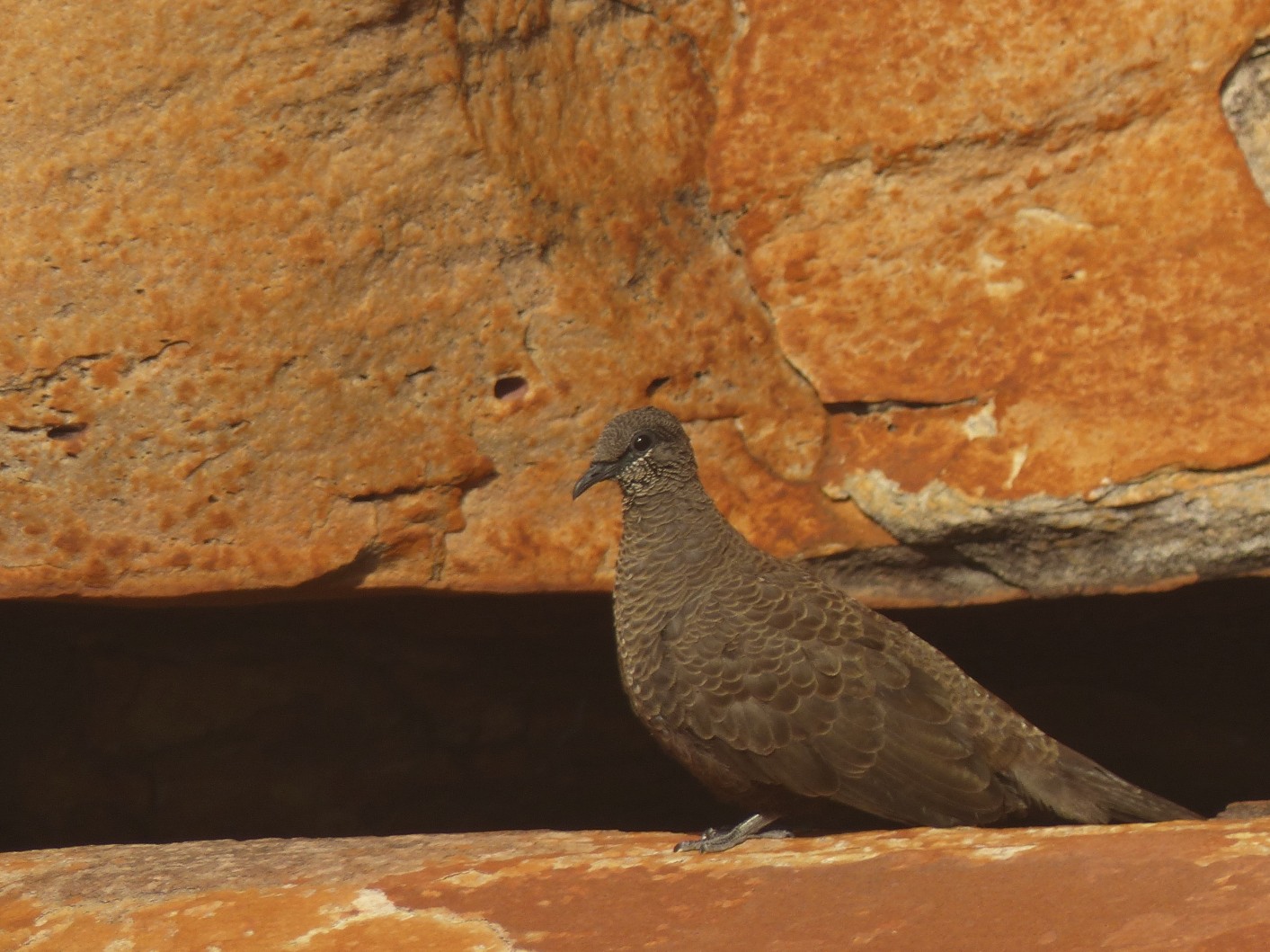
Waiting for us just a few metres from the edge of the falls was a very cooperative White-quilled Rock Pigeon …
Good King George would doubtless have shot it, having despatched over a thousand pheasants in six hours on 18 December 1913. Other notable achievements included shooting 21 tigers, 8 rhinoceroses and a bear over 10 days in Nepal, what a guy.
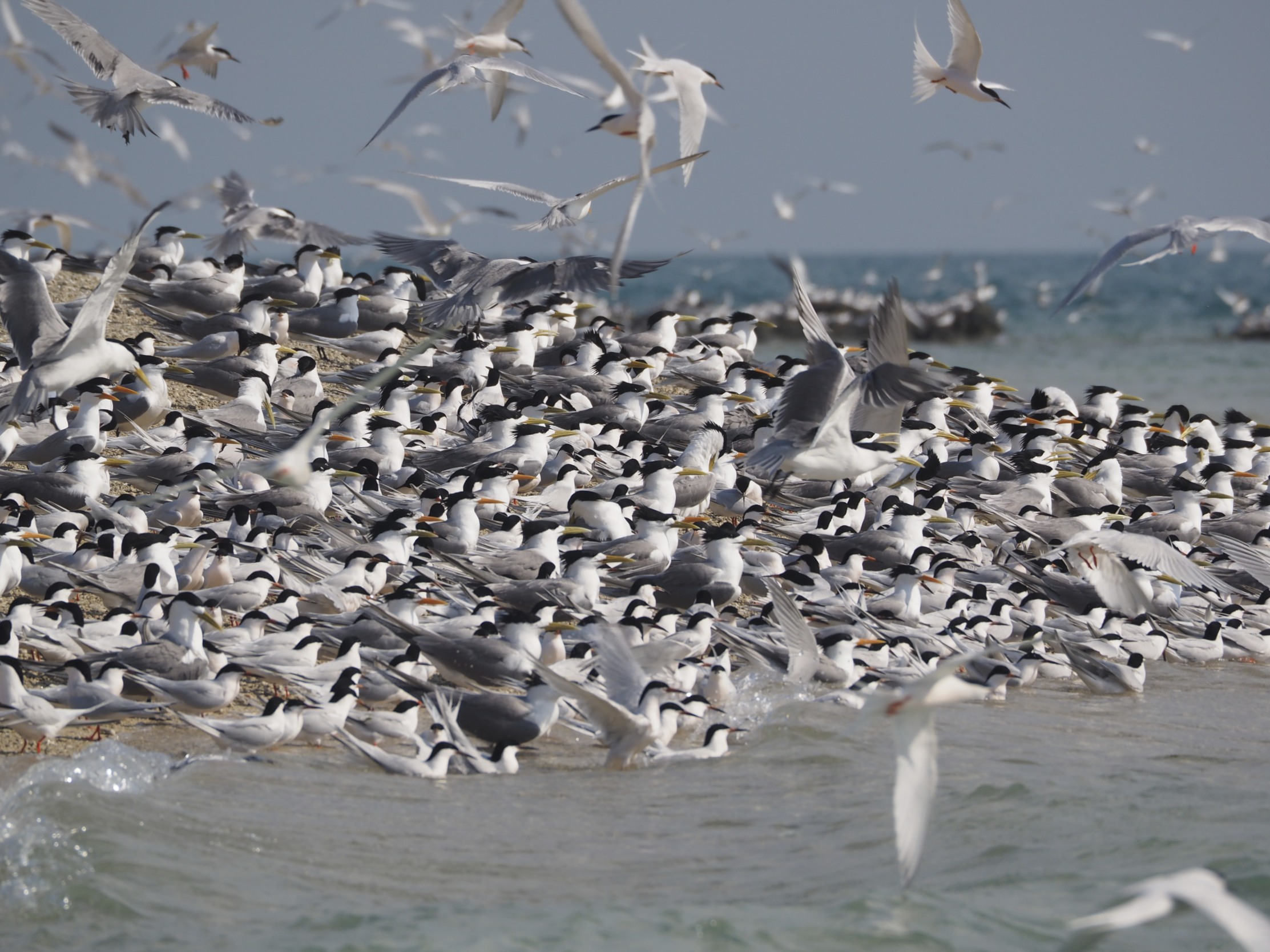
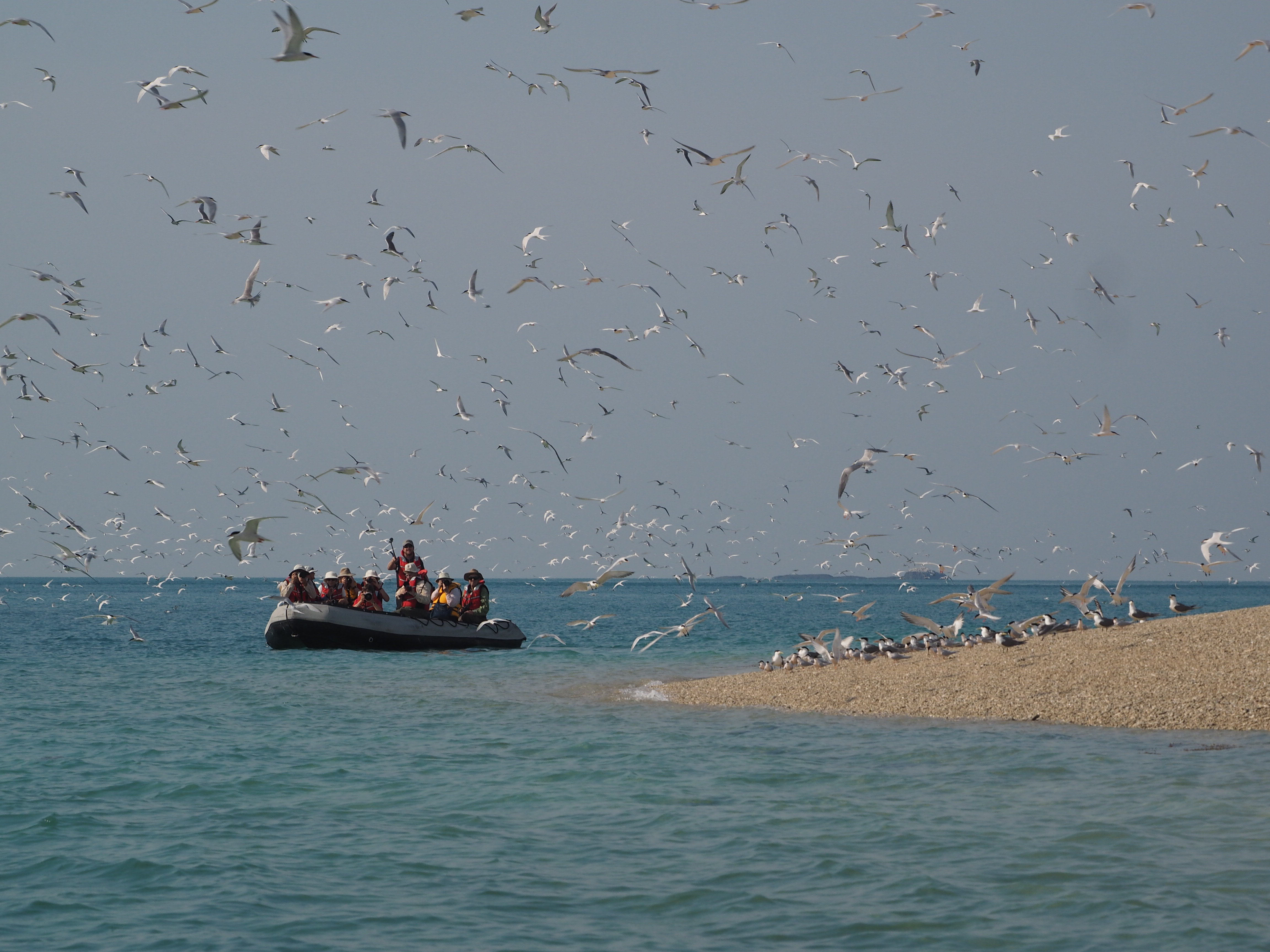
Not far from Bigge Island was, for me, one of the highlights of the Kimberley trip, Sterna Island. If you click on the photo it will fill your screen and you can try your diagnostic skills. There are three species of Tern to be found. If you find a fourth let me know. The back arrow in your browser brings you back to this page.
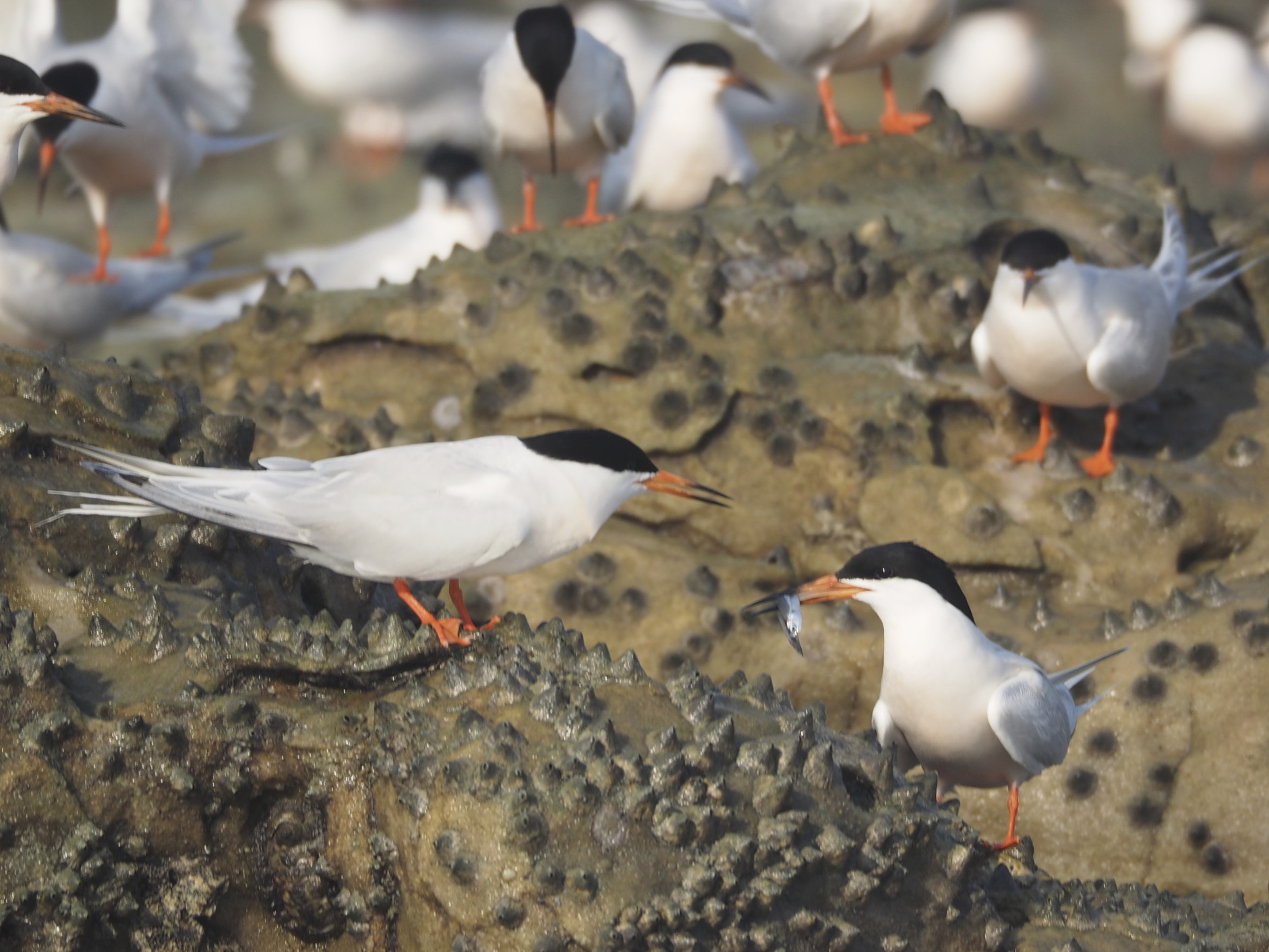
There were many thousands of breeding pairs of terns. Plus a pair of Peregrines that could have lunch whenever they wanted and one did before our very eyes. A White-bellied Sea Eagle also flew through causing a fair bit of mayhem. But it was mostly about the terns. The Roseate were in peak breeding plumage …
The presentation of a fish serves the same purpose as a rose on Valentines day.
The next photo shows Crested and Lesser Crested Terns in the one view. To tell them apart just remember the Crested has a bill the colour of Lemon peel, the Lesser Crested has a bill the colour of Orange peel …
Birds just bursting with energy. You have to click on this one …
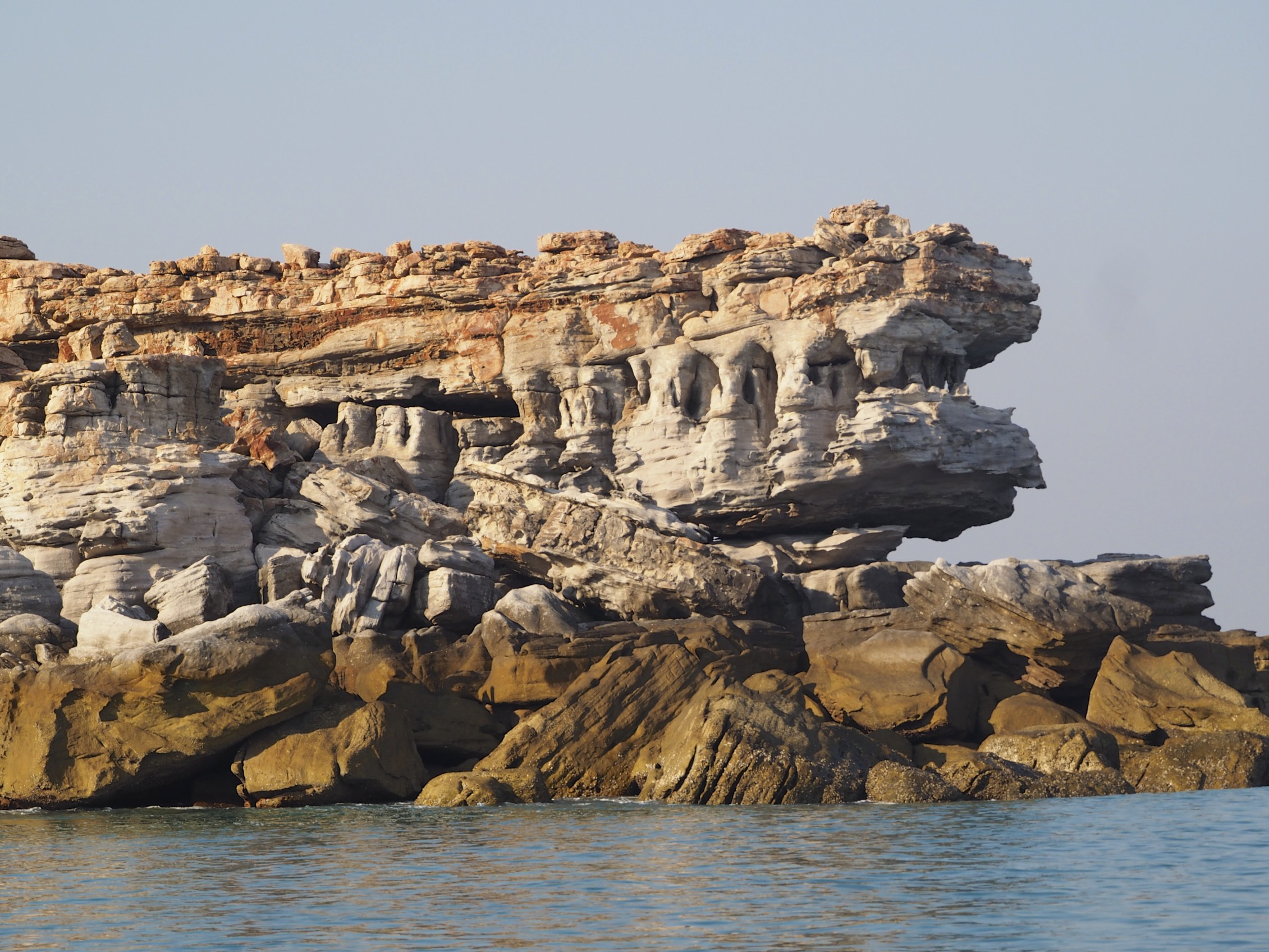
Another big day in the Kimberley. May 3rd started out with a boat trip past Crocodile Rock …
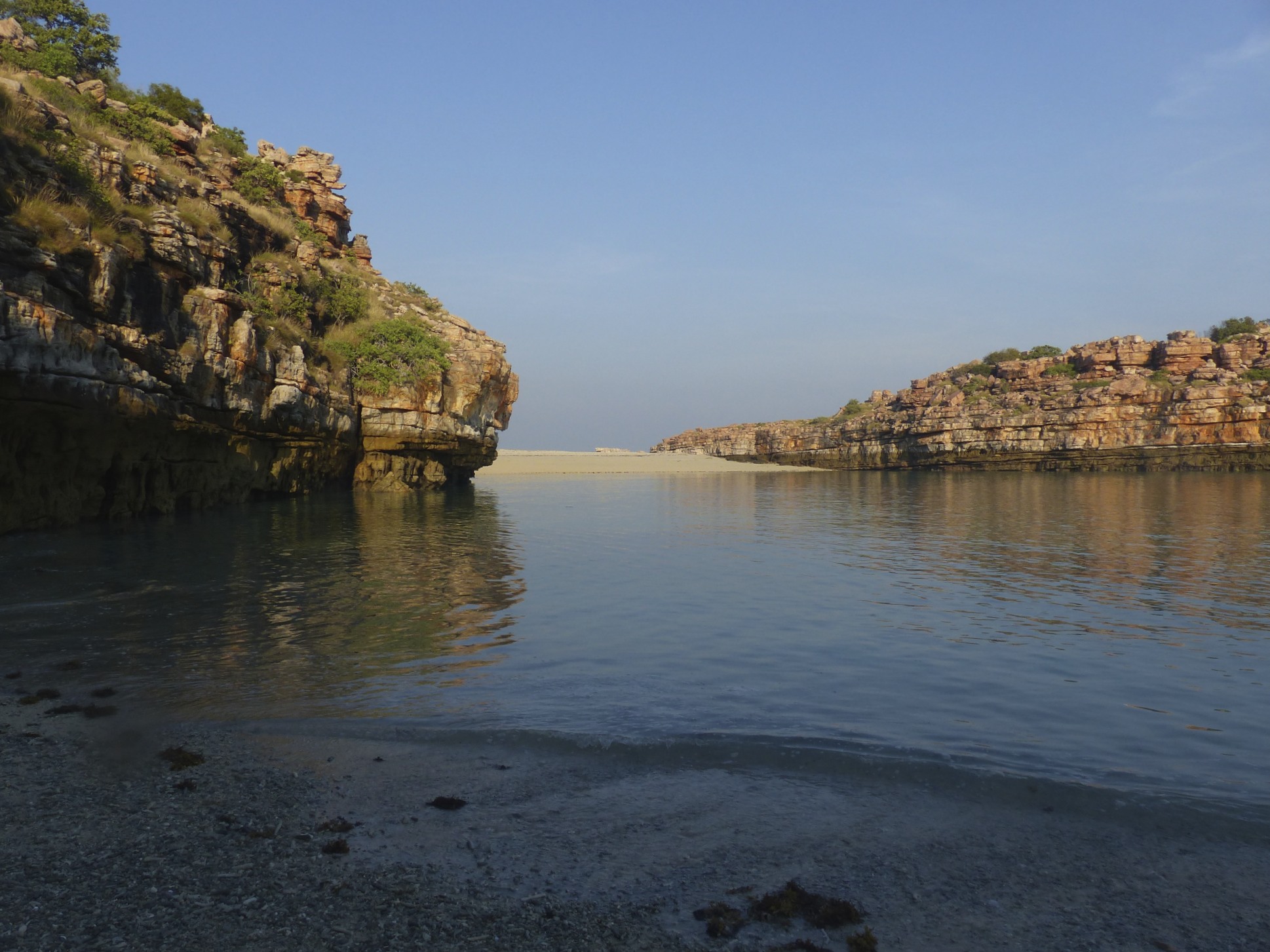
to a little cove …
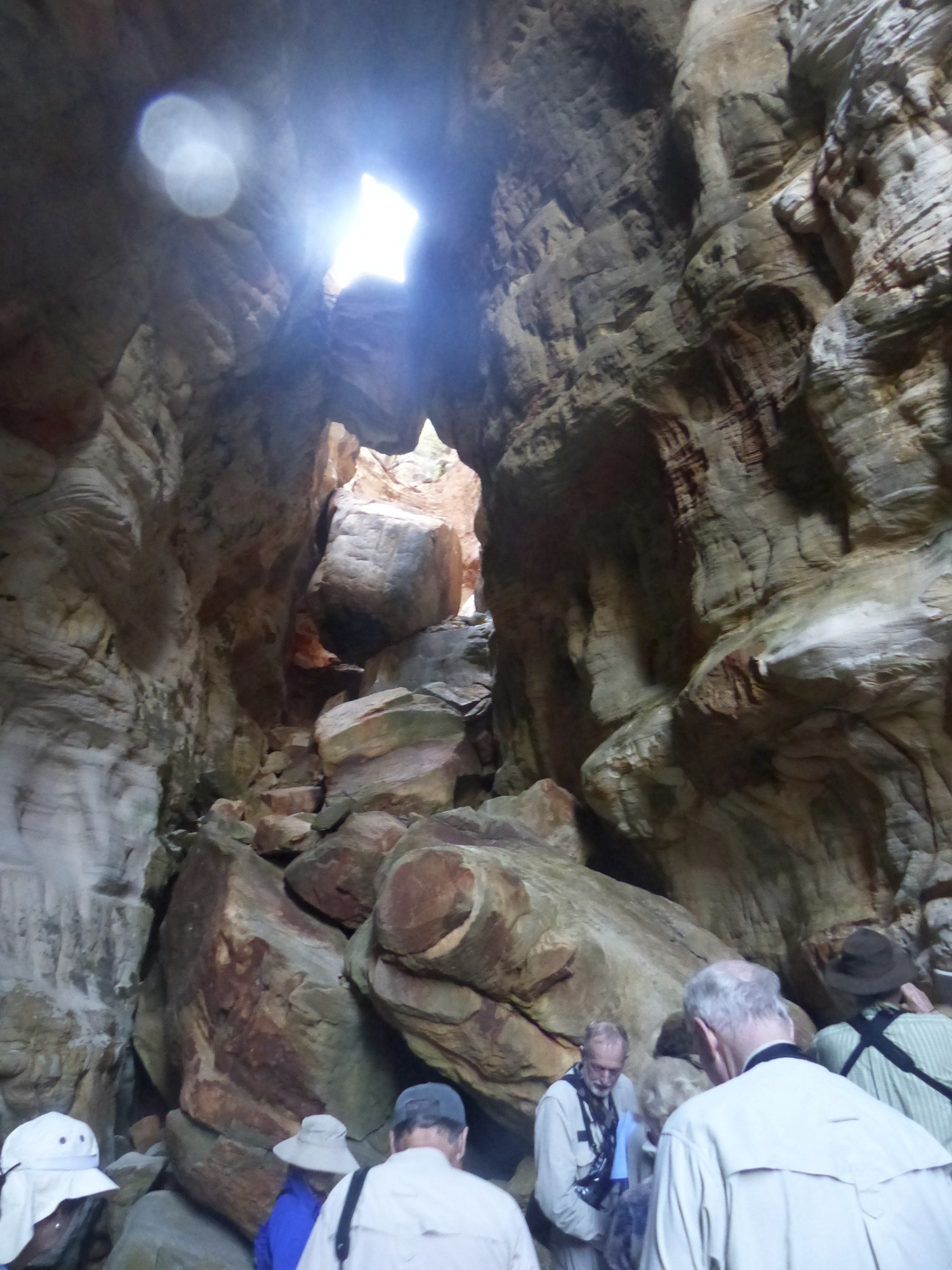
in which, at low tide, there is the entrance to a natural cavern …
It was a day spent in the vicinity of Bigge Island, not a lot of other people around but a place of significance to people for probably some 65 000 years. Here is a ceremonial ground, a place where initiations and significant cultural activities would have occurred …
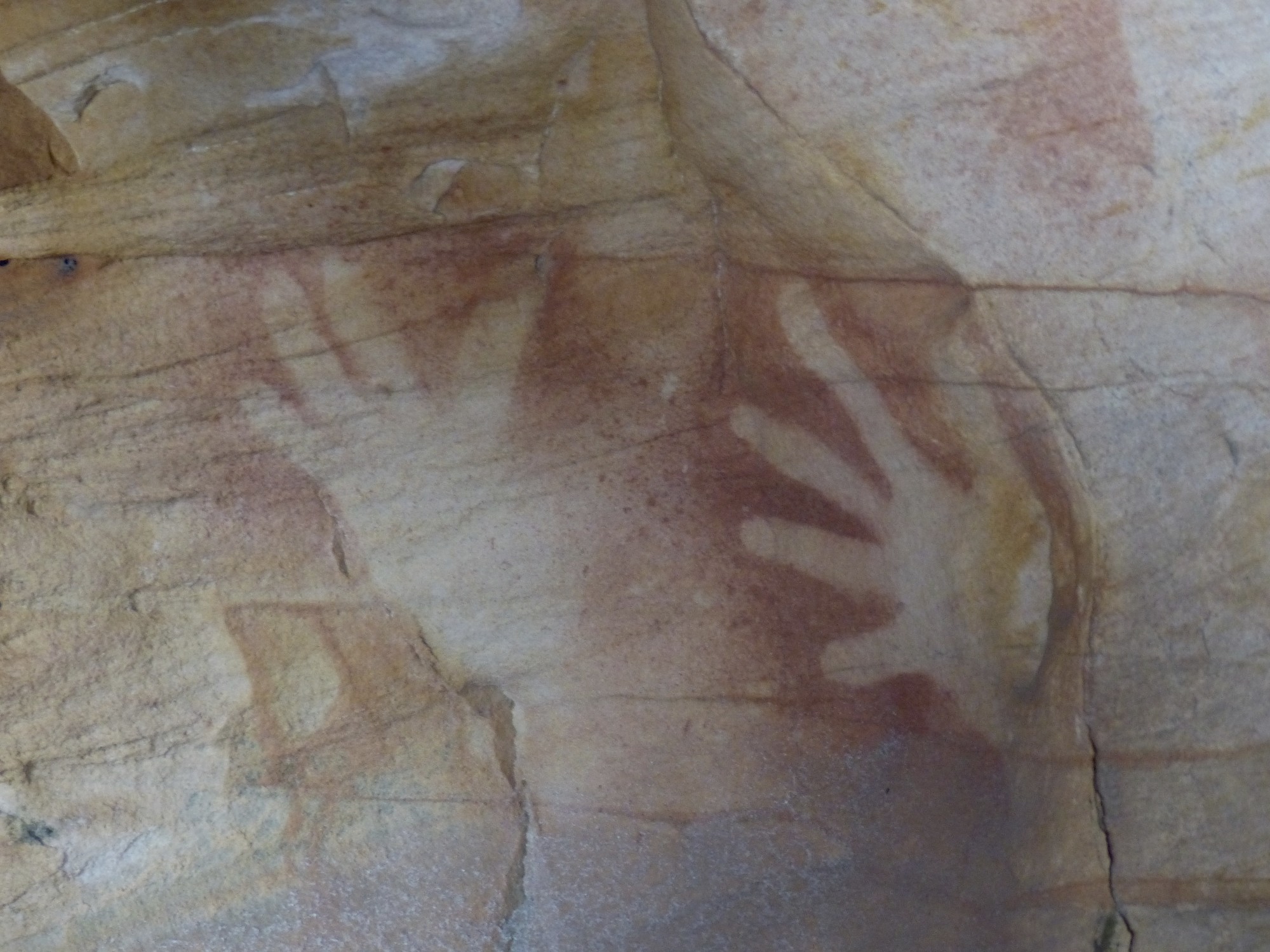
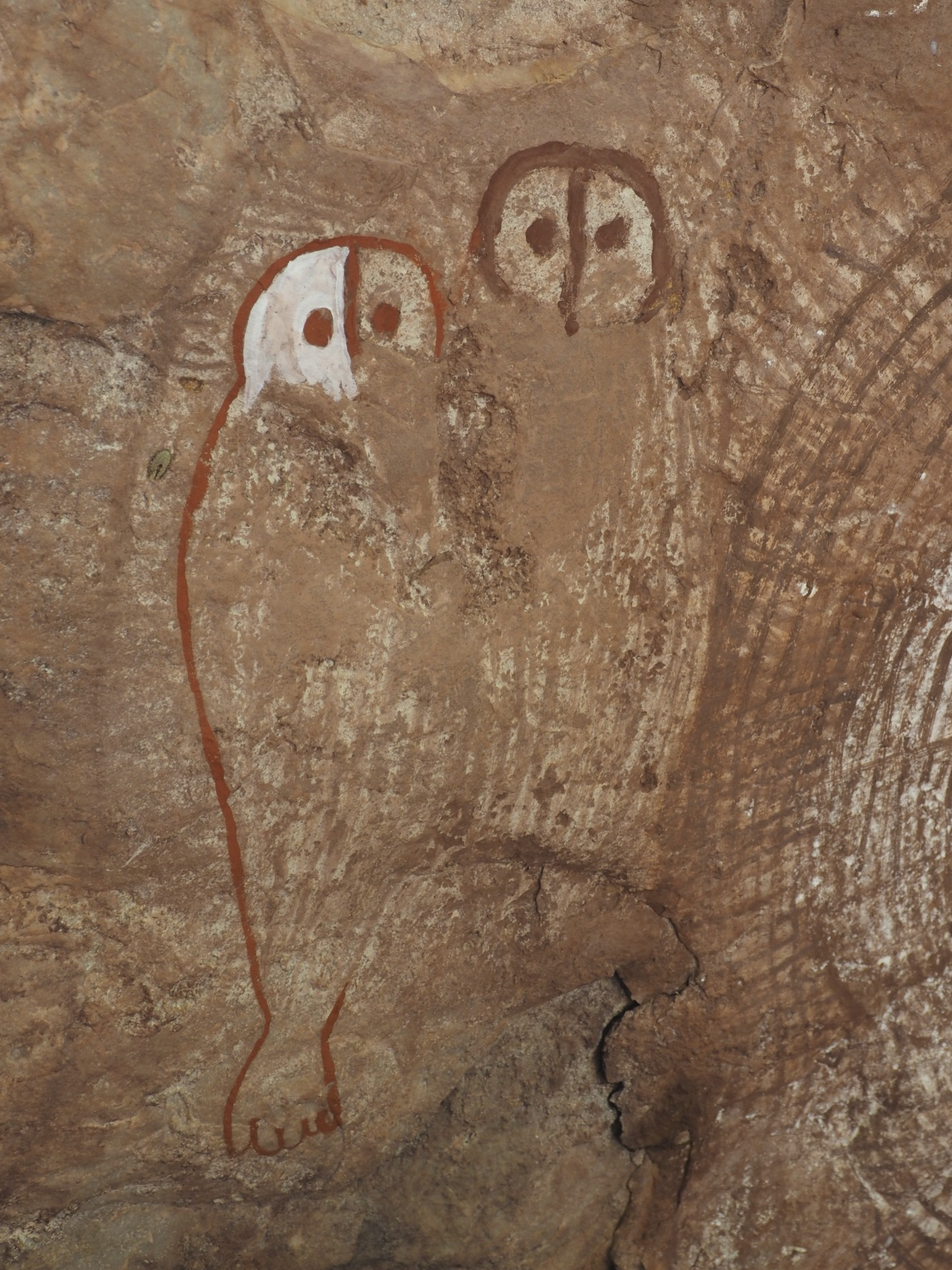
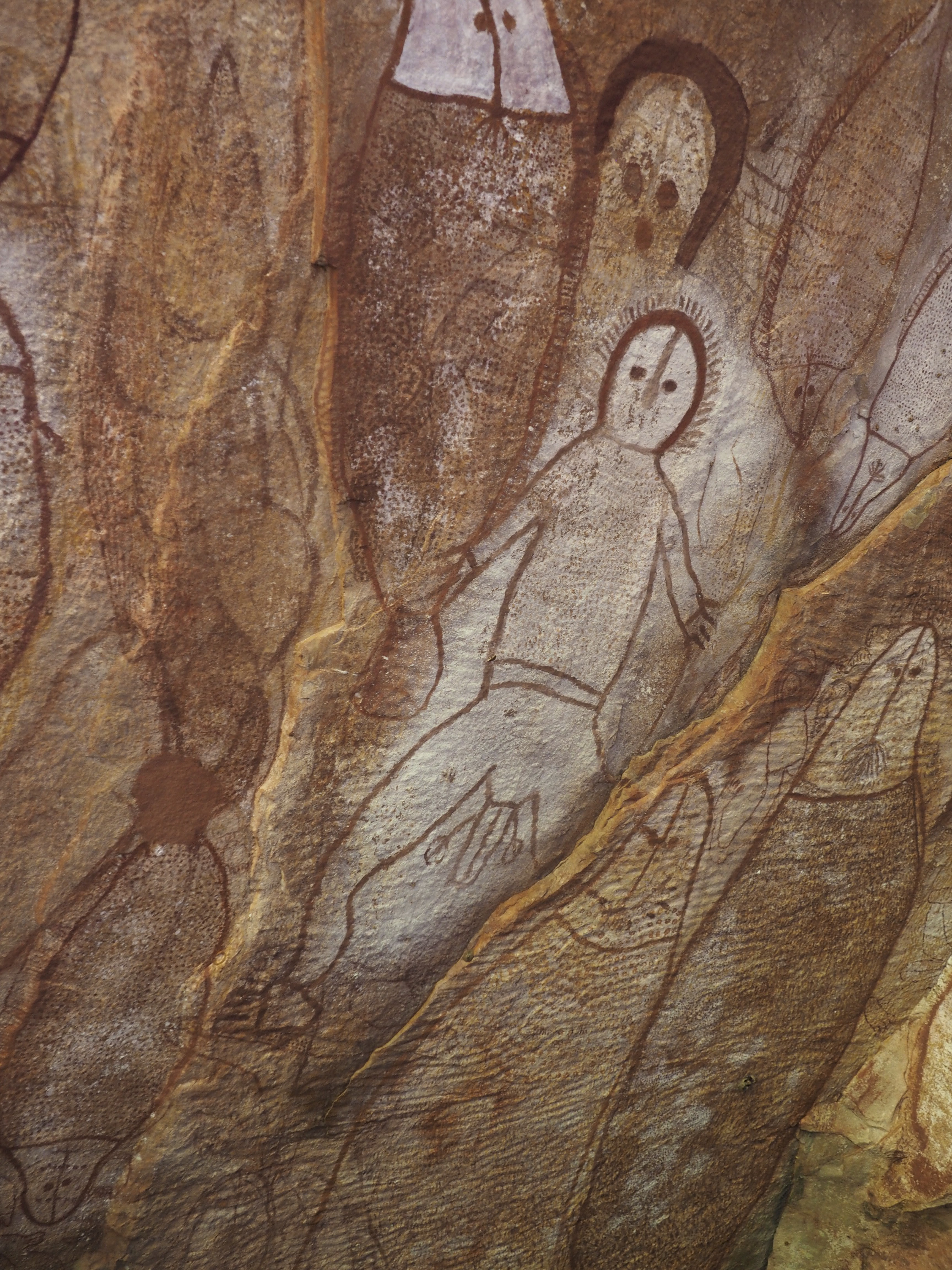
In that one day we were able to see three styles of rock painting. The Wandjina style is a living tradition, the most prominent theme is the Wandjina itself …
… but other dream time figures and animals are also depicted. Hands are popular.
These in-filled kangaroos are beneath an overhang that is not suitable for habitation and may be an example of an older style …
Most intriguing of all though are the Bradshaw figures. Not only are they elegant, they are shrouded in mystery and have an interesting recent history. There existence was made known to the European world by Joseph Bradshaw who discovered them in 1891 whilst searching for a suitable place to run some cattle. He was familiar with the Wandjina style and recognised these figures as something quite different.
He wasn’t carrying a camera and the exact location was hard to record. The pastoral enterprise came to nought and so when he later came to address the Victorian branch of the Royal Geographic Society all had to show was his sketches. His enthusiasm for the fine detail and an aesthetic worthy of ancient Egypt elicited a lukewarm response.
American archaeologist Daniel Sutherland Davidson in a survey of Australian rock art published in 1936 was dismissive, pointing out that Bradshaw’s encounter with this art was brief and lacked any Aboriginal interpretations, his sketches were likely inaccurate and drawn from a Eurocentric bias.
Bradshaw’s discovery didn’t reach the mainstream until the 1950’s. Rediscovery of his original gallery has shown his sketches to be remarkably accurate.
And what of the Aboriginal interpretations? When archeologists began to ask about the figures they found that the local people did not hold them in high regard, tastes had changed. They have explanations for the origin of the paintings but, unlike Wandjina art, no stories that bring them into the fabric of their lives.
The paintings mostly depict human silhouettes in a dynamic style that suggests running, hunting or dancing. They are often dressed in elaborate head ornamentation and often have tassels or sashes at the waist.
An enormous amount of research has been carried out by amateur archaeologist Grahame Walsh between 1977 and and his death in 2007. But for all that we know little about the people who made these ancient and evocative images and exactly when they were painted.
One of the first questions after the helicopter briefing was “Will we all get a window?” Clearly there was a concern that we might not get a good view. The answer, said with a smile, was “No, you don’t all get a window”.
In fact, you don’t all get a door. If you’re in the back the view is absolutely unimpeded. In the front you get a nice big window.
The ride took us from the beach up to the Mitchell Plateau to where the Mitchell River drops rather splendidly off the edge.
A short walk from the helipad brings you to this view.
In 1820 Phillip Parker King, exploring the Kimberley coast in the good ship Mermaid, came across the mouth of a river. He named it the Prince Regent River after the soon to be King George of Hanover and appropriately enough he named the bay it issues into Hanover Bay. King had been instructed to pay particular attention to any river that might provide a navigable route into the centre of Australia, there was still a strong belief at the time that there might be an inland sea or at least a Mississippi size river to be found. He also needed fresh water.
He recorded in his journal that as his men rowed up the river …
At a distance of 17 miles from St George’s Bank we were surprised by hearing the noise of a fall of water. But distrusting our ears we were not convinced of the fact until an opening in the mangroves exposed to our view a cascade of water 160 feet in breadth falling from a considerable height.
King continued up river until he was satisfied that it didn’t offer access to the inland and collected water on his way back to the Mermaid. The falls are now called the King Cascade.
In fact the river arises not that far away in the Caroline Range. The line of least resistance was a fault line and consequently the Prince Regent River runs a remarkably straight course. The few tributaries that it has, also following fault lines, run in at nice orderly right angles.
It is an idyllic place but do resist the temptation to have a swim at the foot of the falls, estuarine crocodiles are common in the river. In 1987 24-year-old American model Ginger Meadows was taken by a four-metre crocodile at this exact spot. And as we were hearing about this sad event we were watching this guy patrol the water behind the boat …
You can find some thought provoking information from WA Parks about crocodiles <HERE>.
If you know the tides well enough you can take a raft from Montgomery Reef and make it to Raft Point. Get it wrong and you will vanish without trace. We took a ship.
Welcome to the traditional home of the Worrorra people.
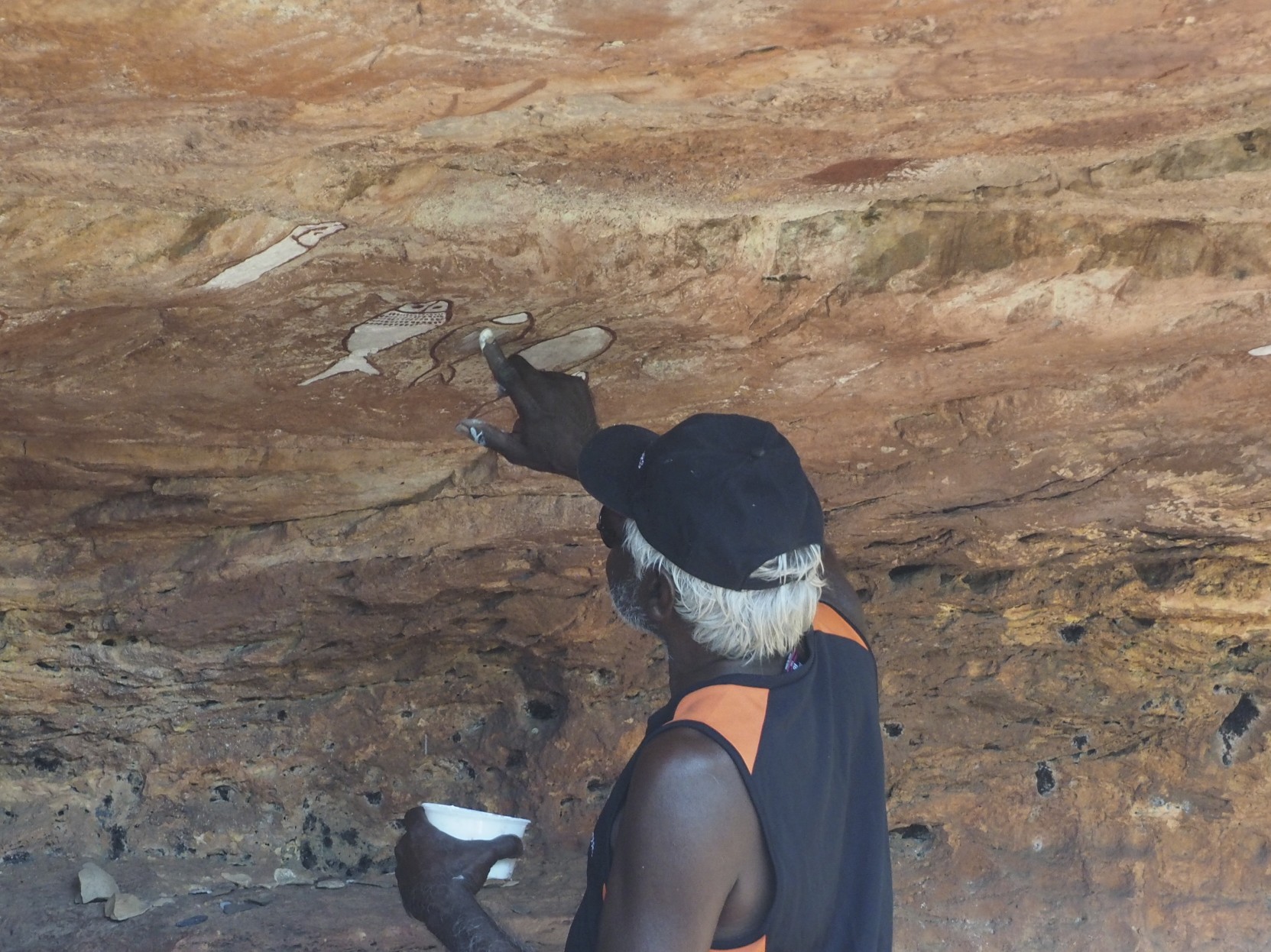
Two nightjars fought, blood was spilled. The blood of one was a light ochre in colour, the other darker and so today the Worrorra paint mainly with light and dark ochre. They are one of the groups that share the Wandjina tradition. In the dream time the Wandjina travelled the earth, altered its shape, lived, fought their battles and when it was time to die entered caves and left their images on the walls. It is the task of the modern folk to maintain the images.
This is Uncle Donny, the current custodian of the tradition, the only person qualified to paint the figures. It his task as well to instruct the younger men and one day he will choose his successor. It will be a great honour for the person chosen, and it will not only be for their painting skills but also their knowledge of the stories attached to each figure.
As well as the Wandjina figures, always painted without a mouth, there are other dreamtime characters such as the Lightning Man and images of food animals.
At the back of a nearby beach there is the site of a great Wandjina battle. The losing army was turned to stone and can be seen to this day.
The Poms began to arrive in Australia, to stay, in 1788. They were particularly concerned at that time about the intentions of the French regarding this newly available continent.
Naturally the early explorers were from Britain and Europe, the first generation of Australian Europeans had to be born and grow up for a while. Phillip Parker King was born in the penal colony on Norfolk Island in 1791. His father, Philip Gidley King was the commandant of the settlement and would later be the Governor of New South Wales. Young Phillip was sent back to England for his education and looked forward to a career in the Royal Navy.
In many respects his timing was abysmal. King entered the Navy in 1807, the war with France was at its height, he served with distinction and was commissioned lieutenant in 1814. The following year it was all over, Napoleon once a rooster was now a feather duster, Britain had an enormous navy and no one to fight. Naval officers were put out to grass.
Fortunately for young Phillip his talent for meticulous surveying and draughtsmanship had been noticed. He was sent out to Australia to fill in the gaps in the coastal charting. A number of Explorers had grazed the coast of Oz. Dampier and Cook perhaps the most famous and Mathew Flinders had completed the first circumnavigation by 1803 (although he was somewhat slow getting the results out due to his imprisonment in Mauritius on his way home … for six years. Those bloody French).
The notable gaps were the Kimberley coast, the northern reaches of the Great Barrier Reef and Bass Strait. Between 1817 and 1822 King meticulously filled in the gaps. And when he’d finished that he went to South America and sorted out the southern tip. He deserves to be right up there with Flinders but he is hardly known, a neglected native son.
Montgomery Reef was discovered by King in 1821 and named for the ship’s surgeon. It’s out in a bay about 22 km from the nearest point on the mainland. On a high tide you might pass right over it but as the tide falls it emerges and looks rather splendid.
It’s home to turtles and sharks and at low tide numerous Eastern Reef Egrets and wading birds that have to make alternative arrangements when the water rushes back to cover it all again. The reef is about 80 km long and covers an area of about 400 km². Small sand islands, called the High Cliffy Islands, were home to the Jaudibaia people, excavations reveal their presence as long ago as 6,700 years. They spoke a distinct dialect. They are unique among Australian aboriginals in living on such small islands but fish and turtles were stranded on the adjacent reef twice a day and provided handsomely. The Jaudibaia were reputed to be of impressive stature many reaching 7 feet in height. A film crew for Pathe News visited in 1929 when they found about 300 people. The next time anyone thought to look there were none. No trace and no explanation.
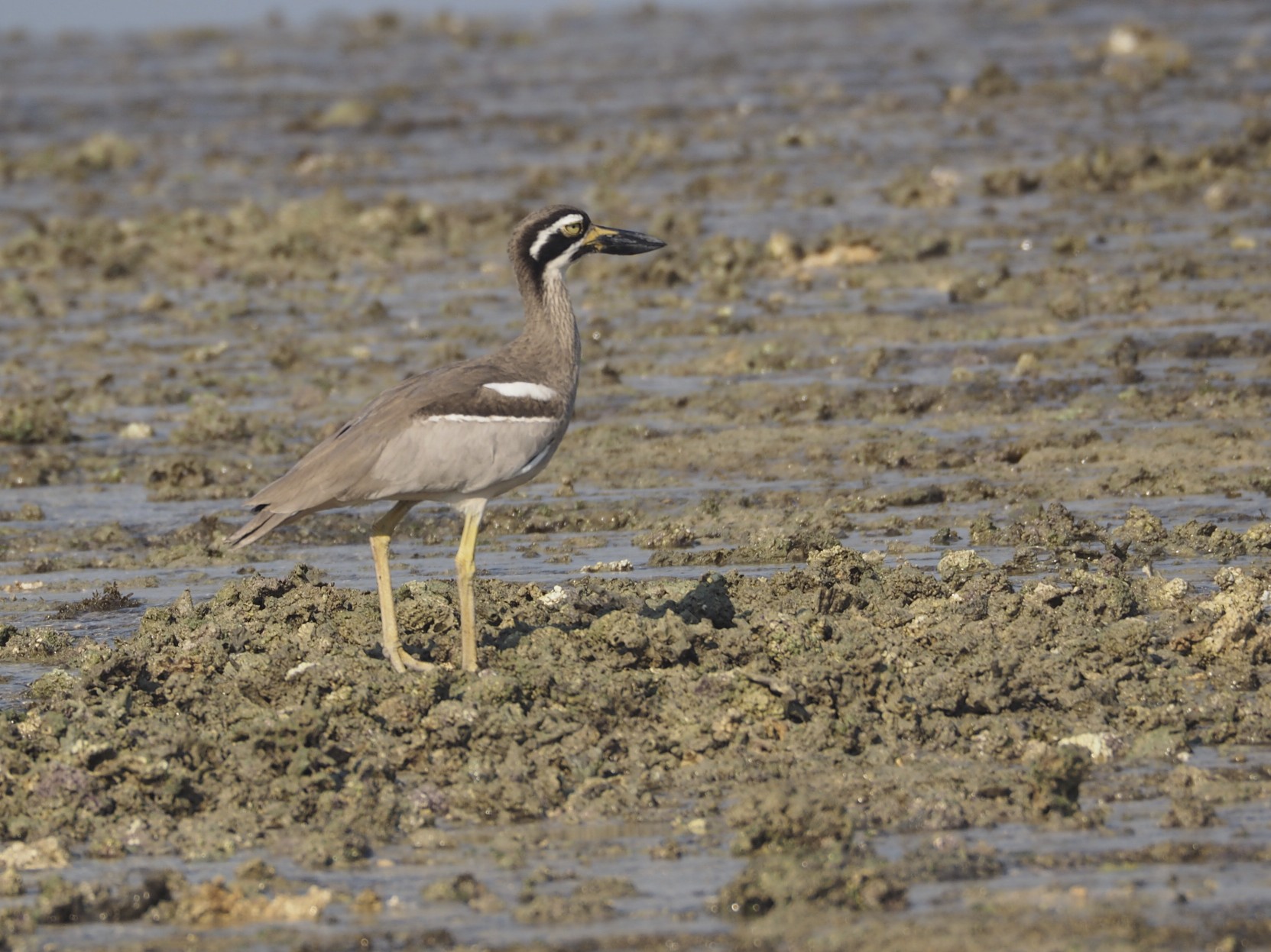
Our visit was graced by a flock of White-winged Terns in full breeding plumage, a stranded turtle and many in the water, close looks at Eastern Reef Egrets and other shore birds such as this Beach Stone-curlew …
King’s ship was His Majesty’s Cutter Mermaid. It had been cobbled together with iron not copper nails. As time passed and the nails rusted out it began to leak furiously. During 1820 King selected a suitable beach with easy access to fresh water and careened her. The work took six weeks, numerous holes being plugged with locally cut wooden bungs. The Mermaid still leaked when she was refloated.
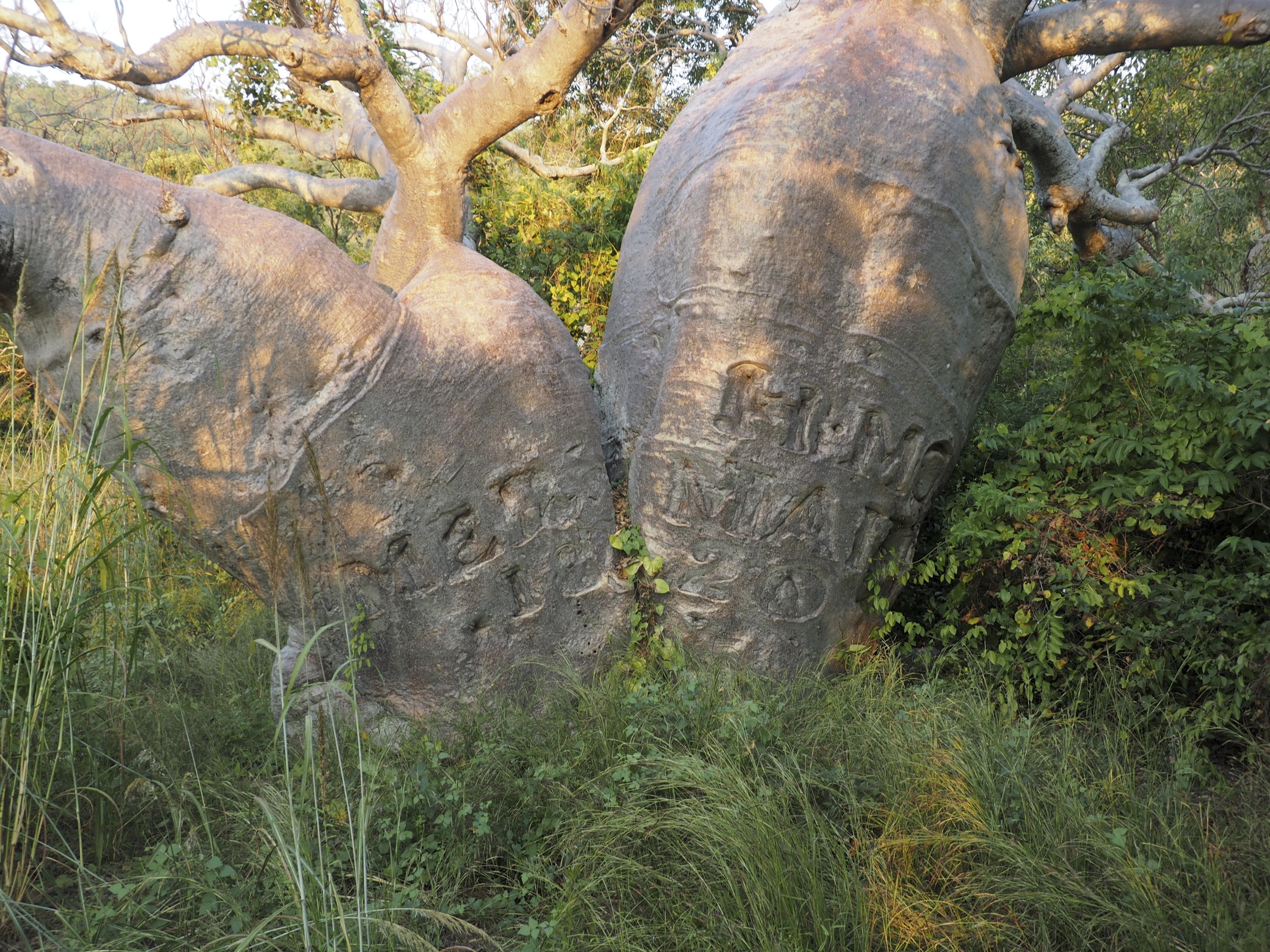
Whilst at Careening Bay a memento was carved in a Boab tree.
HMC Mermaid 1820
Admiral Phillip Parker King, FRS, RN died at his home in North Sydney on 26 February 1856.


















 bobmcgee