The Power and the Glory …

The Power meter arrived.
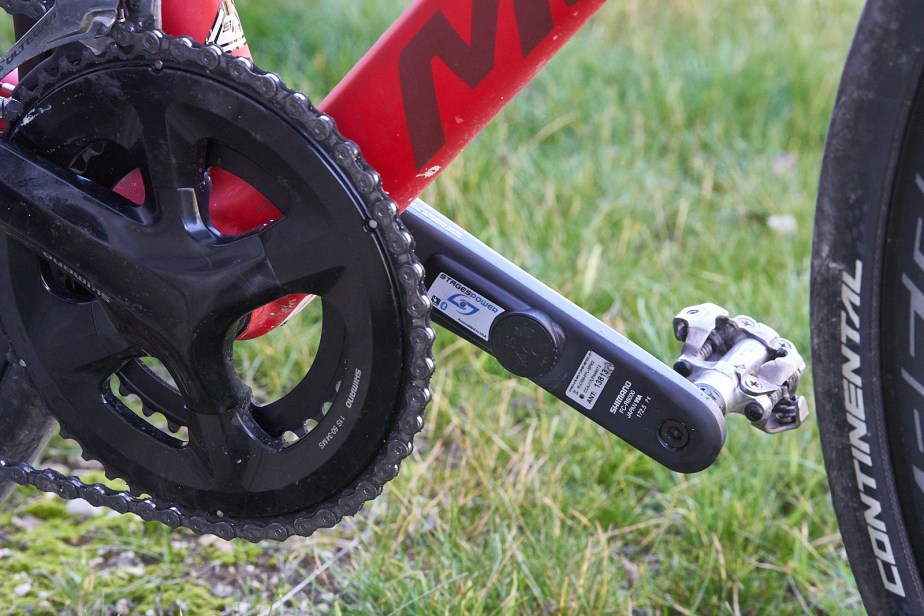
It is not a thing of great beauty but it does make the bike go much faster. The mechanism by which it achieves that is simple. It measures the power output of the rider. That finds its way onto Strava where all the world can see it. Therefore the rider works harder so as not to appear a wimp. As a consequence the bike goes faster. QED.

It is the round thing half way along the left crank arm.

It is a Stages Left power meter. This is pretty much the cheapest way to measure power. It goes without saying therefore that it’s not the best but it will suffice until next year’s Tour de France.

A power meter is a strain gauge. They can be put in different parts of the drive train for example in the spider that holds together the chain ring, the cranks or at the rear hub. Perhaps the optimum place is one in each pedal which has the advantages of measuring the output of each leg separately and being easily transferred from bike to bike. Using a single crank measures the output of a single leg and entails the assumption that the two legs are equal which probably isn’t exactly true. However I always use the same left leg so the metric can be compared usefully from ride to ride.

So what exactly does it do?

A quick revision of terms and units in mechanics will come in handy. Work is basically weight through distance. For example Robert and his bicycle through 50 km. It takes a certain amount of energy to accomplish the work. The units that energy is measured in is the joule. A handy way of quantifying work is the number of joules required to complete it.

Robert and his bicycle can travel slowly or a bit more quickly, The work done is the same. Power is the rate of doing work or put another way – all those joules divided by time and the answer is in Watts.

A power meter measures the rate of doing work in Watts. Your speed will vary when going up hill or down, with the wind or into it. The power meter will still tell you how much effort you’re grinding out whereas your speedometer will not.

The Stages Left comes mounted on a crank arm which replaces the original. If anyone would like to purchase a left Shimano Ultegra crank I have one for sale. Setting it up to work with my Wahoo Elemnt Bolt bicycle computer could not have been easier. Insert the battery in the power meter. Using the Wahoo app on the phone introduce the two bits of high tech. Download the Stages app and zero the power meter. Go for a ride.

One of my first impressions as I set it up was that the battery cover was a very flimsy piece of plastic. Without it the rather expensive meter won’t work. This could be an issue. However it’s still in place after a couple of hundred kilometers. Maybe they thought of that.

The next step is to put it to profitable use. Stay tuned … but for now some wise advice from Dr Oliver Bridgewood.


Mixed Messages …

The morning rides have been a bit on the chilly side. I had a close brush with frostbite just the other day, well cold fingers anyway. Flame Robins have deserted the high country for the winter and have been moving through this district in recent days, always a welcome sight. Winter is also the time when we see more Crimson Rosellas and Grey Currawongs.

But here we are only just past the winter solstice and some of the birds are singing from a different hymn book entirely. Just west of Dunolly in recent days I have encountered a Fan-tailed Cuckoo emitting its mournful whistle and yesterday I was swooped by a couple of Magpies, one in desultory fashion and one with great enthusiasm. The latter made contact with my bike helmet a couple of times. I knew there was a good reason to wear one.

We are, of course, talking about the Australian Magpie Gymnorhina tibicen not the original Eurasian Pica pica.

Frostbite … ?

It was a chilly one this morning. The grass was crackling under my feet and the puddles were frozen as I got the bikes out of the garage.

Readers from elsewhere in the world may have the notion that Australia is a land of never ending sunshine and warmth. Not so. South-east Australia even has some ski resorts. The Victorian goldfields are on the inland side of the Great Dividing Range away from the moderating influence of the sea. We have some knockout frosts. The last couple of mornings -2° C.

Having said that, though, it’s the cloudless nights that produce the lowest temperatures. Cloud cover helps to hold the warmth in. Snow (below 1000) meters is therefore unusual.

Plugging away at 25 kph into a 5 km headwind made the fingers numb after a while. I haven’t solved the problem of the appropriate gloves yet – I’m on to my third pair presently. Do avoid neoprene it doesn’t keep out the cold but sure does a good job of keeping in the sweat. Anyway, the mind turned to consideration of frostbite. Is the wind that is generated by the forward motion of the bike sufficient to turn an uncomfortable experience into a dangerous one?

Once home again and thawed out I consulted the internet. I found a couple of windchill calculators that talk metric after a fashion. One at calculator.net can be persuaded to accept metric input. It then calculates a metric answer and also a Fahrenheit answer which you can look up in a nice graphic.

Another at  romseyaustralia.com is very informative but having got your answer you consult a table to discover the likely outcome for your fingers and toes which is not quite as intuitive as the graphic. It was at this site that I learnt …

Twelve volunteers (six men and six women) participated in the clinical trials. These consisted in four walks, at 4.8 km/h, on a treadmill in a refrigerated wind tunnel at the Defence and Civil Institute of Environmental Medicine in Toronto, Canada: one walk at each of -10, 0 and +10 deg C, plus a “wet trial” at +10 deg C during which participants received, every 15 seconds, a light one-second splash of water in their faces. During each 90-minute walk, the volunteers were walking while facing a wind of 2 metres per second (m/s) for 30 minutes, followed by 30 minutes at 5 m/s, and 30 minutes at 8 m/s (or about 4, 10 and 16 mph, respectively). Sensors were fixed to participants’ forehead, cheeks, chin and nose, as well as to the inside of one cheek, to measure skin temperature and heat loss. The results from these trials were used to determine the various thresholds for frostbite, as seen on the new wind chill chart.

The new wind chill equation is now in use in both Canada and the United States. Therefore, there is now a consistent wind chill formula across North America.

Where would we be without volunteers?

Should you distrust the calculator and prefer to compute your own here’s the formula …

Twind_chill = 13.12 + 0.6215*T – 11.37*(v0.16) + 0.3965*T*(v0.16)

If you were surprised to discover that Australia has ski resorts you probably won’t be surprised to discover that my fingers and toes were in no danger whatever. At -2° C. the wind would be uprooting trees before it caused sufficient chilling to freeze my extremities. Hypothermia, though, is another issue.

Burning Matches …

Training is of benefit because of the response it engenders. Exercise at a greater intensity than the body is used to (overload) will produce some minor muscular mayhem that will be followed by repair and restoration (adaptation) leading to a greater capacity for future exercise (increased fitness).

There is considerable science to support all this for which we are indebted to an unbelievably large number of athletes who are prepared to exercise to exhaustion while breathing through masks and surrendering muscle biopsies at intervals.

Not everyone responds to the same extent or in the same way to training and there are way too many variables to formulate a precise prescription for the best of all training plans. The gap between Sports Science and Sports Coaching is the realm of Art.

I think it’s a very reasonable assumption that more is better, until more is too much. You’ll know where the boundary is after you cross it.

Endurance events are completed (by and large) at a rate at which oxygen supply keeps pace with fuel consumption except perhaps for the last hundred meters or so. In order to improve that pace it has been the practice of many athletes to train at the very boundary of aerobic/anaerobic metabolism. A growing body of coaches believe that this is too high a risk for the rewards it brings. The same risks are there for the enthusiast but the rewards don’t include gold medals.

The currently fashionable answer is polarised training. It’s a combination of a lot of Long Slow Distance with a little very high intensity mixed in. The middle intensity around the lactate threshold is avoided.

The suggested mix is 80% LSD and 20% high intensity. The true believer measures this out with a stopwatch and a power meter. The less obsessed can simply burn a match on a hill or two or try for a personal best on the next Strava segment on their morning ride.

Everesting …

The Strava Climbing Challenge is to cycle up 7500 m (24,606 feet) of climb in a month.

It’s not especially mountainous around the Victorian Goldfields. In cycling 1266 km so far this month my climbing adds up to a mere 4998 meters. So if I cycle around randomly I’ll have to push the distance out to

7500/4998X1266 = 1899.759903961584634 km.

That degree of precision is probably unwarranted. Let’s call it 1900 km or 2000 to be safe. June only has 30 days.

Obviously it would be more efficient to find a decent hill and go repeatedly up and down it. This is not a novel idea. George Malory, inspired by his grandfather also George Mallory and quite possibly the first person to climb Mount Everest in 1924 (He died on the way down) came up with the idea of going up and down a suitable hill until the Everest equivalent of 8848 meters (29,029 feet) were in the bank. Mallory did this on Victoria’s very own Mount Donna Buang in 1994.

Winter snowfall in Victoria commonly reaches down to 1200 meters, Mt Donna Buang stands at 1250. It’s a short 89 km drive from Melbourne so it’s the place where most of Melbourne’s kids get their first feel for snow. A short drive there, heaps of fun stuffing snow down each other’s necks and a long miserable drive home – a rite of passage for parents and children alike.

Everesting now has rules and a Hall of Fame which I’m unlikely to be joining any time soon. A desirable hill is as steep as you can manage to keep the horizontal component short and as straight a route as possible so that you can descend safely even with your brain in a fog of exhaustion. A relatively short course with many repetitions may be preferable to a very long course.

That’s the lovable Dr Oliver Bridgewood PhD from Sheffield UK which is where I studied for my first degree. The accent brings back a lot of fond memories. If I was obliged to endure England’s execrable climate again Yorkshire is where I would choose to do it.

Ollie ground out his Everest in a shade under 16 hours so assuming an even pace throughout he earned his Strava Climbing merit badge in 7500/8848X16hours or just 14 hours.

That of course is not a record. In recent weeks Keegan Swenson knocked off the 8,848 meters in an impressive 7 hours, f40minutes, and 5 seconds. He’d have got his merit badge in about 6 hours and 45 minutes and I need a month!

Job Done …

It was a late lunch but gee I enjoyed it.

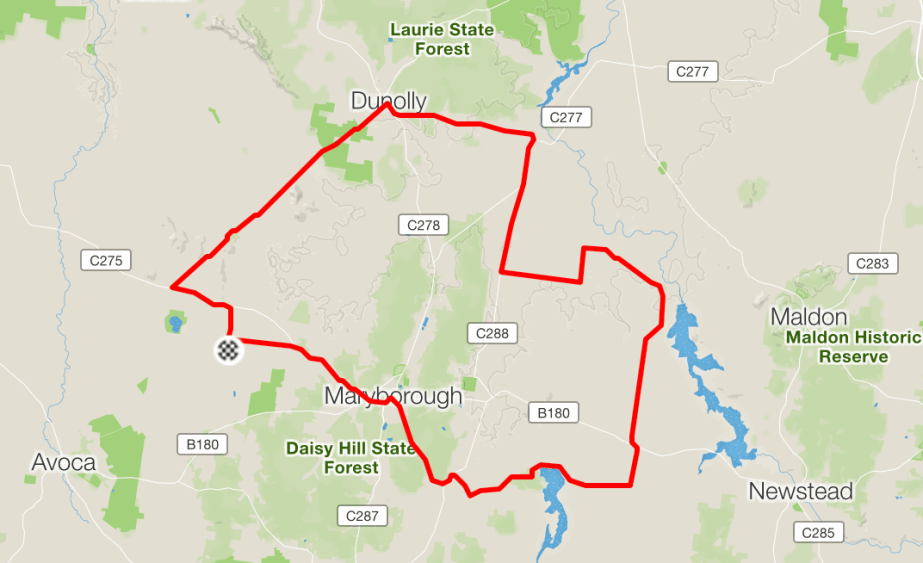
The ride took me through Maryborough, out to Majorca and around Tullaroop Reservoir. Out to the right from there I could see Mount Tarrengower at Maldon, the highest point for  miles around. A Black Kite followed me for a couple of kilometers there. Perhaps it thought I would expire.

North past Cairn Curran reservoir, north again to the little town of Eddington. I must have blinked because I didn’t see any sign of it. Into the gold rush town of Dunolly and then south over the Mount Hooghly Ranges to home. Not a lot of people know the Mount Hooghly Ranges largely because there is no such geographical entity. A passenger in a car would hardly notice the hills. On a bike they make more of an impression. I reached the highest point of the ride at kilometer 103 – I organised that well!

I did it that way around because some of the route was unfamiliar and Dunolly being reasonably large was going to be easier to find than places like Baringhup West that are really nothing more than names on the map.

115 km at 24.3 km/h, 674 meters of climb. And that nailed the Strava May Distance Challenge with four days to spare. Another merit badge for the Trophy Cabinet.

What next you ask. Well, the other non-trivial monthly challenge is the climb.

Merit Badges …

When I was researching Durability I came across the feats of Kurt Searvogel and following links I arrived at his Strava Trophy case. He has a truly impressive trophy case crammed with merit badges. As a Strava newby not only was mine empty at the time I had no clue how to get them.

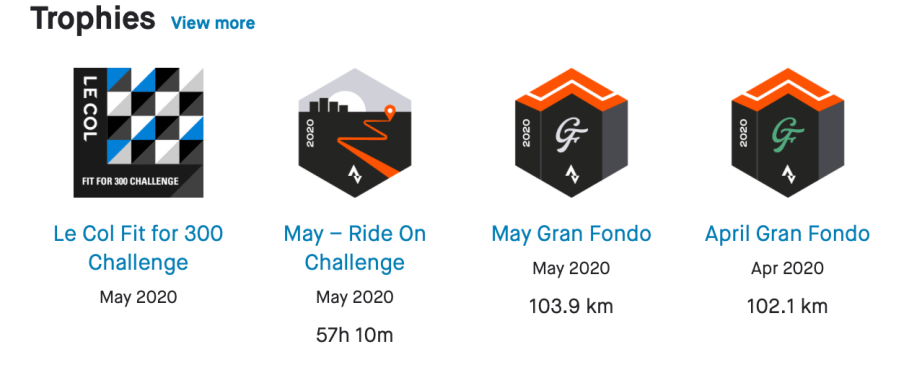
Subsequent exploration led to Challenges. On that page one can choose from challenges in a variety of flavours suited to a variety of sports. The first one I accepted was the May Grand Fondo. Sometime in May I was to ride 100 km and thereby earn my merit badge.

Uncertain that I could meet such a challenge I did the ride then accepted the challenge. Let’s not put the ego on the line publicly. Child that I am I immediately craved more badges.

The sun is about to emerge above the trees behind me and at the moment my trophy case looks like this …

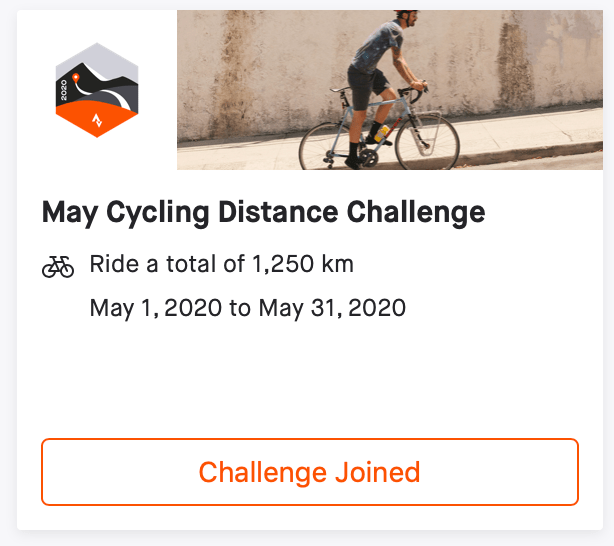
Not all challenges are created equal. Among the less trivial and therefore more desirable is the …

As you can see I was rash enough to join before I’d actually accumulated the distance but I’m now only 98 km from completion. The sky is blue. The wind is light. Once the sun has dealt with the frost I’ll be off. That badge may be in the case around lunchtime.

Renting My Life …

I rent this domain. Add a subscription to WordPress for hosting the blog. Add a subscription to my internet service provider. I fled from Lightroom to Capture One to avoid a subscription. Phase One no longer upgrade my program but they offer a subscription. Sometimes it seems like I rent my life from someone else.

It may only be the cost of a coffee and a doughnut at a time but add all the opportunities together and they could easily add up to a nasty case of obesity.

I recently gave up obesity in favour of riding a bike. In the process I discovered Strava and an easy way of tracking my training. It comes in two flavours – plain vanilla and subscription. Plain vanilla did everything I felt the need for … until today.

That things were going to change had made it to my consciousness via Bike Radar and Global Cycling Network and a notice on Strava itself. Co-founders Mark Gainey and Michael Horvath were careful to get the spin they wanted on the news. The components of the change that were emphasized were that Segments and Route planning were largely going to go behind a paywall. We were assured, however, that there would always be a free Strava and that it would be good enough to serve as a worthwhile introduction to the program.

There were three ways ways to review your training, on the Dashboard, the Training Log and the Training Calendar. The Log provides the easiest way to compare week against week, the Calendar is the easiest way to find out where you are for the month. It always struck me as odd that the daily rides in Calendar didn’t have the distance in numerical format. That deficiency in the Calendar makes the Log the most useful means of long term comparisons.

The Log disappeared behind the paywall this morning.

Without the Log a free Strava doesn’t really cut it. Not that Strava has a duty to provide me with a free anything. It has been a pleasure to use, it is not full of annoying adverts and it has not made a profit. Good value for the consumer but not a long term business model to invest in.

So it’s time to consider renting another little slice of life or do I just start a spreadsheet? When I fled from Lightroom I realised that whilst I owned a lot of good photos finding the ones I was looking for had suddenly become a problem. The changes in Strava make me realise that I don’t even own my own training diary.

Colour Fast …

There is a new steed in the stable. It’s red.

The task of choosing a road bike has come to fruition. It’s a beautiful red Merida Scultura.

It doesn’t tick every box on my shopping list but I think it ticks enough. Most importantly it was less expensive than a spa which was a competing interest (at least as far as Gayle was concerned). The price was at that point on the curve where extra bang was going to cost rapidly increasing extra bucks. And it has the benefit of being red.

For the fanatic let me tell you it has a carbon frame and forks, the Shimano Ultegra group set and disc brakes. I would have liked DI2 (electrical) rather than mechanical gear shifting but it was unavailable for this frame in my size. The covid19 crisis has played havoc with the supply chain.

I thought it would go better with pedals so I put some on. I find it a little odd that bikes come without pedals these days but it makes sense given the different cleat systems in use.

It’s been on the road twice now for a total of just over 100 km. I am relieved to report that it is noticeably quicker than the mountain bike. Not sure I can live with the saddle though.

I will be fitting a Stages L power meter but it’s on back order!

I switched the tyres from 25C to 28C to help out on the gravel. Every ride from home has to start and finish with a bit of rough riding from here to the bitumen.

So far I am ecstatically happy. Did I mention that it’s red?