Wyperfeld …

Spent a few days at Wyperfeld National Park in north-west Victoria.

It is the eastern fringe of the Big Desert and ranges from dune scrub to mallee with Black Box woodland in the parts that flood (on very rare occasions). There are two main camping areas, Wonga in the south and White Plains in the north. On this occasion I stayed in the south although I had a run up to White Plains to test out the recently acquired short wheelbase Prado on the desert track. It performed beautifully.

Also working as well as expected was the recently acquired Kwik Kampa.

DSC_9593

The Pod Trailer is a delight to tow, I had a previous version that went all the way to the Gulf of Carpentaria with us but the first tent design was nowhere near as elegant as the trailer it was mounted on. This version is quick, simple, light and efficient. And Stockman Products are a delight to deal with.

The country was a riot of flower, the mallee sections especially …

DSC_9599

DSC_9612

The weather was kind and some of the locals were making good use of it …

SONY DSC

SONY DSC

Highlights of the bird list included good views of Mallee Fowl in the south and Orange Chat and Major Mitchell’s Cockatoo in the north.
Broome …

The Kimberley adventure brought us finally back to Broome. We finished the trip at the Broome Bird Observatory.

BBO

One of the trio still needed a few mangrove birds for his Aussie list and Little Crab Creek, not far from the observatory, would be the place to find them. A tour of Broome including the Port, the playing fields and the sewage works is birding heaven. Add the proximity of Roebuck Bay, which even over winter holds a wonderful trove of migratory waders, Pindan woodland and open plains and a hundred species in a day can be seen with relative ease. I gave a guarantee that I would deliver the White-breasted Whistler and the Dusky Gerygone.

The first morning saw us in the mangroves beating off the mozzies. The whistler duly surrendered and what’s more, the first one to parade for us was a beautiful male, usually much harder to find than the drabber females and young males. But no Dusky Gerygone. Then off to Nimilaica, Barred Creek and back up the Derby Road to Taylor’s lagoon. A great day, some great birds but …

Dawn of day two and we were back in the mangroves, swatting the mozzies, ignoring the White-breasted Whistler, the Broad-billed Flycatchers, Yellow White-eyes, Mangrove Grey Fantails, Sacred Kingfishers, Brahminy Kites and the rest, reputation is at stake, I have never dipped on the gerygone, ever.

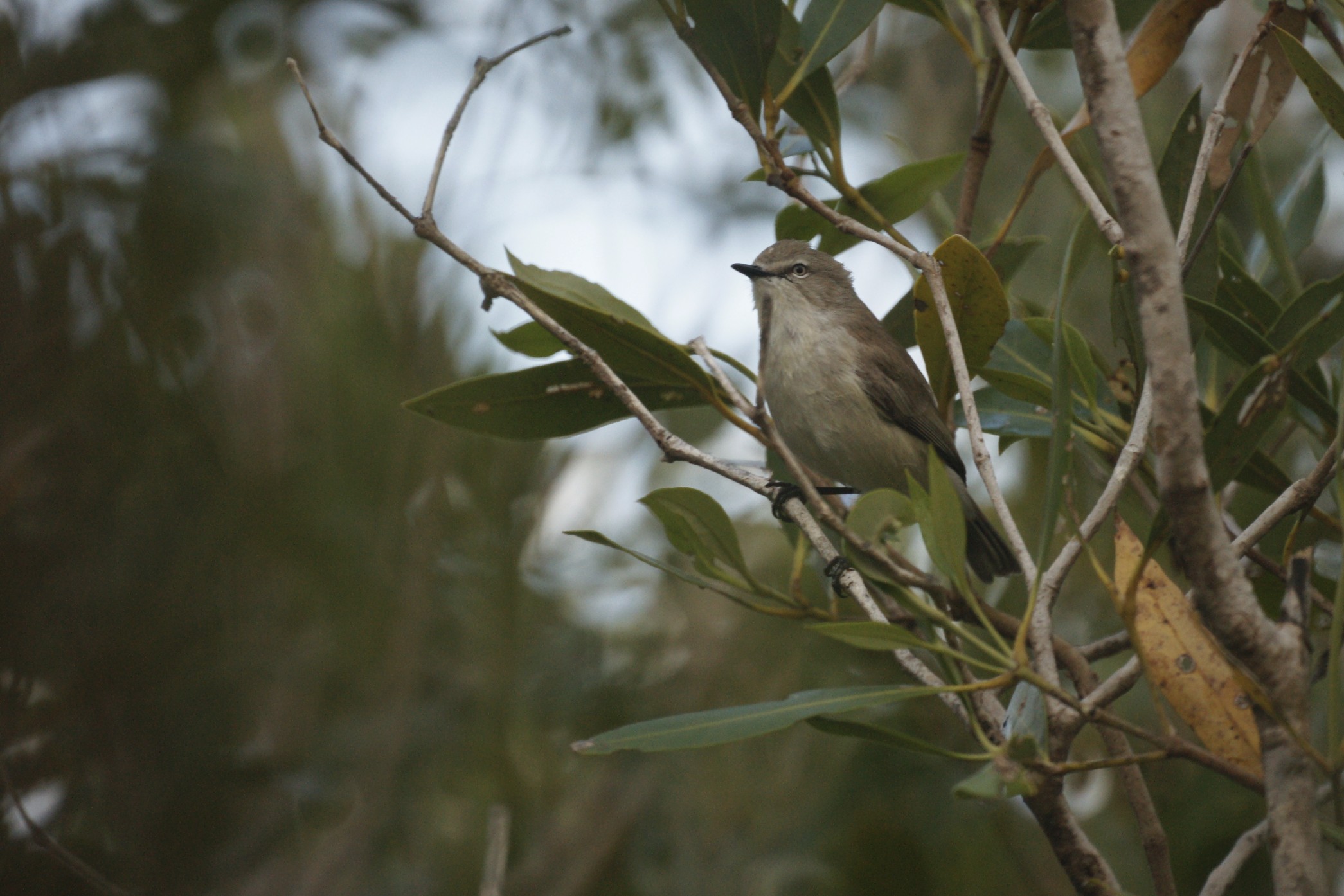
The Dusky Gerygone is found only in the mangroves from about Broome, south west along the WA coast to about Shark Bay. Gerygones are little birds, often grey or brown or greyish-brown, distinguished by subtleties of eyebrow or tail tip, and amongst all these the Dusky is distinguished by its lack of distinction, no contrasting tail tip, the subtlest of eyebrows. The clinching detail is the pale iris! You need a good look.

My colleague slapped another mozzie, I distinctly heard him muttering about trusting me instead of trying Streeter’s Jetty. Everybody gets them at Streeter’s Jetty.

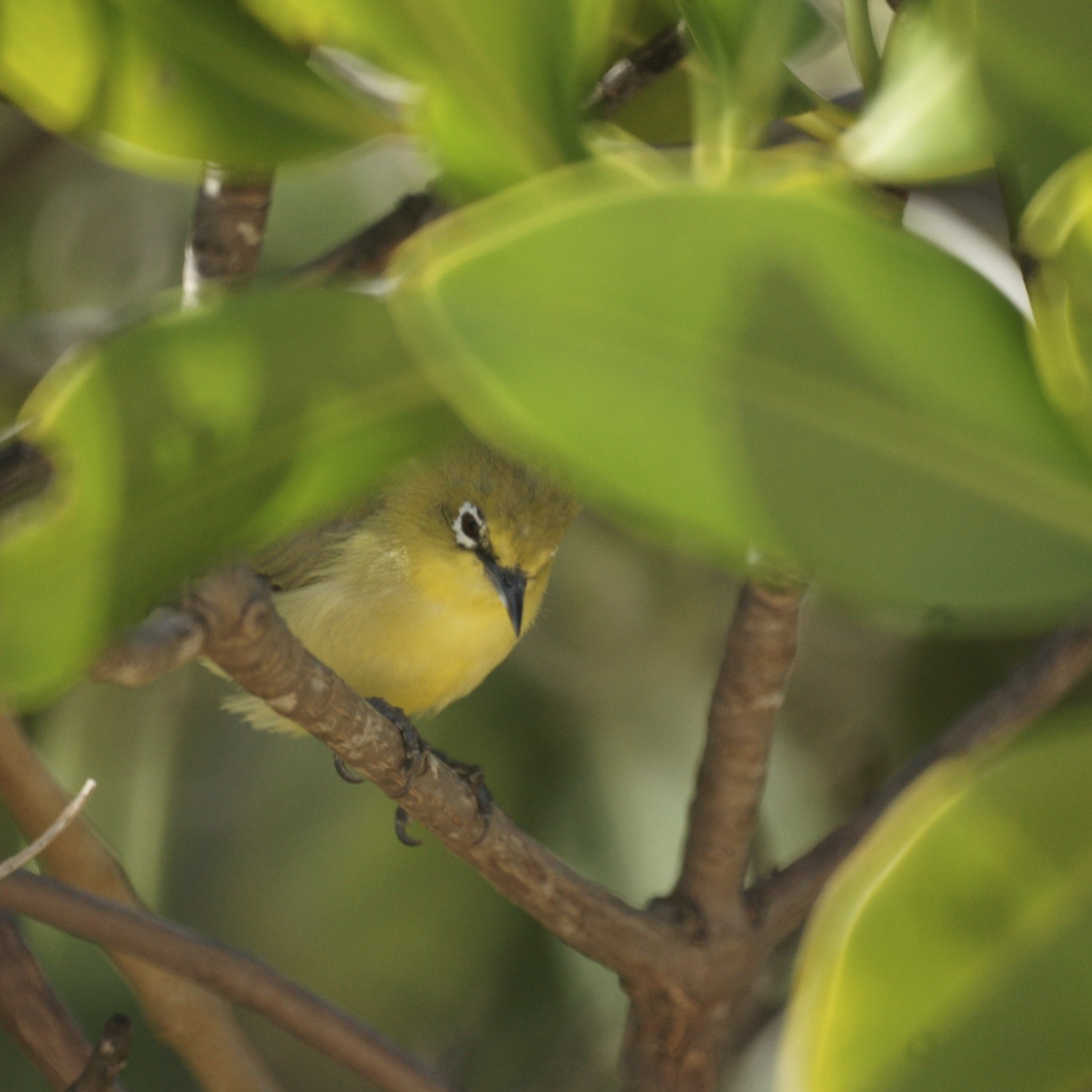
A Yellow White-eye peeked out …

Yellow White-eye

Dime a dozen. Mangrove Golden Whistlers are much harder to find, I doubt that one has ever been dismissed as lightly as this one …

MGW

More muttering, then …

Dusky Gerygone

Reputation rescued.

The Black Grasswren …

Bachsten Gorge, 11th June, 2013 …

Got it. First a call, then a fleeting glimpse of two birds up hill of us on top of a blackened sandstone boulder. We wait in the hope of a second look but a couple of minutes pass with no success. We creep up to a spot where we can look down on the boulder. Gone.

A few moments later the whole party can be seen travelling fairly quickly across country about a hundred metres up hill. Hoping that they would be consistent in their direction of travel we hiked hard to intercept them at a rocky knob on the skyline. We got there just in time to enjoy very brief close views as they went one by one over the crest of the hill.

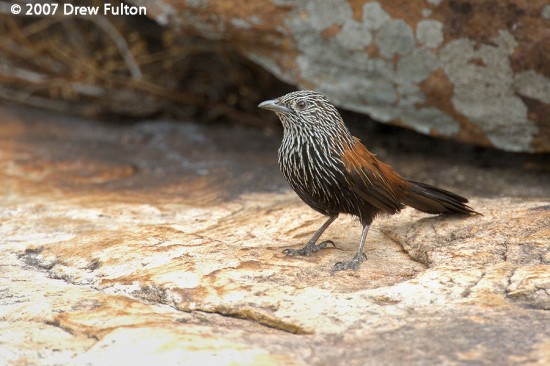
This is, of course where I would put my photograph, but on this and subsequent contacts they were just too active to get them in the open and in focus. I hope Drew Fulton will forgive me using this superb photo of his …

normal_black-grasswren-00002

This is a male, the girls have chestnut bellies. They are bigger than I expected, certainly bigger than the majority of Grasswrens and superbly coloured to fit into their environment. Picture it, open woodland with spinifex between the trees, broken by large sandstone boulders ranging from red to black, harsh shadows cast by the tropical sun, the grasswrens on the move, bold, active and beautiful.

<NEXT>

The Kimberley …

A fabulous and fabulously remote part of Australia.

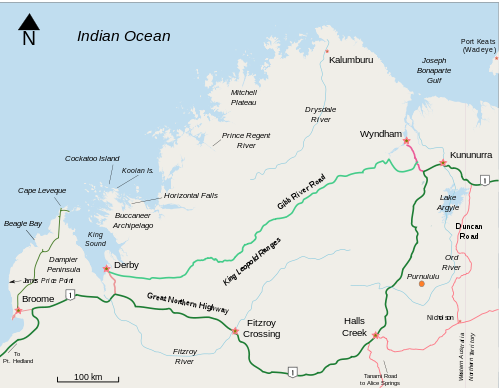
It is the northernmost portion of WA, it is entirely north of the tropic of Capricorn. It has a wet season, the southern hemisphere summer and a dry, the winter. It is scenically splendid, and among many other wonderful creatures it is the home of the Black Grasswren. The McGee Australian birdlist hadn’t had an addition for a couple of years, an expedition was in order. Enquiry revealed that the only “accessible” places where it might be sought with a reasonable chance of success are Bachsten Gorge and the Mitchell Plateau. Early in the dry was tipped as the best time, swollen rivers close many of the roads in the wet. Access to both sites is from the infamous Gibb River Road.


500px-Kimberleys,_Western_Australia_map,_labelled.svg

The western half of the Gibb River Road provided access from Derby to cattle stations as far as, you guessed, the Gibb River. It was completed in 1956. Subsequently it was pushed further east and is now the scenic route from Derby to Kununurra. It is a reasonably well graded dirt road, 4WD is recommended. Almost all the car hire companies prohibit using the Gibb River Road. Broome is a very civilised place to begin and end, a circular tour can be completed via the Great Northern Highway, which is sealed and has the added advantage of taking you past the Purnulu National Park, better known as the Bungle Bungles.

This year has seen very late and heavy rainfall, as the time to go approached none of the roads were open. Two hundred millimetres of rain fell on Broome just before we arrived, but the outlook further west was encouraging. McGee and two intrepid companions left Broome on the 7th of June. The Gibb River Road was open, but for access to the Mitchell Plateau the King Edward River needed to drop a fair bit. It had a few days to do it.

In Derby we visited the wetlands and sewage works, a fair test of the 4WD capability of our Toyota Prado. The covering of red mud that it acquired made us look especially authentic. We headed for Windjana Gorge for our first camp site … <NEXT>.