Durability …

I have a buddy who lives in Queensland. We had taken a little time off our regular careers to study something totally unrelated and met at Charles Sturt University. Roy and I have a lot in common including a passion for birds and live music. It was not in the least surprising that we enjoyed a yarn and a beer.

When I signed up to the cycling app Strava up popped Roy’s visage and we have followed and encouraged each other since. Roy has clocked up more than 35,000 km since he started using the app. I am most impressed.

It got me thinking about the sort of distance Grand Tour professionals accumulate over their careers. Or what about a single big year?

When Strava got started the bench mark to aim at belonged to Tommy Godwin a native of Stoke on Trent, UK and a professional cyclist. Back in 1939 he rode a staggering 120,805 km (75,065 miles) in a year. Since 100,000 miles was a good round number and not far off he carried on to nail that landmark in 500 days!

The record stood until 2016 when the American Kurt Searvogel edged him out with 122,432 km (76,076 miles). The Ultramarathon Cycling Association logged his efforts on its website and vouched for his achievement to the satisfaction of the Guiness Book of World Records. His Strava trophy case is stacked with badges although it seems that he is not currently active.

Nor is his record. That was eclipsed by another American, Amanda Coker, the very next year. She blew it away with 139,326 km (86,573 miles) about 382 km a day. By then she was in the groove so she took the opportunity to knock off Tommy’s 100,000 mile record in just 423 days.

Bird watchers like to go for a big year so what about a cycling big year? I think there is a great opportunity there for you Roy.
Volume vs Intensity …

Cycling does you good. Does more cycling do you even more good?

Given my advanced age the effect of cycling on all cause mortality is of urgent concern. Research on older folk getting off the couch and onto their bikes is scant. The obvious advantage of such studies would be the relatively short time the researchers would need to wait for the endpoints. In the absence of old folk as guinea pigs  we can look to wise coaches for opinion or extrapolate from studies that draw their participants from a wider spectrum.

Joe Friel is wise and famous and a prolific author. In Fast After Fifty he tells us that long slow distance will set you apart from the guy next door. It will also set you apart from the guys on the podium. In other words he damns it with faint praise. His prescription is to go for the intensity.

This is borne out by findings from the Copenhagen City Heart Study (Schnohr et al)

Relative intensity and duration of cycling were recorded in 5106 apparently healthy men and women aged 21-90 years drawn from the general population of Copenhagen, and followed for an average of 18 years. Total number of deaths during follow-up was 1172, of these 146 were coronary heart disease deaths. For both sexes we found a significant inverse association between cycling intensity and risk of all-cause and coronary heart disease death, but only a weak association with cycling duration.

If you want to live longer ride faster not further. QED.

Charity rides are a fun way to spice up your riding program. They’re better than races because they are races really but a large proportion of the riders don’t realise it and are therefore easier to beat. These events have succumbed to the Corona virus for the moment but they will return one day. The one I’m looking forward to is Maryborough’s R3R. I did the short course last time. Next time my goal is the full 109 km.

Can I prepare for 109 km by doing interval sprints? Well not on their own. Volume is vital, the effort though must be at a certain intensity. The “fat burn” zone doesn’t cut it. Joe again …

Very low heart rate training is often referred to as the “fat-burning” zone. This is another case of a myth that refuses to go away. Low intensity, slow exercise does not burn more calories or more fat than does high-intensity, fast paced exercise.

In fact high intensity exercise will have a greater impact on body fat than low intensity junk miles even if the calories consumed during the exercise is less because of the impact on metabolic rate during the rest of the day.

Which leads us to the real point. Volume is a fairly meaningless metric. What matters is effort versus recovery, training versus over-training.

Progress Report …

We are two weeks into the Low Carb diet. Gayle has been cooking up a storm. Some of the food is less than exciting but most is delicious. Some is quite exceptional given the inclusion of previously shunned fats.

We haven’t been able to bring ourselves to eat dead animals so have to be thoughtful about our protein, eggs and cheese are in after that it’s tofu and nuts. Ground linseeds help with the omega 3s. Vitamin B12 comes from a pill.

I was losing weight before starting the diet. Three kilograms in the three months since I bought the bike. Two more kilograms have gone in the past two weeks along with 2 inches off the belly. No cravings, hunger satisfied. Not a calorie has been counted. I’m drinking a lot and peeing a lot, sure signs of ketosis. My confidence is high.

It feels as though athletic performance has suffered a bit, perhaps more for Gayle than me. We have been able to keep up a pretty high volume (by our standards anyway) 343 km in the past 14 days. I skipped this week’s long ride in favour of a more modest distance. I think we are getting through that now as we start to burn fat as our energy source.

Every diet that I’ve tried has worked … for a while. The promise from this one is that it will go on working. We will see.

Diet and the Older Athlete …

I’m losing weight faster than you because I’m busy doing stuff not sitting reading about nutrition.                           Gayle.

The story so far … overweight, unfit, somewhat depressed old dude starts cycling in an attempt to reduce his weight and improve his health. Finds it exhilarating and becomes obsessed.

I’m no stranger to losing weight. I’m actually quite good at it. It’s just that I’m even better at gaining it. It’s practically an annual cycle. Weight loss diets work, the kilos drop off, the will power is reinforced by the success but the hunger mounts, the weight loss stalls and I crack. Six weeks in, six kilos down, six months in back to square one. At least the annual average is slightly lower and there are some benefits that last a while even though the weight has returned.

The last couple of diets have been 5/2 style exercises. The first was very effective. I ate nothing two separate days in the week and my normal diet the other five. Weight loss was quick. It slowed after about 7 kg. I suspect the main reason was increasing my intake on the eating days led to a stalemate. The regime collapsed on a holiday in Japan and I didn’t find the enthusiasm to resume.

The weight crept back up. A year later I tried again. This time I ate a small evening meal on the fast days. It was not quite as effective but the rebound was.

A wise man once said “Don’t make any change to your diet that you’re not prepared to make permanent”. That was Ogie Shaw. What he recommended instead was an exercise regime well outside my capabilities physically and not in the least appealing. Nonetheless the advice is good. Lets make it a lifestyle diet not a weight loss diet.

So what should the older cyclist eat?

Stuffed if I know, but there are several places to go for advice. Quickly categorised these are

  • Doctors and dieticians
  • Government issued dietary guidelines
  • Cycling mythology
  • Medical literature
  • Dr Google
  • Fads, quacks and influencers

There is a lot of overlap in these broad groups, the professionals may reinforce the dietary guidelines and you’d hope that they occasionally delve into the literature. However there is a subset of doctors who take issue with the guidelines and they’ve certainly found literature to support their case – ask Dr Google about Low Carb.

Cycling specific advice is interesting. As always the brains are attracted to the money. In cycling the money is with national bodies hoping to bring home gold medals. Top exercise physiologists and coaches are working with elite riders with peak performance as their goal. The result is an extraordinarily high carbohydrate intake.  Peak performance in a brief competitive career may not equate to long term health. I am not expecting to win any gold medals so I will not be sucking on any gels, my liver and pancreas deserve better and I’m very fond of my teeth.

Back in my marathon running days I knew that long runs build stamina, patience and experience but could never fit in as many as I would have liked. enough time to run many long distances in training. I would find myself increasing the length of my sessions as the big day approached aiming to do one 20 miler a week or so before the race. At the same time I was very conscious that being lighter was being faster. Let me tell you from experience that calorie restriction and an increasing workload do not sit well together.

So, while Gayle has been out chopping down trees and replacing fences I have been doing some research. Stay tuned.


R3R …

The big day.

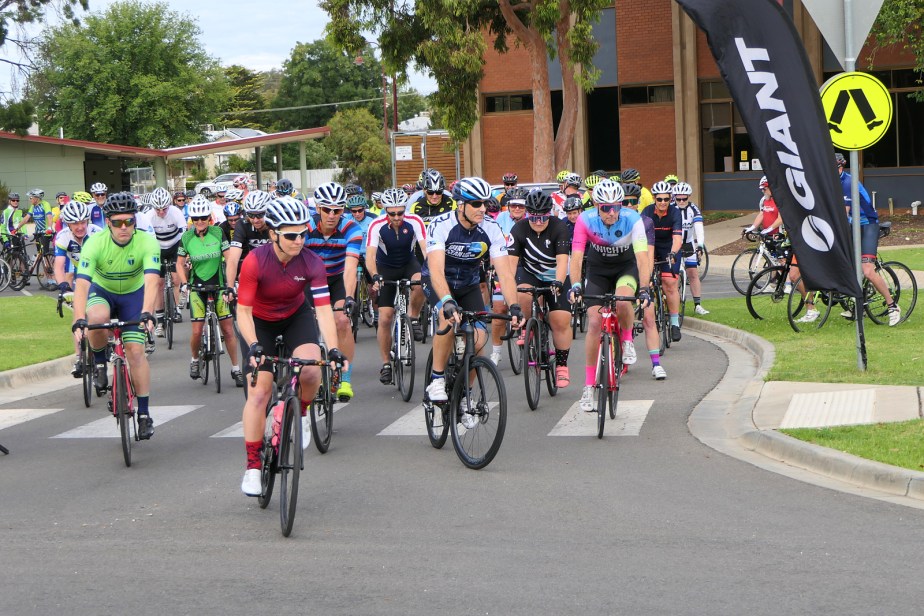
The start

Most of these fit looking people are about to ride 108 km. I on the other hand will wimp it out with a mere 33.

That’s an average speed of 23.9 km/h – in line with expectations. Happy with that. The biggest climb is towards the end; fortunately there was still some gas in the tank.

It felt good to arrive back at the Maryborough Station and I’m sure it felt even better to the real heroes after 108 km …

An Event …

It is at least 25 years since I last entered an endurance event. As I recall it was a 42 km cross country ski race, the Kangaroo Hoppet at Falls Creek. I finished. It may have been 3000th, but I finished. I even had the cheek to sprint past some other poor bastard at the line condemning him to 3000 and 1st or so.

So now that I am a trained endurance athlete having completed three months of cycling about 20 km five times a week I am (or may be) ready for the R3R Charity Ride. It’s tomorrow and it’s not a race (not a race, not a race, not a race …)

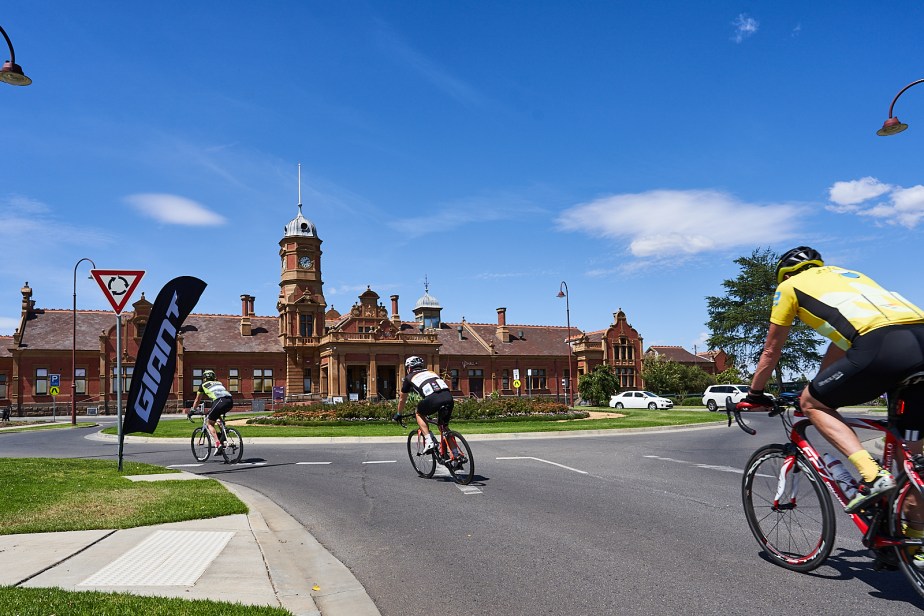
The ride not race is organised by the Maryborough Rotary and sets off from the famous railway station. It is so impressive that Mark Twain described Maryborough as “A railway station with a town attached”. Unless, of course you believe the Twain scholars who tell us that he said no such thing. Even if he didn’t he should have.

If you want to join me you had better hurry up. Go <HERE>.

The route visits the three local reservoirs, hence the name, and the full journey is 108 km. However there is also an R2R – 73 km and an R1R – 33 km. I’ve signed up for the R1R. I know, pathetic.

But I will cut a dash. I am borrowing Gayle’s gloves. They will go on. It’s getting them off that’s the challenge but I’ll have all afternoon. I have invested in cycling shorts so that’s OK. The hi-vis work shirt tops the ensemble off, hopefully hiding the belly a little. Admittedly my fat wheels will put me at a disadvantage compared to road bikes. Nonetheless I do expect to be quicker than some grannies at least those accompanying very small children.

Wish me luck.


Beach Road …

I have a few days in the big smoke so a chance to find out why boys die faster than girls on bikes.

Melbourne sits on the east side of a large bay with only a narrow entrance to the ocean. Beach road winds its way along cliff tops and beside beaches. It’s beautiful and busy and very popular with cyclists. And they are not especially loved by the car drivers or indeed the pedestrians.

I spent two sessions with a clip board and pen sitting by the side of the road. The first session was from 5pm to 6pm on a Friday evening. Rush hour traffic. The second session was on Saturday morning from 8.20 to 8.35.

It might be considered likely that commuters were well represented in rush hour whilst virtually every cyclist on Saturday morning was riding for fun or fitness.

There were so many cyclists in the second session that I was restricted to counting one side of the road only.

So on Saturday morning I counted 241 cyclists passing my nose in fifteen minutes. 216 were male, 25 were female. The other side of the road seemed equally busy so it seems reasonable to double the number. Multiply by 4 to get an hourly figure which brings us close to nearly 2,000 cyclists an hour using Beach Road as a training track. 89.6% were boys 10.4% were girls.

By comparison there were few brave enough to tackle Beach Road during the evening rush hour the previous day. Just 54 passed counting in both directions during an hour of observation and only 2 were female. 96.3% versus 3.7%.

Why was it that 90% of cyclists killed 1999 and 2015 were male? Because there is a big imbalance between the sexes when it comes to cycling. 90% of cyclists are male.

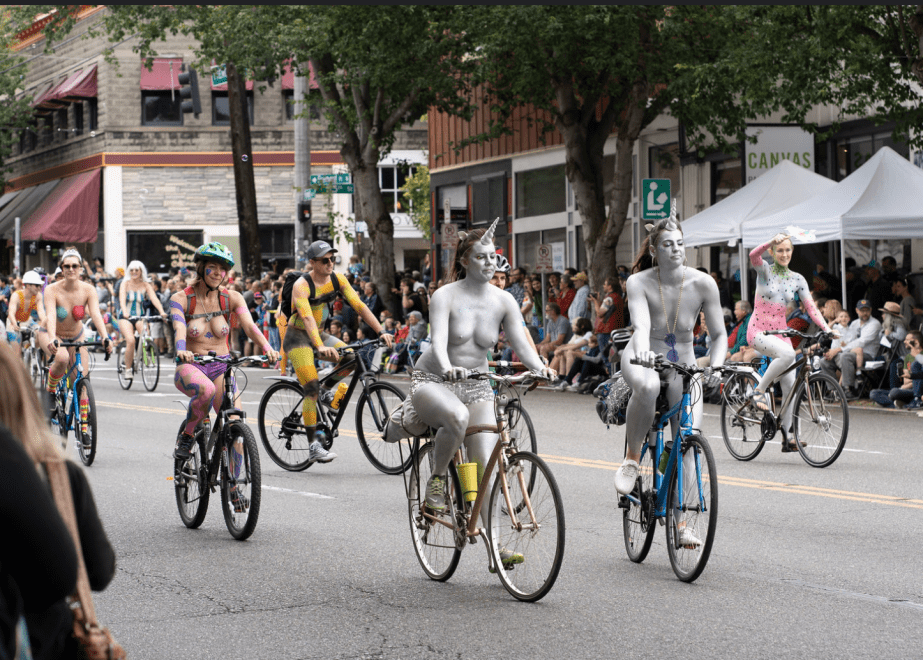
How can this ratio be improved? In an admittedly small sample it does appear that higher female participation rates can be achieved if they are given the opportunity to take their clothes off.


Strava …

I liked the computer. I liked being able to see that I was going really fast. Downhill I could be really impressed with myself. For the secondary display I usually chose distance covered but on the eBig Tour you can cycle through all the options as you ride. It’s nice to be able check your average speed. Apart from the odometer  the other data is ephemeral. I didn’t keep a record.

The new bike has no computer. I could buy one. I really like the Wahoo ELEMNT Roam which does all the tricks I had before plus GPS mapping. It comes in at a mere $600 but I’ve spent all my pocket money for the year on the bike.

I have a smartphone. There are a number of ways of putting that to use. I have been using the Strava app. You open an account and download the app on your phone. When you’re ready to go for a ride or a run you open it up.

Across the bottom of the screen there are a number of options, the centre one is labelled record. Press it and you are rewarded with a bright orange button. Once you have satellites press the button and set off. Don’t forget to take your phone!

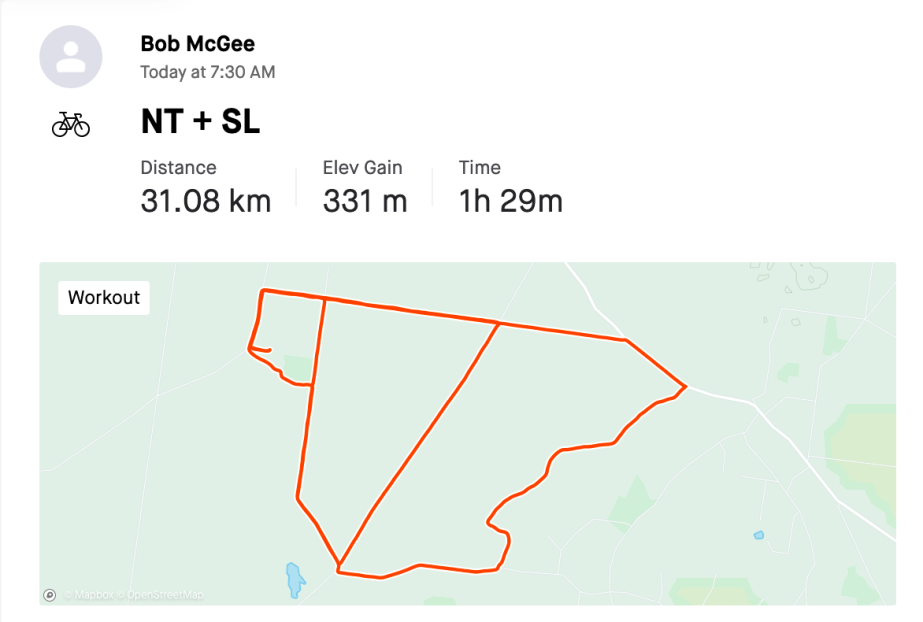
At the completion of the ride press the finish button and you can give your ride a title and description, add a photo, write notes and sync it to the cloud. When you go to your real computer your session will look something like this …

and you can track your workouts in a number of different formats. In addition you can compete against others over road segments.

It’s a combination of training log and social media. You can keep it private, share it with friends or share it with the world.

There are some other features to explore. You can sync heart rate and power monitors. The basic app is free but there is a deluxe version for those whose pocket money hasn’t run out. You can sign up at strava.com and get the mobile app from your friendly app store.

There’s no display to watch during the ride but you can work out your average speed at your leisure.