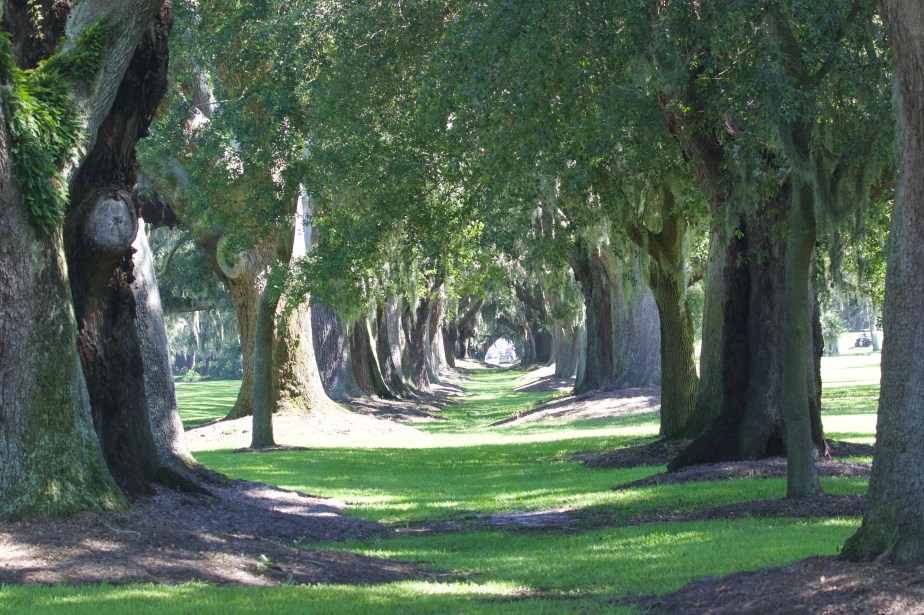
Is one of a string of sand barrier islands along the coast of Georgia. It is quite densely settled but the homes and businesses are tucked away amongst a forest of Live Oaks (Quercus virginiana) draped in Spanish Moss (Tillandsia usneoides). Add extensive marshes, numerous golf courses and land set aside as green space by the island’s Land Trust and you have a community that merges comfortably into nature … Except, perhaps, when a hurricane bears down on it. The highest ground on the island is about five metres above sea level.
White-tailed DeerEastern Grey Squirrel
It was home to Creek Indians for millenia. After the Americas were put on the European map by Mr Columbus the Spanish were quick to explore Florida and Georgia but the French were the first to found a colony. In 1564 René Goulaine de Laudonnière built Fort Caroline in what is now Jacksonville, Florida. It was short-lived. The Spanish founded their own colony at St. Augustine a little further south. Before long they attacked Fort Caroline and slaughtered most of the garrison.
The Spanish spread their influence northwards founding missions to convert the native inhabitants. The missionaries were accompanied by soldiers to establish Spanish authority and ensure the safety of the priests.
After 1600 the pace of colonisation picked up considerably. The French, the English, the Scots and the Dutch all founded colonies in North America.
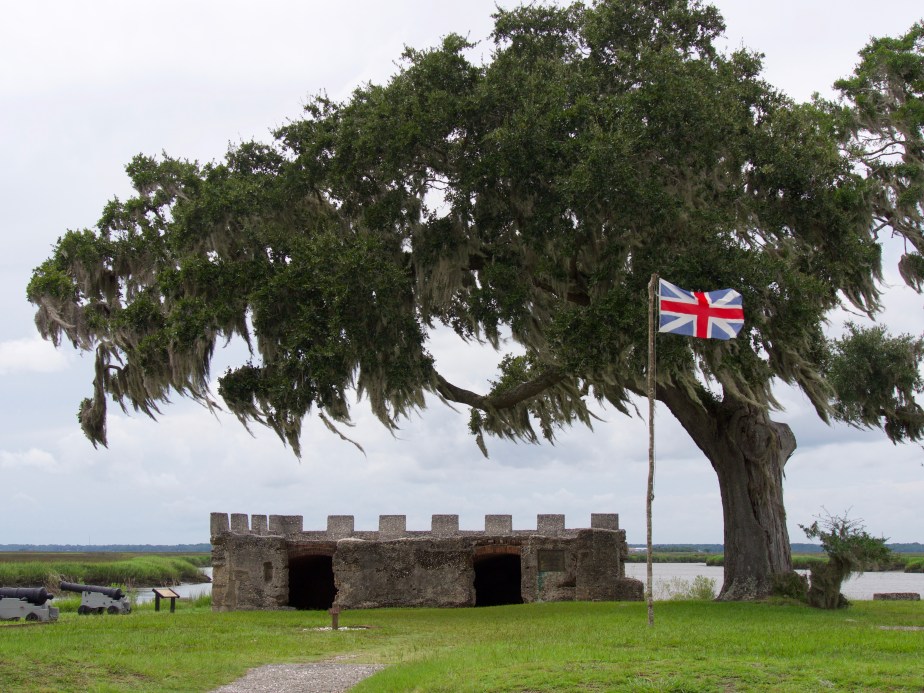
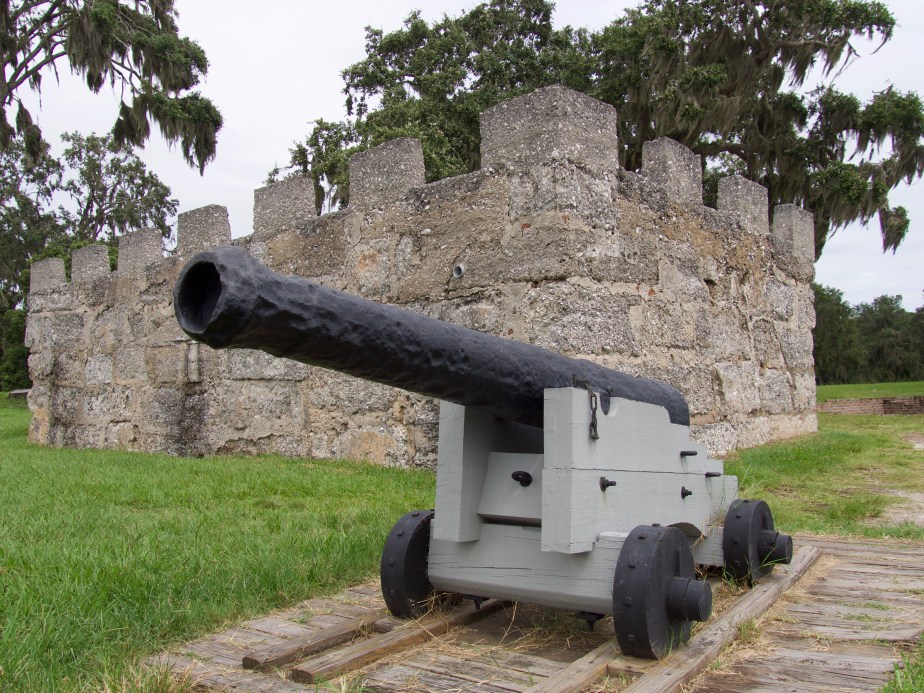
A century later St Simon’s Island lay at a strategic position between Spanish Florida centred in St Augustine and the British in Virginia. A Spanish mission on the island had fallen into disuse. Spain and Britain were not getting along all that comfortably. James Oglethorpe was sent to erect a fort on the island. In 1736 he founded Fort Frederica with a small town adjacent. Not far away on the mainland Fort King George was built and the town of Darien grew up adjacent to it, settled mainly by Scots.
In 1713 the British had wrung from the Spanish the right to sell slaves and some goods into South America. In 1731 the brig Rebecca was boarded by the Spanish off Florida. The captain, Robert Jenkins was accused of smuggling and suffered the indignity of having his left ear cut off. It was but one of a number of irritants that led to war, again, with Spain, a war that came to be called the War of Jenkins Ear.
It began in 1739 and ran on into the broader War of the Austrian Succession which finished in 1748. It was largely a naval affair fought in the Spanish colonies in the Caribbean and South America.
In 1742 the Spanish landed 2000 troops on St Simon’s Island in an attempt to push Britain out of its colony in Georgia. Oglethorpe’s men from Fort Frederica fought off the Spanish in two engagements, the Battle of Gully Hole Creek and the Battle of Bloody Marsh. The Spanish withdrew from the island, probably unaware that they had a numerically superior force.
‘He didn’t discover America he invaded it’: Protesters now rally to REMOVE statue of Christopher Columbus from Manhattan after NYC Mayor Bill de Blasio said it was under review as a ‘symbol of hate’ The Daily Mail.
As an Australian heading for the New World one of the first things to strike me is that it’s not all that new. By the time Captain James Cook found the east coast of Australia in 1770 Columbus had found an island near the east coast of America (1492), the Mayflower had deposited the Pilgrim Fathers in Massachusetts (1620) (an event that captured the American imagination far more successfully than the first English Colony at Jamestown, Virginia founded 13 years earlier) and about 2 million colonists had followed them. The struggle for independence was underway.
On the 4th of July six years after Cook named Point Hicks America declared its independence. The loss of America may well have been the catalyst for British settlement of Australia in 1788.
Indeed, so ancient is the New World that the Scots were founding colonies in North America prior to Union with England in 1707.
Australia, as a country rather than a bunch of colonies, dates from just 1901. It’s brand new.
Although I must point out that both continents were inhabited long before our European explorers put them on Europe’s map. Wouldn’t want the blog to be considered a symbol of hate. And just for completeness let’s add that neither of these great explorers were the first Europeans to reach the respective land masses. History can be so fickle.
Just imagine those heady days of pride and optimism. Days when we could celebrate the 4th of July or the 26th of January or erect statues to our heroes.
Obliterating history doesn’t change it – just makes it harder to learn from. Civic pride seems so much more constructive than communal self loathing.
A state without the means of some change is without the means of its conservation. Edmund Burke (1729–1797).
Mal Brown was kind enough to comment on my recent post regarding our little Australian constitutional crisis, in part saying “ … I didn’t know Britain doesn’t have a constitution. What caused that anomaly ?”
It’s not an anomaly – it’s the proper way to do it! Admittedly it is unusual, there are few other countries that have not adopted a written constitution, New Zealand, Israel and Canada are among them.
So in the absence of an overarching document what does Britain have? Tradition, and some documents and ordinary acts of parliament. The system by which Britain is governed has grown as it has gone along. The general trend since Magna Carta was agreed between King John and a few rebellious barons in 1215 has been to diminish the power of the monarchy, increase the power of the Parliament and to make the parliament accountable to an increasing proportion of the population.
Lord Denning (1899 – 1999), the greatest English judge of modern times, described Magna Carta
as the greatest constitutional document of all times – the foundation of the freedom of the individual against the arbitrary authority of the despot.
But despite the great Charter’s great fame the Bill of Rights of 1689 is actually more important. This followed a real constitutional crisis, the Glorious Revolution of 1688, in which a group of parliamentarians invited William of Orange to overthrow King James ll. William became King but was obliged to
solemnly promise and swear to govern the people of this kingdom of England, and the dominions thereunto belonging, according to the statutes in parliament agreed on, and the laws and customs of the same.
In other words The Bill established the supremacy of Parliament over the Crown. It also provided “for the regular meeting of Parliament, free elections to the Commons, free speech in parliamentary debates, and some basic human rights, most famously freedom from ‘cruel or unusual punishment’” to quote Professor Robert Blackburn who goes on to outline what is in my opinion one of the greatest strengths of the British system …
There are a number of associated characteristics of Britain’s unwritten constitution, a cardinal one being that in law Parliament is sovereign in the sense of being the supreme legislative body. Since there is no documentary constitution containing laws that are fundamental in status and superior to ordinary Acts of Parliament, the courts may only interpret parliamentary statutes. They may not overrule or declare them invalid for being contrary to the constitution and ‘unconstitutional’. So, too, there are no entrenched procedures (such as a special power of the House of Lords, or the requirement of a referendum) by which the unwritten constitution may be amended. The legislative process by which a constitutional law is repealed, amended or enacted, even one dealing with a matter of fundamental political importance, is similar in kind to any other Act of Parliament, however trivial its subject matter.
Edmund Burke would be pleased.
So the Poms today are governed by the House of Commons, they can vote for a candidate of their choice if they so desire, the House of Lords acts as a house of review but its powers are much less than formerly, the Queen is an expensive ornament that presides over a continuing soap opera for the chattering classes and signs whatever parliament puts in front of her. The first past the post voting system ensures that there is usually a majority government or as Richard D North quaintly put it the constitution …
enshrines a prejudice against the mob. It is designed to eliminate any serious danger of direct democracy, and is instead a system for selecting and controlling a governing elite (the parliamentarians). A plebiscitic democracy, perhaps ushered in by the silicon chip, would, in one sense, be merely the last step towards democracy, but, in another, the first towards popular rule. But direct democracy risks the perpetual excitement of surfing moral panics, or the tedium of living in a Swiss canton.
I left the Genocide Memorial with many more questions than answers.
The genocide began on April 6, 1994. It had its origins long before that.
The Germans colonised Rwanda in the 1890’s. They found a monarchy with a Tutsi ruling class holding power over a Hutu and Twa underclass. Their interpretation was that there were three races, they believed that the Tutsi were of a northern origin and were higher in the racial scale although not so high, of course, as the Germans themselves. The Germans left the monarchy in place but made sure that they did as they were told.
During the First World War control shifted to the Belgians. They too, chose not to overturn the social structure that they found. One particular action of the Belgians had far-reaching implications, they issued ID cards with the ethnicity of the holder on it.
The modern myth in Rwanda is one of a rosy past, these were not racial divisions, society was fluid, intermarriage was common, the descriptors were of a class, caste or occupational nature. That is, until the Belgians forced a racial structure upon them. In the Genocide Memorial the date is given as 1932 and the dividing line as possession of 10 cows. Another version has it that the division was based on stature and facial features.
There is ample historical evidence that the division existed prior to Belgian involvement. It is generally accepted that the Twa were the first inhabitants perhaps earlier than 3000 BC. Bantu people came from about 700 BC onwards, clearing forests for agriculture. Pastoral people followed and the rate of their arrival reached a peak around 1500 AD.
There is some genetic evidence for a different origin for Hutu and Tutsi. There are some markers that suggest the Tutsi may have come from the Horn of Africa (Somalia, Eritrea, Djibouti, and Ethiopia) and there are differences in rates of lactose tolerance and sickle cell trait. About 75% of Tutsi adults are lactose tolerant, some Bantu peoples are totally lactose intolerant as adults, about 33% of Hutu are tolerant. A particular haplotype of the sickle cell trait, which confers some protection from malaria, is found in central African people including Hutus but is almost non-existent among the Tutsi.
On the other hand there is plenty of evidence of genetic intermixing. In the spurious terms of racial purity there are no modern Hutus or Tutsi of pure pedigree. Such a degree of intermarriage would indicate that there was no general belief in a racial difference.
The Germans found a feudal structure in which Tutsi chiefs were the equivalent of Lords of the manner, the Hutu underclass held land in return for labour. But there was a degree of social fluidity, intermarriage occurred and successful Hutu could join the ranks of the nobility. The entire community spoke the same language, Banyarwanda, a Bantu language.
So yes, the past was entirely rosy, but the nobility got the flowers, the peasants got the thorns.
After the Second World War there was a movement for independence throughout colonised Africa. By this stage the Rwandan populace had embraced Catholicism and in return were receiving an education in church schools and status as officers within the church structure. The old upper class had some competition from an emergent middle class.
The Tutsi pushed for an early independence on Tutsi terms but in 1960 the Belgians dismissed most of the Tutsi chiefs and organised communal elections. The tide had turned in favour of the Hutu majority. The king was deposed. Independence followed in 1962.
Purges of Tutsi followed, refugees departed to neighbouring countries from where some waged an insurgency, more irritating than effective.
In 1973, Army Chief of Staff, Juvénal Habyarimana seized power in a coup d’état. Rwanda became a one party state, his followers were required to sing and dance in adulation at his public appearances. Tutsi’s were discriminated against in employment and education.
In the 1980’s some exiles in Uganda under the command of Fred Rwigyema took up arms with Ugandan rebels in the Ugandan Bush War which led eventually to the overthrow of Milton Obote by Yoweri Museveni. The Rwandans stayed on in the Ugandan military but had plans of their own.
In October 1990, Rwigyema led the Rwandan Patriotic Front (RPF) across the border. France and Zaire came to the aid of the Rwandan Army, Rwigyema was killed in action. Paul Kagame took command, led a tactical retreat into the Virunga Mountains. With funds from the Tutsi diaspora he improved the arms and built his forces. By January 1991 he was ready to begin a guerilla war.
The presence of a rebel military force in one corner of the country galvanised the more extreme Hutus to an even more hardline and overtly racist position. The situation for Tutsis became worse.
The RPF was having sufficient success to undermine the government, the French, sympathetic to the Hutu establishment pushed for relaxation of the one party state to produce a broader coalition. The RPF called a ceasefire and peace talks began.
At this point there were four groups taking positions. The government under Habyarimana and propped up mainly by his wife’s family members and connections, a fairly orthodox and moderate Hutu opposition, the Hutu hardliners and the RPF.
The hardliners were forming militia groups and preparing for a final solution. The French were training the militias. When a peace accord and power sharing arrangement with the RPF seemed likely the hardliners unleashed the militias on the civilian Tutsis. The RPF abandoned the ceasefire and took a significant swathe of the country.
The government was forced back to the table, the Arusha Accord was signed. The UN provided a peace keeping force. The RPF would play a part in a Broad-based Transitional Government. By March 1993 the hardliners were drawing up lists of those they intended to kill.
Sentiment in the general Hutu community, alarmed by the Tutsi rebellion, was hardened further by events in neighbouring Burundi. The first Hutu to be elected president was assassinated by Tutsi army officers.
On January 11, 1994, General Romeo Dallaire, commander of the UN peace keeping force informed the UN that Rwanda was on the brink of genocide. Kofi Annan instructed him to do nothing.
On April 6, 1994, the aeroplane carrying Rwandan President Juvénal Habyarimana and Cyprien Ntaryamira, the Hutu president of Burundi, was shot down as it prepared to land in Kigali, killing everyone on board. It is unclear who brought the plane down but the hardliners were suspiciously well prepared for such an event.
A crisis committee met that evening. The Prime Minister Mrs Agathe Uwilingiyimana should have taken the reins but the committee refused to allow her to do so. General Dallaire endeavoured to persuade them to follow the constitution. When this failed he sent 10 Belgian troops to move her to a safe location. The Presidential Guard intervened. The prime minister and her husband were murdered. The Belgian soldiers were tortured and then murdered. The genocide had begun and it was very well organised. Moderate Hutus, journalists, judges were all early victims.
The UN peace keeping force did nothing.
The killing went on for 100 days. It was brought to and end by the advance of the RPF. Kigali was encircled quite early in the campaign but control of the country was given precedence over taking the city. The genocide continued within the capital even as the rest of the country fell.
When the international community woke to the disaster it finally came to the aid … of the Hutu refugees in UN refugee camps in Zaire. Camps that were housing the perpetrators and run by the former military establishment.
Paul Kagame, leader of the RPF, became the President and is the president still. He was reelected just the other day with almost 99% of the vote. For those of us who live in a western democracy that seems an unlikely figure but from personal conversations I can tell you that he is a very popular figure.
Just a few last minute arrangements and then airport here I come to catch a Qatar Airlines flight for Entebbe via Doha.
Hey, that’s the same Qatar that just got ostracised by the rest of the Gulf states for their support for terrorism. Entebbe rings a bell too.
June 27, 1976, Air France flight 139, Israel to France, hijacked in Greek airspace by four Palestinian sympathisers. It was diverted to Benghazi, Libya, another familiar name, and after refuelling there it flew to Entebbe where it received a warm welcome from President Amin. Four additional freedom fighters joined the original hijackers. The army made some helpful alterations to the old airport terminal to where the hostages were transferred.
In subsequent days some of the 248 passengers were released. Ultimately the hijackers were holding 106 hostages which included 12 crew and 84 Israelis. They issued some demands and set 1 July as the date on which the killing of hostages would start. Diplomatic efforts saw that put back to July 4, it suited Amin, whilst the spotlight was on him he could fly to Mauritius to hand over chairmanship of the Organisation of African Unity.
And it suited the Israelis just fine too. It gave them just enough time to put together a rescue mission that was spectacularly successful. Seven hijackers were killed, somewhere between 33 and 45 Ugandan soldiers were killed when the troops opened fire on the rescuers and 11 fighter planes were destroyed on the ground.
Three passengers and the Israeli commander were killed in the raid. Some were injured. Dora Bloch, 75 years old, was left behind.
Idi had a major tanti. Kenya had given some minor assistance to the Israelis. Hundreds of Kenyans living in Uganda were murdered as a consequence. Poor Dora Bloch was dragged from her hospital bed and killed, as were doctors and nurses who tried to intervene.
It sometimes seems as though the world has gone mad but it was always thus. Would I be better off heading to London, Paris, Manchester? As the French say plus ça change …
There was a time when every Australian child knew that Captain Cook discovered Australia. Not exactly true, of course, but quite possibly more than today’s school children know about the early days of the European influx that led to our modern society.
James Cook was born at Marton in Yorkshire in 1728. He was a bright lad of humble origins. The family moved to Great Ayton where his father became a farm manager. His father’s employer paid for young Jimmy to go to school.
Cook’s career at sea began in the merchant navy as an apprentice on a coal carrier. He studied diligently those subjects that he would need to take charge of his own ship, mathematics, navigation and astronomy, and at the end of his three year apprenticeship passed his exams. Three years later he was promoted to mate. Soon after that he passed up the chance to take command of a collier to join the Royal Navy.
That was a move that saw him starting at the bottom all over again. In 1755 Able Seaman Cook joined HMS Eagle. By 1757 Cook was master of The Pembroke. This was a time of war. The Seven Years War (1755 – 1764) has as good a claim to being a world war as any subsequent war. It pitted Britain against France with virtually all of Europe aligned with one side or the other and dragging in their colonies notably Canada.
It was during this war that General Wolfe surprised and defeated the French on the Plains of Abraham outside Quebec City, a pivotal moment in Canadian history. To put the troops in position to launch the attack it was necessary to navigate up the tricky St Lawrence River. A three month siege preceded the battle during which time Cook on The Pembroke surveyed and mapped the river. And it was Cook that led the troop carrying flotilla into place.
Cook went on to survey and map the Newfoundland Coast.
By the conclusion of the war Cook’s talent as a map maker combined with his obvious competence put him in good stead with The Admiralty. Meanwhile the Royal Society was urging a voyage of exploration in the direction of the much anticipated Terra Australis (necessary to balance the great land mass of the Northern Hemisphere and keep the globe from toppling off its axis). They proposed that Alexander Dalrymple, a noted geographer, be in command. The First Lord of the Admiralty’s response was that he’d rather cut a hand off than have a civilian in charge of a navy ship. Cook was acceptable to both these august bodies.
First step was Tahiti to observe the transit of Venus. Which was duly observed on a clear night on June 3rd 1769. After which our James opened a sealed envelope revealing the rest of his super secret instructions, essentially search the Pacific.
Early October saw him arrive in New Zealand, the first European visit since being discovered by Abel Tasman in 1642. Cook mapped the entire coastline, discovering in the process that the North and South Islands are separated by what is now known as Cook Strait. One of his few errors was not recognising that Stuart Island is similarly separated from South Island.
Having completed his task in New Zealand Cook had a problem. He could discover nothing by heading north west and returning home via The Cape of Good Hope. It was late autumn, his ship was not fit to take a southerly route to round Cape Horn. He outlined his thinking in his Journal and determined …
… upon Leaving this Coast to steer to the Westward until we fall in with the East Coast of New Holland, and then to follow the direction of that Coast to the Northward
Europeans had been bumping into the north and west coasts of Australia aka New Holland since 1606 (Janszoon on The Duyfken). For almost all the rest of the century the Dutch pretty much had a monopoly on the place accumulating quite a list of discoveries. It was 1699 before the poms got involved, William Dampier exploring the west coast and collecting the first botanical specimens to reach the scientific establishment.
The north east extremity of Australia is Torres Strait. That was put on the map in 1606 by Luis Váez de Torres who wrote of “very large islands, and more to the south“. The south east extremity was put on the map by Tasman in 1642. Cook set out to join the dots.
Landfall was well south on the coast on Friday 20th April. Cook named it Point Hicks after the his Lieutenant (a Stepney lad and therefore a cockney like me). Proceeding north Cook discovered Botany Bay and Port Jackson, subsequently the place where Sydney was founded, (according to Melbournians the largest of Cook’s mistakes). Then even further north to the Great Barrier Reef and after bumping into that off Cape Tribulation to the mouth of Endeavour River where he repaired his ship.
The repairs took seven weeks. While they were in progress the scientists went collecting. One of the most important things they brought back was a word garnered from the local aboriginal people, gangurru, which we spell a little differently these days.
This is the place where Cooktown now stands, which is where you can find the statue shown above.
It is a small tropical town, only recently discovered by tourists and not overly commercialised. It is a delightful place to visit just as it is but for me it ranks as one of the most significant historical sites that we have.
The Poms began to arrive in Australia, to stay, in 1788. They were particularly concerned at that time about the intentions of the French regarding this newly available continent.
Naturally the early explorers were from Britain and Europe, the first generation of Australian Europeans had to be born and grow up for a while. Phillip Parker King was born in the penal colony on Norfolk Island in 1791. His father, Philip Gidley King was the commandant of the settlement and would later be the Governor of New South Wales. Young Phillip was sent back to England for his education and looked forward to a career in the Royal Navy.
In many respects his timing was abysmal. King entered the Navy in 1807, the war with France was at its height, he served with distinction and was commissioned lieutenant in 1814. The following year it was all over, Napoleon once a rooster was now a feather duster, Britain had an enormous navy and no one to fight. Naval officers were put out to grass.
Fortunately for young Phillip his talent for meticulous surveying and draughtsmanship had been noticed. He was sent out to Australia to fill in the gaps in the coastal charting. A number of Explorers had grazed the coast of Oz. Dampier and Cook perhaps the most famous and Mathew Flinders had completed the first circumnavigation by 1803 (although he was somewhat slow getting the results out due to his imprisonment in Mauritius on his way home … for six years. Those bloody French).
The notable gaps were the Kimberley coast, the northern reaches of the Great Barrier Reef and Bass Strait. Between 1817 and 1822 King meticulously filled in the gaps. And when he’d finished that he went to South America and sorted out the southern tip. He deserves to be right up there with Flinders but he is hardly known, a neglected native son.
Montgomery Reef was discovered by King in 1821 and named for the ship’s surgeon. It’s out in a bay about 22 km from the nearest point on the mainland. On a high tide you might pass right over it but as the tide falls it emerges and looks rather splendid.
It’s home to turtles and sharks and at low tide numerous Eastern Reef Egrets and wading birds that have to make alternative arrangements when the water rushes back to cover it all again. The reef is about 80 km long and covers an area of about 400 km². Small sand islands, called the High Cliffy Islands, were home to the Jaudibaia people, excavations reveal their presence as long ago as 6,700 years. They spoke a distinct dialect. They are unique among Australian aboriginals in living on such small islands but fish and turtles were stranded on the adjacent reef twice a day and provided handsomely. The Jaudibaia were reputed to be of impressive stature many reaching 7 feet in height. A film crew for Pathe News visited in 1929 when they found about 300 people. The next time anyone thought to look there were none. No trace and no explanation.
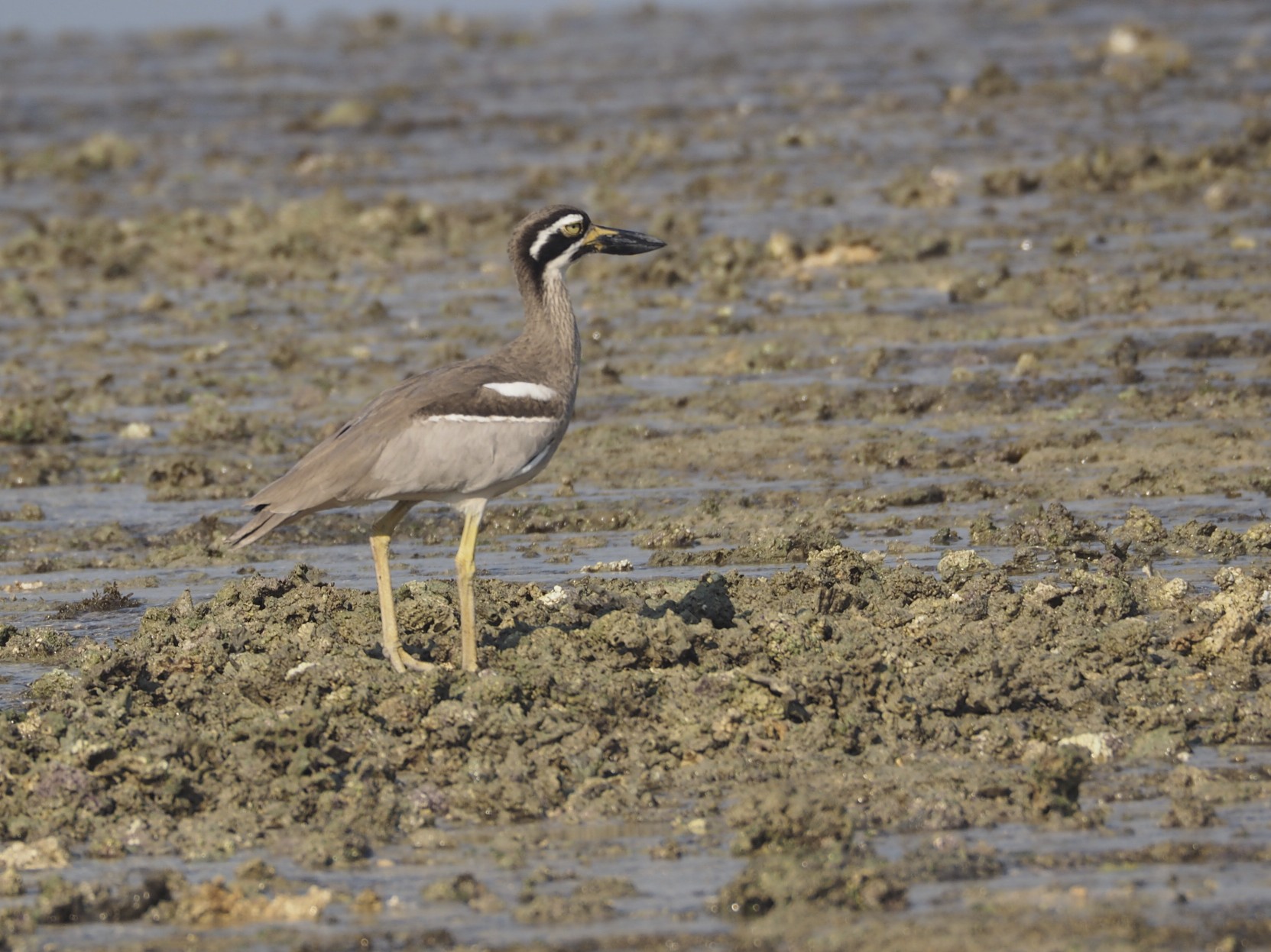
Our visit was graced by a flock of White-winged Terns in full breeding plumage, a stranded turtle and many in the water, close looks at Eastern Reef Egrets and other shore birds such as this Beach Stone-curlew …
King’s ship was His Majesty’s Cutter Mermaid. It had been cobbled together with iron not copper nails. As time passed and the nails rusted out it began to leak furiously. During 1820 King selected a suitable beach with easy access to fresh water and careened her. The work took six weeks, numerous holes being plugged with locally cut wooden bungs. The Mermaid still leaked when she was refloated.
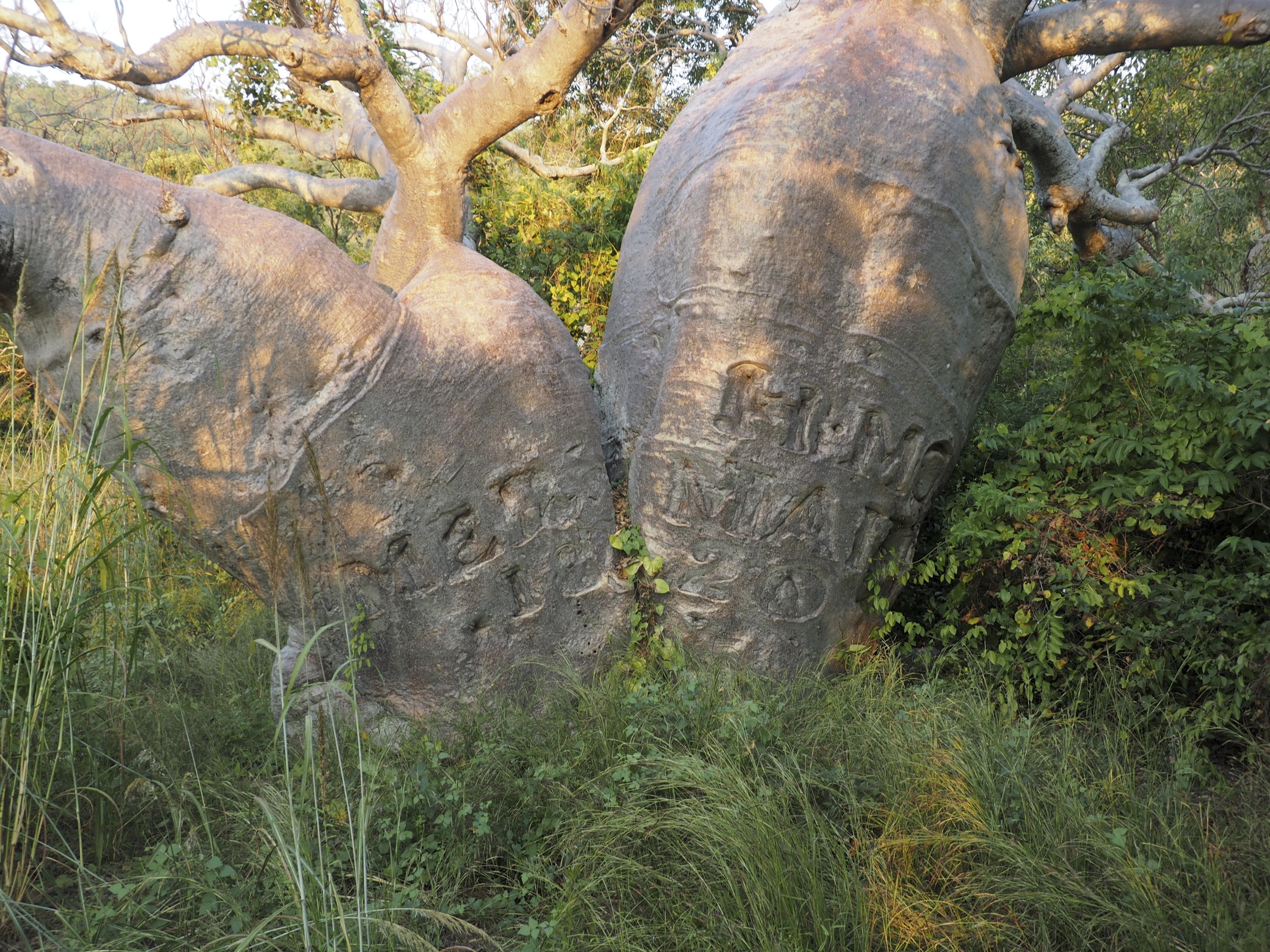
Whilst at Careening Bay a memento was carved in a Boab tree.
HMC Mermaid 1820
Admiral Phillip Parker King, FRS, RN died at his home in North Sydney on 26 February 1856.




 bobmcgee