The hours of daylight are declining, mornings are chilly. Our summer birds are thinning out. My own migration north is almost due although the diesel supply may complicate that, we’ll see.
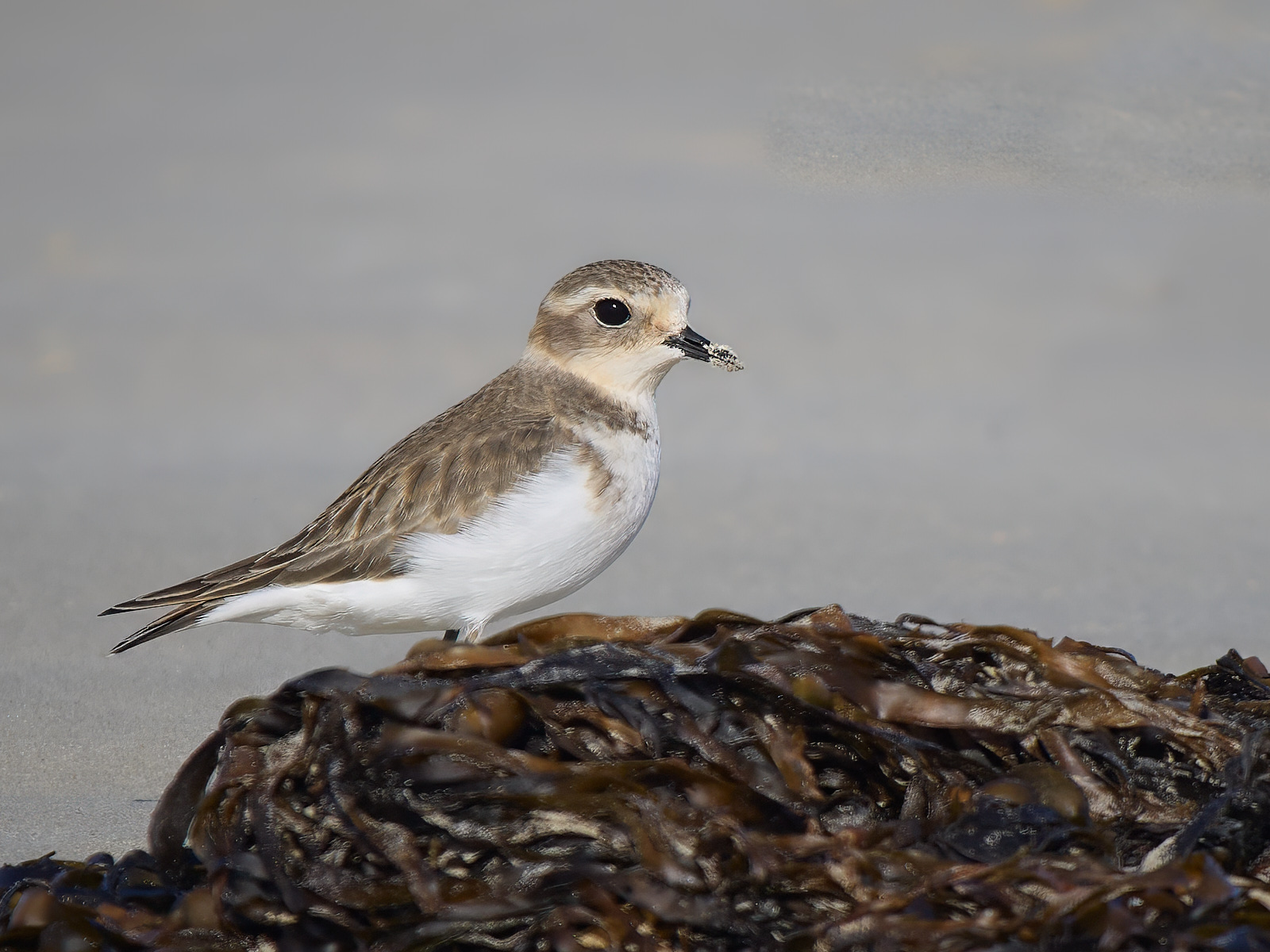
But Victoria does have its winter visitors too. This morning I was on Killarney Beach (not the original – we do have quite an Irish influence around here) chasing Double-banded Plovers. They breed in New Zealand and some think that Australia, even chilly Victoria, is a better place to spend the winter.
Roebuck Bay is the premier Australian location to see waders. Mostly long legged birds in the order Charadriiformes. At low tide there is a vast area of mud flat housing huge numbers of invertebrates for them to feed on. Some of the species here are resident, living and breeding locally. Many more are long distance migrants breeding in the northern hemisphere and escaping from the snows of winter up there by flying all the way to sunny Australia. For some of these birds it means a 20,000 km round trip every year of their adult lives. For some of them the journey north starts today.
Different species typically depart at characteristic times. The early birds left from about the second week of March. Prominent among those are the Eastern Curlews and the Greater Sand Plovers. We are right in the middle of things now but most of the Red Knots and Red-necked Stints are still out in the bay putting on weight. Peak period for the stints will be next week. Most of the Red Knots will hold on until the first week of May.
I shamelessly filched the graphic from the Broome Bird Observatory website. If you click on it you may be able to read it.
The Broome Bird Observatory is a great place to watch the departures. Get there at about four in the afternoon, head to the beach and stay until about six. Observatory staff will be charting the departees and they will be happy to explain what’s going on. Just say hi.
What they and you are looking for are single species lines of birds forming up on the mud flats. There is much chattering and wing stretching. Then up they go. They may make a couple of orbits and go or a couple of orbits and land again. When they form a big boomerang shape and head north at a higher altitude than for local flights you know they mean business. Or not. Some may come back after a while, sometimes all of them come back. But if you want to make babies sooner or later you’re off.
Light a candle for them when you get home. They’ll still be flying after the candle is exhausted. Some will fly non-stop to China, 6,000 km plus, 5 days, no food, no drink, no rest. Some do stop on the way on the coasts of Indonesia, Vietnam and the Philippines.
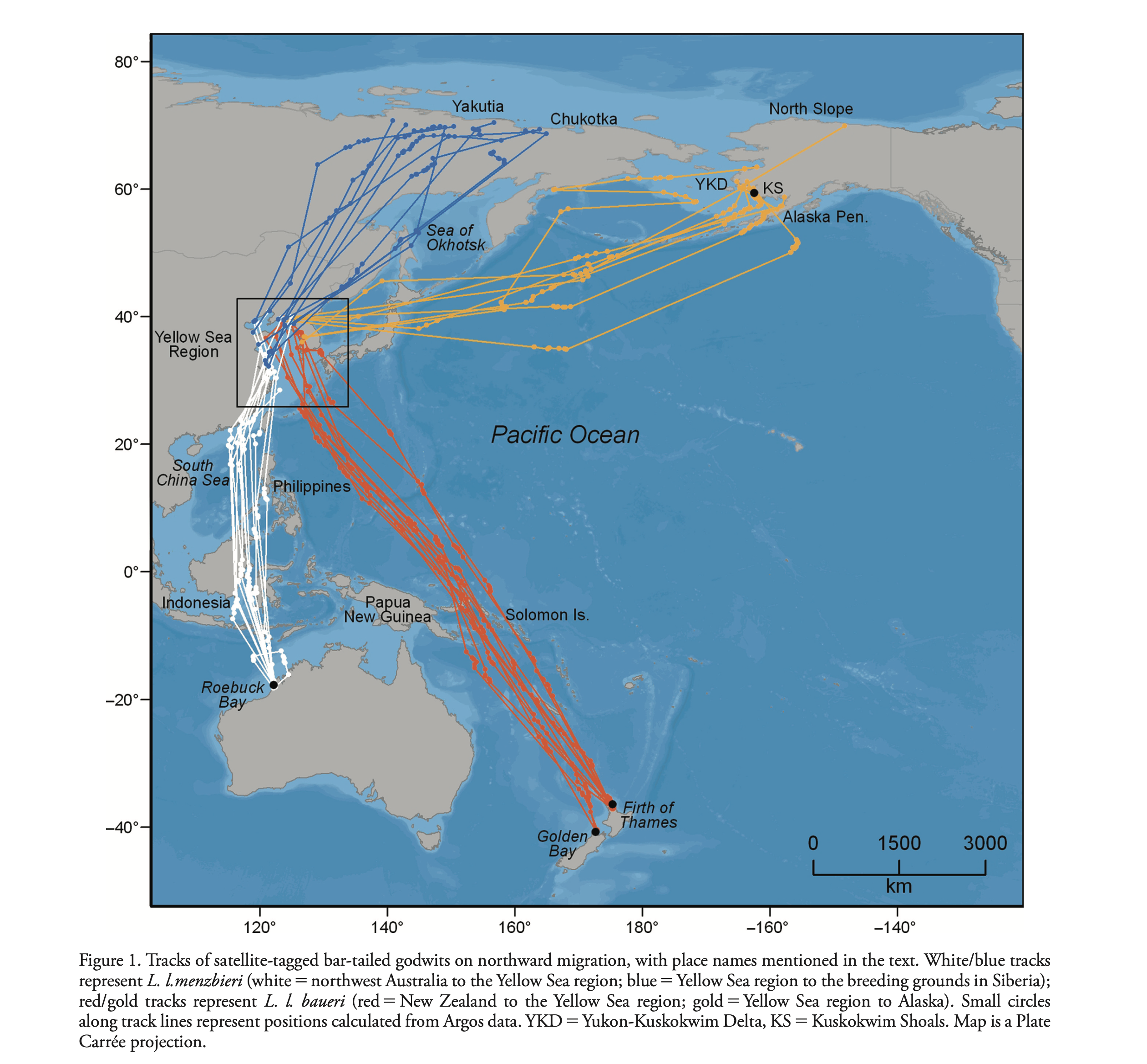
Birds can be equipped with transmitters so that their progress can be tracked. The transmitters are small but so are some of the waders so we know far more about the big ones than we do the little ones. The next map is pinched from a paper by Battley et al, Journal of Avian Biology 43: 21–32, 2012 and concerns Bar-tailed Godwits on their journey from Roebuck Bay and New Zealand.
The birds spend about a month re-fueling on the shores of the Yellow Sea before continuing to the breeding grounds. Those feeding grounds are absolutely critical to the species survival.
The pay off when they get home makes it all work. The tundra is uninhabitable in winter but in summer is so rich in insect life that the young chicks can feed themselves from almost the moment they hatch.
These are extraordinary journeys. I always feel a little emotional when I watch them go.
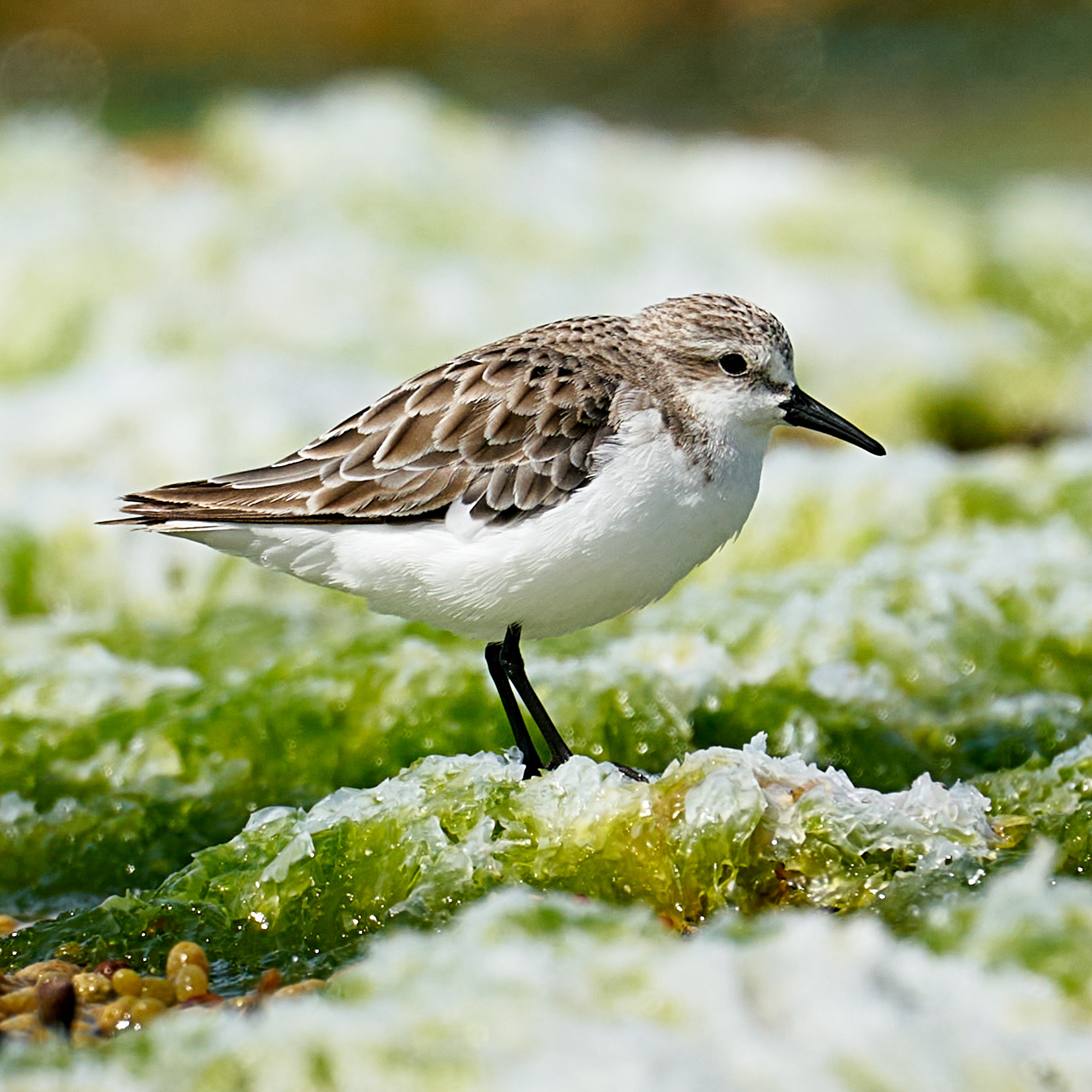
A few months ago this little guy hatched in the Siberian tundra. He or she started feeding themself almost immediately, grew fairly quickly and soon outfitted themself in their first suit of feathers. The parents provided some measure of protection at first but then abandoned it. Our little hero then flew 12,000 km to Australia’s south coast. It weighs about 30g. (Barely more than an ounce for American readers).
Red-necked Stint (juvenile)
When overwhelmed by the need to procreate it will fly all the way back again. What a crazy strategy but it’s one that millions of migratory shorebirds will pursue. Thirty-seven species regularly spend the northern winter in the Australian summer sun.
The route these birds follow is the East Asian Australian Flyway or EAAF for short. There are other flyways in the Americas and Europe to Africa. The birds that do this perform amazing feats of endurance. Read about the Bar-tailed Godwit that holds the record non-stop 13,500 km flight Alaska to Tasmania <HERE>. That tiny Red-necked Stint will overwinter in Oz this year but after that it will do the 24,00 km round trip every year for the rest of its life. And its life span may well be as much as 18 years.
How do we know this? The answer to that is that interested people have caught them and put bands on their legs and caught them again in subsequent years, sometimes numerous times. Scientific bird banding started in Denmark in 1899 when bands were placed on 162 young Starlings. The first recovery of a banded bird in Australia predates that and has nothing to do with science. In 1887 an albatross was found near Triggs Island, Western Australia, with a tin collar around its neck carrying the message “13 naufrages sont refugies sur les iles Crozet 4 Aout 1887′. (13 shipwrecked sailors have taken refuge on the Crozet Islands, August 4 1887). Sadly they perished about a month before the help summoned by their ingenuity reached them.
One drawback of numbered metal bands is that you need to catch the bird to read it. In recent years engraved flags enable birds to be identified in the field. That’s handy for life span studies. Not so handy over the horizon on their long journeys but advances there mean that our 30g stint can now be followed by means of 0.3g geolocator.
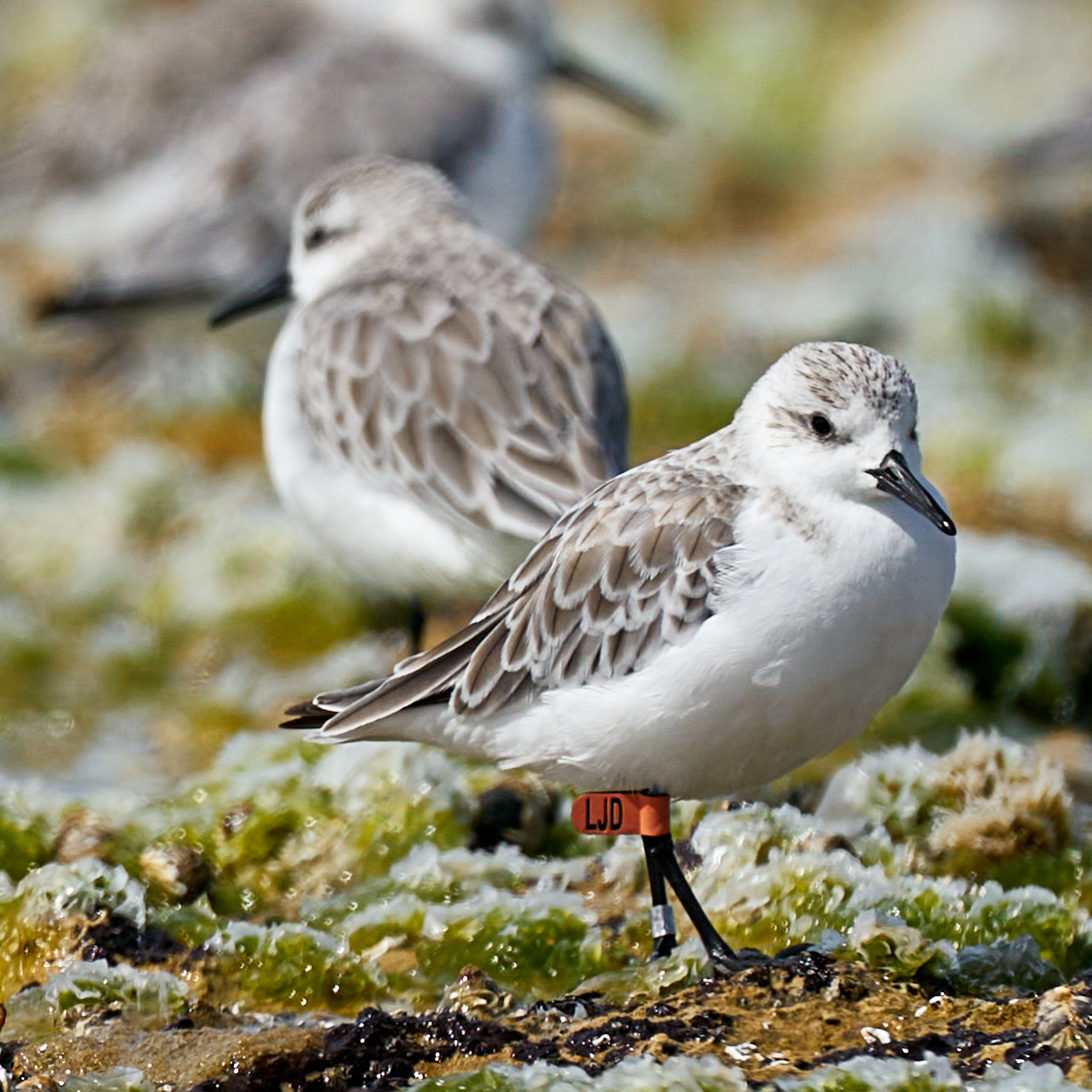
I’ve spent the last couple of weeks in Port Fairy on Australia’s south coast and I’ve come across a number of flagged birds. I photograph these when I can and report them, a minor contribution by way of citizen science.
Bird banding is heavily regulated. In Oz it’s by the Federal Government through the Australian Bird and Bat Banding Scheme and it’s to them that you report your observations – online <HERE>. Similar bodies exist in other countries and these too can be found online. A photograph is nice but isn’t essential just a sight record will do. If you come across a dead bird with a band on make a note of the numbers on it and submit that. Use the same form.
The ABBBS will eventually get back to you with a report. The scientist that placed the band will also get details of your interaction. In the case of the Sanderling, the only migratory wader in the gallery above – the other two breed locally, I now know that it was banded at Killarny, Victoria 11 months ago. It was 2+ at the time meaning it was in its second year of life or older (in other words an adult). I found it at Yambuck 26 km away. It may have flown a lot further than that given that it is an adult and there has been a breeding season between banding and sighting. Sanderling breed in the arctic as far north as they can get before finding themselves in the sea.
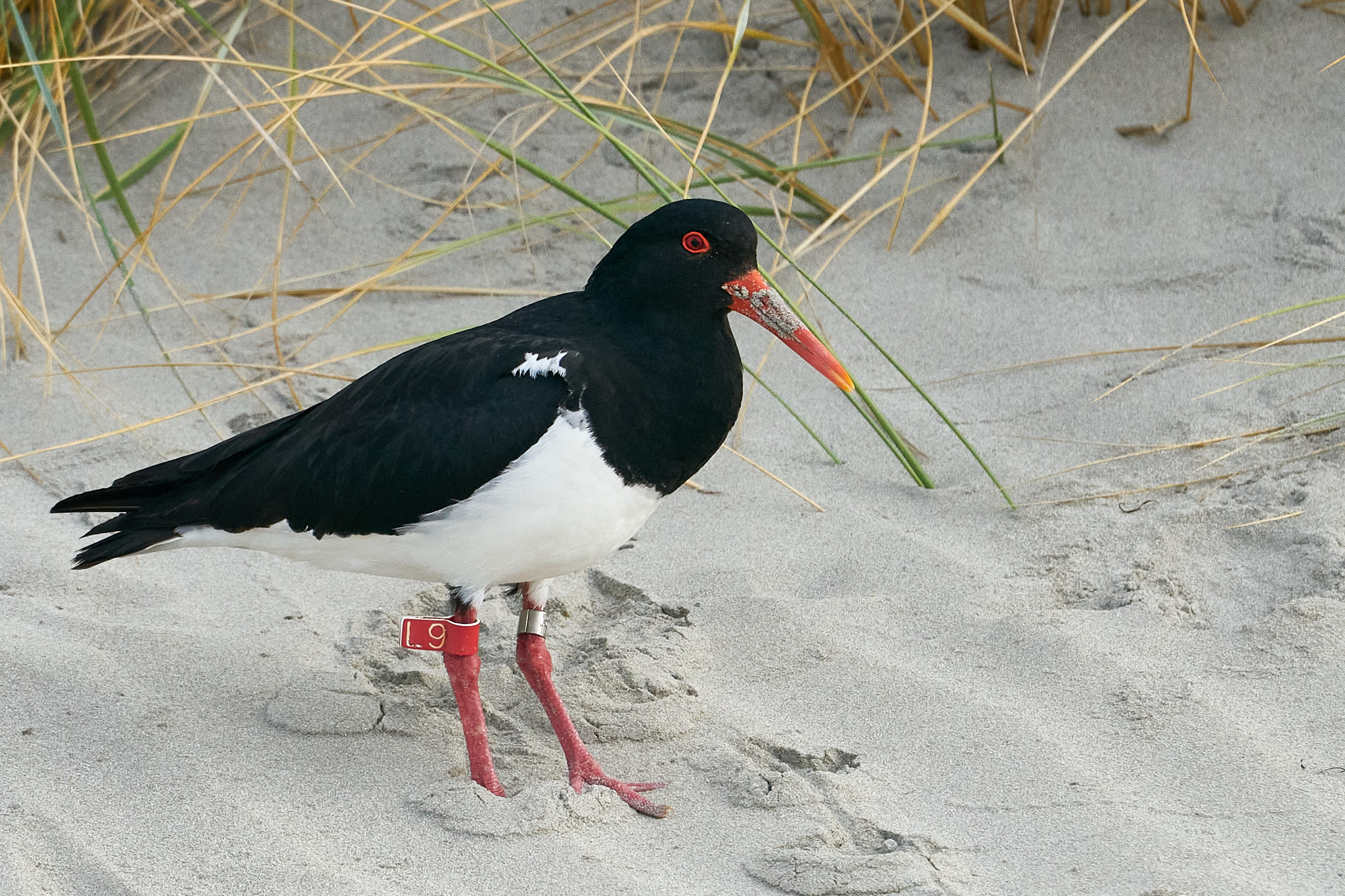
Many birds can be aged accurately from their plumage in their first year of life, some even into their second or even third year. If a flag is placed on a bird of known age its age at subsequent sightings can be determined. The Pied Oystercatcher was judged to be in its third year when it was banded 12.5 years ago which makes it 15 years old now. It was banded by the Victorian Wader Studies Group 286 km east of where I found it. Long may it prosper.
I haven’t received the report for the Red-capped Plover yet.
It’s impossible to mount an argument for conservation without data. A sighting you make on an ordinary day out is a valuable contribution but only if you submit it.


 bobmcgee