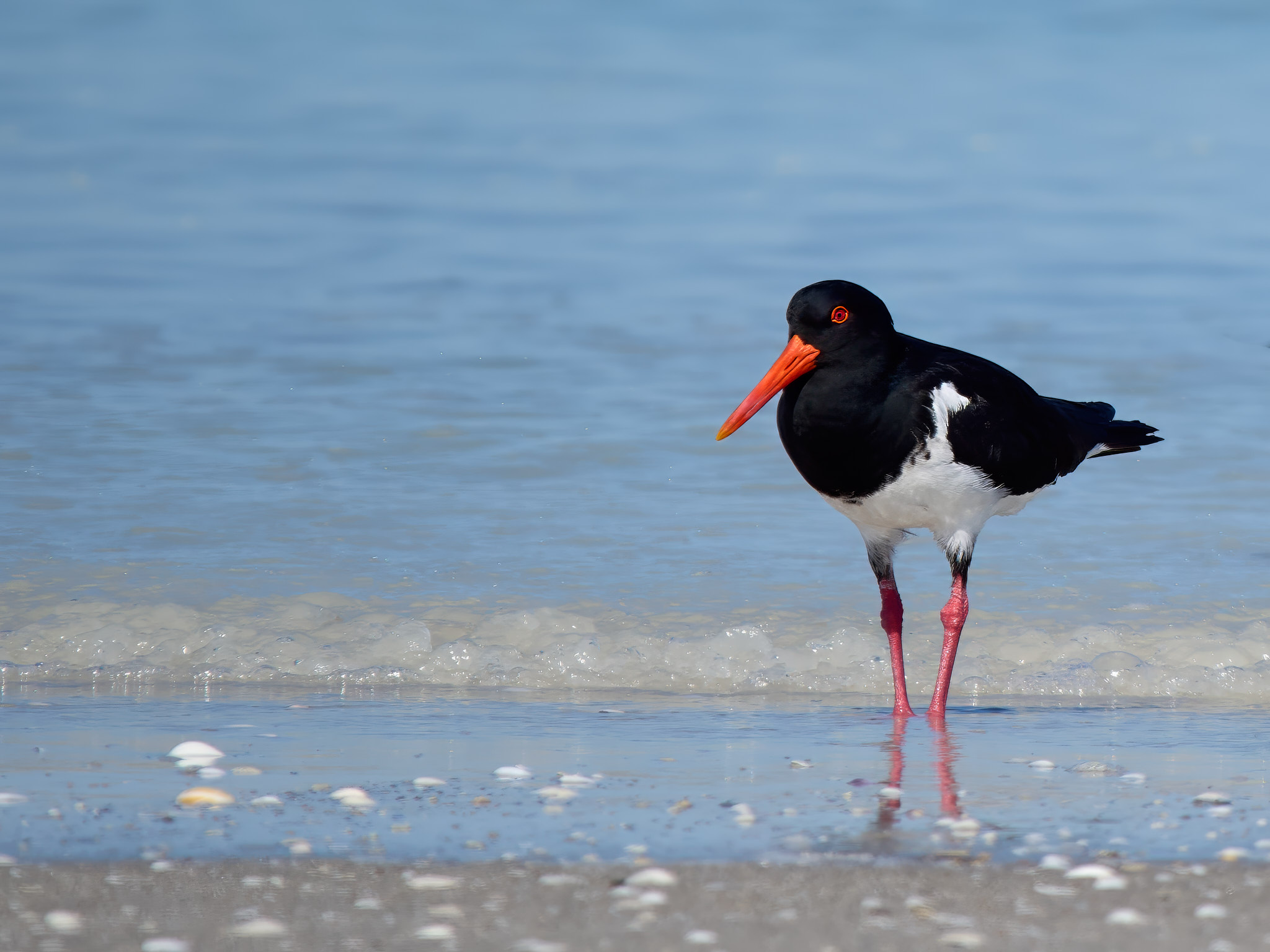
Australian Pied Oystercatcher 5B was in its first year when it was banded in 2013 so is now coming up to its 12th birthday. It has moved 286km from where it was banded and it is in a relationship!
Australian Pied Oystercatcher DV was in its second year when it was banded in 2011 so is now in its 16th year of life. It was foraging by itself 343km from where it was banded.
Sanderling LAX was banded just metres from where I found it 3 years later but far from being lazy it has probably flown further than either of the Oystercatchers because it hatched in the high Arctic and may have been to and from the breeding ground in the interim. That’s more than 11,000 km each way. They run a marathon every day as well. Their foraging style is to chase the waves out, snatch some invertebrates from the sand and run back in front of the next wave.
I found and photographed this trio within a few days of each other on the beaches around Port Fairy. They show the value of using flags that are readable in the field without catching the birds. I just fire away with the long lens as they continue about their business. Clearly the flags are not an impediment. Occasionally you can even read the numbers on the metal band for large birds.
I report the sightings with or without photos to the Australian Bird and Bat Banding Scheme. If you give them your email address they will get back to you and to the bander with the whens and the wheres. Here’s the link ABBBS. If you come across a dead bird with a band you can let them know the number on the band at the same link. It doesn’t matter if you can’t identify the bird – the band will. If you’re not in Australia there will almost certainly be another authority that you can track down on the internet.
The flags do kind of ruin the photos, they are not going to end up on the wall, but when it comes to arguing the case for conservation pretty pictures are trumped by hard data (except maybe for koalas, pandas and polar bears.)
On a more serious ornithological note, the fair city of Broome (population 15,000) looks out over Roebuck Bay, Australia’s most important site for the waders, outnumbering the humans many times over. In Australian (and English) usage waders are birds in the order Charadriiformes. Americans tend to prefer the term Shorebirds and if you say wader they think of herons and such and it’s possible they might have a point. Herons do a lot of wading. Some waders do no wading at all, not all shorebirds live on the shore, but most do. But I digress. The Broome Bird Observatory is the hub of considerable research into the charadriiforms. So it was that on 1st December 2002 members of the Australian Wader Studies Group were in the field (on the beach, actually) using cannon nets to catch birds.
Among the catch that day was an Australian Pied Oystercatcher. It was weighed, measured and closely examined. It was in its third year of life or older. Smart ornithologists can age first and second year Oystercatchers by their moult. It went from being an anonymous Oyk to Oystercatcher 101-07877. Thus if it were encountered again something would be learnt about its movements and survival.
I was not in the field with the AWSG that day in 2002 although I have enjoyed that privilege on other occasions. I was on Gantheaume Beach on the 11th of August 2025 when I met 101-07877. When it faced west I was able to make out the first three band numbers, when it faced east I was able to get the last three. I had no luck getting two numbers in between.
I reported my sighting to the Australian Bird and Bat Banding Scheme. They had records of two Pied Oystercatchers 101-XX877 but the other one is also carrying a coloured flag. Thus we know the identity of this particular little bird, found alive and well just 20km from where it was banded 22 years 8 months and 10 days earlier. Its age is now 25 years or more.
As I point out from time to time Roebuck Bay is the Shorebird Capital of Australia. The shores are in part accessible by car from Broome. Other parts are more of a challenge to reach and are therefore less well studied and less frequently disturbed. Bush Point is 22km due south of the Port of Broome and not easily accessible except by boat. That’s not to say that other means have never been employed. Over the years hovercraft and 4WD vehicles have been used but boat is the most practicable. However boat does have the drawback of limiting time ashore to about one hour on each side of high tide. It’s the 10 metre tides that expose the mud that feeds the birds that make the bay the Shorebird Capital of Australia. Deal with it.
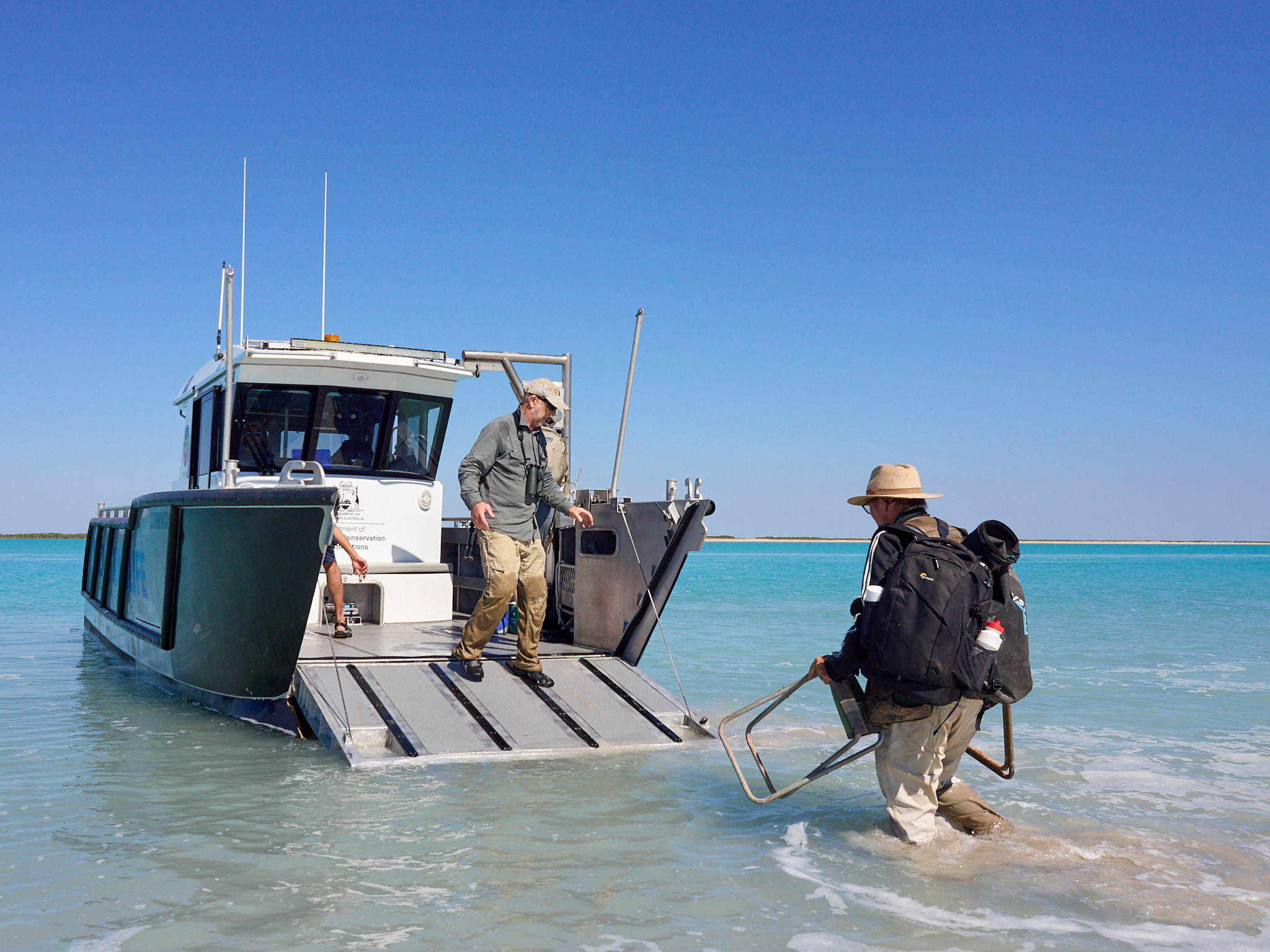
The other day I had the enormous privilege to accompany a party of keen volunteers ably led by Chris Hassell of the Australian Wader Studies Group on the regular winter count at Bush Point. The project has been running for 24 years. Parks and Wildlife provided the boat, a landing craft style catamaran that ripped along effortlessly at 25 knots across the bay. The front was lowered and we stepped off into a few inches of water, not a crocodile in sight.
A winter count is revealing. A migratory shorebird with any intention of breeding is somewhere between here and Siberia. Birds on the beach are mostly too young to breed. The age that they reach maturity varies from species to species. Some species will return north in their first year others spend one or more years in the southern sunshine before going. As a rule the bigger birds wait longer than the smaller ones. If summer counts are available comparing the two gives some indication of breeding success over the recent past.
Our priorities were straight forward. First and foremost to count the migratory shorebirds, secondly the resident shorebirds and we were to avert our gaze from anything not a member of the Charadriformes. This is ornithology, guys, not merely bird watching. We were divided into two groups and sent forth to count. Easy …
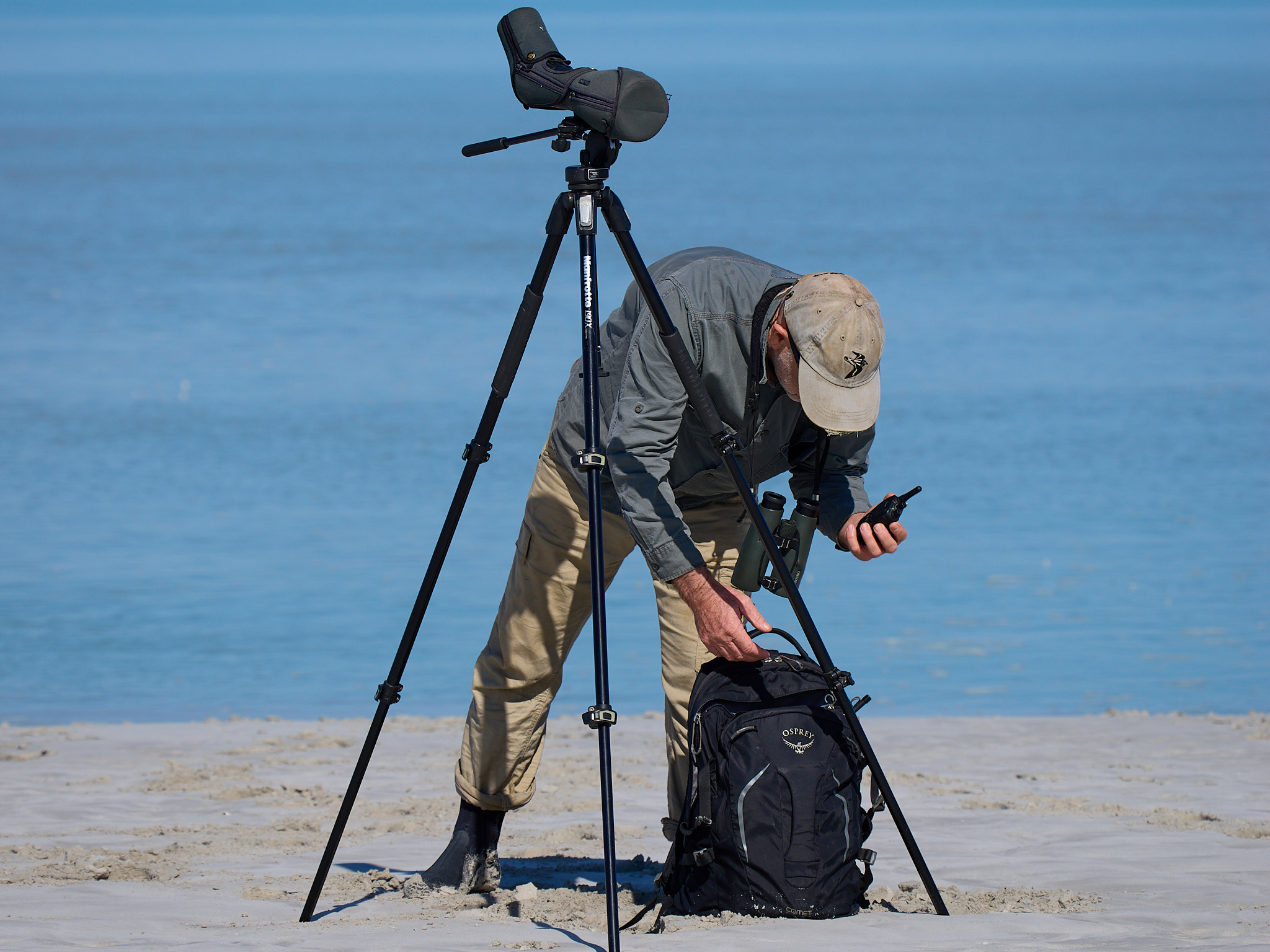
Well, easier when they’re on the ground and keeping them on the ground means a little stealth and maintaining a considerable distance. Identification and counting is done with telescopes.
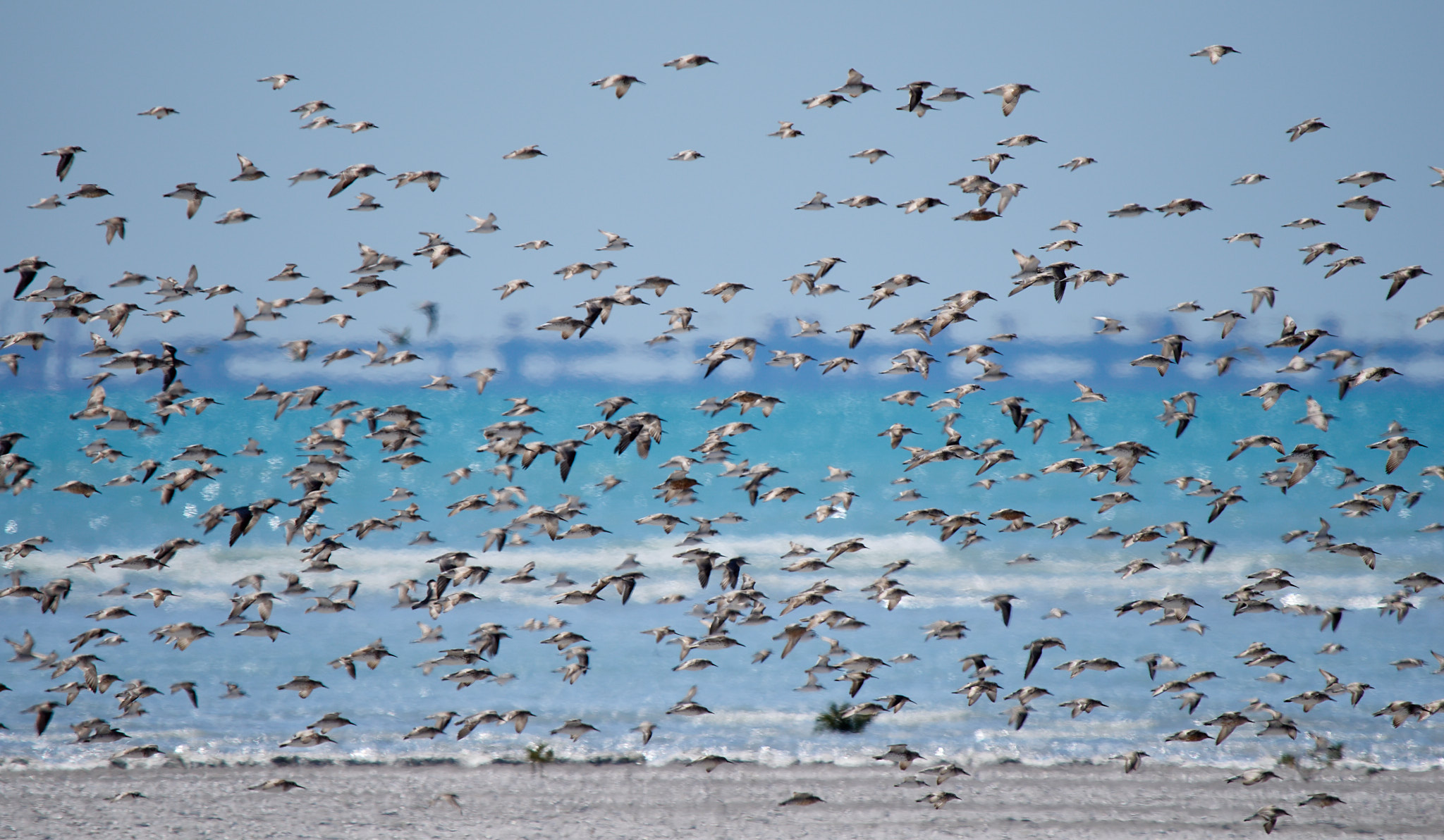
Opportunities for photography were very limited. If a group flew by you might just get a shot …
Great Knots and a Terek Sandpiper
An hour after high tide the volunteers reconvened for the journey home.
So what did we find? Two parties covered about 4km of beach amassing a total of 13,400 individual migratory waders representing 20 species. Red-necked Stints were the most numerous and these would be in their first year of life. Whimbrel and Great Knot were well represented.
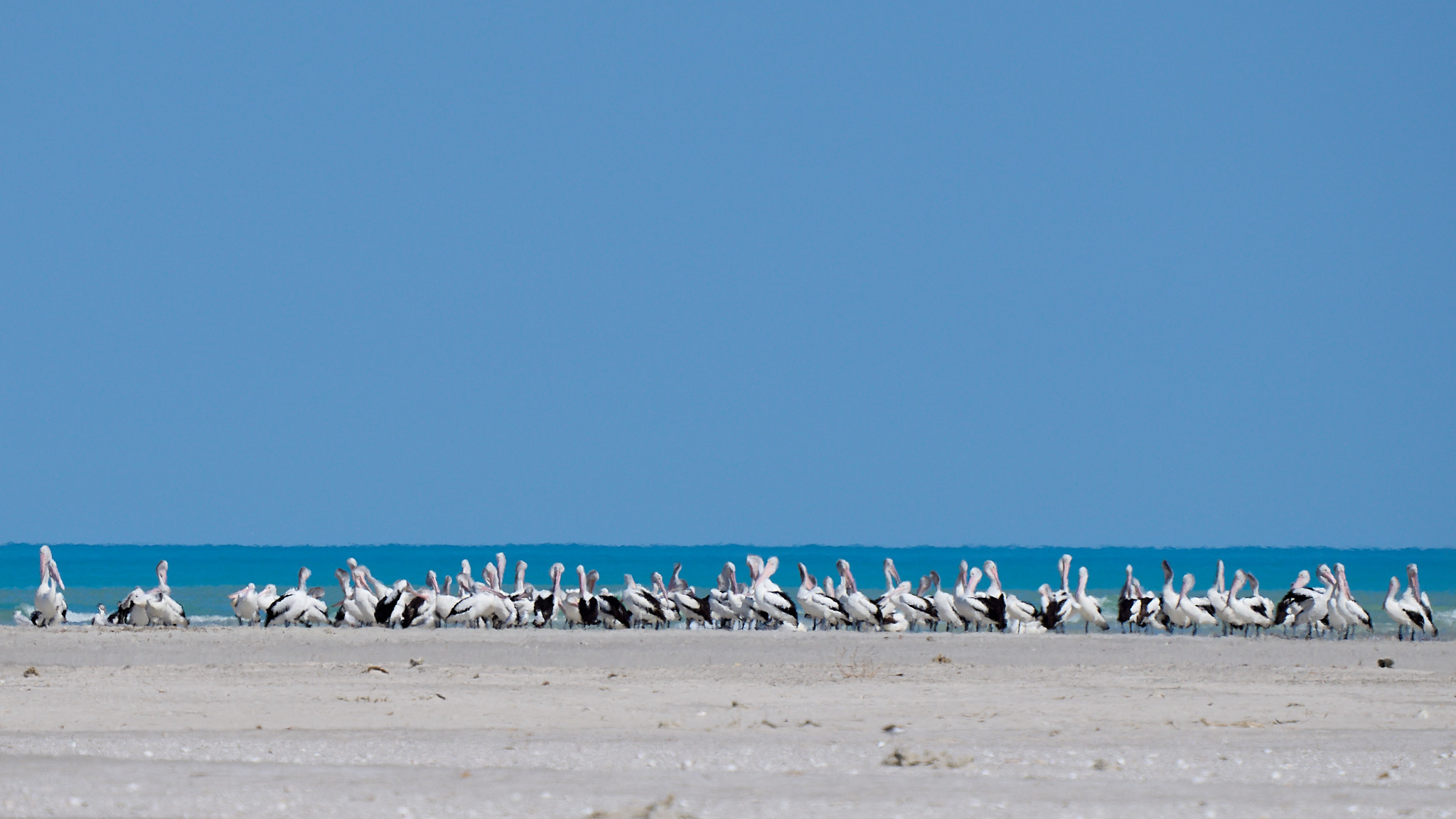
In the few minutes before being put on a short leash and obliged to trudge for miles through soft sand while being sun burnt and bitten by sand-flies (Gallipoli and Normandy were worse, I believe) I did get to point the camera at non-target or low priority species …
Diplomacy is the art of telling someone to go to hell in such a way that they look forward to the trip.
The man that introduced me to that concept was Clive Minton. Sadly he died the other day in a motor car accident in Dunkeld on the Glenelg Highway, Victoria. The car he was driving hit a truck head on. His wife and a friend were injured but are recovering in hospital.
Clive Minton
If you lived on planet Earth and had a passionate interest in birds you bumped into Clive in any number of ways. For me it was through the Victorian Wader Studies Group. Dr Minton got his PhD from Cambridge in metallurgy. Studying birds was his hobby. He was the founding member of the Wash Wader Studies Group and played a major part in developing cannon netting as a means of catching large numbers of birds so that they could be banded and released. Once a bird is a marked individual its movements and life expectancy can be tracked. The shorebirds that he studied make remarkable movements and enjoy relatively long lives.
Clive came to Australia as managing director of Imperial Metal Industries and wasted no time introducing cannon netting to his new home country. He headed up a vigorous campaign in Victoria and led an expedition to north-west Australia every year. One of those expeditions was my introduction to Broome and a number of friends that I hold very dear.
Clive was a giant of a character. He had an enormous intellect, extraordinary energy and charisma by the bucket load. He could be diplomatic and was much of the time. What he could not be was denied. He would have been extremely successful as a Roman General. He made an enormous contribution to ornithology and leaves a million stories in his wake. They will be retold many times when birders congregate for many years to come.
There have been times when I’ve wished that I’d had a father like him and times when I was glad that I didn’t.
I met Chris Hassell in 1996. We were in Broome, WA, to take part in an Australian Wader Studies Group expedition to catch and band migratory waders on the north-west Australian coast.
The leader of the expedition was the legendary Clive Minton, father of cannon netting in Oz, and there were some big name ornithologists along including Professor Theunis Piersma from the University of Groningen, Holland. Chris and I were just foot soldiers.
Chris, like me, is a pom. He comes from the midlands, not far from Leicester. He’d hardly settled in Oz when he set off for Broome.
The exercise we were engaged in involved setting nets just above the high tide mark in a spot where the birds would rest when the sea covered their feeding grounds. The nets were furled, camouflaged and attached to cannons that would shoot them over the unsuspecting flock when the time was right. The birds were then measured, weighed and banded with a numbered metal ring and released.
The work was hot and physically hard and the process considerably more nuanced than the summary above conveys. It ran for six weeks visiting Roebuck Bay, Ninety Mile Beach and Port Hedland. When it comes to cannon netting a good supply of willing volunteers comes in very handy.
Chris stayed on in Broome. For a while he was a warden at the Broome Bird Observatory, then he founded and ran Turnstone Nature Discovery Tours, showing visiting bird watchers and other interested visitors the delights of the region. Because of his knowledge and considerable ID skills he became sought-after for ecological research and census work.
When Birdlife and the Global Flyway Network needed a researcher on the shore of Roebuck Bay he was their man. He now has a little army of volunteers of his own. No longer a foot soldier, in my view he has surpassed the mighty Minton as a catcher of birds. Chris, very modestly, disagrees.
Do I like birds? If I tell you that last week I went to our school book parade dressed as the Field Guide to Australian Birds, with a bird bath on my hat, does that give you a big enough clue?
This was my sixth cannon netting and there’s always a story. At school they tell us a good story has to have a problem. This time we had three. Firstly, the day was windy, which makes the birds flighty. Secondly, there were two Brahminy kites circling over head. And thirdly because of the big high tide, the net had to be set below the
tide. Listening to the pre-catch talk about how to deal with this was therefore very important.
What we didn’t reckon on was the fourth problem. One of the cannons didn’t fire . There are three cannons, right? Surely, two would do the job? But most of the birds (over 300) were in one corner of the net, while the cannons that worked, beautifully captured the 14 birds that were in the other corner.
Chris was very brave. Very, very brave. Even though this is the second time this has happened this season, he didn’t swear in front of the kids, or cry in front of the adults. He did disappear for quite a bit, though.
As there weren’t so many birds in the net, Chris gave us a great demonstration in tagging, banding and measuring the birds we caught.
What’s in it for us kids? Well, firstly, if you can be quiet and still, you sometimes get to go with him to the hide, which means you
actually see the net fire. You get to race to the net to get it out the water and help get the birds out and into the boxes. This time though, as there were so few birds, all the kids got to carry one to the cages, where the birds settle before tagging. If you’re calm and steady, you get to fetch the birds to the adults for measuring, and then release them in groups afterwards. Best of all, you get to take pictures of the birds up close. I really loved seeing the Ruddy Turnstone, the Grey Plover and the Greater Sand Plovers (who love pecking you).
People say you should never work with kids and animals, but at the cannon-netting they do both, and with explosives too!
There’s a great future for that kid. And the reason this work is done is to ensure that there’s a future for the birds as well. I’m sure someone has thought of putting a marina in Roebuck Bay, maybe a five star hotel and a golf course. Research gives us an understanding of population trends, longevity and breeding success. These are essential ingredients in any argument to sway governments towards preserving the bay.
Stops along the migration route are also invaluable links in the chain that determines the survival of migratory shorebirds. When the birds take off for their breeding grounds Chris takes off from Broome bound for Bohai Bay in China where he helps monitor their passage. This year’s Bohai Bay Report can be found <HERE>.
Could be a bad summer for Chris this year, he still supports the English cricket team, no future for him in parliament.








 bobmcgee