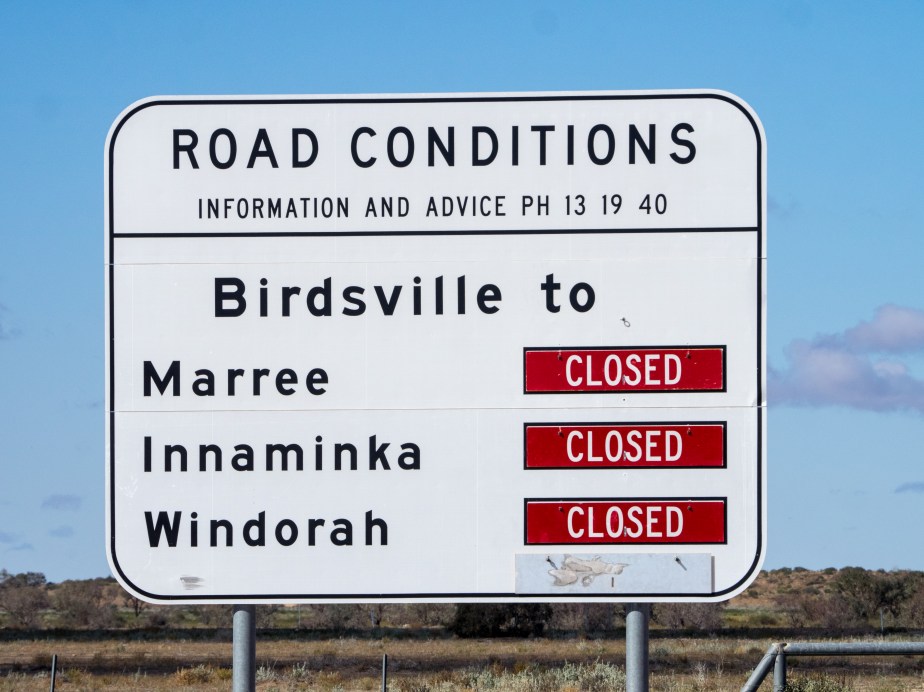
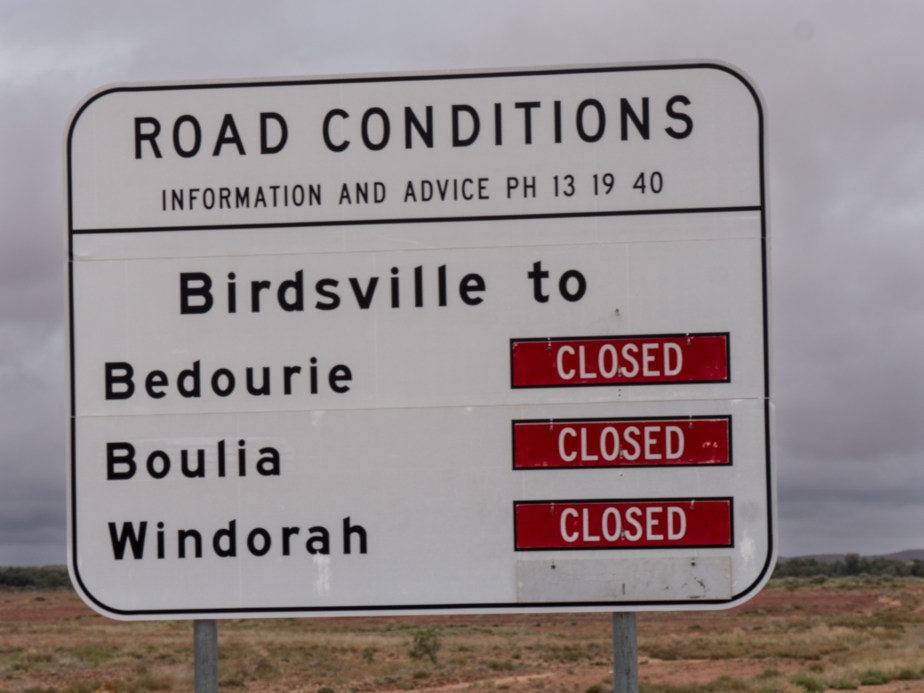
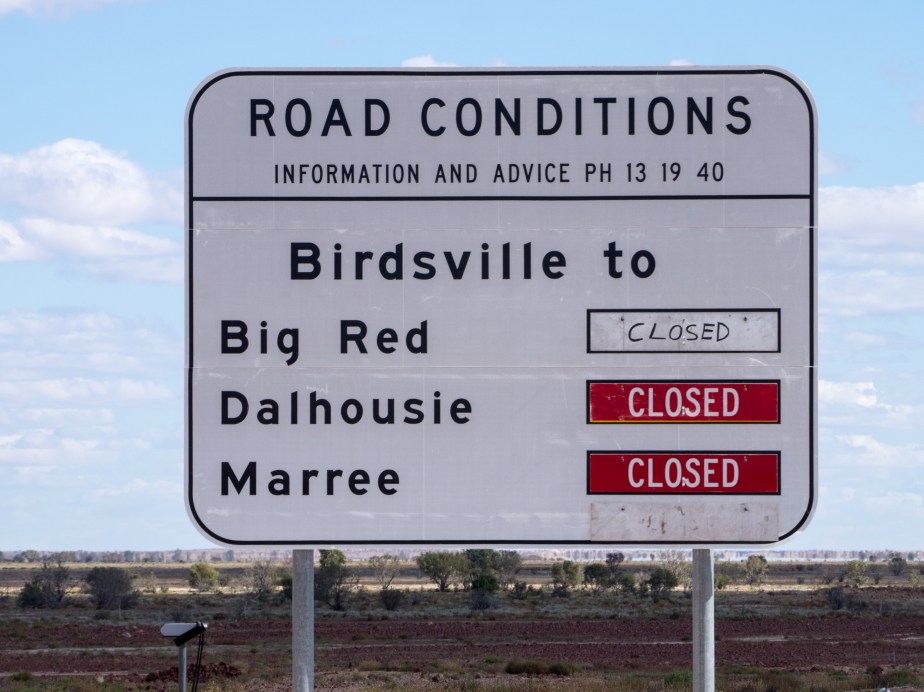
En route at last …

It has been a very wet winter. We had been watching the weather closely for a month or so. Rain had closed the roads to the Simpson Desert repeatedly. We had gone so far as to make alternate plans – the Nullarbor surely would be dry.

Plan A would take us across the French Line to Poeppel’s Corner and then south via the Warburton Track to the Birdsville Track near Mungerannie. The Warburton River was not in the mood to cooperate. Plan B was to head to Birdsville instead. But before you can cross the desert you have to get there.

The party assembled in the Victorian Goldfields on the 12th of August. The quartet was Mark and Will, both professional biologists thrilled to get into the field without the burden of their jobs to consider, the lovely Gayle and myself. After last minute packing we set off the next morning.

During the day we crossed the South Australian border into the Riverland. Quarantine restrictions are in force to protect the region’s agriculture. Honey, fresh fruit and vegetables are forbidden. Canned, processed and freeze-dried foods are OK as are meat, eggs, dairy products, nuts, mushrooms and seeds. Potatoes are forbidden, sweet potatoes are permitted, the rules are somewhat convoluted. If arriving from Tasmania (presumably by plane) you may take date palms but coming from Victoria we must leave our date palms behind. Soil is forbidden no matter what … how do Tasmanian date palms get on in hydroponics?

A little over 600 km later we camped for the night in the South Australian Mallee.


SAMallee

Not far from our camp we found the excavations of the Southern Hairy-nosed Wombat. This is a creature that mines on a grand scale. Their burrows are interconnected into warrens that are shared by as many as ten wombats. We staked out a burrow and hoped that as night fell one would choose this particular exit. Despite considerable patience (two beers at least) we were not rewarded. However, a return visit later in the night surprised one above ground. It didn’t stay long.

It was one very cold night.

The Great Inland Expedition 2016 …

It started as a thought bubble, why don’t we drive across the Simpson Desert?

According to the frequently erroneous Wikipedia, the Simpson is the world’s largest sand dune desert, with the world’s longest dunes. It covers 176,500 km2 (68,100 sq mi) and the dunes range in height from 3 metres in the west to around 30 metres on the eastern side.

There are no made roads and no fuel stations. The tracks are well-defined, even sign-posted in places, but you must take them just as you find them. The prevailing wind is from the west. This has a profound effect on dune morphology, the west face of the dunes has a slope of 10-20° whilst the eastern face has a slope of 34-38°. West to east seems a good idea for a beginner.

There are a number of routes to choose from. Of the two most popular, the French Line is reputed to be harder than the Rig Road. So the Rig Road seems another good idea for a beginner. We chose the French Line.

Last fuel on the west can be either Oodnadatta or Mount Dare Station the next, on the east, is at Birdsville (taking the QAA Line from the end of the French Line) or Mungerannie (taking the Warburton Track). Mount Dare would have been a little out of our path but shortens the distance a little. The longest of the possibilities is Oodnadatta to Mungerannie at about 750 km.

A solo trip seems foolhardy for a beginner so I invited some friends along. Two high clearance 4WD vehicles were set up for the gig, an FJ Cruiser (petrol) and a Landcruiser series 70 ute (diesel). Both have electric winches, radio and a shovel – the first self rescue item to turn to in sand. There was one satellite phone. And of course, the sand flags. We would carry some extra fuel.

We would be travelling in the tracks of countless aborigines and many other Europeans including Mrs Middleton’s little boy, Johnny; and Bill from Cunnamulla who did it twice on his bike. The first white explorer to see the Simpson was Charles Sturt back in the 1840’s. It was in the way of his attempt to travel north to the geographic centre of Australia. He was unimpressed …

We had penetrated to a point at which water and feed had both failed … The spinifex was close and matted, and the horses were obliged to lift their feet straight up to avoid its sharp points. From the summit of a sandy undulation close upon our right, we saw that the ridges extended northwards in parallel lines beyond the range of vision, and appeared as if interminable. To the eastward and the westward they succeeded each other like the waves of the sea. The sand was of a deep red colour …

In 1880, Augustus Poeppel, a surveyor with the South Australian Survey Department made an incursion from the east along the 26th parallel, the Queensland/South Australia border, and marked the point where they meet the Northern Territory. He placed the tristate junction a little too far west, in the middle of what is now Lake Poeppel. It has since been moved to its correct position and is called Poeppel’s Corner.

Development on each side of the desert occurred quite early. Edward Meade Bagot took up the lease on Dalhousie Station on the western fringe in 1873. Birdsville, on the eatern fringe,  dates from about 1881 initially as Diamantina Crossing but quickly renamed. The Birdsville Post Office opened in January 1883.

David Lindsay, a formidable explorer, joined the dots. In January 1886, the height of summer, he set out from Dalhousie on the west side of the desert with Paddy – a Wangkangurru Aboriginal man and Charles Bagot, the pastoral lessee of Dalhousie Station and headed east into the Simpson Desert. He visited and documented a series of nine Aboriginal wells and travelled to the Queensland/Northern Territory border. Considering the country further eastwards to be “discovered” and also considering Mr. Bagot’s health, he backtracked to Dalhousie.

In 1886 Warburton, properly Peter Egerton-Warburton (1813-1889) penetrated from the south. He explored the area around the north shore of Lake Eyre searching unsuccessfully for Cooper Creek but found a large river which was subsequently named the Warburton River. He traced this north to the Queensland border. We hoped to follow his track south from Poeppel’s Corner but his river just happened to be in flood.

The name Simpson Desert was coined by Cecil Madigan, in honour of Alfred Allen Simpson, an Australian industrialist, philanthropist, geographer, and president of the South Australian branch of the Royal Geographical Society of Australasia. Mr Simpson was the owner of the Simpson washing machine company. Madigan made an aerial reconnaissance flight over the desert in 1929, which proved that the desert was composed of numerous parallel sand dunes, with no evidence of permanent water.

Ten years later Madigan crossed the desert by camel and celebrated being the first across the entire desert in the very readable Crossing the Dead Heart.

He was not, of course, the first, in fact not even the first European. That honour goes to Ted Colson who had traversed the full width of the desert in both directions three years earlier.

On 27 May 1936 after a season of good rains, Colson set off from Mount Etingamba 53 miles north of Bloods Creek with a lone aboriginal companion Eringa Peter. He carried provisions for two months, a compass and maps and travelled due east following the 26th parallel. Facing approximately 140 miles of unknown country, they subsequently traversed over a thousand sand ridges. He named some hills near the western side after his wife Alice, and a dry salt feature Lake Tamblyn after John Tamblyn his school master. His course took him to Poeppel’s Corner then on to Birdsville which they reached on 11 June, and set out for the return journey three days later. He had missed the corner post on the outward trip (by only 300 yards), but found it on the return journey and took photographs as it was still in good condition a little over 50 years after its placement. They arrived back at Bloods Creek on 29 June 1936, after 36 days and almost 600 miles of travel.

The first crossing by car was by Reg Spriggs with the wife and kids in September 1962. They took 12 days to travel from Andado Station to Birdsville in a short wheelbase Nissan Patrol. The following year French Petroleum commissioned a seismic survey which involved bulldozing a route a little to the south of the Spriggs’ – the French Line.

So, the plan …

 Inland 2016


You can click  on the map to enlarge it.


The Races …

Birdsville, Queensland, has a population of about 100. The annual races are run in the first week of September. T’other day all roads were closed and the track was underwater. The camp grounds were a sea of mud, you grew taller as you walked about.

The weather forecast for …

Thursday 1 September

Summary
Min 14
Max 22
Rain.
Possible rainfall: 25 to 40 mm
Chance of any rain: 100%

Cloudy. Very high (near 100%) chance of rain. The chance of a thunderstorm. Heavy falls possible. Winds east to southeasterly 15 to 20 km/h turning southerly during the morning then tending northwest to northeasterly 25 to 40 km/h during the afternoon.

courtesy of the BoM on August 30th.

Tipped to win …

2a237cdfc47f71d73b58dc071a0acf7d


Nature, naturally …

What’s wrong with this guy? All the way to Japan interested primarily in the wildlife. Well I’m not the only one. Nature rated third in this survey at Japan-guides.

Survey

I am nearly done with my account of the trip. It was a great trip, one to remind you of why you travel at all. We tend to imagine that the whole world runs on the same rails that we do, or would do if they had a choice. The reality is quite different, there are many people, indeed whole societies, out there who have a totally self-confident and utterly different outlook on life.

Owl …

Owls have acquired symbolic meaning at different places and at different times. In the west we tend to think of the wise old owl and that was true for the ancient Greeks as well. The owl was the companion of Athena, goddess of wisdom and also associated with wealth. But they don’t always give folk the same impression, back in the dark ages they were associated with witches, black magic and evil doings.

The Japanese for owl is fukuro 梟. Other kanji can be combined to render the same syllables. One way is 福来郎 which means luck will come. Another way is 不苦労 which means no suffering. So, by a play on words, the owl offers good fortune and protection. It is a popular lucky charm in Japan.

About a dozen species of owl have been found in Japan. In a short visit you obviously aren’t going to find too many. The easiest seems to be this one …

Ural Owl
Ural Owl

They tend to roost at the entrance of a sizable tree hollow. Suitable hollows are fairly uncommon. Some roosts are well-known and reliable, the bus stops seemingly in the middle of nowhere and a well trodden path leads off through the snow to a roped off viewing spot.

The Ural Owl is found throughout Japan and through a large area of the adjacent Asian mainland.

The ultimate owl, though, is Blakiston’s Fish Owl. On the one hand this is rare and endangered on the other hand it is large and spectacular, a heady mix, enough to make any twitcher twitch. They are only found north of Blakiston’s line (what a tragedy it would have been if Blakiston’s owl didn’t care two hoots about Blakiston’s line). Their stronghold is in east Hokkaido where they are found in steep-sided , forested valleys adjacent to the coast.

As rare as they are my chances of seeing one were excellent because my guide was none other than Mark Brazil. He is on intimate terms with some pairs having carried large and heavy nest boxes up suitably steep and forested valleys to make up for a shortage of natural hollows. He has earned his knowledge the hard way and handsomely repaid the birds in the process.

So it was off to the coast at twilight.

P1080505

We staked out a spot where the stream ran from a valley under a road bridge and into the sea and waited for dark.

Even before it was pitch black we could hear the low double note call of the male. Initially it was given every few minutes and went unanswered. Then it was answered. The response was a single note, even deeper than the male’s, you could feel it as much as hear it. From then on it was as though it was a single bird calling. The technical term is antiphonal duetting. It sent a tingle down the spine (technical term frisson).

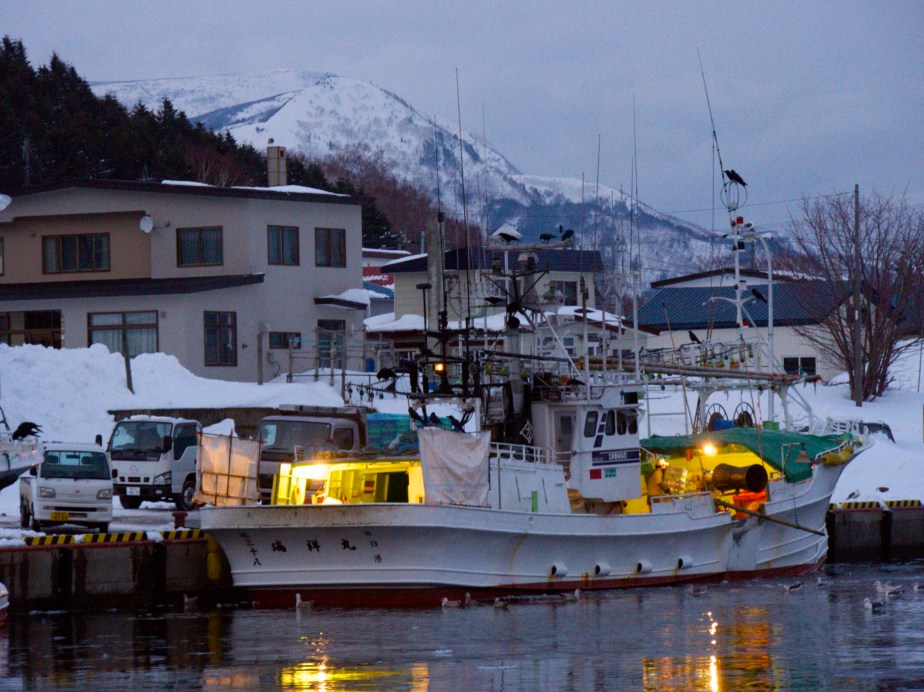
After a while I became aware that, well away from the lights, a bird had landed silently on the bow of a small boat. The binoculars gathered just enough light to turn the tingle into a twitch but could do nothing to satisfy the camera. Continued study through the gloom revealed another bird, how long it had been there was anybody’s guess. Then two more sitting on nearby boats. The whole family had come down to the sea to fish for their supper. The male, the female and two large youngsters.

One did fly closer and into the outer reaches of the lighting on the dock … but I won’t bore you with the photo because two nights later one flew and landed under the outside lighting of a streamside building. What are the chances?

Blakiston's Fish Owl
Blakiston’s Fish Owl

A Mammal or Two …

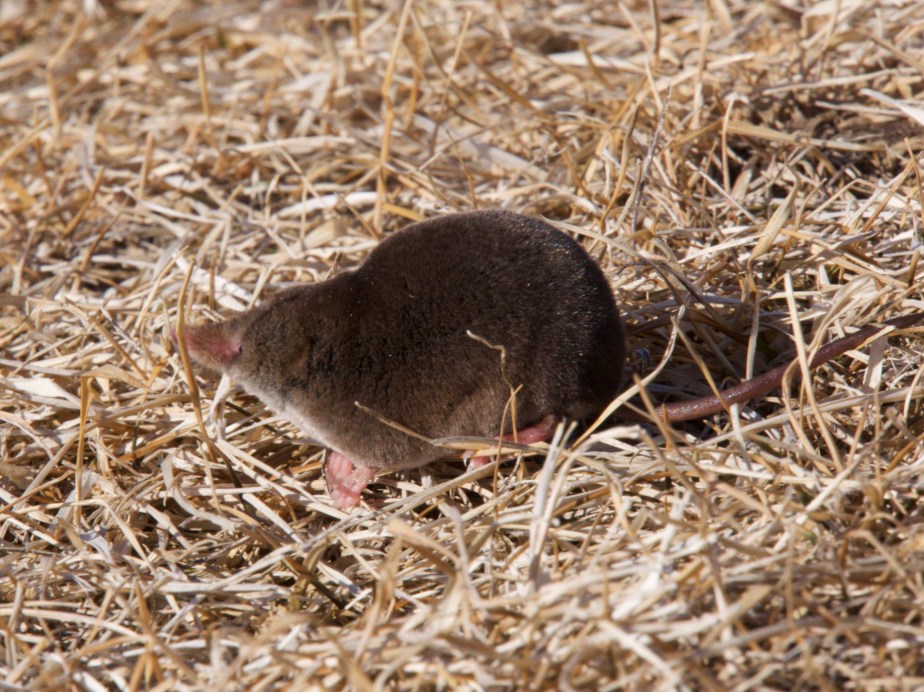
Hokkaido has quite a list of mammals, it still has Brown Bears for example. These are formidable creatures closely related to the Grizzly. They may reach more than two meters tall, weigh about 300 kg and can run at a speed of 50 kph. They mostly eat shoots and salmon but are not averse to the occasional hiker. It does nothing for your comfort to know that, not only can they outrun you, they can out swim and out climb you as well. According to a Japan Times article the government started keeping records in 1962, between then and 2008 there were 86 attacks 33 of which were fatal. The article has some amusing suggestions for people venturing into bear country. They hibernate from mid-December to late March. So no photos this trip, here’s a Long-clawed Shrew to make up for it …


Long-clawed Shrew
Long-clawed Shrew

Blakiston’s line divides the Brown Bear, found only in Hokkaido,  from the Asiatic Black Bear of Honshu and Shikoku. The Long-clawed Shrew is also found only to the north of the line.

For more on bears in Japan, including the story of the Sankabetsu Brown Bear Incident of 1915 go <HERE>. The Long-clawed Shrew standing on its hind legs would barely make 10 cm, it weighs up to 20 g moves quite slowly and has never been involved in attacks on humans.

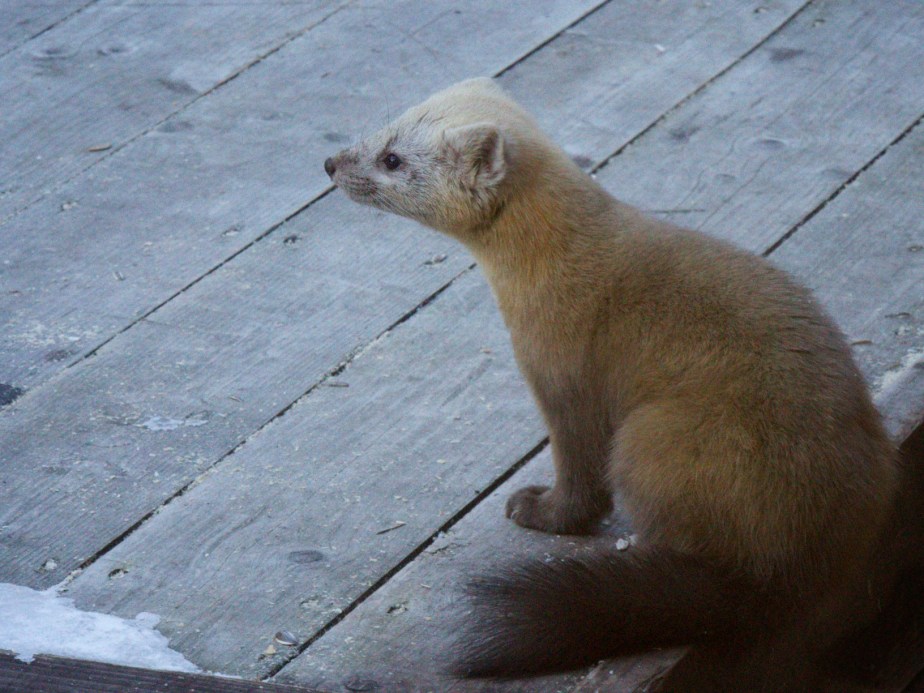
A few other mammals were kind enough to pose. This Sable, once again only found north of Blakiston’s line, had its den under the deck of one of the hotels I stayed at.

Sable
Sable

It is a Mustelid along with weasels, badgers and otters. It is happiest eating squirrels, smaller rodents, birds and fish but will also eat berries, vegetation and pine nuts when the going gets tough. This one mostly ate bread.

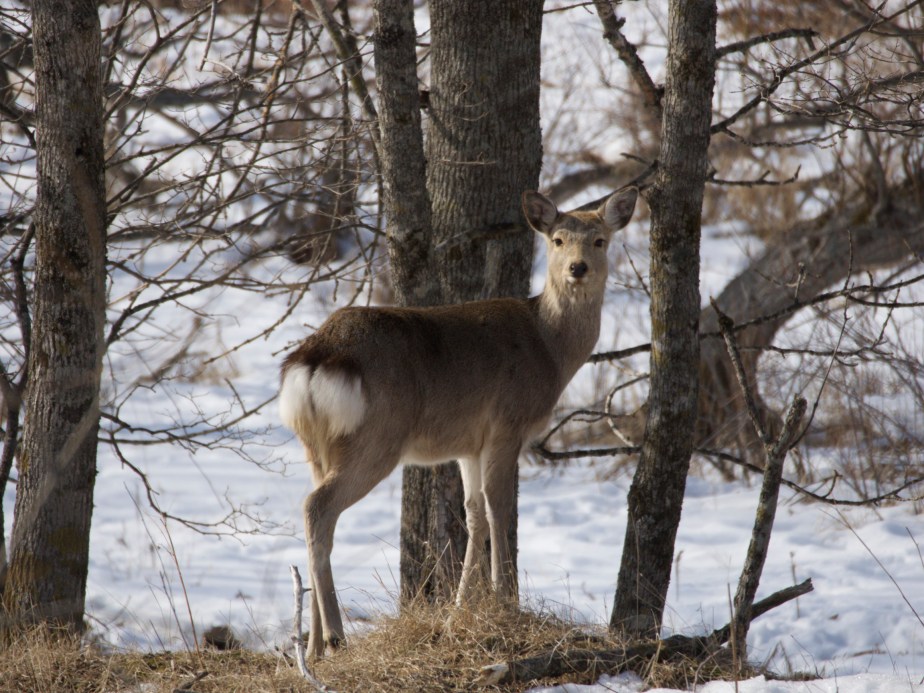
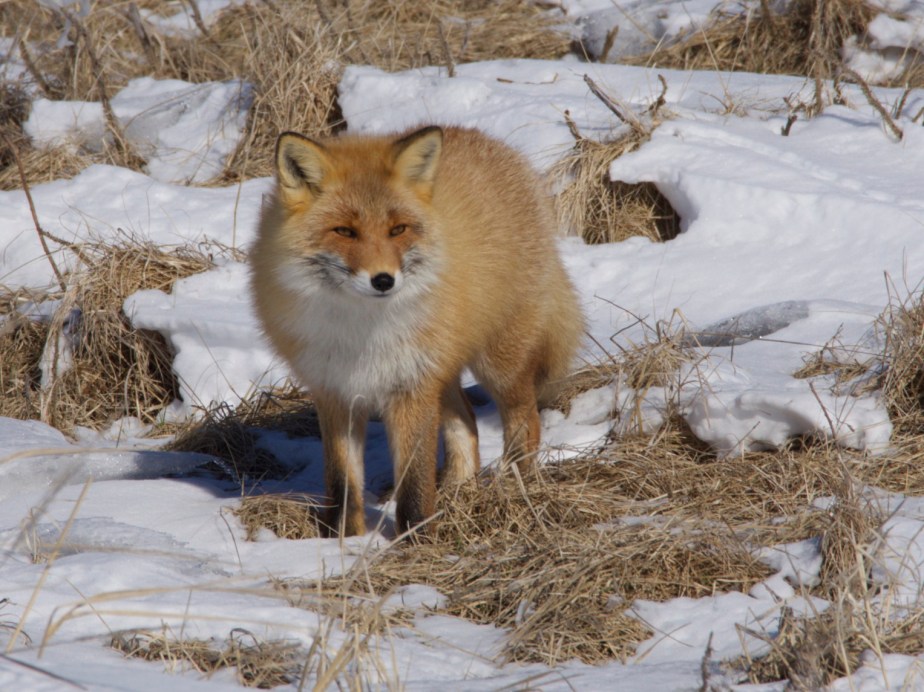
The next couple of species have no regard for Blakiston. They do not toe the line.

Sika Doe
Sika Doe
Sika Stag
Sika Stag
Red Fox
Red Fox

Rausu …

Time to head to the coast and the fishing port of Rausu.

P1080499

P1080019

P1080020

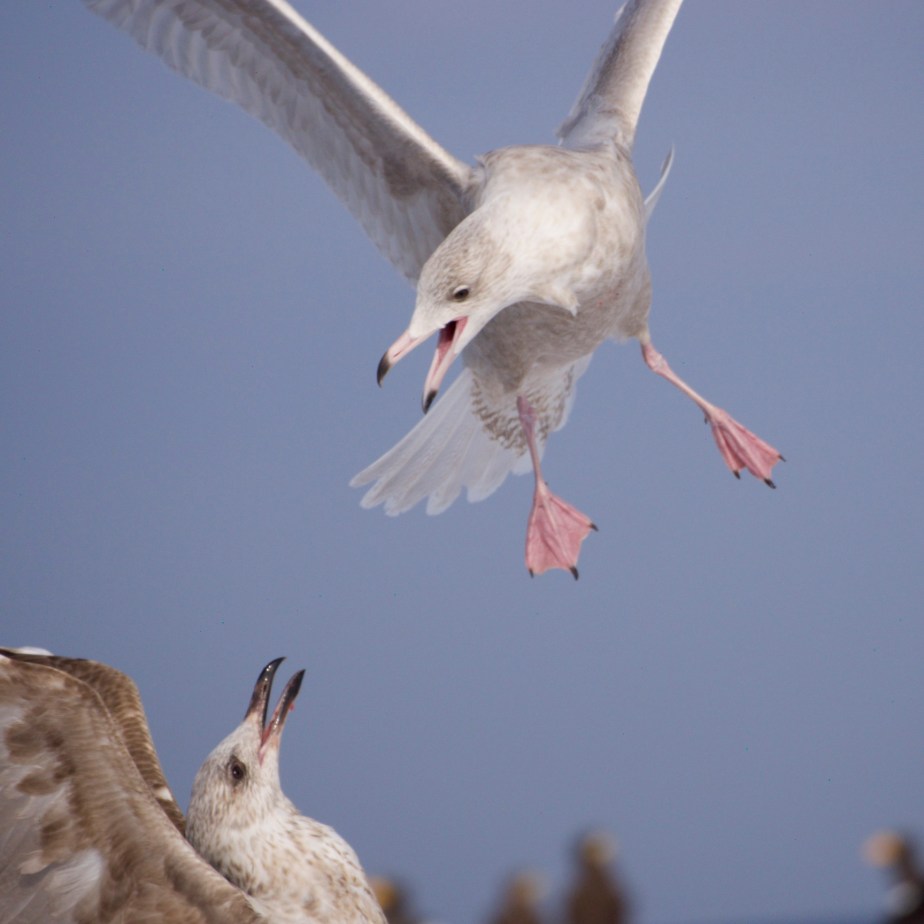
We were going to sea to get some stunning views of some eagles. We donned our life jackets, packed several trays of frozen fish, which meant that they were pretty much at ambient temperature and headed out onto the briny. The gulls were quick to take an interest, this is a regular event for them …

P1080487

P1080379

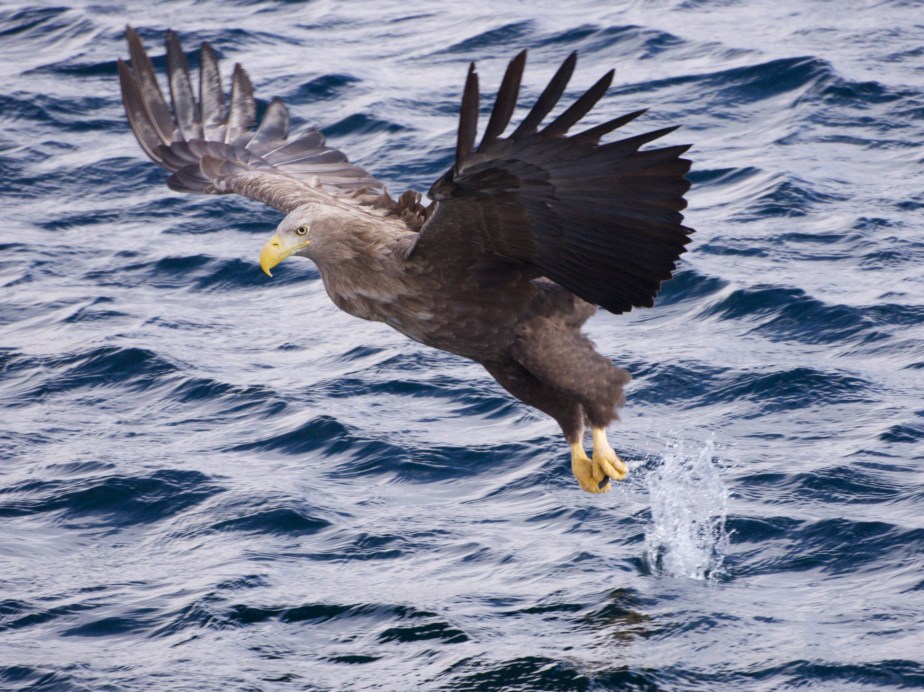
But once we started throwing out the fish they were obliged to make way for the White-tailed Sea Eagles,

P1080708

and when the big guys show up, look out. Steller’s Sea Eagle was the bird I had come to Japan to see. On a previous trip I had been on a ship outside Petropavlosk. The Russian port authorities, perhaps because there were mainly Americans on board, had kept us waiting for hours. By the time we docked it was time to head straight to the airport. The only significant result of that was to deny some dollars to the local economy. I was not too upset, I spent the whole time looking for the world’s largest and most spectacular eagle. I would have stayed an extra day … in fact I would have needed to. None showed up. Going hungry improves the appetite, dipping on a bird sweetens the eventual sighting …

P1080384

Whilst back in the woods …

Hokkaido is a really cool place, literally, the year round average temperature is just 8°C. Trees are found up to about 1500 metres. In the lowlands there is deciduous forest dominated by Mongolian oak (Quercus mongolica) with dwarf bamboo (Sasa spp.) undergrowth. Above that the dominant forest cover is coniferous, mainly Asian spruce (Picea jezoensis) and various firs (Abies spp.). Where climate and landform suit agriculture the forest has been cleared and much of the remainder has been logged but there still seems plenty for most of the birds.

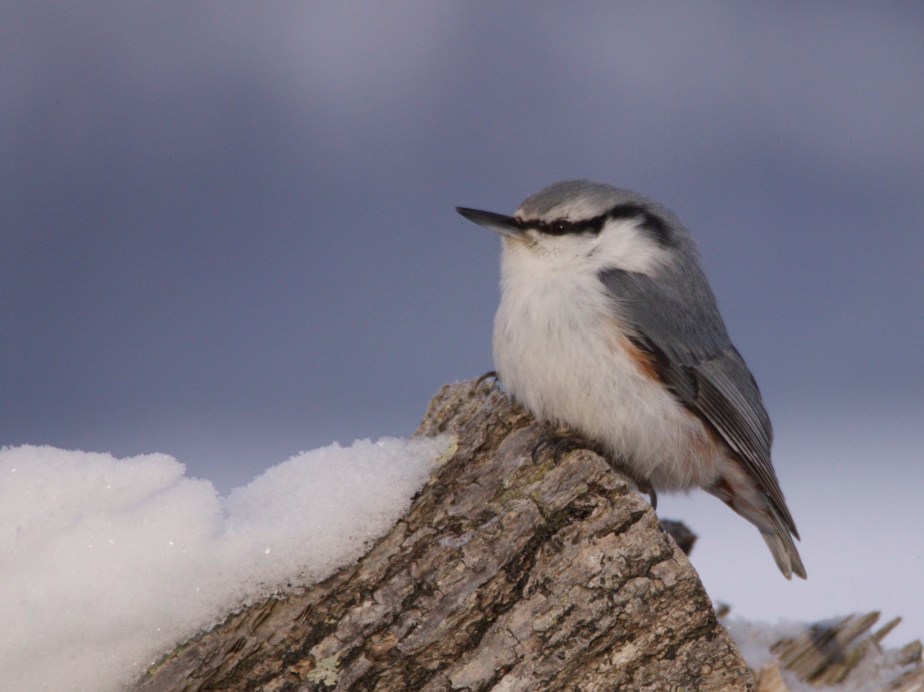
Eurasian Nuthatch
Eurasian Nuthatch

This one is right way up but the nuthatch is often seen creeping head first down the trunks of trees inspecting the bark for insects.

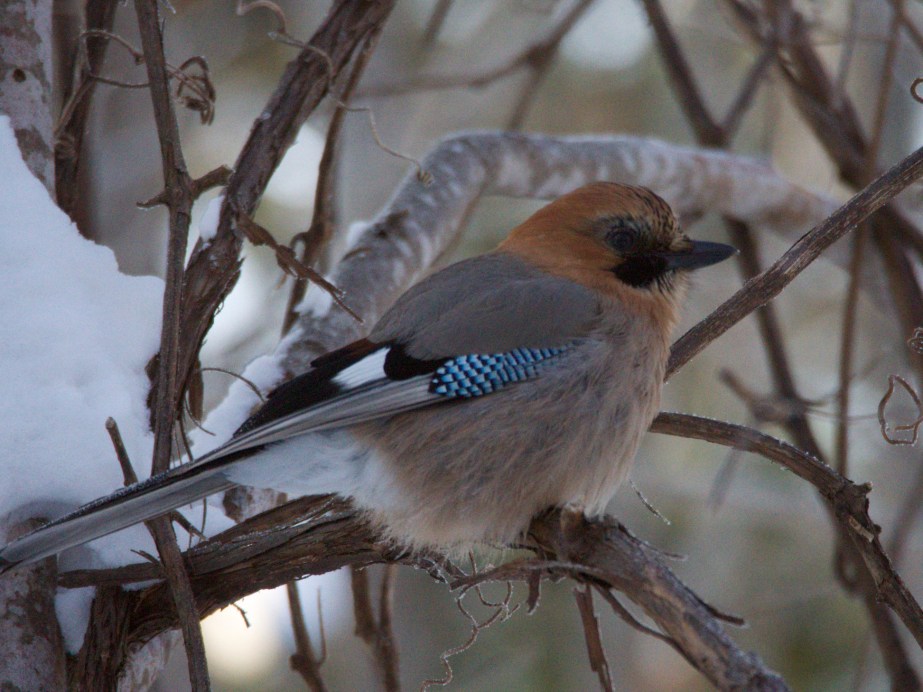
Eurasian Jay
Eurasian Jay
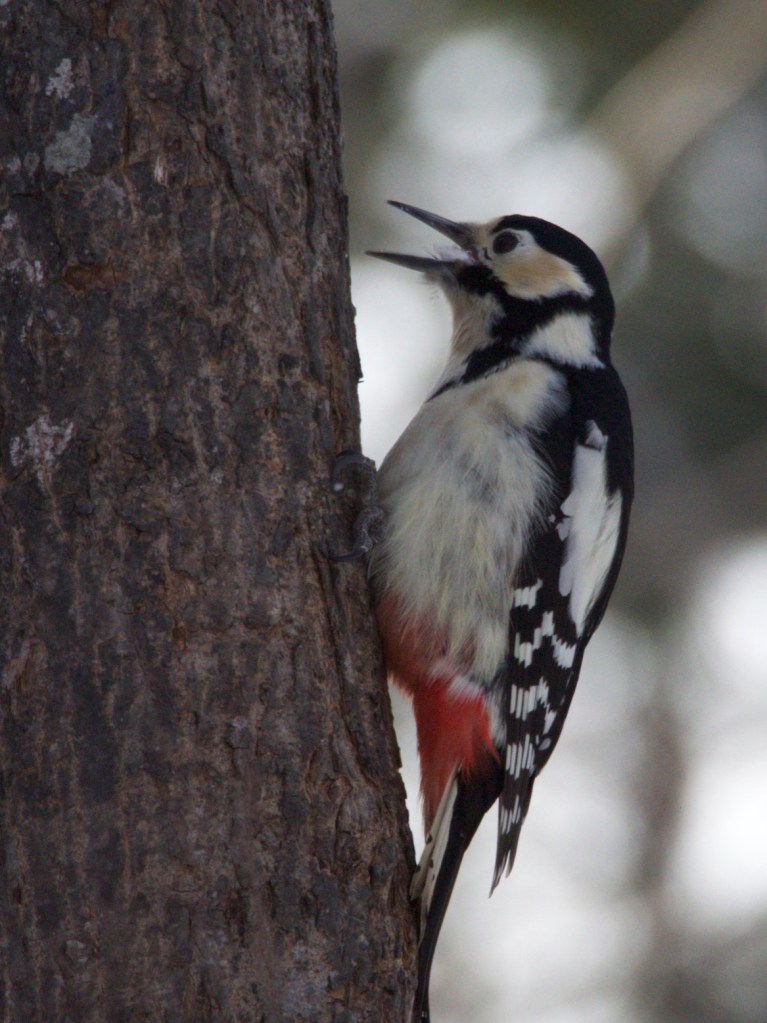
Greater Spotted Woodpecker

These three are old friends. Their range extends across Asia and Europe. As a kid growing up in England I could find all of them in the local forest.

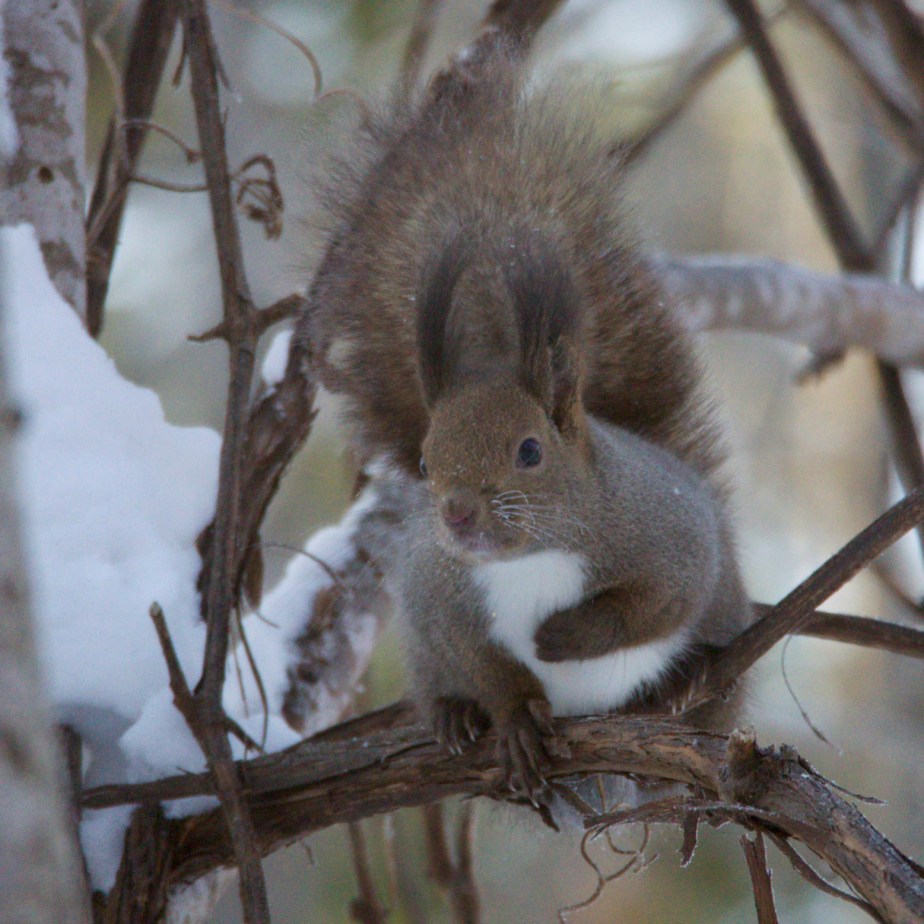
This next guy is another example with which to illustrate Blakiston’s line. In the three large southern islands of Japan there is an endemic squirrel, funnily enough called the Japanese Squirrel (Sciurus lis). In Hokkaido, though, we find the Eurasian Red Squirrel. The local subspecies (Sciurus vulgaris orientis) has really cute ears. (The scientific term being auribus vere bellus).

Red Squirrel (Sciurus vulgaris orientis)