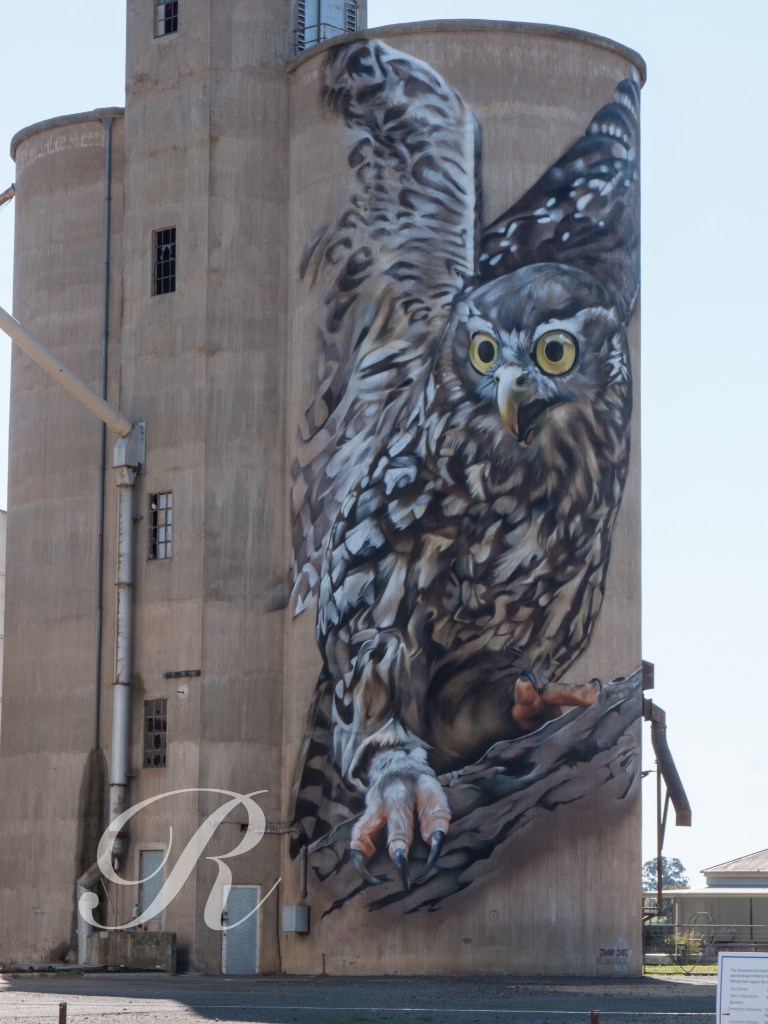
I was so impressed with the silos painted by Dvate at Rochester that I headed to Goorambat near Benalla to see his work there. Impressive. It was painted as part of the 2018 Wall to Wall Festival. The bird is a Southern Boobook.
Goorambat – DvateGoorambat – Dvate
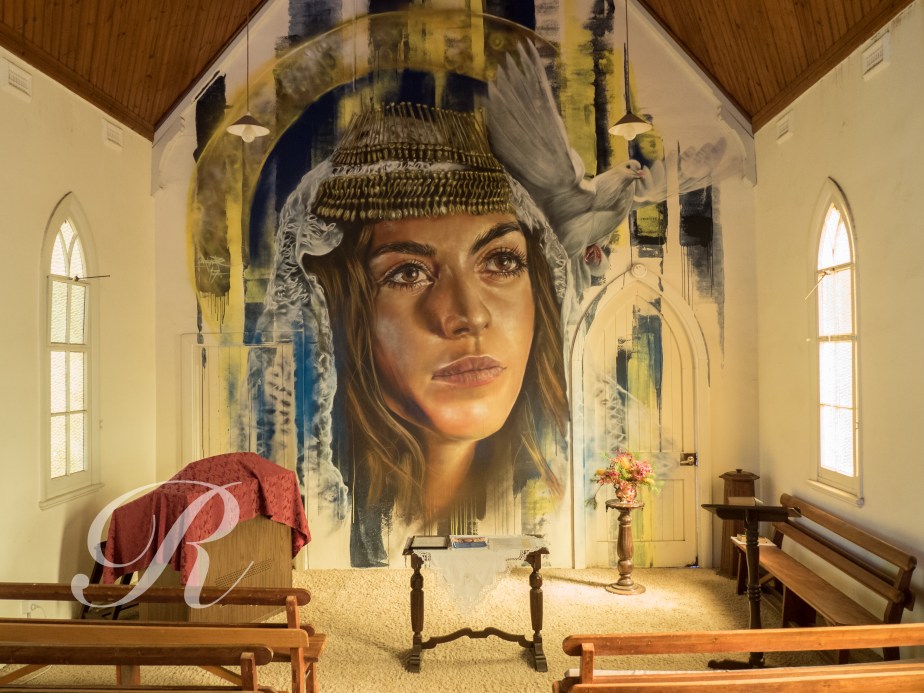
700 metres away there is a mural in the church painted by Adnate …
Rochester this time, a small town on the Campaspe River in northern Victoria.
Rochester, Vic
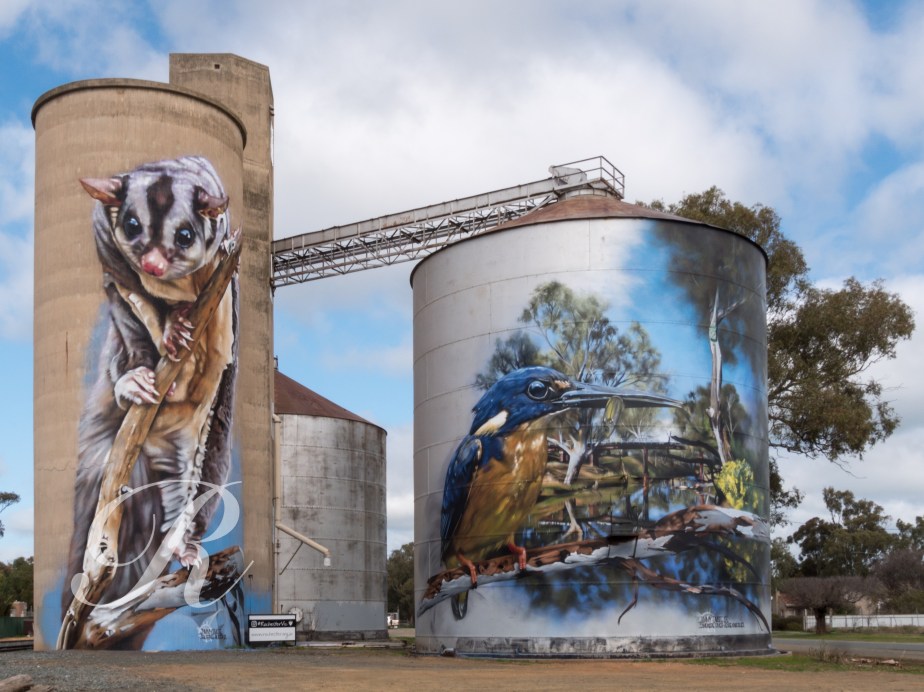
The artist is Jimmy Beattie aka Dvate and the subjects are a Squirrel Glider and a Sacred Kingfisher. The glider is a rare resident in the woods along the Campaspe while the kingfisher is a fairly common and colorful summer visitor. The medium is acrylic on silo.
Rochester, Vic
Dvate has painted another silo near Benalla which I hope to catch up with soon.
Many more places possessed of silos are queueing up for a painting. As an art critic I am entering a burgeoning field. I hear there are some north of the border as well.
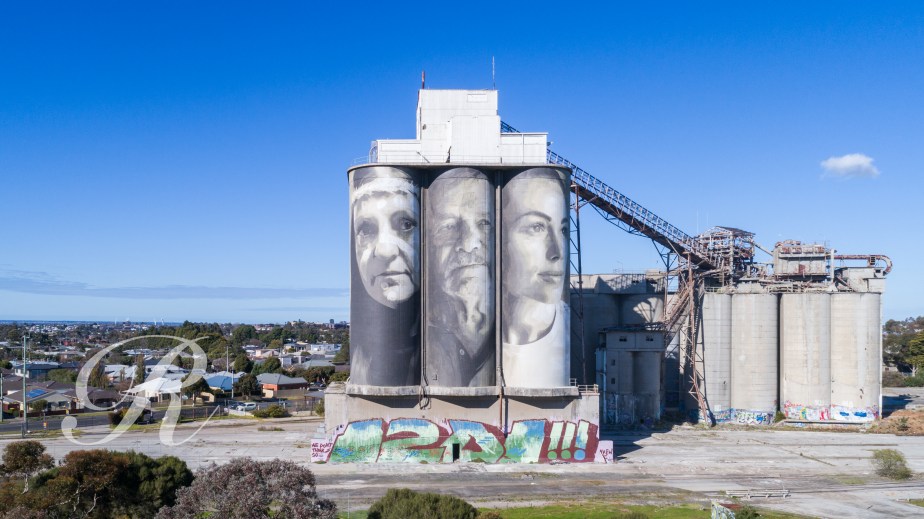
Another silo beautified, this one in a more urban setting. It is the old cement works overlooking Fyansford on the outskirts of Geelong, Victoria. The artist is Rone who has done great things in New York and London and has come home to Geelong for this project. The subjects are local folk. From left to right we have Corinna Eccles, a Wadawurrung elder, Cor Horsten who worked at the site for 35 years and Kelly Cartwright, an athlete who won gold in the long jump and silver in the 100 metres at the London Paralympics in 2012.
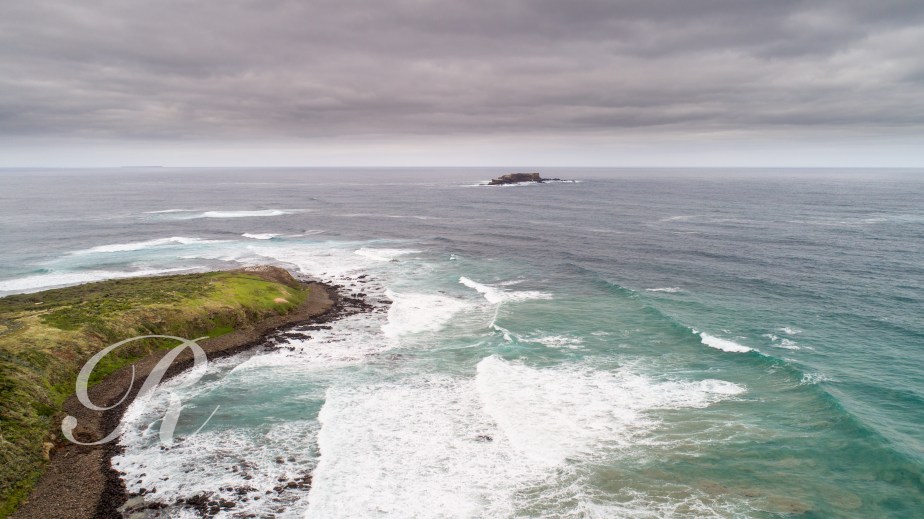
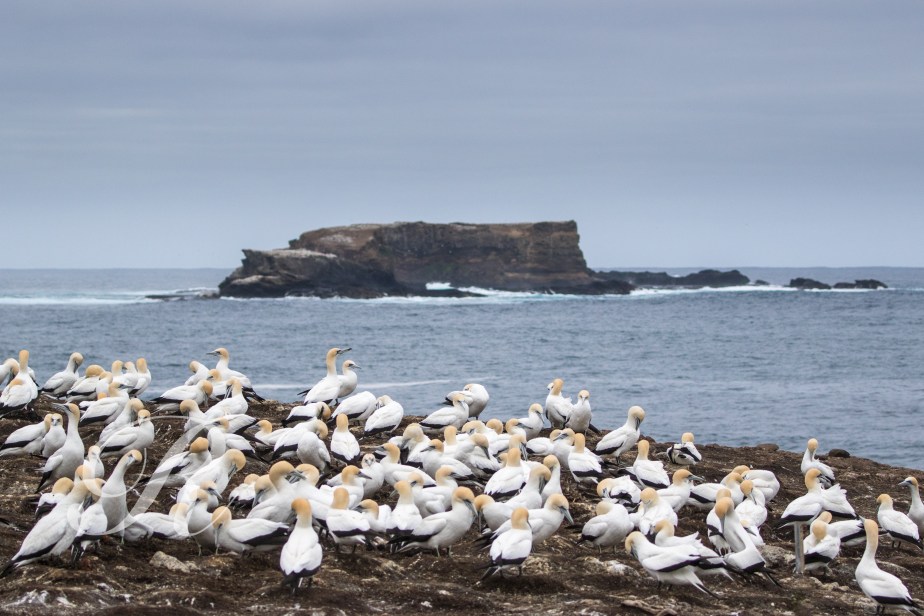
Not far from Portland, Victoria, there is a major nesting colony of Australasian Gannets safely out of reach of foxes on Lawrence Rocks.
Point Danger and Lawrence Rocks
Whilst the rock is safe from terrestrial predators real estate is at a premium. In 1996 some adventurous Gannets gave it a go on Point Danger. It wasn’t a great success but humanity stepped in, fenced the area and there is now quite a colony, the only colony on the mainland. It depends for its success on a tall outer and an electric inner fence. Maremma dogs were trialled as guards but were not a great success.
At the weekend I was lucky enough to be invited into the enclosure.
Australasian Gannet colony
You can get a good telescope view of the colony from a viewing platform about 125 metres from the birds and you can get a little closer by following the perimeter fence around to the left. But if you are lucky enough to be granted access you can get to about 25 metres away.
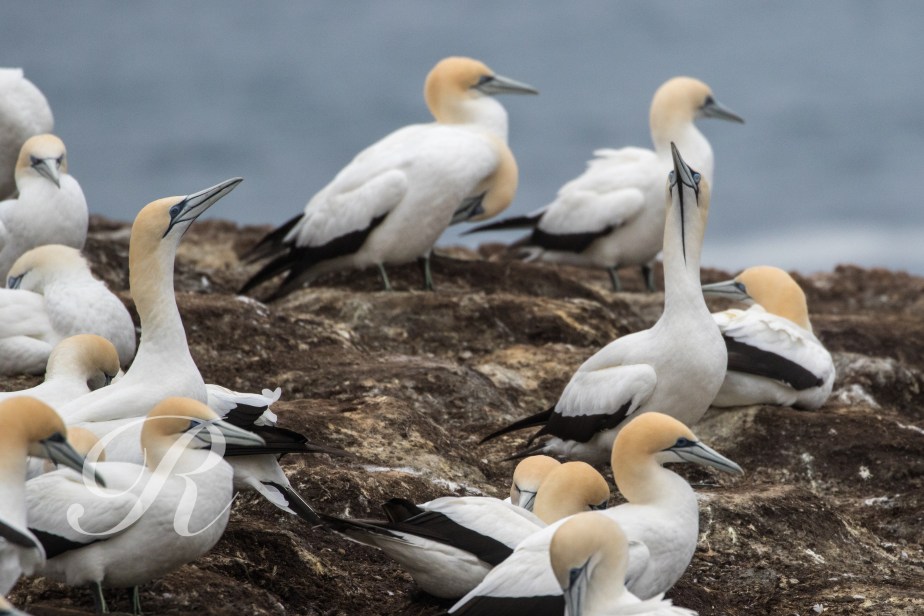
Australasian Gannet
As you can see from the photos it was a great opportunity. And this isn’t the breeding season. That runs from October to February corresponding with the Bonney Upwelling when ocean currents bring nutrients that trigger a boom in the food chain from the bottom up, a good time to be feeding youngsters.
When you get close to a Gannet colony part of the fun is spotting the one that doesn’t belong. When I visited the Lambert’s Bay colony of Cape Gannets the big news was one Australasian Gannet among thousands of the locals. Likewise at Point Danger the visit was all the sweeter for finding a Cape Gannet in the crowd …
Cape Gannet among the Aussies
The Cape Gannet is the one on the right showing off its long gular stripe. On the Australasian Gannet the stripe is much shorter. You can just make it out on the guy on the left also pointing his bill up.
There are some other differences that help distinguish the Cape, it has an all black tail whereas the Aussie has a black centre and white outer tail feathers. Their call is also harsher. There is no substitute for getting up close.
As beautiful as the Great Ocean Road between Lorne and Peterborough is, it does mean that there are no secluded hideaways along the coast. It’s one of Victoria’s top tourist attractions but I can’t help feeling that an inland road with dead end offshoots would have given the magnificent coastline more of a Cornwall feel. For me the adventure starts where the road stops and this road goes on and on.
But at least there is access. Continue west beyond Peterborough and the highway ducks inland. It hits the coast at Warnambool, very settled and domesticated but a good place to see whales in the winter. You can get to the sea again at Port Fairy, more rugged and way more charming. After that access to the coast is extremely limited until you get to Portland. Tourists can look across privately owned farmland to the distant ocean and wonder what they’re missing.
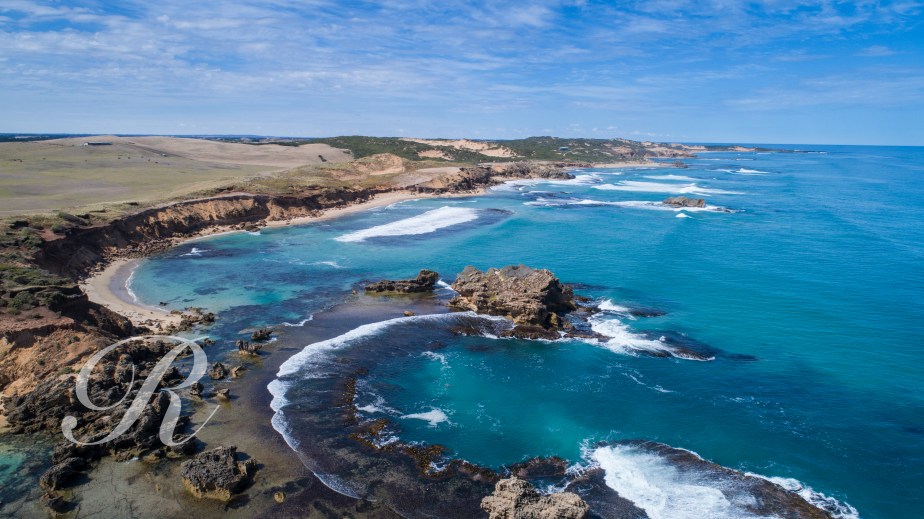
In fact they’re missing scenery that is the equal of the Great Ocean Road.
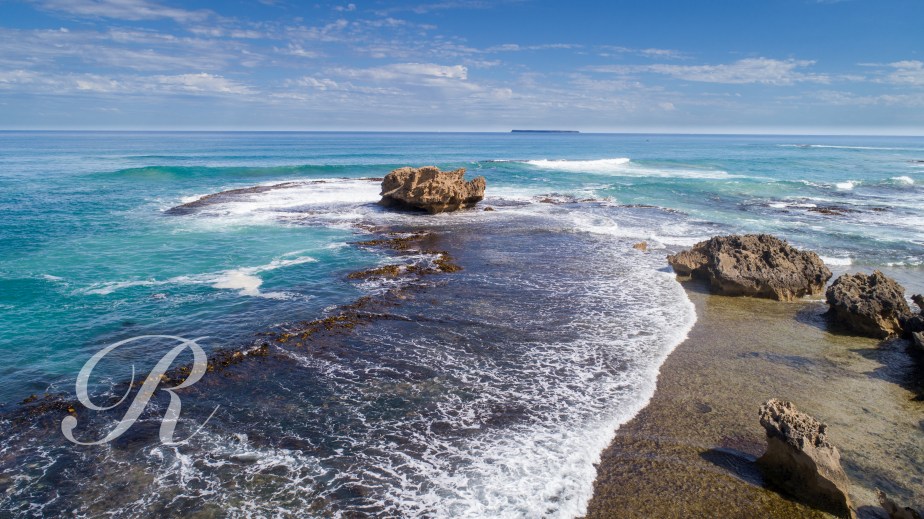
From the Crags and from Yambuk Lakes you can see Australia’s only off shore volcano, Lady Julia Percy Island. It’s been fairly quiet for the last 6 million years but you could get lucky. The island is home to Australia’s largest fur seal colony – about 27,000 strong. Sea Lions and Elephant Seals are occasional visitors. A number of different sea birds nest there. It’s the long flat topped one on the horizon …
Ship wrecks are a dime a dozen along Victoria’s coast but plane wrecks are not so common. There is a memorial at the Crags to four airmen who lost their lives in 1944. They were the crew of an Avro Anson thought to be looking for submarines. For reasons unknown it failed to return to its base in Mount Gambier. Wreckage was found on Lady Julia Percy Island and in the sea nearby. The bodies of the crew were not found.
You can visit the island by boat from Port Fairy courtesy of Southern Coast Charters. It’s a great trip.
The early history of the European settlement of the Victorian coast is shrouded in mystery. Most of the early players came across Bass Strait from Van Dieman’s Land to explore and exploit what was then the Port Philip District of New South Wales. By ship it is less than half the distance from Launceston to any part of the Victorian coast than it is from Sydney. Settlement was forbidden and mostly went undocumented.
Port Fairy gets its name from The Fairy, a cutter that visited the Moyne River in search of fresh water in about 1828. Sealers and whalers from Van Dieman’s Land were probably using the area from about that time on.
There were three islands at the mouth of the Moyne. Some characters named Penny and Reiby established a whaling station on the largest of them.
In 1834 the Henty brothers settled an area about 70 km to the west which would become Portland. They were the first settlers to come to the government’s notice, their presence being discovered by an exploring party commanded by Major Thomas Mitchell. By the time officialdom, in the form of Foster Fyans reached the area in 1839 there was already a settlement at Port Fairy catching whales and growing potatoes. Captain Foster Fyans, magistrate and Commissioner for Crown Lands arrived in Geelong in 1837 charged with the virtually impossible task of overseeing the orderly settlement of all of south west Victoria. Geelong and Portland are 240 km apart. Fyans and his party made the first recorded overland journey between the two.
In 1835 a gentleman named John Griffiths purchased the whaling station at the mouth of the Moyne and the island acquired his name. The station operated until about 1843 by which time Southern Right Whales were too scarce to warrant such an establishment. But as whaling declined the importance of the port increased.
Melbourne was also pioneered by adventurers from Van Dieman’s Land. The founding of a town wasn’t approved until 1837. Until Melbourne eclipsed it Port Fairy was the busiest port in the district. It remained busy until 1960 when the harbour at Portland opened for business. It still is a working port – 30 tonnes of squid were landed during my stay.
Victoria gained its independence from New South Wales in 1851. Van Dieman’s Land became Tasmania in 1856.
A lighthouse was built on Rabbit Island in 1859. Various improvements were made to the mouth of the river which combined with natural build up of sand caused Rabbit, Goat and Griffiths Islands to coalesce into one, still known as Griffiths Island.
Griffiths Island
The lighthouse was manned by two keepers until it was automated in 1954. The keepers’ cottages were demolished soon after but some plants from their garden linger on.
The island is home base for a colony of Short-tailed Shearwaters. They nest in burrows during the summer. They spend the remainder of the year on an extraordinary journey that takes them way into the northern hemisphere.
A stroll around the island takes about 45 minutes. You are quite likely to meet one of these on the way …
In the old joke an Arab goes to Blackpool for his holiday. On his return to the desert he’s asked how it was. He replied “Perfect, it rained every day”
It hasn’t rained at home in the Goldfields for two months, three days in Port Fairy and two cold fronts later has me wondering if the grass will be green by the time I get home. I doubt it but the sea looks even more exciting in a gale …
… and the sun has been out between showers. A bit of bad weather can’t spoil Port Fairy. Stay at Doc’s at the Mill, it’s right on the wharf. You book through Langley’s (03 5568 2899), tell them I sent you and I’ll get a discount next time! A morning walk on East Beach and lunch at Rebecca’s. You can’t beat it.
The mill was built in 1860 and enjoyed a relatively brief career as a steam driven flour mill. It’s right on the wharf and the tallest building in town.
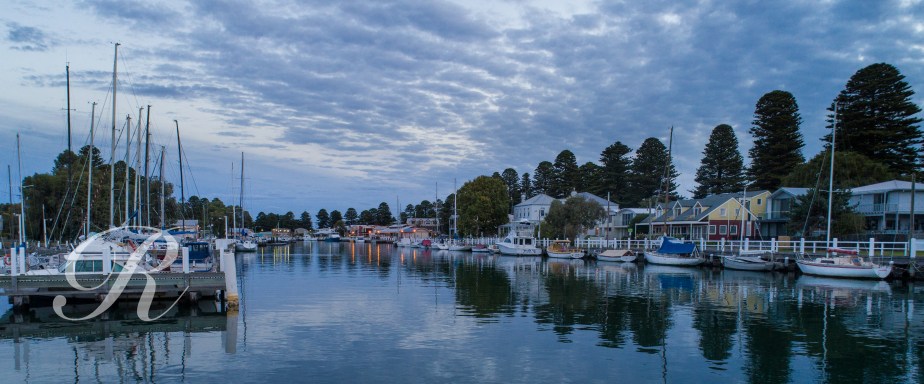
In the evening as the lights come on …
The town is situated where the Moyne River reaches the Southern Ocean. It is one of the oldest settlements in the state of Victoria and was once an important port.
If you are reading this blog in your email program you are missing out on features that are not supported in that format. Your web browser is the place to be.
The Wimmera River rises on the inland slopes of the Pyranees Ranges near Ararat, western Victoria. It heads in the general direction of the Murray but it doesn’t make it that far. It flows through the towns of Horsham and Dimboola and usually discharges into Lake Hindmarsh. When times are particularly dry Lake Hindmarsh dries up. When times are particularly wet it may overflow and begin to fill a series of usually dry lakes on the fringes of the Big Desert. It is the longest land-locked river in Victoria.
Along the way the river forms the eastern boundary of the Little Desert National Park. It is one of my favourite places. Whether it should be called a desert is a moot point. It is certainly sandy and in places there are well formed dunes, the region is quite arid. On the other hand vegetation cover is pretty good for the most part. The further west you go the more convincing the argument for a desert becomes especially if you bog the wheels in deep sand on a hot summer’s day.
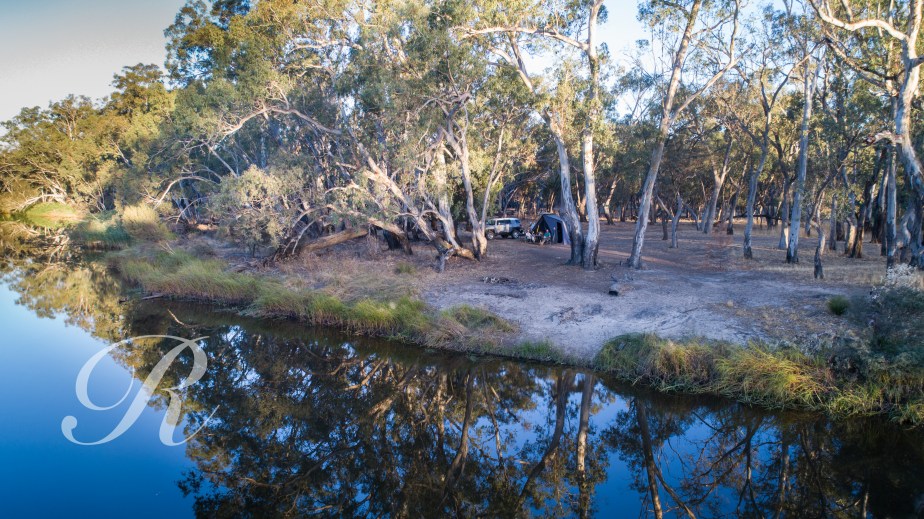
The river margins are quite different. Black soil covers the sand and some quite tall trees, River Red Gums mainly, attract the birds and other creatures. The trouble with national parks though is the prohibition of one of my dearest companions. Wail State Forest is on the eastern bank of the Wimmera River. You can camp on the bank and look into the park. Two hundred metres back from the water you can bog your wheels in deep sand, the same birds fly back and forth and you can take your dog.
I was there last night.
Varanus varius
I was setting up camp around midday when this big lizard decided that he’d be happier up a tree. The day before had been cold (by local standards, everything’s relative). It was a little sluggish. Usually they are quick to get well away from people, this guy was happy to sit in the sun for a while.
I surprised a second one later on and was able to get some closer shots in better light …
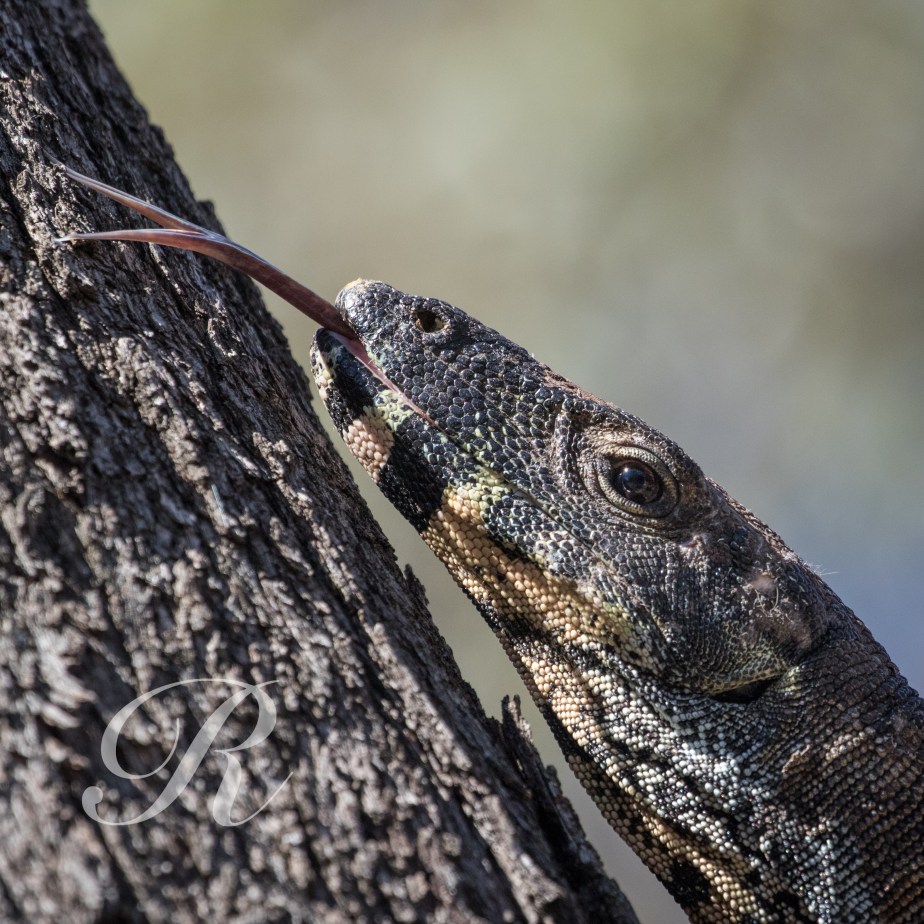
The claws are impressive, so too is the tongue …
Monitor Lizards are found in Africa, Asia and Australasia. There are about 50 species in all. The largest of them is the Komodo Dragon Varanus komodoensis in Indonesia. It gets to more than 3 metres in length. Australia has 27 described species but Victoria has only two monitor lizards, the Lace Monitor and Gould’s Goanna. A big Lace Monitor grows to a little over 2 metres whilst Gould’s can only manage about 1.6 metres. The dark and light bands under the lower jaw are diagnostic of the Lace Monitor, V. varius.
They eat birds eggs, nestlings and any other small animal they can catch. They lay their eggs in termite mounds, mum comes back to break the youngsters out when they hatch.











 bobmcgee