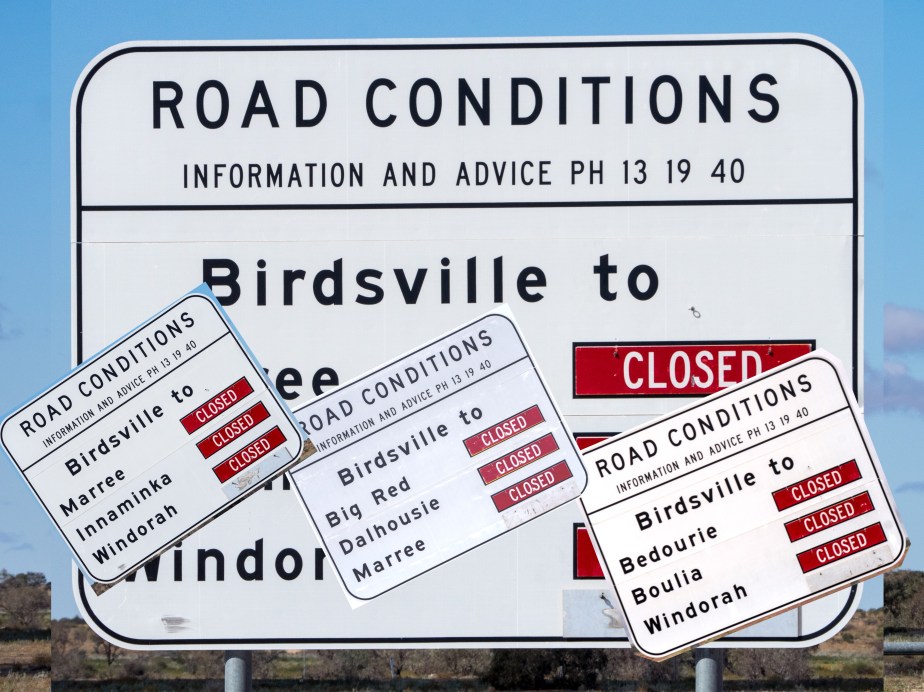
There I was trapped in Birdsville, less than a month later and 2000 km away here I am trapped in Victoria.
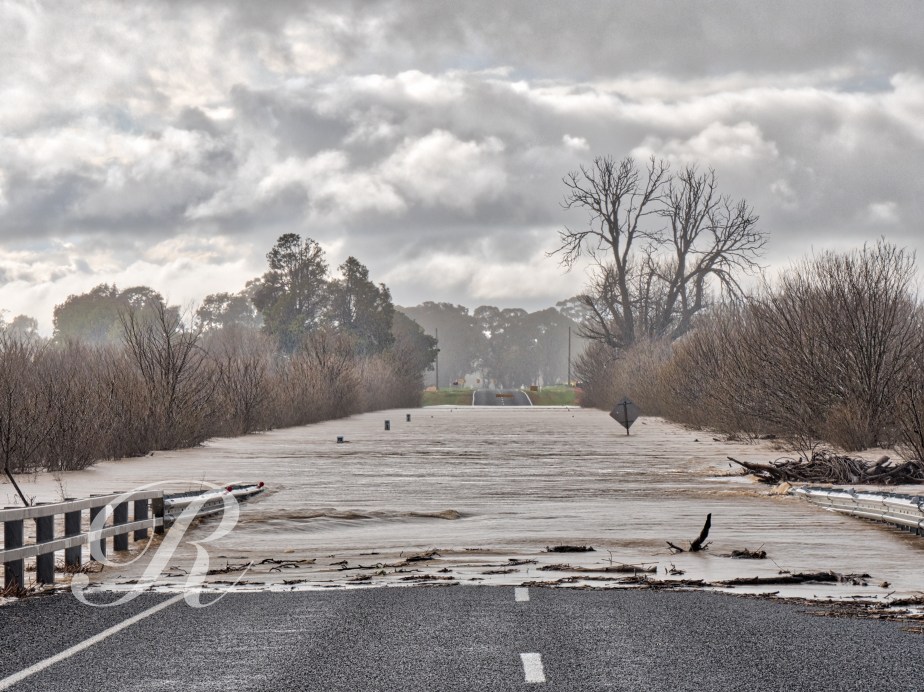
I live on the banks of an inoffensive little creek, I woke up this morning to find it lapping at my back door. I have the choice of a ford and two bridges if I want to go anywhere. The ford would be certain death, the photo of the nearer bridge doesn’t tell the story all that well – you can’t see the bridge! Here’s the other bridge …
The floorboards are still dry, there’s food in the pantry and beer in the fridge. I’m better off than many another …
I have compared crossing the desert to scuba diving. I can’t breathe underwater or find water in the desert but I can strap some tanks on my back and dive or fill a vehicle with the essentials and drive. Birdsville is like a little boat, you can surface and relax, resupply with food, refuel the vehicle, rejoin the life of modern Australia. During the time that this little boat has been anchored here the divers surfacing have changed from drovers to drivers.
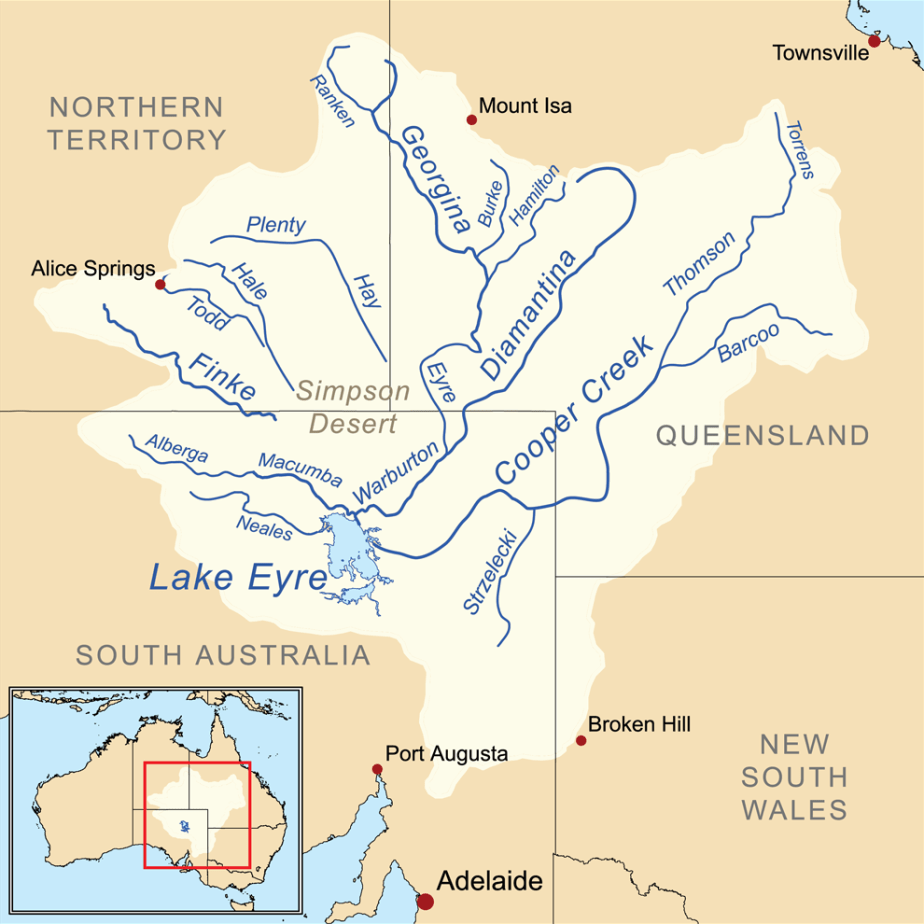
Birdsville sits between the channel country and the Simpson. The nearest dune is currently invading the cemetery just the other side of the airstrip, the Diamantina River is 4km from town when it’s behaving itself. It comes to visit occasionally. The main road runs north south.
Way over to the west is Mr Stuart’s road, the main road from Adelaide to Darwin, it towed the telegraph and the railway behind it. Birdsville lies on the Burke and Wills road. What came after them were more explorers trying to find where they’d gone. This is the losers’ side of the desert. For the graziers of the channel country there was a major market off to the south. The principal reason for a road was as a stock route. And at the time the stock route came into being Queensland and South Australia were colonies. Starting in about 1878, Birdsville grew up at the intersection of the road, a river and the colony boundary. It is adjacent to the best spot to cross the Diamantina, often a place occasioning some delay. Where better for a store to resupply the drovers and a border post where import duties could be collected. When the railhead reached Marree in 1883 things really kicked along. In 1900 it had three pubs (droving is thirsty work) and a population of about 300 people. Australian Federation happened in 1901, this brought free trade between what were now states. So the tolls were abolished and the population steadily declined.
In the 1950s the population was down to about fifty.
Birdsville, it seemed was consigned to history. In the cemetery you can find the graves of Wankangaru aborigines born in the desert, white settlers, drovers and Afghan cameleers, whilst the legend of Tom Kruse the man who brought mail and supplies up the 500 km Birdsville Track lives on. The history is rich.
The races are an enduring tradition in Birdsville. They were first run in 1881. The crowds are far bigger now than there were then. The rise of the 4WD vehicle has put Birdsville back on the map. People come from all over to visit Australia’s most isolated town, the population now might be about 100 souls, but on race day expect to see at least 7 000 other people.
The little boat is now anchored here to supply the tourist. There is only one pub these days but you can buy a beer at the bakery! Driving is thirsty work.
Birdsville can be very hard to leave …
… we had to wait three days before we could. It gave us time to take in the sights …
the Bakery … sleepy hollow until the races then unimaginable bedlam. Not only can you get a beer here, Curried Camel Pie figures on the menu. We all found an excuse not to try one, mine was vegetarianism. After breakfast a quick walk to the Royal Hotel, built in 1883 last drinks were served in 1923 when it was converted to a hospital which it remained until 1937.
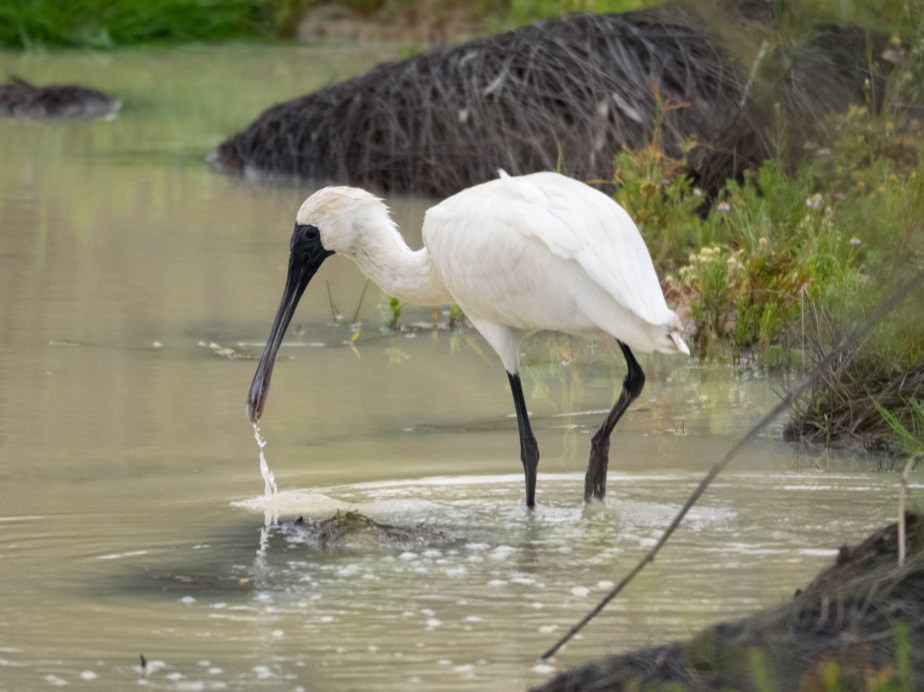
Other essential stops include the Roadhouse and the Visitor Centre.The bird watching around Birdsville is excellent. Between the town and the Diamantina there is the famous billabong, sadly the track to Pelican Point was underwater, not that that bothered the Pelicans. Nor did it bother the Caspian Terns, Kites, Red-backed Kingfishers, Woodswallows in several flavours or Spoonbills …
Black-faced Woodswallow (photo – TLG)
Royal Spoonbill
The race track is out this way as well. Heavy just about summed it up …
photo – TLG
That’s not the river on the other side of the fence, that’s the track.
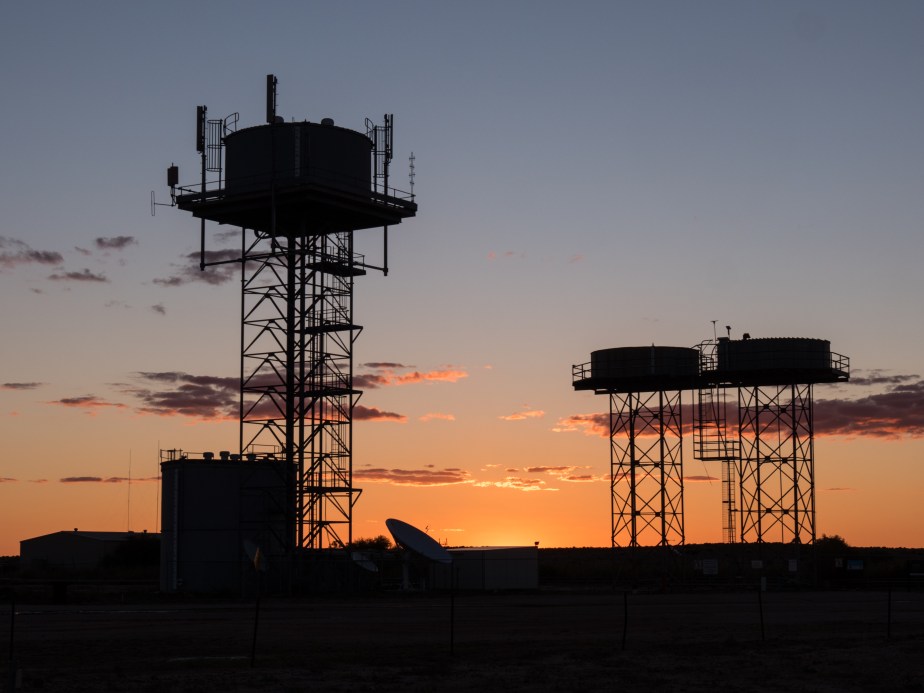
Birdsville’s drinking water comes straight out of the ground. The bore is 1280 meters deep and delivers water at 98ºC. The heat isn’t wasted, it’s used to drive Australia’s only Utility Company owned geothermal power station with an output of 80kW meeting about a third of the town’s electricity needs. Surplus water runs off to the billabong to keep the ducks happy, whilst the rest is stored aloft in reservoirs that look stunningly beautiful for several minutes every day …
And by the time you’ve finished the Cook’s tour you’re ready for a drink at one of my favourite Aussie Pubs … the Birdsville Hotel …
If you plan well then the trip is likely to go well. If you have considered what might go wrong and you have a strategy ready it may not seem so bad if it happens.
How much fuel will you need to cross the Simpson?
Oodnadatta to Birdsville via the French Line measured on the odometer was 640 km. We had reckoned on 750 km for the trip to Mungerannie via the Warburton Track. You need to factor in the effect of low speeds, low gear and slipping tyres. You also need to allow for side trips and diversions.
We had a petrol and a diesel vehicle in our little convoy. This meant we couldn’t share our reserve fuel but it also meant that we could compare the two. We set off from the Pink Roadhouse with full tanks plus 40 litres each in jerry cans. There was no need for anxiety regarding fuel. Both vehicles arrived in Birdsville more than half full.
Usage …
Toyota FJ Cruiser petrol 108 litres = 17 litres/100km
Toyota Landcruiser series 70 diesel 82 litres = 13 litres/100km
The difference in economy is nowhere near as great on the open road. Diesel is clearly better in the desert. (But I still love my Cruiser.)
We transferred the reserve as soon as we reasonably could. Corrugated roads are hard on containers, the last thing you need is your reserve fuel leaking into the sand.
We had crossed the Simpson Desert. I would do it again at the drop of a hat. It was right up there with any place I have ever been.
Is it for you?
Yes it is … provided you can tick these boxes :-
You have a reliable high clearance 4WD vehicle and some experience using it
A companion vehicle
Maps
Satellite phone (or HF Radio)
Dune Flag
Shovel
Winch
Radio
Snatch strap
Fuel
Water
Food and
A sense of humour
I hope to see you out there but I have a favour to ask. UTFR.
This stands for Use The Radio.
I have a pilots licence and a Marine Radio Operators Licence, I have absolutely no fear of public speaking. Give me the radio and I will give you a lecture. It’s easy for me. If you find it daunting remember they can’t see you … that’s the whole point.
On the track you will hear chatter between vehicles. Some of it is so inane you will wonder what on earth the speakers have between their ears. But you will know they are there. They are on the same one lane track as you and they may be coming toward you on the other side of the very next dune. Say hi, say where you are and which way you’re going, express an interest in where they are and which way they’re going. Don’t be shy. And if they ask, please reply.
Big Red
Some people do it really well. I use this photo again because you see a little convoy on the right of the picture. From the top of the dune they had broadcast this …
Convoy of three vehicles departing Big Red, west bound, now.
Thank you party of three, safe journey.
Channel 10 is the channel to use in the Simpson.
The technology is not perfect. UHF is essentially line of sight and dunes do interfere with reception. If the aerial set up is different between stations it is possible that you may hear them but for them to be unable to hear you. So a dune flag and a sharp lookout are also essential. Motor bikes are not required to fly a flag and are unlikely to be using radio.
Big Red is 40 km west of Birdsville, about 30 metres high and famed in legend and song. It is the focus of an annual concert and a car rally. Many a 4WD wannabe takes the run out there from Birdsville to try out their truck. Coming from the west it is, by some counts, dune number 1113. You first see the top of it over this ridge …
One dune away …
and when you get closer it looks like this …
Big Red
On that particular day the tracks on the left ended with steep churned up sections, the tracks further right were easier. The place to celebrate is on top …
There was a bit of a breeze and the next rain band wasn’t expected until the evening. There was nothing to gain by rushing off, better to let things dry out a little. We took the time to enjoy the locals enjoying their new lake …
Crimson Chat (photo- TLG )
And we took our opportunity to smell the Gidgee Trees. I found them not as bad as their reputation. Their leaves though are poisonous to stock (and presumably people, don’t eat the Gidgee).
When we got to Eyre Creek there was practically no water in it. When it floods it’s because of heavy rain over a much wider area and the result can be a river up to 30 km wide that can take months to subside. That’s not to say there was no challenge, the flood plain was a quagmire especially on the western side. So we slipped and slid with many a sideways moment for several kilometres. We were thrilled to be on the eastern bank …
There was a magnificent sunrise and no ice on the cars. Cloud had kept some warmth in.
We packed up and drove up the west side of Lake Poeppel, crossing the salt encrusted surface near the northern end. Light rain settled the dust.
Having made our northing we headed east along the QAA line towards the Queensland border. One desert but three states and three different regulatory authorities. In South Australia we’d travelled through the Witjira National Park and then a Regional Reserve, in the Northern Territory we appeared to be on vacant Crown Land. At the Queensland Border we entered the Munga-Thirri National Park.
The QAA line is initially similar to the French Line, rolling dunes. The dunes are quite high and the swales quite broad often with a clay surface. The amount of vegetation seemed to be slowly declining.
We had a decision to make regarding our camp site. Beyond Munga-Thirri lies Adria Station. After leaving the National Park there would be nowhere to camp until Eyre Creek. Off to our north-east lie the three major rivers of the channel country, the Georgina, Diamantina and Cooper. Georgina joins with Burke and Hamilton to become the Eyre Creek, this is the driest of the three. Some years water flows down these channels into Lake Eyre, some years there is no flow at all. When we set off we knew that the Warburton was flooded and that Eyre Creek was dry.
We could smell the impending rain. The big question was would it be enough to bring us to a halt? There were three options
a mad dash for Birdsville
a longish day to the far side of Eyre Creek
short drive, camp in the park
One of the highlights of the trip was still ahead of us, the most famous dune in the universe – Big Red. We had no wish to rush this. The mad dash was rejected.
A camp in the park would be on sand. Wet sand is absolute luxury compared to mud. The black soil along the creek would only be fit for hippos after just a couple of millimeters of rain. And surely there would only be a couple of millimeters, big rain events are usually summer phenomena …
We camped just inside the park.
One of the locals was also happy to smell the roses ..
By evening it was cold and raining heavily. Overnight there was a very impressive thunderstorm. My guesstimate is we had 25 mm of rain. We piled out of our tents in the morning to a landscape full of little lakes.
photo -TLG
We got the weather forecast by satellite phone. They’re was much more to come and the Eyre Creek flood plain ahead of us. This was going to be interesting.
Towards the eastern end of the French Line the dunes get higher and further apart. The swales are more likely to be clay and salt lakes make their appearance. This is Lake Tamblyn, named by Colson after his school teacher.
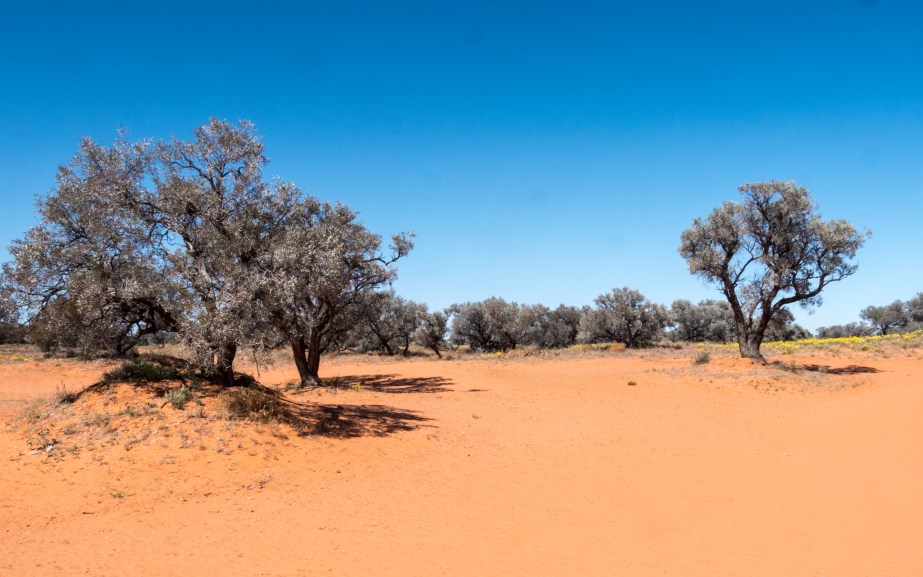
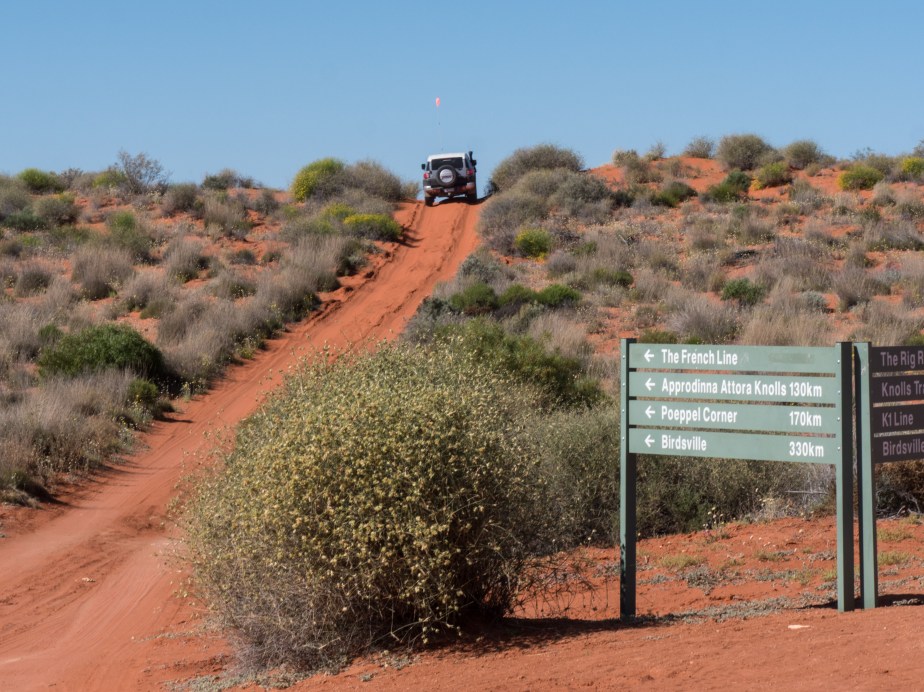
Before long we reached the intersection with the Knolls Track where there is even more obvious evidence of change … trees.
These are Gidgee trees, Acacia cambagei, said to emit an offensive odour when wet, variously described as like boiled cabbage or town gas. The weather this day was fine but we would have our chance to savour the smell before the trip was over.
At the intersection there is a rough and ready plaque celebrating the efforts of the surveyor David Lindsay who passed this way in January 1886. These days he would be fined up to $1000, the nanny state closes the desert for the summer.
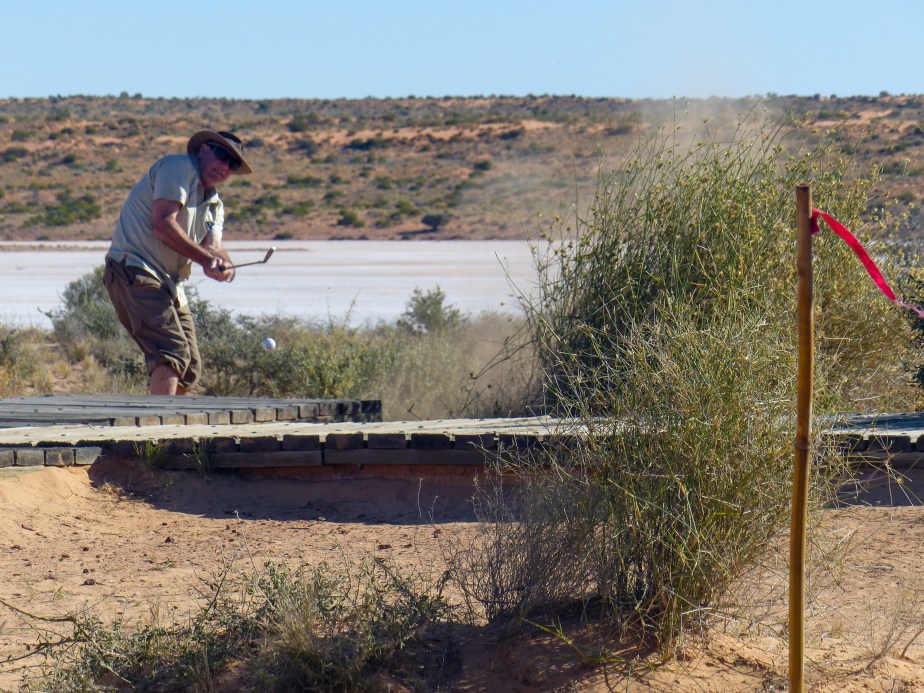
Our next landmark was Poeppel Corner. Once just like any other spot in the desert but now a magnet because it is the entirely artificial place where South Australia, Queensland and the Northern Territory collide. Mal and Kelly and sundry others had preceded us and left an indication of their IQ …
Just imagine, you could chip a golf ball from South Australia, through the Territory to a hole in Queensland and someone has been kind enough to provide the opportunity … but you need to be a left-hander.
photo TLG
Whilst there are three main routes across the desert they are by this stage reunited for the last push to Birdsville. To avoid a crowded campsite we took ourselves to the western side of Lake Poeppel for the night. Sunrises are so much better in the Northern Territory …
We had come here to enjoy the desert not conquer it. We’d knocked off the 1900 km to Hamilton in four days, an average of 475 km a day. For the next six days we would average just 88 km a day. This would keep us driving for as much as four hours a day but give us plenty of time to stop for anything that sparked our interest.
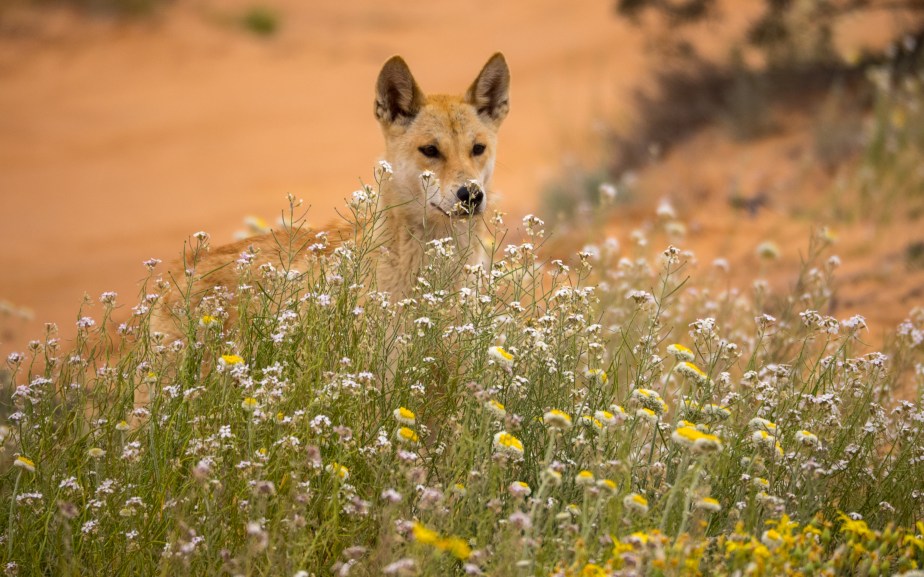
The desert was carpeted in wild flowers. I was surprised at how densely vegetated it was. Birds and reptiles were well represented but we saw little in the way of mammals. There were plenty of camel tracks and some camel droppings … by the way, these look like horse shit designed by a committee. To that can be added one House Mouse and a dingo.
For all its awesome reputation driving the French Line west to east presented no great challenge. Concentration was required, you needed just enough momentum to ease you over the crest, too much would rearrange the contents of the vehicle unnecessarily. There was often a moment when all you could see was the bonnet and the sky. When the road came back into view it wasn’t guaranteed to be straight ahead.
The dunes trend SSE-NNW and continue parallel for many kilometres, some as much as 200 km unbroken. This pattern is seen throughout the deserts of Australia. The height and spacing between the ridges have an inverse relationship. Where there are 5-6 ridges in a kilometer, the height is around 15 meters. Where there are one or two ridges per kilometer the height jumps to 35–38 meters. Dunes on the west of the desert are mostly small but they increase in size as you head east. The eastern faces are not only steeper, they are also longer. (No you don’t get further and further below sea level, you climb quite gently across the interdune space before reaching the next challenge.) Where dunes are close together the surface in between mostly remains sandy but where they are widely spaced the surface is often clay – much more of a challenge than sand when wet.
In places the track is scalloped, this effect is blamed on the drivers who fail to lower their tyre pressure and those who insist on towing camper trailers although I think injudicious use of the brakes on the downhills is just as much to blame. On steep faces the scallops are out of phase, your left wheels go in as your right wheels come out, it feels like riding a camel. On lesser slopes they are side by side. Either way the wave length is the average length of a vehicle.
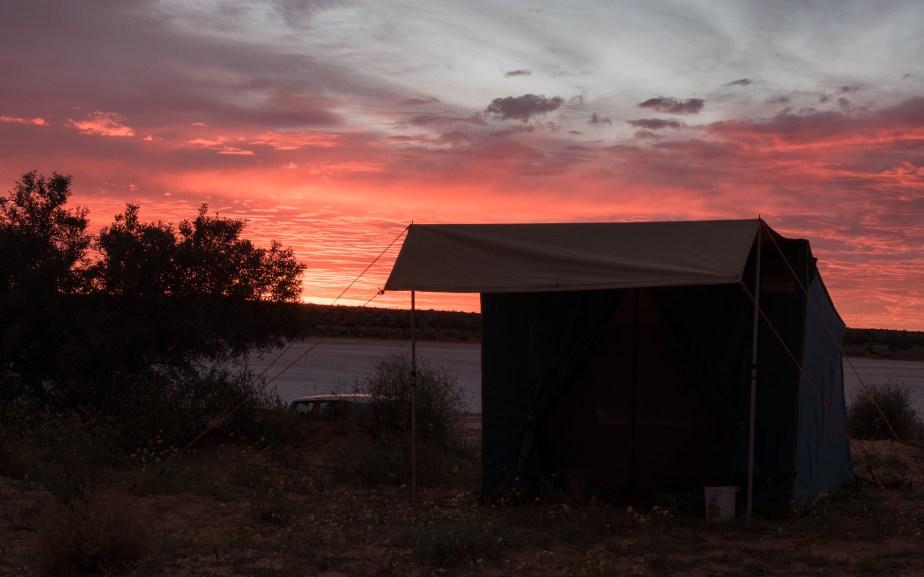
During the second night a cold front passed through. It brought no rain but the wind drove sand into everything. I woke with sand in my sleeping bag, even some between my teeth.
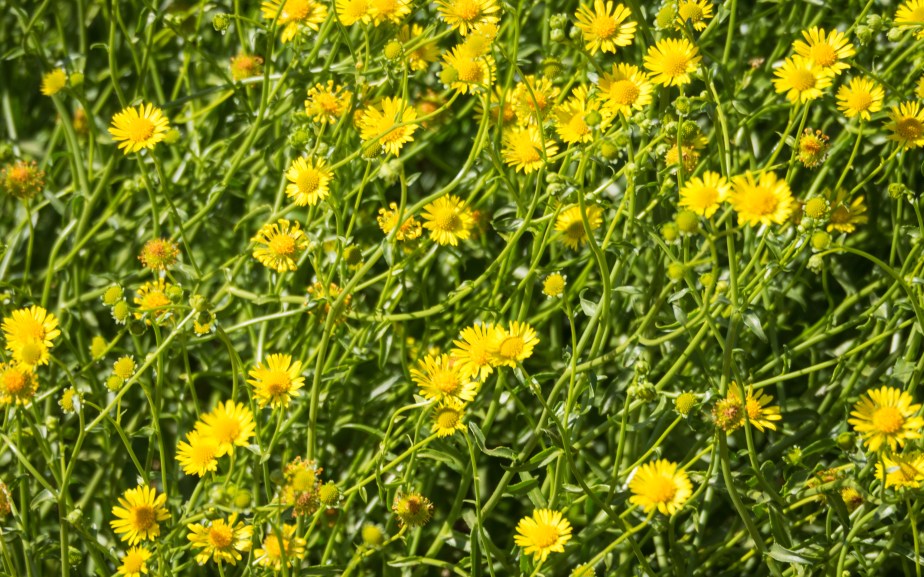
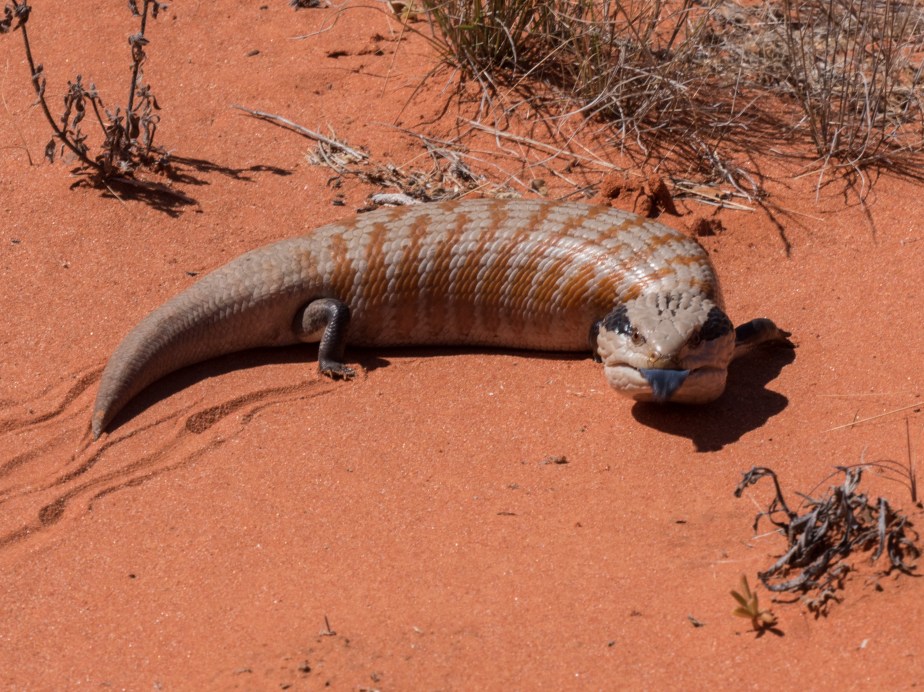
Regal BirdflowerFleshy GroundselCentral Blue TongueCentral Netted Dragon
The desert has a stark beauty. Visiting is a little like scuba diving … we don’t have the means to live there but we can take what we need to enjoy it for a short time and come away looking forward to the next time.
The road beyond Dalhousie Springs had not been graded and had a challenge for every season, clay pans for the wet, dunes for the dry and stones to puncture the tyres at any time at all. The corrugations were ferocious – we were carrying hard-boiled eggs that were actually peeled for us by the vibrations. Vehicle contents were redistributed freely – note to self, screw top lids are a really good idea. They would have saved scooping up the sugar off the floor of the car.
At Purni Bore it all changes. No more stones, corrugations become far less arduous. This is the start of the sandy desert. Time to drop the tyre pressures to 18 – 20 psi.
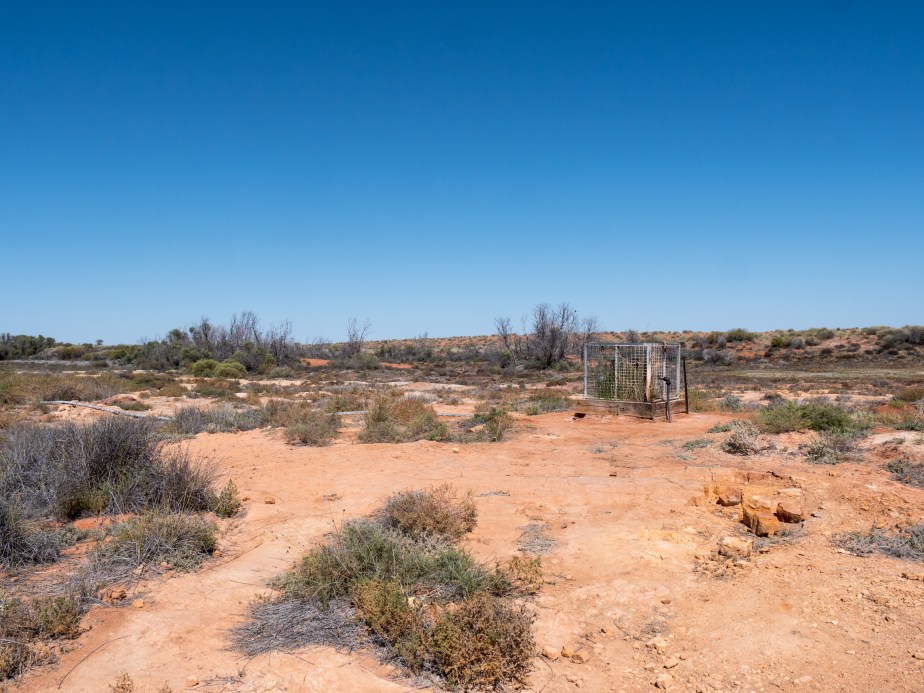
Purni Bore
Soon we leave Witjira National Park and enter the Simpson Desert Regional Reserve. Before long we are cresting the first dune on the French Line. The first of many, you could count them, but be aware, if you get confused tradition dictates that you go back to the beginning and start over.
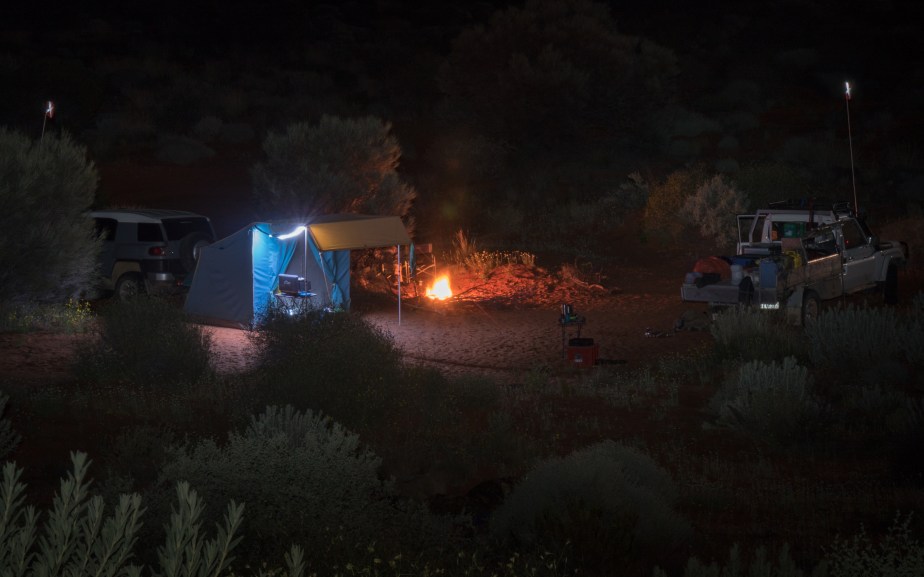
Camping restrictions are eased. We can now camp anywhere within 50 metres of the road.














 bobmcgee