I’m tired out from all this travel. Need a holiday. Where to?
Western Australia perhaps. There are 2.646 million square kilometres to get lost in and just 2.6 million people to share it with. That’s almost three times the size of Texas which is a mere 696,241 square kilometres. Texas is a little crowded though with more than ten times as many people (nearly 28 million).
So, it’s off to Broome, a favorite stamping ground. You can read about my last visit while you wait for me to share this visit.
The change of seasons in Victoria is far less dramatic than in the US or UK. There as summer fades the leaves change colour and a big proportion of breeding birds head south for winter. An influx of winter birds take refuge from what will soon be a snow-covered landmass further north.
Here autumn is a bit of a flop. The plants tend to be evergreen and there is no major landmass to the south to provide us with a winter influx. Antarctica doesn’t have much to start with. Tasmania does its best for us with a couple of parrot species. New Zealand sends us a tern and a shorebird.
But spring is everything it should be. The wild flowers bring some colour. The Superb Fairywrens take on their breeding plumage. Bird activity and numbers increase.
Our Clamorous Reedwarblers arrived the other day and a big flock of White-browed Woodswallows has passed through.
The three days in London flew past. Time, too soon, to fly home to Australia.
In doing my research for the historical context of my account I came across an interesting map that I didn’t use but is both interesting and amusing, the Roman Roads of Britain by Sasha Trubetskoy …
Quoting myself here …
Around AD 410 rule from Rome came to an end. The Angles and Saxons were invading Britain, the Visigoths were besieging Rome. Paganism was the new thing. Except in Ireland where the Celts had proven quite resistant to Roman rule but had adopted Christianity.
Gives the impression that Christianity was flourishing in Ireland before Roman rule in Britain had faded. This is incorrect. As the pagan Angles and Saxons forced themselves into Britain Christianity retreated into Wales from where it made its way across the Irish Sea from AD 431 on.
Some sources give the impression that Celtic practice was vastly different from the Roman. This is ascribed to the influence of Coptic Christianity of the time which was more monastic and ascetic rather than congregational. The devout retreated from the general community rather than live within it and gather at church on Sunday. In Egypt they tended to take themselves off into the desert. There are quite a few place names in Ireland that include Dysart which might indicate proximity to one of these early monasteries. (See sacredconnections for example).
Other sources suggest that the differences weren’t great, although they did come to differ in the calculation of Easter.
After the reintroduction of Christianity to England around AD 600 until the Norman conquest 1066 we have four and a half centuries with no churches to show for it. Recycling me again …
Until the Norman’s popularised the practice of building with stone, churches in Britain had been mainly timber and thatch affairs. None has survived to the present day. So 1066 marks the beginning of church architecture in Britain …
The Romans in Britain had built in stone, not only roads and walls but substantial villas as well. Christians elsewhere were building in stone such as the magnificent Hagia Sophia in Istanbul dating from AD 537. Why not the Anglo-Saxons?
Mea culpa, I repeated the popularly held oversimplification that there are no pre-Norman churches remaining in Britain. There aren’t too many in their original state but there are a few.
This is perhaps the finest of them. It is Escomb church from the far north-east of England. The photo is taken from the web site greatenglishchurches with permission from Lionel Wall the author. It was built somewhere around AD 680.
A few other examples exist but most have been modified extensively.
Anyone planning a visit to England that has an interest in the great parish churches would do well to browse this site. It’s a beauty.
Escomb has gone on my bucket list, its not far from Durham so I can combine it with a visit to Durham Cathedral and the Oriental Museum at Durham University (which was called the Gulbenkian Museum last time I was there).
Take the Ermine line from Londinium, change at Petuaria …
Where my interest in nature came from is anybody’s guess, none of my family shared in it. It was evident very early, by age eight I was off on my own making lists of the birds I came across. Whipps Cross was my patch.
When I was older and got a bike I could venture further afield. I tended to concentrate on larger birds, I didn’t own any binoculars until much later.
I counted it a particularly successful outing if I managed to see a Jay or a Great Crested Grebe.
Great Crested Grebe
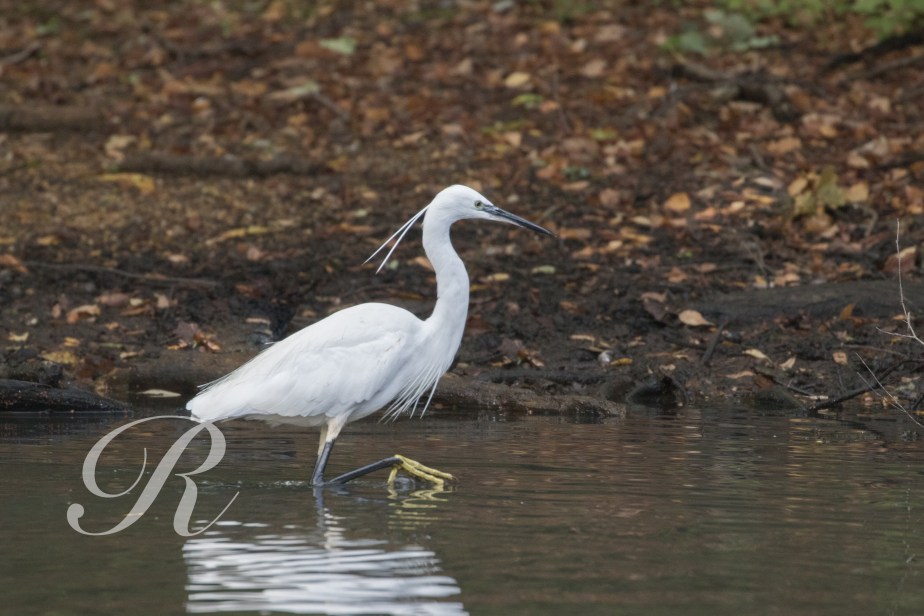
So, naturally, I managed to fit a little birding in between seeing the sights of London, starting with Whipps Cross where I saw both a Jay and a Great Crested Grebe plus a couple of birds that were not present in my young days, Little Egret and Egyptian Goose. Interestingly I didn’t come across Chaffinch or Yellowhammer.
Little EgretEgyptian Goose
Other spots that I visited included Fisher’s Green near Waltham Abbey. This was a place that I used to fish at. It’s changed a great deal since then. Some old powder mills are gone. Gravel extraction has produced extensive shallow lakes. It’s now a great place to see water birds and even an otter if you’re very lucky.
Another old favourite was the Lea Valley reservoirs running from the back of Hackney Marshes out to Tottenham. Arriving there I found that Europe’s most extensive urban wetland was in development and would open October 20th. The place where I saw my first Smew was being recycled as Walthamstow Wetlands.
Although it wasn’t yet open it wasn’t all that closed either so I found my way in and had a wander and found perhaps the most exciting bird of the UK trip …
In flight it showed triangular white patches at the base of the tail. The photo shows the patterned plumage and the white supercilium. It’s a Whinchat, exciting because quite unexpected on the outskirts of London. It’s a summer visitor to Britain, I may just have been lucky to see it as it made its migration southwards.
But it’s not all about the novel or the rare. It’s nice to spend time with old friends.
Waltham Abbey stands on the bank of the River Lea. In 1577 a lock was constructed nearby. It was the first of a series that improved the river for barge transport. If you point your barge down stream you will pass through Enfield Lock, Ponders End, Edmonton, Chingford, Tottenham, Walthamstow, Upper Clapton, Leyton, Hackney Wick, Stratford, Bromley-by-Bow (past Fish Island), Poplar, Canning Town and finally Leamouth where it meets the River Thames.
You will also pass through much of my family history. Just before you go under the bridge at Leabridge Road you will have Hackney Marshes on your left. In the days when Tottenham Hotspurs were semipro my Grandfather played for them here. My father and then I too played football here although not for such illustrious teams. One of the most memorable spectacles of my young life occurred here. I was playing cricket for my school when Porter’s Paints caught fire. Drums of solvent were exploding and flying into the sky all afternoon. New Year’s Eve has nothing on it.
Shortly after passing under the bridge you will pass the site of a wood yard that occupied one side of Rock Road. Half my family occupied the other side of the road.The timber came on horse drawn barges. On hot days my father and uncles and aunt would swim in the Lea.
It was here in 1952, at a street party to celebrate the coronation of Queen Elizabeth ll that I won half a crown in a fancy dress contest. My mother had dressed me as Wee Willie Winkie, I was running around waving a candle stick in a holder. Rock Road and the wood yard are long gone in the process of slum clearance.
At Hackney Wick you will pass my first home. We lived upstairs in two rooms, there was no bathroom. The toilet was in the back yard. We shared it with the occupants of downstairs. In the London I grew up in there was an adventure playground in every street courtesy of the Germans. “I’ll be playing in the bomb site, mum”.
On the corner of Wick Road there was a pub, The Tiger. It was hit by the last bomb of the war. My uncle was standing at the bar. That last bomb fell in more places and killed more people than any other bomb of the war. That area too has been demolished and rebuilt.
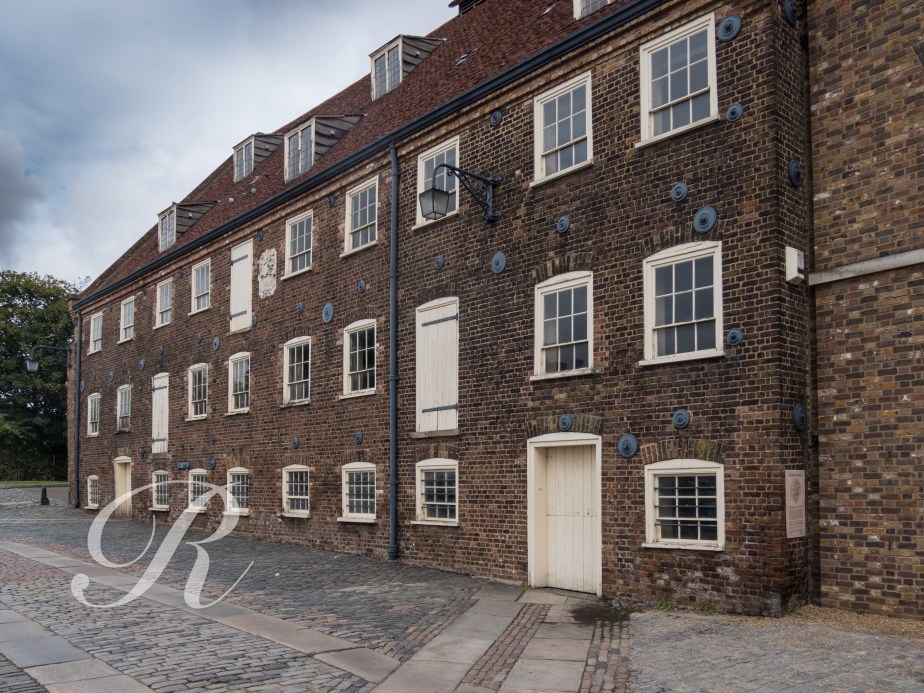
But keep going, the Lea is becoming tidal now. And we’ll stop at the Three Mills, Bromley-by-bow. Two are still standing, this is the older …
It stands astride the river. It was built in 1776. There are two tides a day that filled a 57 acre mill pond, when the ebb started to run the water turned water wheels beneath the building which drove the mill stones and also did the lifting that took the grain up to the top floor. Depending on the height of the tides the mill would operate seven or eight hours each day.
The grain would come by cart or by barge, the flat stones were there so that cart wheels needn’t run over the cobbles.
The miller’s house is to the right running out of the photo. There is no communicating door between the two for the very simple reason that a naked flame would have led to a massive conflagration. Candles were OK in the house but open a door to the mill and disaster would have ensued.
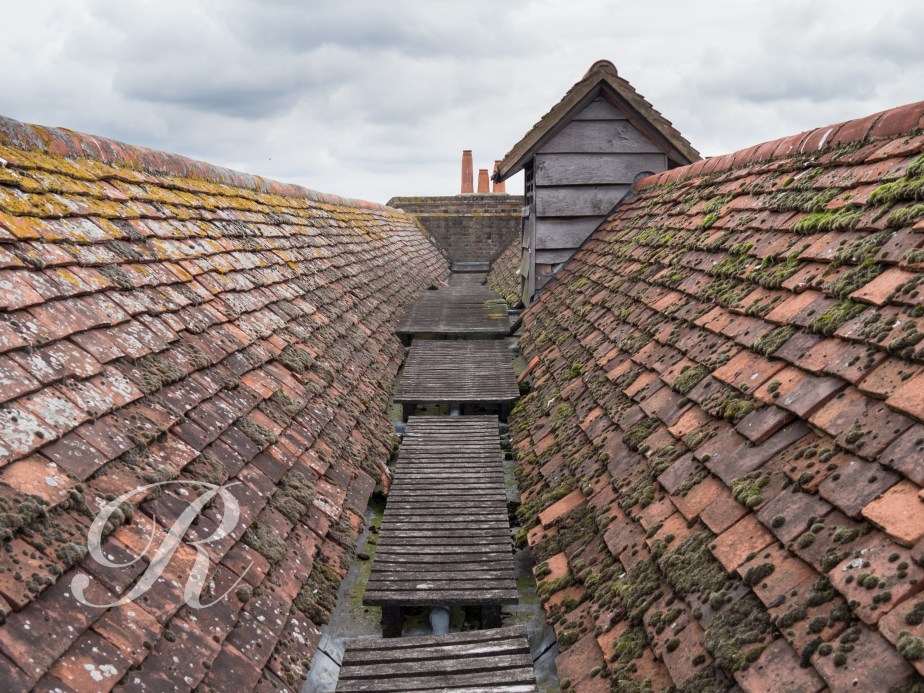
My good friend Kathy is a volunteer at the mill. Her friend Tony gave me a very comprehensive and informative private tour. The paying public do not get to see the roof …
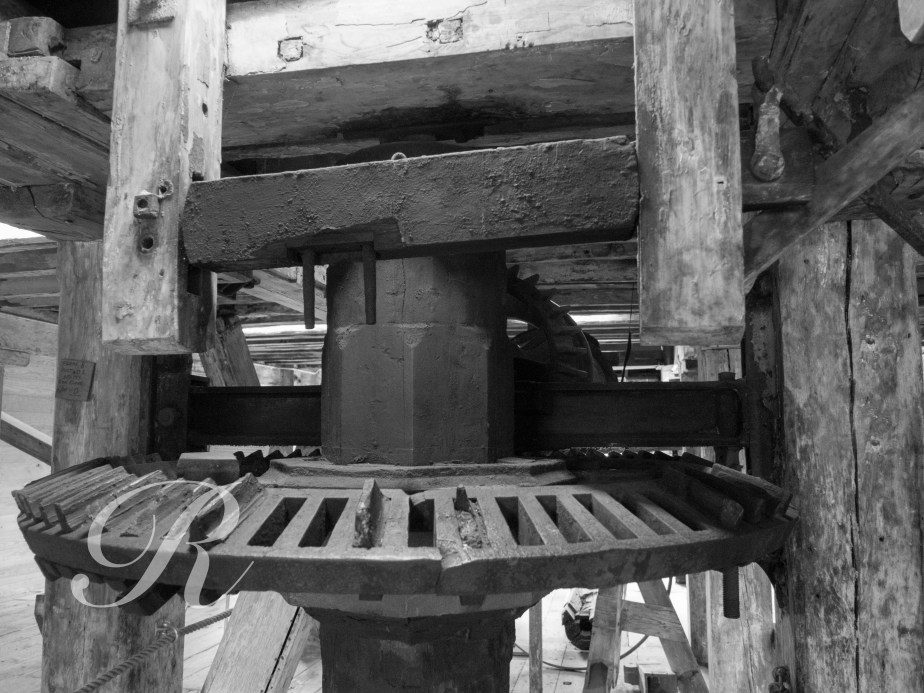
The working day was dictated by the tide not the clock. Without any artificial light it was largely managed by ear. The control room is on a lower level, an ingenious arrangement of levers and ropes controlled most of what happened on the floors above.
There have been tidal mills on the Lea throughout recorded history. The Domesday Book, commissioned by William the Conqueror to take stock of his new realm, records nine mills along this section, although it is uncertain if this meant nine pairs of stones or nine buildings perhaps holding even more pairs.
The flour produced traditionally went to the bakers of Stratford-atte-Bow who sold their bread in the City of London. By 1776 there was a more valuable commodity than bread. The output of this mill mainly went into gin production. Hogarth would have been horrified.
As you can see the building behind the stone facade is wood. The stresses imposed by the milling machinery were enormous. The carpentry owes more to ship building than residential housing.
Claudius, the unlikely Emperor of Rome, needed a military conquest to earn a little respect. In AD 43, he sent four legions to invade the Catuvellaunian kingdom in Britain. They were successful and Claudius was able to make a visit soon after. The Catuvellaunian capital was given a Romanised name and Colchester became the accidental capital of Roman Britain. It took another thirty years for the Romans to subdue the rest of the country.
Dover sits at the narrowest point of the English Channel. It was settled and used long before the Romans but they fortified it and set up lighthouses.
Between Dover and Colchester there’s a problem, the Thames. The Romans built a bridge. The site was obvious it had long been in use. At low tide it was shallow enough to ford, at high tide you could take a boat. Why exactly there? Because a natural causeway to the south bank through an otherwise marshy area sits opposite a high point on the north bank.
The river was now an opportunity, ships could come up the Thames, goods could be transported north or south. A village grew up around the bridge.
London Bridge came before London. Once it got started it grew apace.
Between London and Colchester there was another problem. The River Lea. Just how do you spell it, Lea or Lee? You’ll find both so neither is wrong but in some contexts one is more right than the other. But the more important problem is negotiating the marshes and crossing the river. Traditionally at Old Ford, Hackney.
Bear in mind that the prevailing wind is from the west.
Problems, opportunities, accidents. A bridge, a growing town, a main road that runs northeast, the River Lea, it’s marshes, a west wind … these are some of the things that made the East End, and the East End made me.
Docks grew up on the Thames, associated industries grew nearby, ropemaking for example. Some industries are smelly, tanning for instance, put it down wind from the richer citizens. Or hazardous like making gun powder. The big city needs grain and fresh water, take it by barge down the River Lea. It’s tidal … harvest the tide for milling grain.
In 1720 John Strype described London as consisting of four parts …
the City of London, Westminster, Southwark, and “That Part beyond the Tower”.
That part beyond the Tower was spreading northeast up the main road into the countryside. It was constrained by the marshes and the River Lea.
East End. No end. Grey streets, grimy streets, streets without number, streets without meaning, streets that spread on and on under the dull, dreary eastern sky until, somewhere out past the miles and miles of docks they dissolve like an estuary, into a sea of nothingness. East End. Dead end. The East End was not a place, it was a state of mind. London, Edward Rutherford.
And not necessarily a sober state of mind. In 1736, the Middlesex Magistrates complained …
It is with the deepest concern your committee observe the strong Inclination of the inferior Sort of People to these destructive Liquors, and how surprisingly this Infection has spread within these few Years … it is scarce possible for Persons in low Life to go anywhere or to be anywhere, without being drawn in to taste, and, by Degrees, to like and approve of this pernicious Liquor.
There is no God but my word He commissioned some wonderful architecture and some of the finest music ever written. You could listen to this as you read …
Canterbury Cathedral is a triumph of stone in the service of light. It is an extraordinary building but my personal favorites are from the older Norman era. When all the mason could build was a simple arch the choice had to be made – do you want the church well-lit or would you like it to stay up. My all time favorite is Durham Cathedral with Ely in second place. When you enter these buildings you feel his presence, the hairs on your arms stand up. If you’re lucky enough to hear the choir rehearsing you’re already in heaven.
As a kid there was an impressive Norman era church close enough for me to ride to on my bike, Waltham Abbey.
Anno Domini, the year of the Lord. One Dionysius Exiguus thought it a good idea to start the calendar at the moment of Christ’s incarnation. This was back in AD525 and of doubtful accuracy more than 500 years after the event. The year Mr Exiguus did this would have otherwise been Diocletian 248. He was motivated by the desire to remove Diocletian’s name from the calendar because of Diocletian’s persecution of Christians. His main interest in the calendar was in calculating the timing of Easter, no simple matter.
Diocletian became Emperor of a declining empire in Diocletian 1 totally unaware that it was really AD284 . Besides his tireless work for the nutrition of lions he raised the personality cult to a state of perfection, introduced the most bureaucratic government the Empire had ever seen and divided it into four parts which he ruled with three junior co-emperors. He made Rome great again. He retired after 21 years and managed, eventually, to die of natural causes. All in all a remarkable achievement.
After his retirement chaos resumed.
In AD306 Constantine the Great, son of Constantius one of those junior co-emperors, emerged victorious from the civil wars and became Emperor. During Diocletian’s time Christianity was the dangerous obsession of a small minority. Constantine was tolerant of Christianity and at some point converted (after a fashion) and Christianity became the state religion. There were some Christians living dangerously in that corner of the empire known as Britannia. Now they could come into the open.
And so Christianity flourished throughout the land for the next century.
Around AD410 rule from Rome came to an end. The Angles and Saxons were invading Britain, the Visigoths were besieging Rome. Paganism was the new thing. Except in Ireland where the Celts had proven quite resistant to Roman rule but had adopted Christianity.
The reintroduction was two-pronged. Pope Gregory sent Augustine to spread the word to King Æthelberht of Kent, whose wife was a Christian from the continent. Augustine became the first Archbishop of Canterbury in 597. The good news spread northwards.
Edwin King of Northumbria heard it, converted to Christianity and established Roman practice in his realm. After his death and a year of political instability, Oswald gained the throne. He had learned Christian practice and to speak Irish from the monks of Iona during a period of political exile. He encouraged Ionan missionaries to preach in Northumbria, making St. Aidan bishop of Northumbria in 635 with the seat of his diocese on Lindisfarne.
The two schools of Christianity had different ways to determine the date of Easter. Problems arose at the Northumbrian court with King Oswiu, Oswald’s successor, observing Easter on a different day than the good Queen Eanfled. While one royal faction was celebrating Easter, the other would be fasting for Lent. After Aidan’s death matters became so serious that the issue had to be debated at the highest level. It was decided at the Synod of Whitby AD664 to follow the method devised by our friend Dionysius Exiguus, the Roman way.
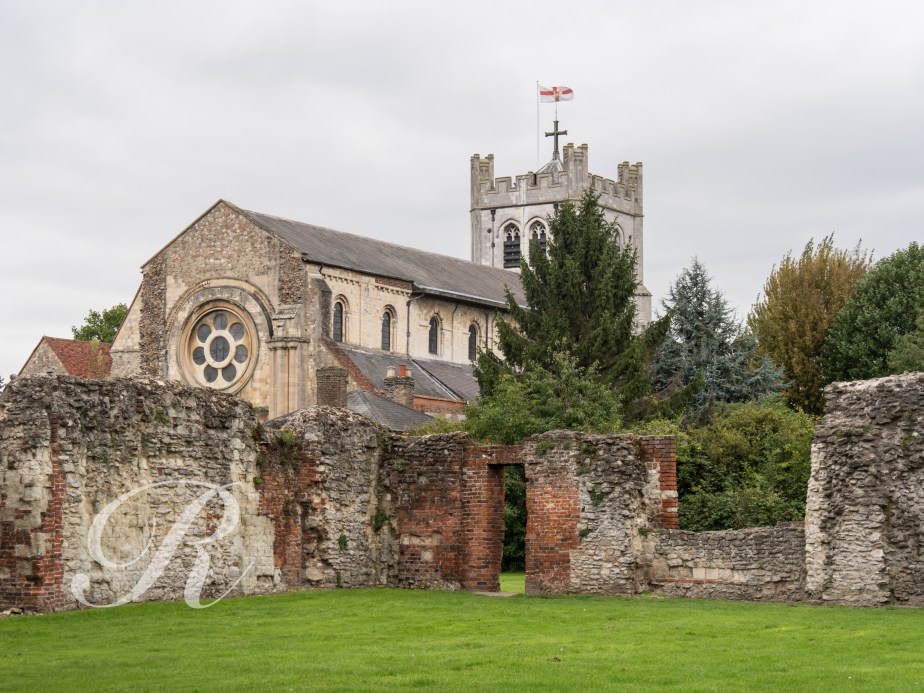
So far I’ve mentioned a whole bunch of places that deserve another visit but with so little time the best I could do was to visit The Church of the Holy Cross and St Lawrence aka Waltham Abbey.
Until the Norman’s popularised the practice of building with stone, churches in Britain had been mainly timber and thatch affairs. None has survived to the present day. So 1066 marks the beginning of church architecture in Britain and the end of King Harold. Guess where he’s buried.
The first church on the site dates back to about AD610. It was wooden. It was followed by a partially stone church built in the eighth century.
Cnut King of Denmark defeated Edmund Ironside at Assandun, Essex, in 1016, and became king of all England on Edmund’s death. During his reign the manor of Waltham was held by his friend Tofig who also held another in Somerset. According to a twelfth century source, De Inventione Sanctœ Crucis Nostrœ (The Discovery of our Holy Cross) a blacksmith on the Somerset estate had a dream that led him to discover a crucifix buried on a hill top. Said crucifix might have been made of flint. Tofig had the cross loaded onto an ox-cart suggesting it was of some considerable size. The oxen would only go in one direction and continued every day until by a striking coincidence they reached Tofig’s Waltham estate, 150 miles away. The Holy Cross was installed in the church and soon became an object worthy of pilgrimage.
Such were its powers that when Harold Godwinson became ill, Wulstan, Bishop of Worcestor sent him to pray before it. Harold, then Earl of East Anglia made a miraculous recovery. In gratitude he had the church rebuilt on a grander scale and donated considerable wealth to it.
Subsequently Harold became the last Anglo-Saxon King of England. It was a brief reign. Crowned in January 1066 dead in October. Harold took his army north to defeat an invasion by Harald Hardrade King of Norway aided and abetted by Harold’s own brother and rival for the throne, Tostig. He won a crushing victory at Stamford Bridge on September 25th. Then it was a race south to meet William of Normandy stopping en route to pray again to the Holy Cross at Waltham. The Battle of Hastings on October 14th ended in his death.
The subsequent disposition of his remains are shrouded in mystery. One version, by far the most appealing in my biased opinion, has his body identified by his mistress Edith Swanneck and taken to Waltham for burial under the high altar of his own church.
In 1090 Harold’s church was torn down and a new one in the Norman style erected. What you see today is mostly from that fourth incarnation.
History hadn’t finished with it though. In 1184, Henry ll, as part of his penance for the murder of Thomas Becket, Archbishop of Canterbury, raised the status of the church to an abbey. Part of the Norman church was demolished and a grand extension built in its place. Cloisters were added.
The Holy Cross continued to attract pilgrims that included the noble and famous. Henry Vlll and Anne Boleyn stayed for five days during their summer progress of 1532.
Then came the reformation. In 1540 it was the last abbey in England to close. The extensions made after 1184 were demolished although the tower on the west end was built in 1556. The interior continued to evolve.
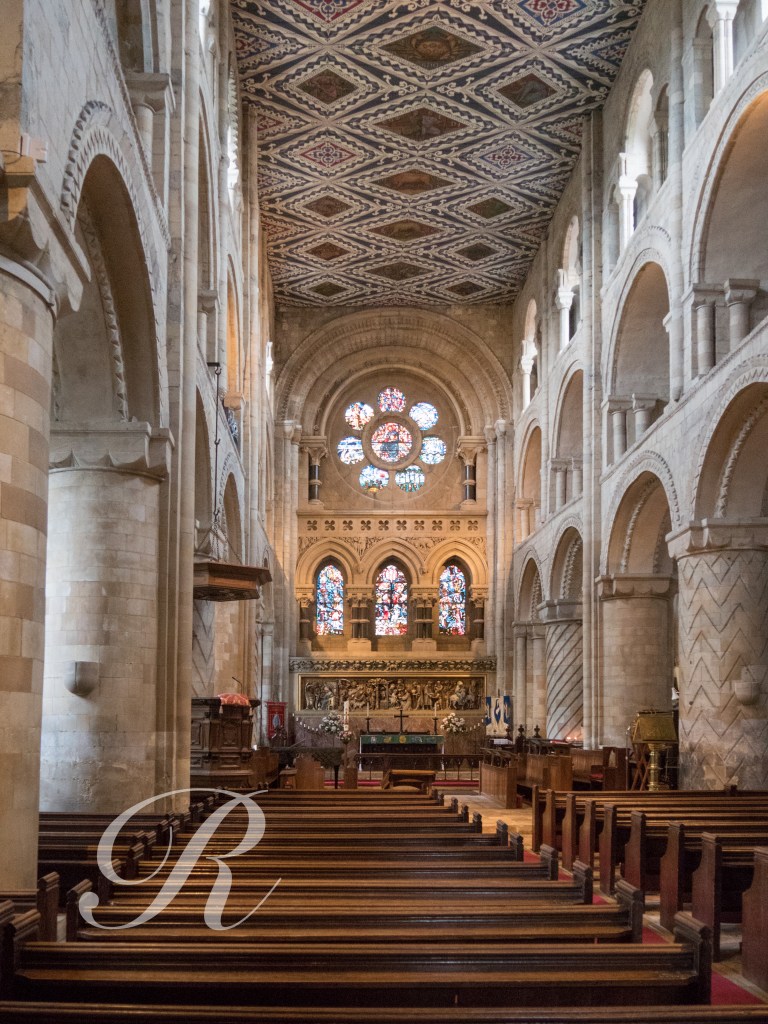
Although only a shadow of its former glory, it is still a very impressive church.
The ceiling was part of restoration work completed in 1876 under the direction of William Burgess.
One of the workers put out of a job when the Abbey closed was Thomas Tallys, one of my favorite composers. He’d been on the staff for about two years at that time. His redundancy payment was quite generous and he soon found work at Canterbury Cathedral. The Holy Cross disappeared at the same time but we’ve already established that it was too big to fit in his pocket.
Best heard at full volume before getting out of bed on a Sunday morning … which is exactly the way my neighbours were introduced to it when I lived in a flat in Melbourne.
I was born in Hackney and largely grew up in Leyton. I left home to study at Sheffield University and never lived in London again. I migrated to Australia when I was 26. There is much that I don’t miss about England but much that I do. I had just three days to scratch the surface.
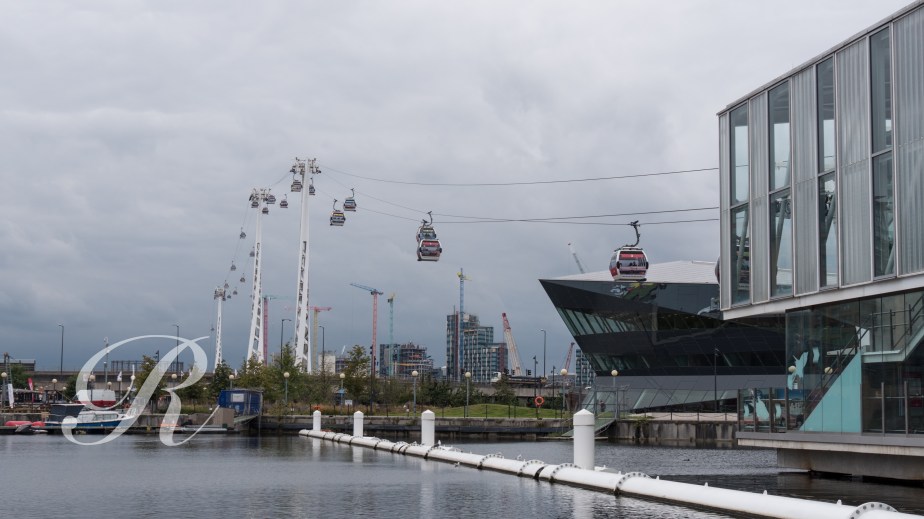
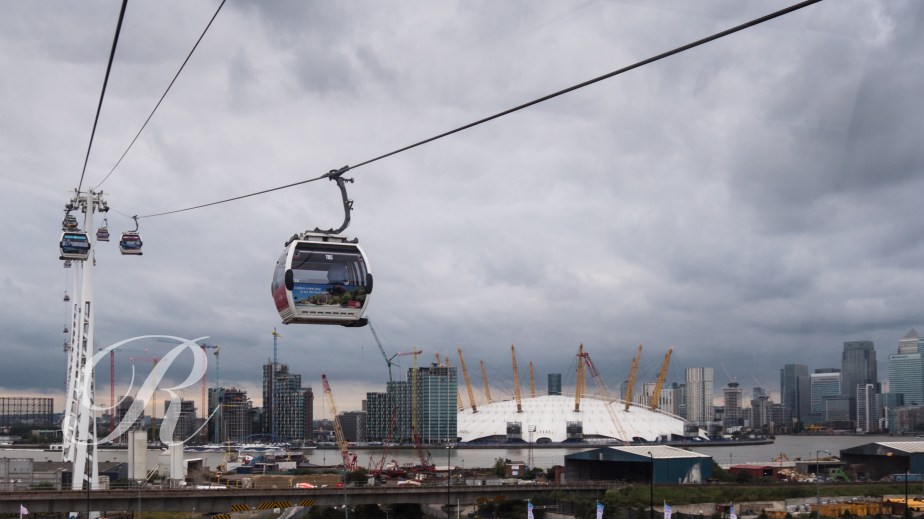
My good friend Kathy had one day planned to perfection. To Stratford by tube, to Royal Victoria on the DLR (Driverless Railway), across the Thames on the Emirates Cable Car. A quick walk around the O2. Up the river on the Thames Clipper. Stroll on the Embankment and home on the tube. A chance to see some of the wonderful sights that I love from forms of transport that were not yet in existence when I left town.
As you can see, the weather hasn’t improved.
The O2 is the low rise circus tent just right of centre. Like the Tardis, it is much bigger inside than you could possibly imagine.
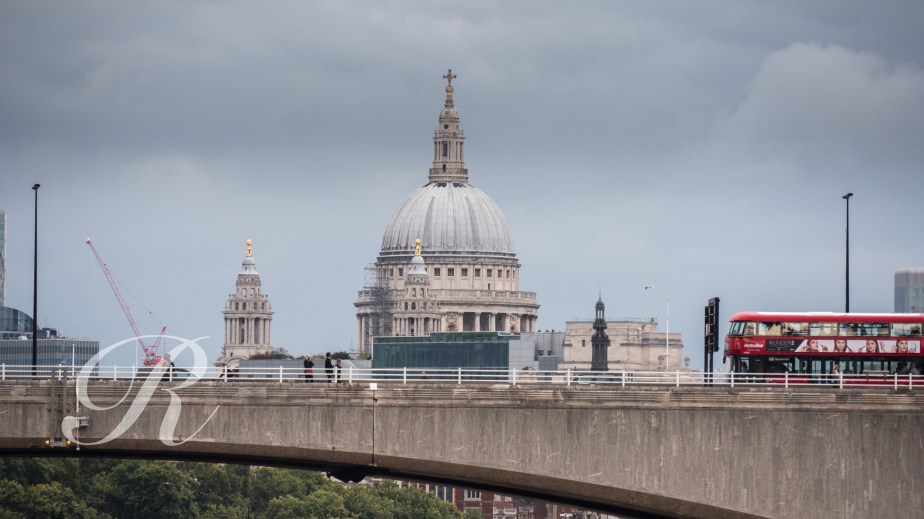
You catch the Thames Clipper nearby and travel west past the Greenwich Naval College before getting glimpses of St Paul’s and The Tower.
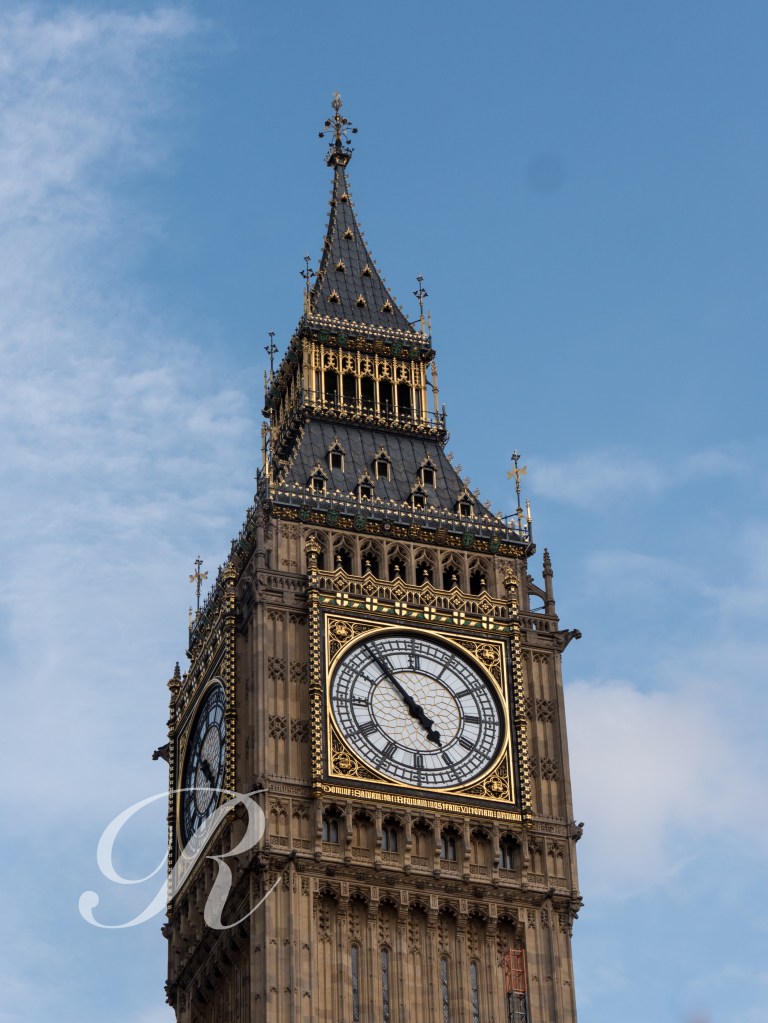
Winnie’s statue outside Westminster Abbey, no doubt erected to commemorate his encounter in 1946 with Bessie Braddock, a plump Labour MP and Tory-hater, who told him: “Winston, you are drunk.”
“Madam, you are ugly, I will be sober in the morning.”
Our stay in the States was both enjoyable and interesting. A very big thanks to the people who welcomed us into their homes and showered us with kindness and hospitality. But the time had come to move on, this time to the UK to visit my oldest friend in all the world, my birth twin.
We were born on the very same day, in London, must have been more than twenty years ago. She likes to remind me that I should respect my elders and of course she is my senior by a couple of hours.
We flew the Atlantic United, wipe the smirk off your face. That joke is ancient and no longer amusing. They have taken the art of miniaturisation to new heights providing the world’s smallest in-flight entertainment screens. At least they didn’t drag us screaming from our seats.
“After our team looked for volunteers, one customer refused to leave the aircraft voluntarily and law enforcement was asked to come to the gate. We apologise for the overbook situation. Further details on the removed customer should be directed to authorities,” the spokesman said. news.com
The quote is irresistible for two reasons. It provides a whole new meaning to the word voluntary. Then apologises, not for dragging the poor bastard trying to get home for work off the plane, but for the overbooking. At the beginning of our stay we cleared customs in LA then flew United to Chicago then again to Jacksonville. Overbooking is clearly a practice they have no intention of giving up, they were calling for volunteers to give up their seats almost from the moment we arrived at the gates.
Contemplation, Seneca style, is very comforting before and during air travel. It can even prepare you for Heathrow.
And then the undergound to Leytonstone. A young man gave up his seat for Gayle. That wasn’t the only revelation. There were people on hand to help you work out how to get to your destination and what’s more you could pay with money, or the local version of dedicated transport card or just tap on and off with your regular credit card. Melbourne could learn a lot.
The locals practise their own form of contemplation as they travel whilst staring at United sized screens which they hold in front of their faces in total silence.
The London correspondent picked us up at Leytonstone Station and whisked us home in time for breakfast. Ahh, London …
I prepared for my American trip by flicking through the National Geographic Society’s Field Guide to the Birds of North America, 2nd edition 1987, a wonderful book in its day but superseded by The Sibley Guide to Birds which I’m saving up for.
As I browsed I came across the New World Sparrows and thought to myself “I’m going to have trouble with these”. In 1987 the index contained 35 sparrows, one of which is the good old House Sparrow described in Wikipedia as …
a symbol of lust, sexual potency, commonness, and vulgarity.
Fortunately for the remaining 34 are not they are not tainted by close association. The House Sparrow is the lustworthy centerfold of the Passeridae whilst the New World Sparrows are in the family Emberizidae, the Buntings and New World Sparrows, members of the nine primaried oscines along with the wonderful warblers though, sadly, nowhere nearly as exciting. They tend to live on the ground and most are nicely disguised for life in dry grass.
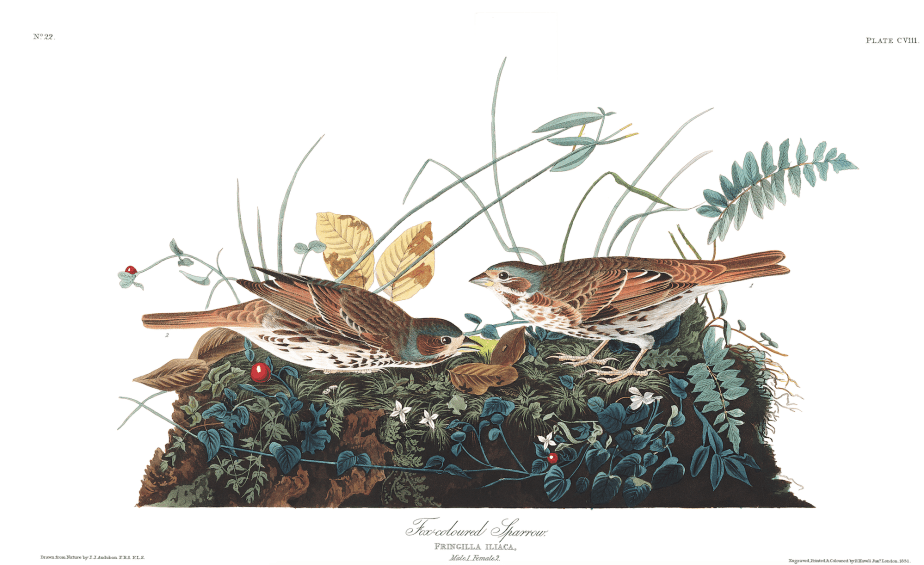
Things have changed over the years. In Audubon’s day you went bird watching with a fowling-piece and came back with creatures you could stuff or draw …
In 1987 you took your binoculars, now you need a genetics laboratory, the advent of DNA studies has tossed the taxonomy of birds into total chaos. Audubon’s Foxcoloured Sparrow of 1831 was the Fox Sparrow in 1987 and is now four separate species according to the Handbook of the Birds of the World. Things did not get easier and plumages vary from individual to individual.
There is a site on the web that is of some use to the beginner, or visiting expert (the same thing) Birdzilla. It offers a key based on three field marks
Is the breast streaked or clear?
Does the bird have wing bars ?
Is there an eye ring?
Based on these you can get in the ballpark where the remainder of your observations will nail your bird. Maybe. Bear in mind though that wing bars and eye rings vary with the freshness of the plumage and the angle of the light.
So here we go …
Streaks – yes, eye ring – yes, wing bar – faint at best. Note the yellow supercilium. Oh dear, the key ain’t working. It’s a Savannah Sparrow. That eye ring is leading us towards Vesper Sparrow – saved by the yellow.
The eye ring won’t get us this time …
because the Song Sparrow is included in the eye ring positive and negative groups. It’s the other details that get us home, central spot in the breast, grey above and below the eye.
So the key has to be used with caution and it’s no use here either because it only works for adult birds and this one is a juvenile …
Field Sparrow (juv)
There is no alternative to practise and critical analysis. I got all these wrong but my friend who has had the practice sorted me out. If you disagree please tell me why and I’ll take it up with him!



















 bobmcgee