Around and about …

We spent a few days in the Cooktown region. Overall it was a very productive time from a wildlife perspective. The sighting of Bennett’s Tree Kangaroo was the crowning moment. If you are considering a visit, some of the places to include are the McIvor River, Mt Webb National Park, Keatings Lagoon, Black Mountain and Little Annan Gorge.

The McIvor River can be reached at a couple of spots, the easier place is via a bitumen road. On the way from Cooktown to Hopevale turn left 10 km prior to Hopevale in the direction of Laura. There is a second crossing not far downstream from there  that can be reached via a dirt track from Hopevale airstrip or from the crossing on the made road via a commercial plantation a little further in the direction of Mt Webb. Good birding in pockets of riverine rainforest can be had at both.

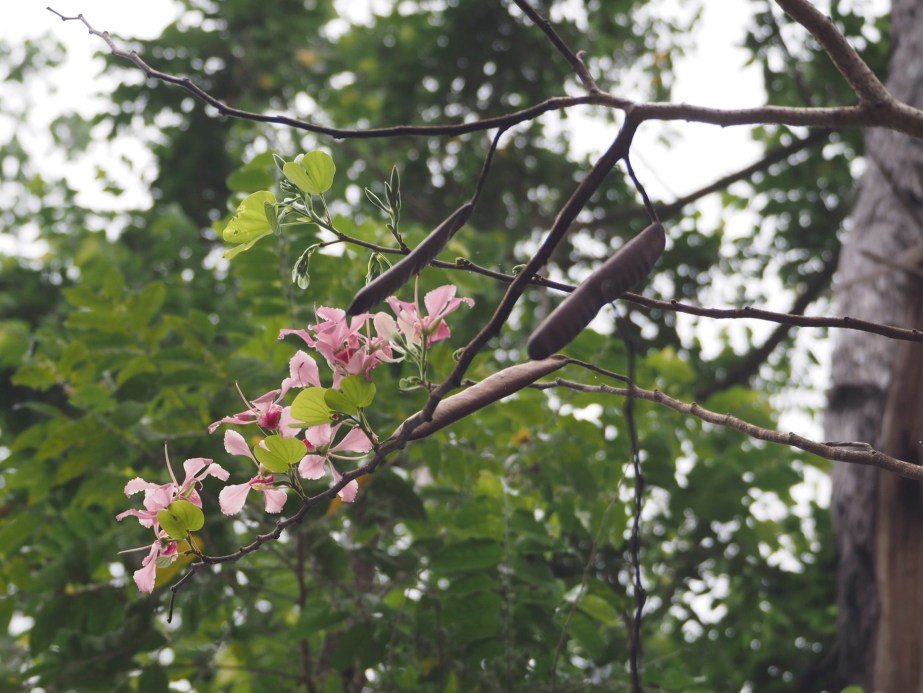
Flowering tree

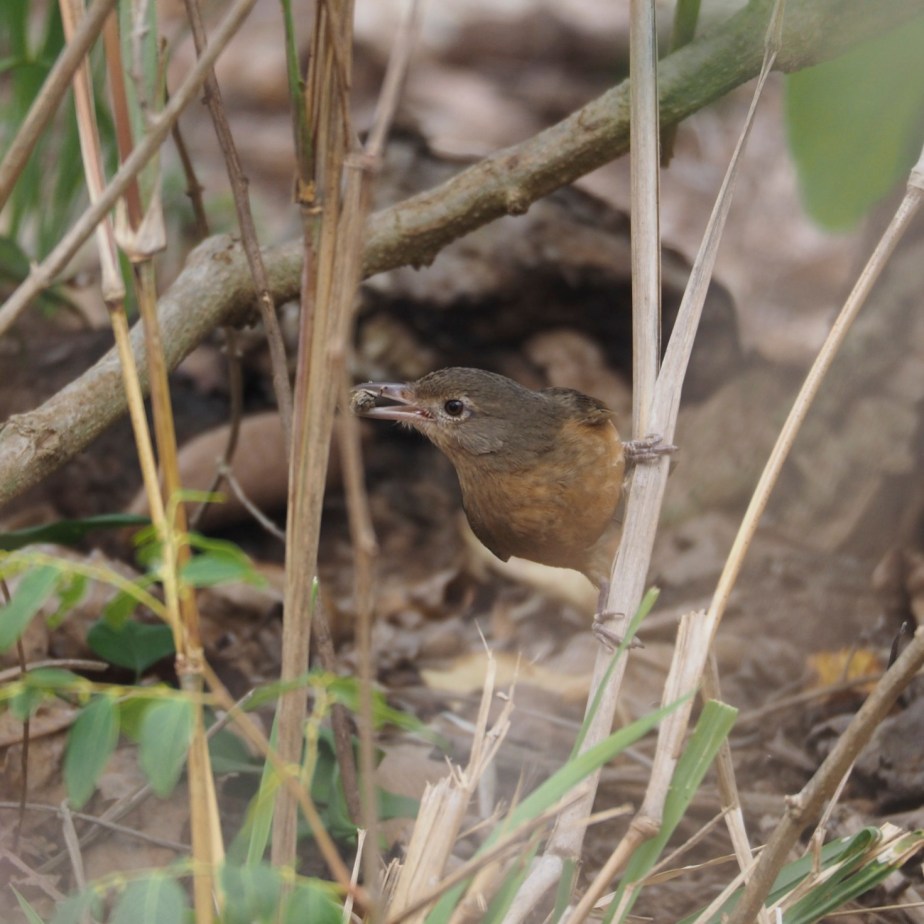
There are no real facilities at Mt Webb but you can get off the main road and poke around. We saw White-eared and Black-winged Monarch here, the latter is a summer migrant to Cape York and this is just about its southerly limit. I photographed this Little Shrike-thrush here …

Little Shrike-thrush

Also had good views of an Amethystine Python which I was about to photograph when the Black-winged Monarch flew by. I chased it and ended up without good photos of either. A snake in the hand or a bird in the bush?

A little further north on the east side of the road you can explore a heathy area that looks productive.

There are foot paths and a hide at Keating’s lagoon. It was good for water birds and is surrounded by some dry forest that yielded Silver-crowned Friarbird and other passerines. Magpie Geese …

Magpie Goose

Our main target at Black Mountain and Little Annan Gorge was Godman’s Rock Wallaby but in that we were unsuccessful.


Flying-foxes …

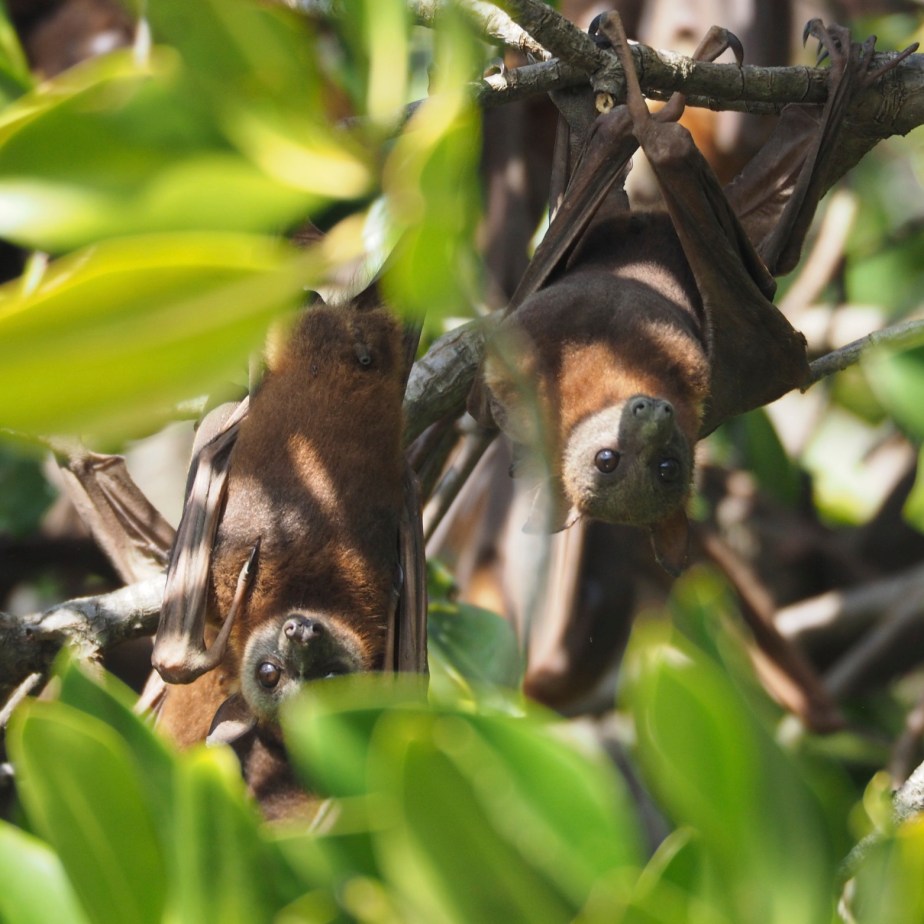
We wandered around Cooktown in the early afternoon. In the mangroves along the Endeavour river we found a large camp of Flying-foxes. As far as we could tell there were two species present, Little Red Flying-fox and the larger Black Flying-fox.

Flying-foxes feed mainly on nectar and fruit rather than insects and do not use echo-location. They are capable of long journeys on the wing and it is not unusual for them to cover 50 km a night.

People are rather mixed in their response to these creatures. They do harbour a virus that can be infect humans, although transmission is a rare event. The camps tend to be rather smelly and noisy.  And some people just find them particularly creepy. The aborigines ate them and it is said that they are very tasty.

We met a guy whose response was one that we had not encountered previously. He had wandered out of the RSL with a beer in hand, clearly not his first for the day. It is an inescapable fact that some of the males sport very impressive gonads. This was something that our gentleman was very keen to discuss. In fact, in making a comparison with his own, it seemed that he felt considerably inferior. I suspect that the next logical step, dropping his trousers so that passers-by could make their own comparison, was only a beer or two away.


Cooktown …

There was a time when every Australian child knew that Captain Cook discovered Australia. Not exactly true, of course, but quite possibly more than today’s school children know about the early days of the European influx that led to our modern society.

Jimmy

James Cook was born at Marton in Yorkshire in 1728. He was a bright lad of humble origins. The family moved to Great Ayton where his father became a farm manager. His father’s employer paid for young Jimmy to go to school.

Cook’s career at sea began in the merchant navy as an apprentice on a coal carrier. He studied diligently those subjects that he would need to take charge of his own ship, mathematics, navigation and astronomy, and at the end of his three year apprenticeship passed his exams. Three years later he was promoted to mate. Soon after that he passed up the chance to take command of a collier to join the Royal Navy.

That was a move that saw him starting at the bottom all over again. In 1755 Able Seaman Cook joined HMS Eagle. By 1757 Cook was master of The Pembroke. This was a time of war. The Seven Years War (1755 – 1764) has as good a claim to being a world war as any subsequent war. It pitted Britain against France with virtually all of Europe aligned with one side or the other and dragging in their colonies notably Canada.

It was during this war that General Wolfe surprised and defeated the French on the Plains of Abraham outside Quebec City, a pivotal moment in Canadian history. To put the troops in position to launch the attack it was necessary to navigate up the tricky St Lawrence River. A three month siege preceded the battle during which time Cook on The Pembroke surveyed and mapped the river. And it was Cook that led the troop carrying flotilla into place.

Cook went on to survey and map the Newfoundland Coast.

By the conclusion of the war Cook’s talent as a map maker combined with his obvious competence put him in good stead with The Admiralty. Meanwhile the Royal Society was urging a voyage of exploration in the direction of the much anticipated Terra Australis (necessary to balance the great land mass of the Northern Hemisphere and keep the globe from toppling off its axis). They proposed that Alexander Dalrymple, a noted geographer, be in command. The First Lord of the Admiralty’s response was that he’d rather cut a hand off than have a civilian in charge of a navy ship. Cook was acceptable to both these august bodies.

First step was Tahiti to observe the transit of Venus. Which was duly observed on a clear night on June 3rd 1769. After which our James opened a sealed envelope revealing the rest of his super secret instructions, essentially search the Pacific.

Early October saw him arrive in New Zealand, the first European visit since being discovered by Abel Tasman in 1642. Cook mapped the entire coastline, discovering in the process that the North and South Islands are separated by what is now known as Cook Strait. One of his few errors was not recognising that Stuart Island is similarly separated from South Island.

Having completed his task in New Zealand Cook had a problem. He could discover nothing by heading north west and returning home via The Cape of Good Hope. It was late autumn, his ship was not fit to take a southerly route to round Cape Horn. He outlined his thinking in his Journal and determined …

… upon Leaving this Coast to steer to the Westward until we fall in with the East Coast of New Holland, and then to follow the direction of that Coast to the Northward

Europeans had been bumping into the north and west coasts of Australia aka New Holland since 1606 (Janszoon on The Duyfken). For almost all the rest of the century the Dutch pretty much had a monopoly on the place accumulating quite a list of discoveries. It was 1699 before the poms got involved, William Dampier exploring the west coast and collecting the first botanical specimens to reach the scientific establishment.

The north east extremity of Australia is Torres Strait. That was put on the map in 1606 by Luis Váez de Torres who wrote of “very large islands, and more to the south“. The south east extremity was put on the map by Tasman in 1642. Cook set out to join the dots.

Landfall was well south on the coast on Friday 20th April. Cook named it Point Hicks after the his Lieutenant (a Stepney lad and therefore a cockney like me). Proceeding north Cook discovered Botany Bay and Port Jackson, subsequently the place where Sydney was founded, (according to Melbournians the largest of Cook’s mistakes). Then even further north to the Great Barrier Reef and after bumping into that off Cape Tribulation to the mouth of Endeavour River where he repaired his ship.

The repairs took seven weeks. While they were in progress the scientists went collecting. One of the most important things they brought back was a word garnered from the local aboriginal people, gangurru, which we spell a little differently these days.

This is the place where Cooktown now stands, which is where you can find the statue shown above.

It is a small tropical town, only recently discovered by tourists and not overly commercialised. It is a delightful place to visit just as it is but for me it ranks as one of the most significant historical sites that we have.

Adventures at Shipton’s Flat …

The wet tropics are famous for being wet. Even here, though, there are drier times and wetter times. The wet season had not yet arrived. Lewis and Charlie were working hard to keep their cattle fed. Lewis was cutting grass along the road and fetching it home to hand feed some of the more pampered animals while Charlie was walking others all over the district, an old Aussie tradition referred to as using the long paddock.

At the end of a hard days work Charlie was more than happy to take us spotlighting. Our targets were any of a number of possum species that are found only in that particular neck of the woods. So off we went, on foot and off trail. After about 45 minutes we were examining some very promising scratch marks around the lower parts of some tree trunks when the back of my right hand came in contact with the leaves of a Dendrocnide moroidies.

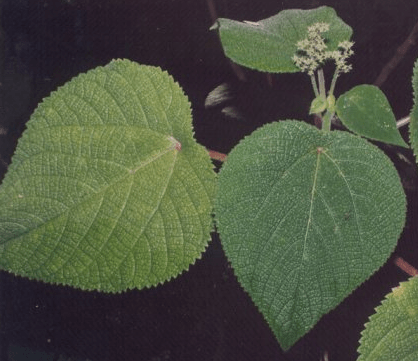
Stinging Tree

They are more popularly known as the Stinging Tree or Gympie Bush. Note the heart shaped leaves covered in fine hairs. This illustration was shamelessly filched from KrackersWorld. The plant is a pioneer that loves to grow in disturbed places such as alongside tracks. Small plants are as unpleasant as the larger ones maybe more so.

The pain was immediate, intense and persistent. Within half an hour the lymph nodes in my armpit were sore and swollen. The pain overnight prevented much in the way of sleep. Charlie was most apologetic … initially. This soon gave way to war stories about the numerous occasions on which he had been stung and what I could look forward to because this is no passing inconvenience. For any where up to 18 months hot, cold, getting wet or knocking the affected part causes pain. It is now five weeks since that momentary contact. The flow of cold air over my hand on the steering wheel is enough to cause severe pain.

Interestingly, although the pain is reminiscent of a burn there is no visible injury to the tissues.

Back at camp Charlie poured vinegar over my hand. This was as good an approximation of the recommended treatment as we could manage. Better would have been the application of a solution of 10-15% hydrochloric acid in water, followed by waxing the area to remove the stinging hairs.

If you’re heading to this region it is well worth knowing what these plants look like. They are often quite insect eaten when they look like <this>. The Cape Tribulation Research Station page is an excellent source of further information. Kids are particularly vulnerable. Long pants, closed shoes and dire warnings about wandering off the track are all useful preventative measures.

The following day it was Lewis’s turn to give up his time. He took us birding and then we switched our attention to a very special mammal. Both the brothers have an encyclopedic knowledge of the natural world around them. Their conversation is peppered with the scientific names of the plants, frogs, birds and lizards. They know every bird call, when each plant will flower and what will visit them when they do. After showing us a goodly collection of Honeyeaters and calling up a Barking Owl we set off in search of Bennett’s Tree Kangaroo. It took some finding but we got it. We had about an hour of hard going over steep and trackless terrain in hot weather. Then we had to retrace our steps. On the way there I was buoyed by the chase, on the way back all I could think of was a long cool drink. Unlike the Lumholz Tree Kangaroo on Mount Hypipamee this guy did not present himself in the open for a photo session, but just to prove it was really there …

Bennett's T K

Honest, look carefully, it’s right in the middle.

Silent Night …

I shall resume my adventures with Lewis and Charlie in the next post. Let me first jump forward to the present. I am in Melbourne for a few days of rehearsals and a Christmas gig on Sunday. Last year was its first at this particular time and place. We had an audience of about 7000. We hope this year it will not be so disappointingly small.

The music teacher to whom I owe the greatest debt was the wonderful Nancy Ovenden. She abandoned her studies at the Melbourne Conservatorium to turn pro and earned her living as a musician and a teacher until she died at 80. She had played everything from Ballet to jazz and she’d taught everything from wonderful musicians to me. And she had to pick me up and put me back together any number of times.

Nancy was never guilty of assuming that everyone shared her opinions. One day she very delicately skipped around the subject of religious music. I think it came as a great relief to her that we shared the same opinion, there is no god but he, or perhaps she, commissioned some amazing music. Before she died she gave me her copy of the score of Bach’s Mass in B minor.

The music for this particular concert was given out last night. This is one of my parts …

Utterly silent

There ain’t nothin more silent than that. I shall play it faultlessly.

I hasten to assure everyone that I get to play quite a lot more in the rest of the show. And here is a Christmas gift to show how beautiful religious music can be.


The Bloomfield Track …

We left Sauce Worcester at the Daintree Village jetty with smiles on our faces and retraced our tyre prints to the Daintree Ferry. The next leg of our journey would be on the notorious Bloomfield Track.

Bloomfield Track

The ferry is a cable barge affair that takes a maximum of 27 vehicles, the wait generally takes longer than the crossing especially in the high tourist season. A two way crossing currently costs $25 for a car.

It wasn’t particularly busy when we reached the pay box. The not at all unattractive and possibly a little bored lady on duty gave us a cold reading.

“G’day”, said  the ticket psychic casting her eye over the Prado and camper trailer armour-plated with mud from the Paluma range.

“Hi”,

“You’ll be wanting a one way ticket … ?”

“Yes please …” and I was about to ask how the track was holding up,

“Yeah, no” she said, “You guys’ll have no trouble”.

Across the ferry you run straight into the perfect collision of rainforest with commercial reality, a tropical paradise subdivided into 5 acre blocks … but you can buy great ice-cream. Drive carefully Cassowaries have little road sense. All of this is soon behind you. From Cape Tribulation on it’s the real deal.

The Bloomfield Track was bulldozed through the rainforest in 1984 against fierce opposition from the conservation lobby. The state government were on a mission to develop the local economy. As is typical of the way we do things here in Oz the federal government followed up by nominating the area for world heritage listing. This was achieved against fierce opposition from the state government, logging is now forbidden.

Now, on a good day, you can drive your 4WD from Daintree to Cooktown in a leisurely few hours. Your alternative is the far longer inland route via Mt. Molloy and Lakeland on the sealed Mulligan Highway. On a bad day you can get stuck, check road conditions at the link in the paragraph above before setting out.

The first tourist to get into a scrape at Cape Tribulation was Jimmy Cook on June 10th 1770. The nearby Endeavour Reef is named after his ship, the Cape is named to reflect his appreciation of the pristine wilderness.

A Google search for the track will leave the uninitiated totally confused. Should you drive it or not. Take courage, my friend, do it. What could possibly go wrong?

It crosses the Donovan and Cowie ranges and is steep in places. Most of the significant river crossings now have bridges but your tyres will get wet, they will cope. If the track is open and your vehicle is 4WD you’ll wonder what the fuss was about and if you get stuck stay with the vehicle there’ll be someone along soon. Tell them that I said they would help you.

Quite where we would stay at the other end of the track had not been determined in advance. But we had a strategy. Our first stop would be the Lion’s Den, we didn’t take the dog.

Lions Den

No Dogs

As a student the biologist you see walking a reasonably straight line out of the hotel took a vacation job at a tourist lodge a little north of here on Cape York. When it finished the young man was introduced to some folks in Cooktown with similar interests in the natural world. The introduction was nice and formal … “Tell them Joe sent you”. So he did, it was the start of a chain of similar introductions. Ultimately he found himself being delivered by the mail lady to a farm at Shipton’s Flat. No one knew he was coming or who he was. Brothers Lewis and Charlie made him welcome, gave him a place to stay and fed him. They took time out from the daily grind to show him around and when the mail lady came the following week he bade farewell.

The farm is off grid, the exact address forgotten, the phone number lost. Only one thing to do, head for the pub. The barmaids were extremely good looking and were dressed very appropriately for the tropics. The guy on the stool next to us had the remarkable knack of ordering a drink that had to be retrieved from beneath the bar immediately in front of us and was from the property right next to Lewis and Charlie. Such blessings, beer, cleavage, information.

When we got to the farm we were made welcome. Mark reminded them of the circumstances of his previous visit but they had made a much greater impression on him than he had on them. They did remember the mail lady who it seems had moved to the remote south some years before, the remote south being anywhere further than Cairns. We were invited into the house for tea and biscuits. It was a typical Queenslander house, raised on stilts to catch the breeze. It was built of rainforest timber that would now cost a king’s ransom. No internet, no air conditioning, in fact no electricity, they used bottled gas to cook and run the refrigerator. On the wall was a beautiful photograph of a stream running through a rainforest. Mark had taken the photo on the Bloomfield Track and sent it to them to thank them for their hospitality.


Daintree River …

One of my favorite memories from previous trips to the wet tropics is birding with Chris Dahlberg. On seeing some interesting bird he would say “Come with me …”, and of course we would, we were after all confined to a small boat. Chris has moved on to another phase of his life but one can still take an early morning cruise on the Daintree River with Sauce Worcester at the helm.

It is essential to book in advance, cruises leave from the jetty right in the Daintree village. In theory cruises last for two hours but Mr Worcester is very generous with his time. He takes you up stream and down and pokes around in the little creeks. Some much sought-after birds like Little Kingfisher, Black Bittern and Great-billed Heron are quite often seen on the cruise and Sauce is pretty good at getting you in the right place for a photo. You will finish the trip with a good list.

Here is a Black Butcherbird, not radiantly attractive to look at and of less than endearing manners, it is an aggressive nest predator, but it does have a lovely voice.

Black Butcherbird

The Azure Kingfisher, on the other hand has better manners and is delightful to look at. Its voice is a rather depressing and monotonous kek …

Azure Kingfisher

And this guy is rarely heard and something of a struggle to see …

 Papuan Frogmouth

It’s in there somewhere. It is a Papuan Frogmouth, they feed at night. Unlike owls their feet are weak, they capture prey ranging from large insects to small mammals by seizing them in their beaks. During the day they do a very good impersonation of a branch. This one is sitting on a nest, a flimsy construction of sticks. It’s the male that sits during the day, the sexes alternate at night.

One often sees some very impressive crocodiles on the cruise but November is not a good time for them. It is mating season, none are sitting out lazing the day away, the large males are patrolling their territories and everything else is hiding from them.

Parting of the ways …

We greeted the new day with heavy hearts, the lovely Gayle would be leaving us today.

Bird watching would not be totally neglected but our most important tasks today would be to get her to the airport on time and to resupply for the next leg of the trip. An early morning stroll in the Barron Gorge National Park was more sombre than usual.

Between us and Cairns Airport was the Cattana Wetlands and there was just enough time to do them justice. From Speewah it is a fairly steep descent to the coastal strip at Smithfield  just north of Cairns. Right at the roundabout then left at the next one takes you towards Yorkeys Knob. Third road on the left is Dunne Road and will take you to the gate, avoid the temptation to take Cattana Road it will not take you to the gate.

There are a number of ponds, a boardwalk, picnic facilities and even a bird hide or two. It’s not been open to the public for very long but the recently planted trees are big enough now to give a reasonably natural feel to the place.

A male Green Pygmy Goose was reasonably approachable …

Green Pygmy Goose

as was this even more attractive Comb-crested Jacana …

Comb-crested Jacana

We disturbed a Lace Monitor along one of the tracks which promptly ran up a tree. They always head for the other side of the trunk, you can sometimes get a photo by staying still and having a companion go around to the other side although by the time you’ve done that it may be way up high …

Lace Monitor

… and while you’re looking in the trees, look out for these …

Ant Plant

They are Myrmecophytes or Ant Plants. There is quite a diverse array of them, this particular type, in the family Rubiacaea, provides a dwelling place in that bulbous base that ants inhabit. The technical term for such structures is domatia. In return the ants keep leaf eating insects away. You can see from the photo that these are growing on another tree and have rather palatial domatial swellings. They are  therefore tuberous epiphytic rubiaceous myrmecophytes, any of which might come in handy at your next trivia night.

By the time I’d finished explaining all this to Gayle she was quite ready to hop on the plane.

And so to the Smithfield Shopping Mall to resupply … at Dan Murphy’s bottle shop.

Tableland …

Our second day on the Atherton Tableland and a lot of ground to cover.

First stop was Lake Barrine where we walked the circuit. Then a short drive to Lake Eacham where once again we walked the circuit.

These are both volcanic maars, that is they were formed by the explosion that occurred when ground water was rapidly heated by volcanic eruptions. The resulting craters both contain lakes that are at least 65 metres deep. The circuit of Lake Barrine is 5 kilometres, there is a private tea house on the shore from where you can take a cruise on the lake. Lake Eacham is a little smaller, 3 kilometres in circumference. The walking tracks are well constructed and take you through a rainforest fringe which is rich in bird life. In fact, between these two lakes and Hypipamee which we had visited the day before you can find all of the higher altitude wet tropics endemics which are … Tooth-billed Bowerbird, Golden Bowerbird, Bridled Honeyeater, Fernwren, Atherton Scrubwren, Mountain Thornbill, Grey-headed Robin, Chowchilla and Bower’s Shrike-thrush.

The Atherton Scrubwren and Bower’s Shrike-thrush are the ones that will give you the most trouble, Grey-headed Robins will have to be fought off, they are numerous and confiding …

Grey-headed Robin

You are almost certain to encounter Musky Rat-Kangaroos, the smallest of the kangaroos. You may confirm the diagnosis by counting their toes, they are the only kangaroos with five. If you’re lucky you may also catch up with a Green Ringtail possum …

Green Ringtail

They are on the menu for Amethystine Pythons. This one has chosen a vine to sleep on, the approach of a python would be easily detected and escape may be made in either of two directions. They are, of course, rather more exciting at night.

By the time we had finished our walks we had completed our collection of the upland endemics and were ready to go for lunch. I can think of no better place than Coffee Works in Mareeba. As well as a splendid restaurant they can also sell you locally grown coffee and many other surprising things. On our way there we encountered a large mixed flock of Brolga and Sarus Cranes. These are quite similar to look at, basically they are tall and grey with a little red decoration around the head. The practised eye will distinguish them immediately by the extent of the red, on the Brolga this is like a bandage going around its head, on the Sarus Crane it is rather more like a hood extending down the neck. Both the bandage and the hood have a hole in as though for the ears. The adult Brolga has a little dewlap the Sarus Crane does not. The Brolga is an inhabitant of northern and eastern Australia and nearby parts of New Guinea but the Sarus Crane ranges across southern Asia to India. It was first recorded in Oz in the 1950’s. So the big question is, did it find its way here around about then or had it been overlooked? According to one authority (Schodde) the Australian birds are sufficiently different to be considered a separate subspecies implying that they had been long overlooked.

As the day warms up so the bird watching cools off, the middle of the day is not the time to go looking for Rock Wallabies either. Eastern Queensland is home to nine species of Rock Wallaby, their ranges form a chain that runs from Cape York to the New South Wales Border. They are mostly indistinguishable in the field and hard to find. However if you know where you are you can make a good guess at which one you’re looking at with the aid of a map, for anything more definite than that you will need a sample of their DNA. But there is one that you can find and identify with ease.

A mere $10 will buy you admission to Granite Gorge Nature Park just 10 kilometres from Coffee Works and an extra dollar will buy a bag of wallaby food. A short briefing will get you ready to navigate the gorge and remind you not to break a leg and off you go. The wallabies are as pleased to see you as you are to see them …

Mareeba Rock Wallaby

We stroked one or two before tearing ourselves away and heading towards Cairns. On the way we set up our camp at Speewah then spent the late afternoon birding along Black Mountain Road, Kuranda. Here we were able to add Barred Cuckoo-shrike to the species list.

Back at Speewah, after dark, we spotlighted along the upper trails of the Barron Gorge National Park. The falling bomb call of the Sooty Owl could be heard clearly but we were unable to get a look at it. Nor was it inclined to come and see what was making, to my ears at least, an excellent copy of its call. Perhaps it was classically trained and not interested in a jazz musician’s interpretation.


Atherton Tableland …

An early start from Etty Beach and we were soon on our way up onto the tableland. This is the premier bird watching destination in Australia but one the party had visited quite a few times before. We had allowed ourselves two days here and we intended to wring the absolute maximum out of our stay.

We drove up via South Johnstone and Millaa Millaa and made our first birding stop at Hypipamee National Park. We were quickly rewarded with Fernwren and Mountain Thornbill but after that birds were fairly slow to surrender and some of the regular suspects didn’t turn up at all. But if we were surprised at that we were even more surprised by Mark’s discovery of a Lumholtz Tree Kangaroo wide awake in the mid morning …


L T K

Our destination for the night was Malanda, specifically chosen so that we could spotlight for this extraordinary creature, the best way to find this always elusive animal. They feed on leaves of rainforest trees in which they are agile and competent climbers aided by impressive claws and the ability to use their hind legs independently. When they come to the ground they bound along in the same fashion as other kangaroos. Generally they spend the daylight hours curled up in dense foliage sound asleep.

Hypipamee is also called The Crater in honour of its striking geological feature, a diatreme created, so they say, when gas exploded beneath a granite surface layer blasting a pipe to the surface. The pipe is 70 metres in diameter and contains a lake. It is 58 metres from rim to the water level and the water is another 70 metres deep. It would appear from the viewing platform that visitors have made a significant effort to fill it in with thrown objects. If it weren’t for the 400 metre walk from the carpark it would now be full of fridges, TVs and old mattresses. The walls are shear but somehow a population of Saw-shell Turtles has made its home there. I suspect though that their descendants will not be making any contribution to the wider gene pool.

From there we made our way up Highway 1 towards Atherton. The next stop was the Wongabel Forest walk. Much of the tableland would have been forest but most has been cleared for agriculture. For some inexplicable reason the patch that the walk is in was reforested. It must have seemed a quite revolutionary idea at the time. Many of the trees are labelled, it makes for a very pleasant and informative walk.

A complete contrast awaited us at Hastie’s Swamp where we quickly notched up a list of water birds along with a few migratory waders. We had lunch there. A majestic White-bellied Sea Eagle also dropped by for lunch causing considerable unrest among the residents. From there to Malanda we looked out for Brolga and Sarus Cranes, there are often quite large flocks to be seen in the surrounding fields but on that occasion we were not successful.

For a commercial caravan site Malanda is a very pleasant place to camp. There is plenty of room and easy walking access to the Johnstone River and the Malanda Falls Conservation Park. There is a new and rather splendid visitor centre in the conservation park. We took tea in the company of Red-legged Pademelons and two of Australia’s Megapodes, the Brush Turkey and the Orange-footed Scrubfowl. These are mound building birds. They lay their eggs in their mound where the vegetable matter they have incorporated composts providing all the necessary heat for incubation. The youngsters hatch, dig their way out and are immediately able to fend for themselves.