Bigfoot …

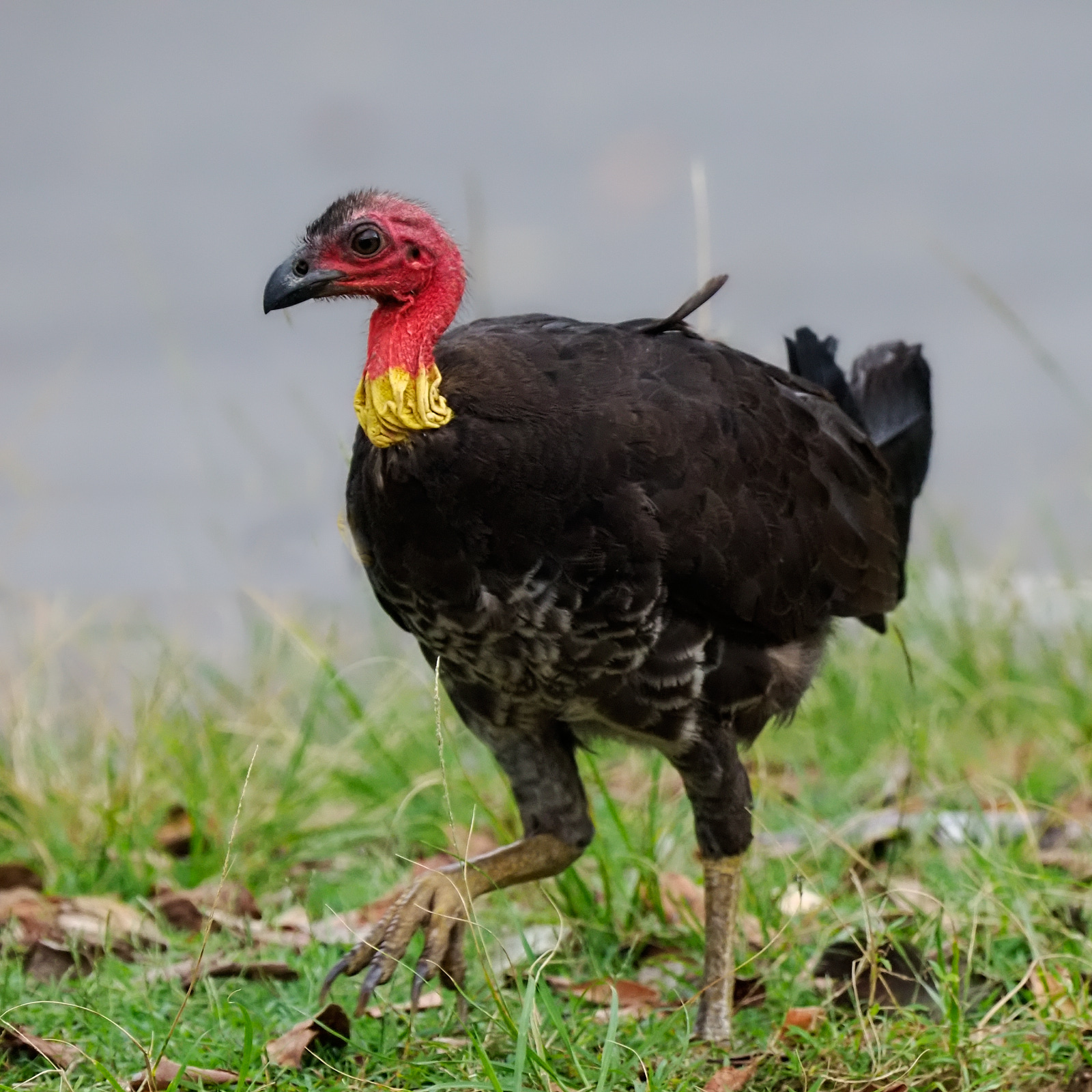
At Byron Bay we found our first Brushturkeys of the trip. They are found in rain forest of Australia’s east coast. They have large strong feet which they use to rake the leaf litter to find their food. Along with the Junglefowl and the Malleefowl they make up the Australian contingent of megapodes.

Megapodes have a very specialised mode of reproduction. The male megapode uses his big feet to create and maintain a mound which includes enough composting leaves to create heat. The females visit and once the eggs are fertilised they are laid in an excavated hole in the mound which then provides all the heat needed for incubation.

When the chicks hatch they have to dig their way out. They emerge into the domain of a father who wants nothing more to do with them and is very jealous of his territory. They must find shelter from him and from predators. Fortunately they can already fly and feed themselves. Henceforth they are on their own.

When the boys grow up they must either inherit or create a mound of their own. If they choose your back yard the petunias are in big trouble.

The road trip has moved up the coast to Brisbane.

Dog Farts …

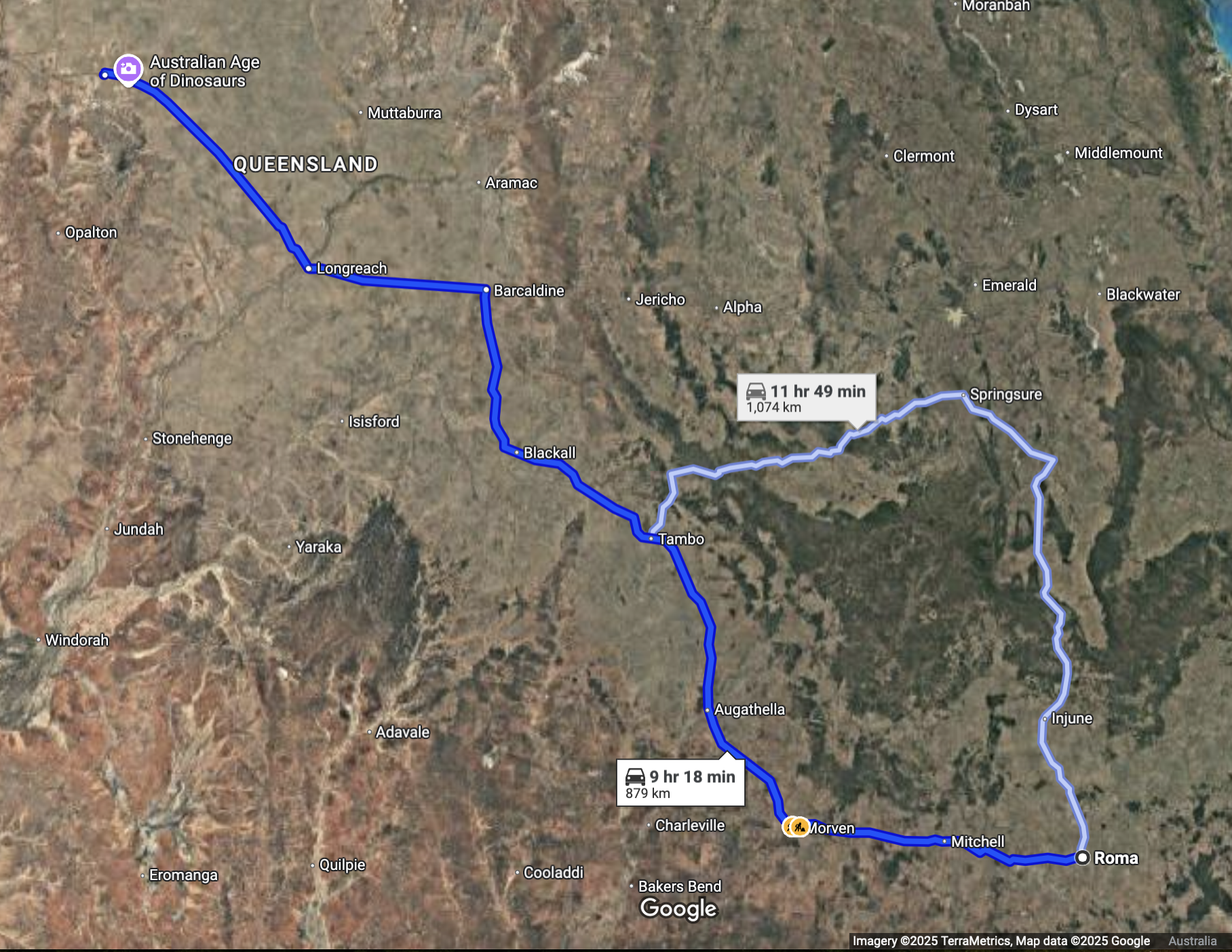
Roma to Byron Bay – 618km.

Fifi McGee is a Fox Terrier. She is 15 years old and she has been with us for about 13 of those. No, we did not choose the name. She is blind in one eye and partially sighted in the other, she struggles to determine how far away things are. She is totally deaf, you could let a bomb off next to her and she wouldn’t notice. On the positive side she is no longer bothered by thunder, there is little downside – she never did take any notice of verbal commands.

She is a very widely traveled little dog and a good camper. There is one problem though. After a few days on the road she starts to fart. There is nothing more potent than a dog fart in a closed car. Shame it doesn’t kill flies.

The Roma dawn chorus this morning was dominated by the Laughing Kookaburra. There are two kookaburra species in Oz. Across the top end we have the Blue-winged Kookaburra which winds up ready for a laugh but just can’t finish the job. I feel quite sorry for it. The Laughing Kookaburra is an east coast bird, (also introduced to the Perth region of Western Australia). They overlap in coastal Queensland from Brisbane northwards. An English survivalist, Ray Mears, made a film about survival in the Top End. The soundtrack features a Laughing Kookaburra that isn’t found there. What would a pom know about survival in Australia? Loony.

The Roma Bush Gardens are mainly the work of local volunteers over a quarter of a century. They have done a magnificent job. It is a great place to find a good mix of bush and water birds. Bird of the day is awarded to Plum-headed Finch.

And we crossed another border. Byron Bay is in New South Wales. Clocks forward one hour because NSW has Daylight Saving Time through the summer.

Contingency …

Winton to Roma – 880km

Things have gone very well for us so far. Behind us the route is open but extreme caution is called for because of flooding at the Fitzroy and Victoria Rivers. We have friends stranded in Geraldton trying to get home to Broome. Not only have they been held up for a few days they had to swelter through 49.3°C (120.7°F).

We were well aware of the risk of flooding. Our contingency plan was to give ourselves plenty of time to wait out a road closure or two if need be. Our contingency plan for arriving early is to impose on, sorry I mean catch up with, some dear friends rather than spend a week sitting outside our tent. Tomorrow’s destination is Byron Bay.

On the birding side of things we have been adding a bunch of species to the trip list. As we fueled up this morning we saw our first House Sparrows for nearly a year. Broome is virtually devoid of introduced species. We added more plastics (twitcher speak for introduced species) at Roma as well as some attractive natives like Pale-headed Rosella and Rainbow Lorikeet.

Presently I am sitting outside the tent, the evening is mild, the sky is clear. I am well fed. Life is bloody great.

Queensland …

Barkly Homestead, NT to Winton, Qld – 918km.

A fine morning, the sky is blue with just a few small fluffy cumulus clouds. Sped across the Barkly Tablelands. I have never seen it so green.

Across the border, new state new time zone, clocks forward half an hour. Increasing cumulus. A quick pause at the Georgina River which in a wet year will send its water all the way to Lake Eyre and close the road for extended periods. Through Camooweal and on to Mt Isa for lunch. Mt Isa has a population of about 17,000. We have traveled 2,840km since leaving Broome (population 15,000), Katherine the largest town in between at fewer than 6,000 people. Broome has no traffic lights Mt. Isa has a fetish for them. Cumulus coalescing and beginning to tower.

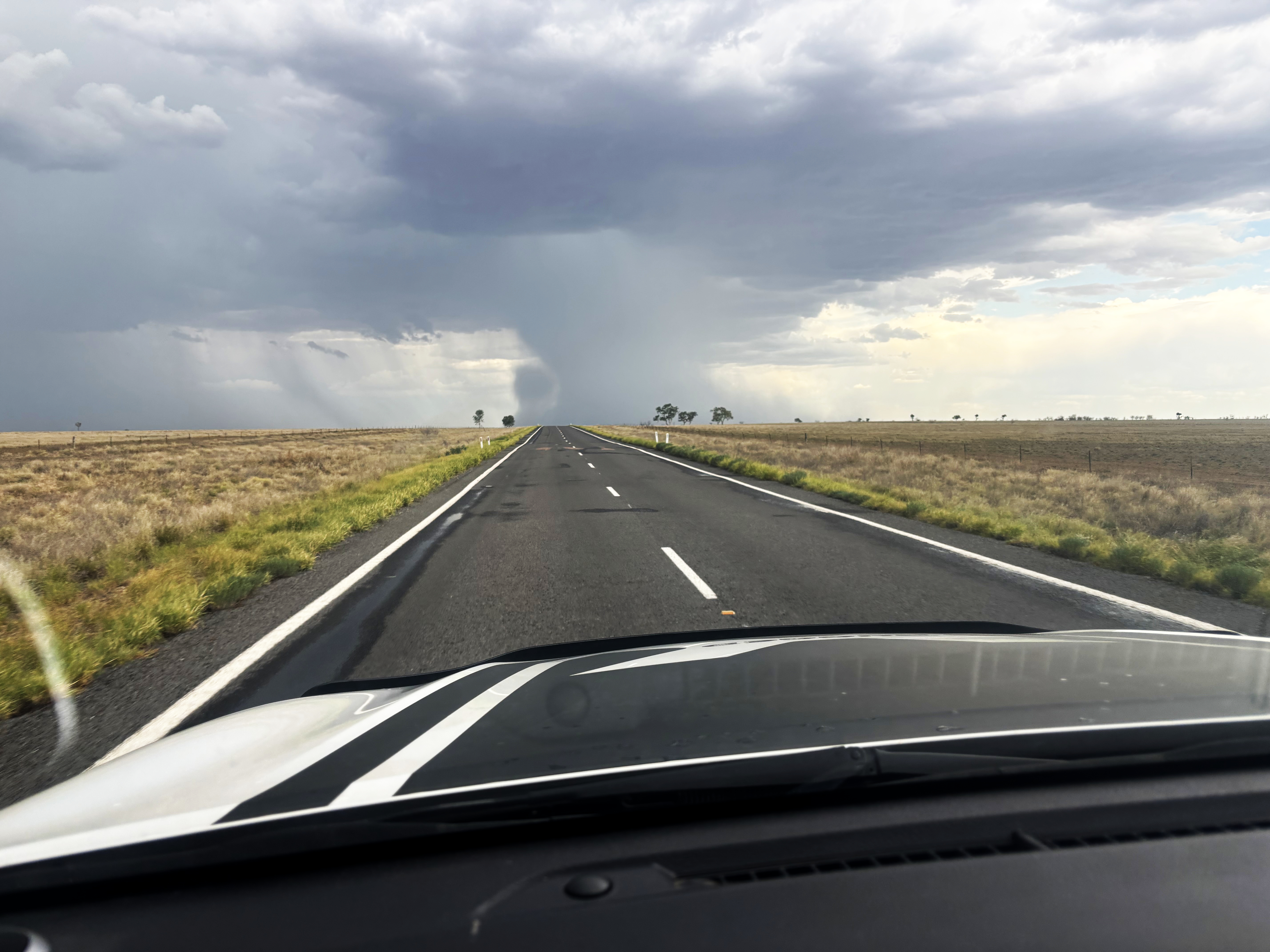
It was about 4pm that the inevitable thunderstorm hit. We saw it coming …

We couldn’t see much at all when it hit. The storm followed us to Winton …

Sugar and Bananas …

I have a friend whose mother used to send her to school with garlic sandwiches for lunch. For me it could be banana mashed onto bread, sprinkled with sugar and covered with another slice of bread. By lunch time it was slightly liquid and somewhat brown but still better than garlic. Bread and jam, cheese and pickle, gee they were the days.

Sugar cane is a grass. It can be grown from seed but commercially it is grown from cuttings. It takes 12 to 16 months to reach 2 to 4 meters tall before being harvested between June and December. Two or three harvests are taken from a stand before replanting. It requires plenty of rainfall and will not tolerate frost.

When the harvest is in full swing in Queensland narrow gauge railway trains ferry the cane to the mills frequently crossing the roads keeping drivers on their toes. The traffic may well be traveling slower already because of more cane being moved by tractors and trucks.

The cane goes into the mill. Sugar comes out. Bags of mulch also come out. These are shipped to Victoria where we put it on our gardens. Does anything else come out?

Sugar Mill, Tully, Qld.

Banana is not a grass nor is it a tree. It is a large flowering herb. The banana fruit is technically a berry but these days berries without seeds. The wild bananas that the modern varieties hail from had large seeds that tended to break teeth.

After planting it takes 12 to 18 months to produce a bunch of 150 to 200 bananas. After harvesting the trunk (stem) of the plant is cut through at about head height. The standing part nourishes new sucker plants that go on to produce the next crop.

Within the plantation different plants are producing bunches at different times. The forming bunch is bagged to protect the fruit. The bags are usually colour coded to simplify harvesting fully formed but still green bunches. These are broken into hands, packed and shipped at 14-16°C. Mothers then mash them and sprinkle on some sugar.

photo shamelessly filched from https://australianbananas.com.au/Pages/all-about-bananas/production

I am a long way behind in this account of my travels partly because of poor internet access. This will only get worse as I disappear into the red centre. I will post again when I can.

Thallon …

If you turn right out of Nindigully on National route 46 Thallon is less than 34km away. You’ll know when you’re close …

Thallon silos, Qld.

The silos face east, so morning is a good time to photograph them. You can see from the long shadows that I’d made an early start.

This work really is a splendid piece. The artists were Travis Vinson and Joel Fergie who took inspiration from the work of three local photographers and discussions with local people.

Thallon silos

The scar tree and view of the Moonie River is based on a photographs by Lila Brosnan, the Pale-headed Rosellas on a photograph by Gary Petrie and the sheep Chantel McAlister.

detail – Pale-headed Rosellas after Gary Petrie

detail – after a photo by Chantel McAlister

The silos are very much in use and Grain Corp would be grateful if you stayed in the designated viewing area so as not to be flattened by a truck.

Camping is available at the site and is of a very acceptable standard. The Moonie River is not far away and apparently there is a very large wombat in the park in town.

Nindigully …

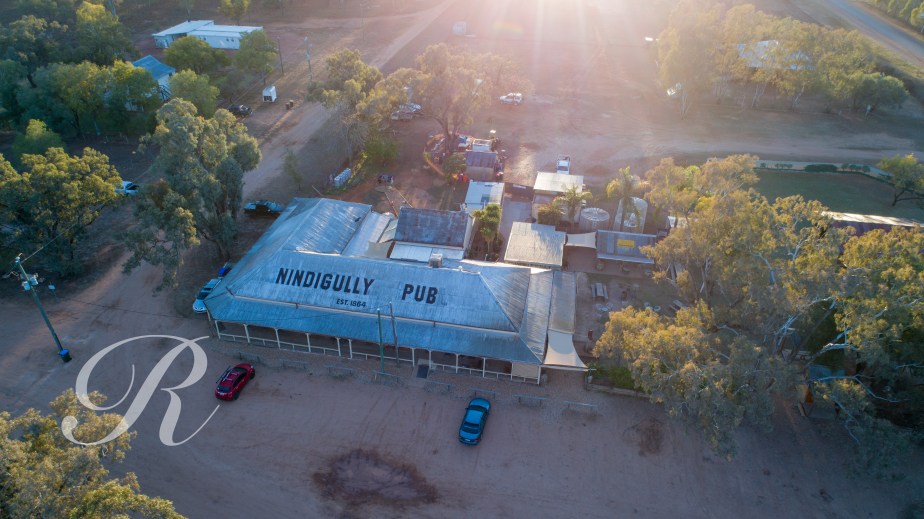
There are some outback pubs with a lot of charm. Queensland holds three of my absolute favorites, the Royal Mail at Hungerford, The Lions Den at Helenvale north of the Daintree and the Noccundra Hotel not far from Nockatunga. Now I have to add a fourth the Nindigully Hotel.

Set on the banks of the Moonie River the Nindigully Hotel has held its licence since 1864 and is said to be the oldest continuously licensed pub in the state. Between the late 19th century and the early 20th century it was a Cobb & Co staging post. These days the adjacent town has a population of just six. The night I was there the restaurant was doing a roaring trade. When the diners and drinkers had finished most of them walked a few yards to their caravans, the camp site is right outside the door and it’s free. And in the daylight it’s a very pretty spot.

The fishing is reputed to be very good. Yellowbelly and Murray Cod are there for the catching. No licence is required.

Moonie River at Nindigully

Moonie River at Nindigully

The Races …

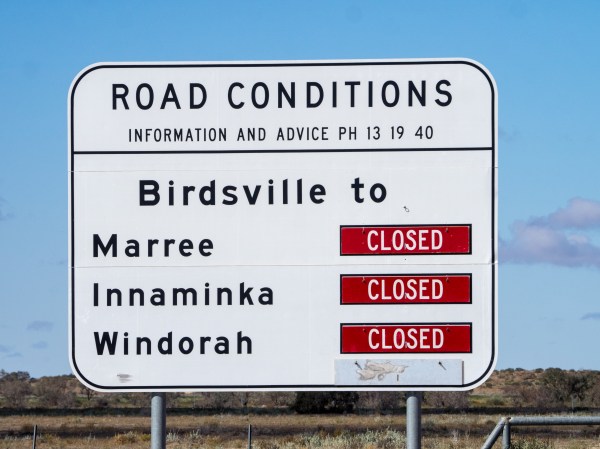
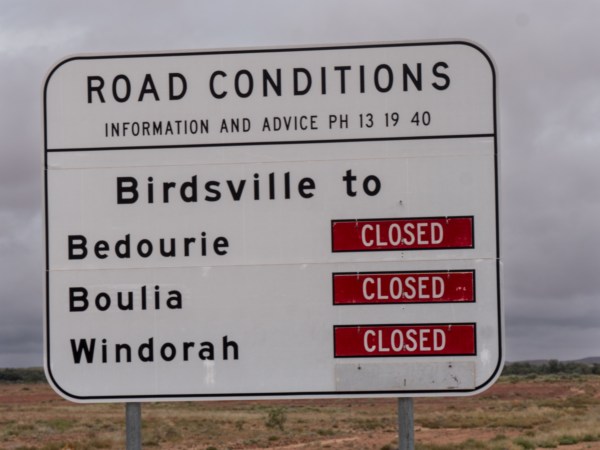
Birdsville, Queensland, has a population of about 100. The annual races are run in the first week of September. T’other day all roads were closed and the track was underwater. The camp grounds were a sea of mud, you grew taller as you walked about.

The weather forecast for …

Thursday 1 September

Summary
Min 14
Max 22
Rain.
Possible rainfall: 25 to 40 mm
Chance of any rain: 100%

Cloudy. Very high (near 100%) chance of rain. The chance of a thunderstorm. Heavy falls possible. Winds east to southeasterly 15 to 20 km/h turning southerly during the morning then tending northwest to northeasterly 25 to 40 km/h during the afternoon.

courtesy of the BoM on August 30th.

Tipped to win …

2a237cdfc47f71d73b58dc071a0acf7d


Birdsville …

Hot on the heels of the explorers came the settlers. The rangelands will carry sheep and cattle. The stocking rate is extremely low but there’s plenty of country. Rainfall is fickle, the good years can give rise to optimism that fries all too quickly in the dry years that follow.

Birdsville came into being as Diamantina Crossing in 1881. Its reason for existence was simple, before the foundation of the Commonwealth of Australia the individual colonies thought it necessary to protect their economies with tariffs. Birdsville is on a droving route used to take northern cattle to southern markets and located just north of the South Australia – Queensland border. It was there to collect taxes.

Tax collecting is thirsty work. It had three hotels and a cordial factory. The population in 1900 was over 300. Its role as a tax collector ceased at Federation in 1901. It was downhill after that, at least for a while.

Not far to the west in the Simpson Desert is Sturt’s furthest north, reached in September 1845 …

We had penetrated to a point at which water and feed had both failed … The spinifex was close and matted, and the horses were obliged to lift their feet straight up to avoid its sharp points. From the summit of a sandy undulation close upon our right, we saw that the ridges extended northwards in parallel lines beyond the range of vision, and appeared as if interminable. To the eastward and westward they succeeded each other like the waves of the sea. The sand was of a deep red colour, and a bright narrow line of it marked the top of each ridge, amidst the sickly pink and glaucous coloured vegetation around.

After Sturt it was the turn of the surveyors.  Augustus Poeppel marked the point where Queensland, South Australia and New South Wales meet. He was in error by 300 metres. The error was corrected four years later by Larry Wells. Then in 1886 David Lindsay penetrated deep into the desert from the west.

To that point no european had gone in one side and come out the other. Ted Colson put that right in May 1936. He set out from his cattle station on the west of the desert with an aboriginal companion, Peter Ains, and five camels, followed the 26th parallel to Birdsville, had a beer in the pub and four days later turned around and crossed the desert again.

Cecil Madigan came next leading a scientific expedition, again on camels but by a more northerly route.

Nowadays the explorers come by 4WD. The first to cross the Simpson by car was Reg Sprigg with the wife and kids. It was September 1962. Since then Birdsville’s fortunes have improved. Thousands come for the races, the bold drive up via the Birdsville Track, the intrepid come across the Simpson. We all make a point of stopping here …

Birdsville Hotel