And the winner is …

I happened upon an interesting video which reminded me of an incident in my own illustrious career. First the video …

In the hope of a holiday in hospital for a change of scenery and routine prisoners will occasionally harm themselves … in a calculated way . When I was a resident a prisoner was admitted who on x-ray had knife, fork and spoon plus a couple of coins making their way through his alimentary canal. He was otherwise well and in no discomfort.

This being Australia a sweepstake was immediately commenced among the hospital staff. Our money went into the kitty. I drew a blank so no chance of winning. Those fortunate enough to draw an object waited to see what would emerge first.

To everyone’s surprise it was a toothbrush that hadn’t been picked up on x-ray. It was followed by the coins and cutlery. No active treatment was required.

Everested …

It was a warm one yesterday. Late in the winter that can only mean one thing – a north wind, and to make sure we noticed it blew up a gale last evening. Not too much of a mess this time.

Today the weather is perfect, cool, sunny and just a light wind. Ideal for a ride with my very own Gayle at the end of which I checked in with Strava to find that I’d climbed 8,750 meters for the month. If I really was climbing Mt. Everest I’d be at the South Summit. That is very definitely in the death zone, no place to linger. So I got back on the bike and rode off to my favorite hill.

The Cornice Traverse is a knife-edge. On my left there is a drop of 2,400 m down the north-west face, to the right 3,050 m down the Kangshung Face. Getting the bike up the Hillary Step is a bugger of a job but …

It’s done, 8,848 m. It took me 21 rides over 27 days. The current record holder is Ronan McLaughlin. He did it in 1 ride of 7:04:41.

Devil’s Peak – North Face …

Early this month it looked like the state of Victoria was going to be sentenced to house arrest again. I quickly got in a long ride that I thought would be my last for a while.

There are only four reasons that we may leave home and whilst one of them is for exercise it seemed for a few days that we would all be restricted to one hour a day within five kilometers of home. That became the reality for the majority – those that live in the big smoke. Out in the sticks we were allowed greater freedom. We can exercise longer and go further.

The prospect of an hour a day got me thinking of how to avoid a crash in my fitness. I resolved to up the intensity making repeated use of a local hill. When all was clarified it still seemed a good time to chase the Strava Climbing Challenge of 7,500m in a month.

I wrote about the phenomenon of Everesting back in May. So this month has been a serial mini-Everesting. (In the interim the rest of the cycling world has moved on to Trenching – 11,034 meters, the depth of the Mariana Trench. Yes, in a day).

Since I wasn’t restricted to 5km I could make use of a better hill than the nearest one. There is a Strava segment not too far away called Devil’s Peak. It sounds more impressive than it is. The segment is on the south side. On the north side there is a steeper section 1.6km long and about 60m high. That section includes another Strava segment with the far less impressive name Dunolly-Avoca Road Climb. I prefer to think of it as The Devil’s Peak North Face. Real hills are a long way away.

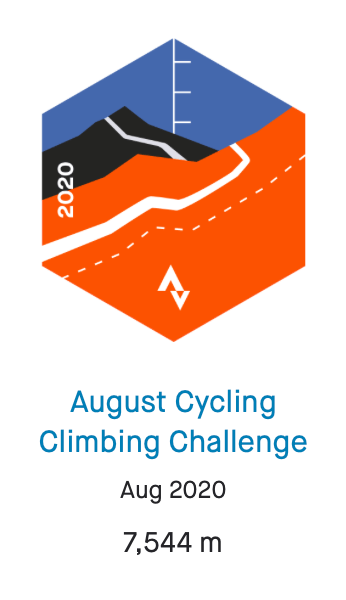
So up and down I went. It took seven visits to nail the Strava Climbing Challenge and get my merit badge …

with efforts that looked like this …


And with a week left in the month!

As of yesterday 398,811 people had taken the challenge. My position was 82,002nd. The leader is Lukas Rathgeber who had been out 22 times and notched up 79,028m. He’s in Switzerland. He has real mountains and I suspect extremely strong legs.

A recent Strava innovation is an award for the person who has completed the most runs through a segment in the last 90 days. That makes you the local Legend and you get a set of laurels. Given the population density here in the Goldfields it can take as few as one ride through a segment to become a local legend. Modesty almost prevents me from boasting no fewer than 43 sets of laurels. I have completed the Dunolly-Avoca Road Climb 80 times in the last 90 days, most of them in the last 20 – I think I should get freehold title rather than laurels.

By the way …

Of the dozens of comments that yesterday’s post elicited none make the point better than this one from Roy …

Yes, you must wear a helmet. In a recent bike accident when I hit the back of a 4WD I received a nasty gash around my left eye. My helmeted head put a significant dent in the metal above the tail light. The Emergency Dept staff put it simply. No helmet no Roy!!

The outside world is no place for your brain.

Readers outside Australia may also be wondering why we are attacked by Magpies when they never have that privilege. The answer to that is simple. Our Magpie isn’t really a Magpie at all.

The Australian Magpie (Gymnorhina tibicen) must have reminded the early settlers of their own Magpie which is not a close relative. It does seem a stretch but bear in mind they had been at sea for a long time.

This one is the original. It’s formal name in English is the Eurasian Magpie, scientifically Pica pica.

There are many other examples of birds that migrants have misnamed for similar looking species back home.

Wear That Helmet …

Personal protective equipment is big news presently.

Cyclists in Melbourne are presently restricted to an hour’s ride a day and no further than 5km from home. Traffic volumes are down but it seems that some drivers see this as an opportunity to drive faster than usual. Where I live cyclists are not quite so restricted but the  roads I ride are open highway – all the traffic is going fast.

It’s worth remembering that Kreisfeld & Harrison 2019 examined the injuries sustained by cyclists and found that about half of those that died did so because of head injuries. So wear that helmet.

Hang on, is that an endorsement? The figures are for Australia. Helmets are compulsory in Australia and compliance is high. Helmets didn’t do a lot for those that died but hey …

there are other good reasons.

Helmets provide excellent protection from Magpie attack. The bird in the video staunchly defends its stretch of road. Where most Magpies are content to swoop without making contact this one routinely hits you in the back of the head. They always attack from behind. I have seen a fox running flat out to escape the attention of a pair of these feisty birds.


AIHW: R Kreisfeld & JE Harrison 2019. Pedal cyclist deaths and hospitalisations, 1999–00 to 2015–16. Injury research and statistics series no. 123. Cat. no. INJCAT 203. Canberra: AIHW.

Plateau …

To recap very briefly … Old couch potato is enticed onto a bicycle and it reawakens something within that has been dormant for quite a few years and he likes it.

The regime goes something like this …

  • cycle 5 days a week – average 250 km/week in recent weeks.
  • weight training 2 days a week.
  • Diet – low carb high fat (keto) ovo-lacto-vegetarian, lunch and evening meal nuts in between (usually no breakfast). Protein supplementation to reach ~1.5g/kg of ideal weight.

No calories have been counted.

Too many progress reports would become boring but not enough could give the impression that I was trying to conceal a failure.

Initially, as always, the weight simply fell off …I weighed myself the day I bought the first bike. The diet started three weeks later. The dots represent every Monday since. Somehow I always seem to weigh more on Mondays than on other days, how does that work? If I changed days would that phenomenon follow me?

About five weeks ago the weight loss ground to a halt. 13 kg of ugly weight gone – a guillotine could not have done better (average weight of a human head is only 5kg). Along with it went more than four inches from my waist.

A successful diet is one where an overweight person intentionally loses more than 10% of their body weight – 11kg of 93 = 12% – and keeps it off for more than a year. The foundational study by Stunkard and McLaren-Hume 1959 found that of 100 obese individuals only 2 were in fact successful.

So this is the time to ponder a few important questions.

  • Why does weight loss stop?
  • What can be done to prevent a big bouncing relapse?

It takes a certain amount of food to maintain a particular weight in the presence of a certain amount of exercise. That’s simple enough but how much varies from person to person and even for one person at different weights. So consider firstly the unlikely case of someone eating the same number of Calories and doing exactly the same amount of work every day. Let’s assume that at the outset Calories in is less than Calories out – the stage is set for weight loss.

There are two forms of energy store in the body glycogen and fat. Glycogen is stored in the liver and muscles.  It is readily available energy, the first to go on a diet and it takes three times its weight of water with it. That’s the easy part. Once we get onto mobilising fat things slow down.

But progress goes on. As weight is lost the energy cost of the work done decreases and the size of the Calorie deficit decreases with it. Weight loss slows and will eventually stop.

In reality it stops well before the point that simple maths predicts for a number of reasons. Humans have not always existed in a world awash with food. We have evolved mechanisms that help us survive food shortages, endure periods of starvation. The recently emptied fat cells pump out lipoprotein lipase, which tells  the brain “hey, we’re starving”. Leptin, the hormone that tells us we have eaten a sufficiency, diminishes. Ghrelin, the hormone that makes your tummy grumble, increases. Peptide tyrosine-tyrosine and cholecystokinine increase. These things conspire to increase your appetite.

Meanwhile the resting metabolic rate goes down in response to reduced thyroid hormone (T3)  and reduced activity in the sympathetic nervous system. Levels of a group of proteins that uncouple metabolism from energy production (analogous to wasting petrol by revving the engine with the clutch disengaged) diminish. In the good times some excess energy was simply turned into heat now faced with a famine nothing is being wasted.

Yet more energy can be saved by reducing nonessential activity.

When the recently obese person is compared to a never obese person of the same weight and body composition their energy economy is quite different. All the differences are to the dieters’ disadvantage. Failure beckons and I’ve traveled that route before.

However, only 98% fail.

So far I’ve relied rather heavily on Exercise Physiology for Health, Fitness and Performance by Sharon Plowman and Denise Smith. The next section owes much to a paper by Wing and Phelan which can be found <HERE>.

They paint a picture that is less bleak, as many as 20% manage to keep the weight off, and they present some of the characteristics of those that do identifying six key strategies for long-term success at weight loss …

  1. engaging in high levels of physical activity;
  2. eating a diet that is low in calories and fat;
  3. eating breakfast;
  4.  self-monitoring weight on a regular basis;
  5. maintaining a consistent eating pattern; and
  6. catching “slips” before they turn into larger regains.

In addition those who initiated weight loss because of a medical trigger such as a relative having a heart attack were more likely to succeed.

Holidays and weekends are dangerous moments and those that maintain the same regime through these periods as they do the rest of the time do best. Once relapse is underway prospects are poor. Depression bodes ill.

I can put a tick against items 1, 4 and 5. Item 6 is really what item 4 is all about and hasn’t yet been put to the test. My most obvious vulnerability is relying on satiety to determine portion size.

But, oh dear, a low fat diet and eating breakfast are not on the agenda.

I have no doubt that these are common practices in those that succeed in long term weight maintenance but my conjecture is that these have not contributed to their success. Clearly these are remarkably self disciplined people. The discipline they have imposed on themselves is a very orthodox one. Dr John Harvey Kellogg told the world that breakfast is the most important meal of the day to the certain benefit of the food producers but there is no evidence that it is to the benefit of the rest of us. On the other hand there is some evidence in favour of intermittent fasting. I tend not to eat after 9pm and defer breakfast until noon giving my pancreas a 15 hour rest on the majority of days.

Fear of fat is another well entrenched orthodoxy. I’ve lost weight on a high fat diet. It defies logic that I can’t maintain weight on a high fat diet.

These two points are examples of well-person confounders – baggage that is carried along with useful characteristics that really do contribute to health.

Or at least I hope that’s the case!
They All Think They’re Churchill …

The daily dose of Dan and the other politicians is stirring stuff …

We will fight on the beaches, we will fight on the landing grounds, we will fight in the meatworks …

and there’s every chance we will fight in the supermarkets that are suddenly meat free zones. Thank goodness I’m a vego. And what is it about toilet paper?

Stage 4 restrictions for the majority of Victoria’s population Stage 3 for the rest of us. Almost no valid reason to let anyone into your house only four valid reasons to leave it. House arrest. There does still seem to be a social licence for these measures. The other day’s Herald-Sun had some snippets from half a dozen persons in the street all in favour. The tone crystalises into putting up with short term pain for long term gain.

There is emerging some disquiet and disobedience. The utter nutters are in the vanguard declaring Covid19 a hoax or blaming it on the 4G network. Just to make sure that they have no protection by way of civil rights Mr Andrews has declared a state of emergency giving the police supernatural powers, after all, these people are not Black Lives protesters or union members picketing a building site.

Following the Covidiots are the invincibles, mostly young with little to fear beyond the death of a grandmother here and there. They don’t believe that Covid will kill them. The government tells them it will but mostly that’s untrue.

The current strategy is to limit the spread of the virus by severely limiting the movement of people. I do believe it will work. I expect that in a couple of weeks case numbers will begin to come down quite quickly. But then what?

The population of Australia is 25 million people. As of yesterday there had been 18,318 cases of Coronavirus infection. That means that 99.94% of the population are naive to this virus. Unless there are no cases left in the community there will be a third wave once restrictions are lifted. If there are indeed no cases we will all be safe … until we open our borders.

Will there be social licence for stage 5 restrictions when the populace realises that this isn’t short term pain?

Hot Air …

Over the last few days I’ve estimated my VO2max by some of the many methods available to those unfortunate enough to lack a gas analyzer and cycle ergometer.

The first couple of methods don’t involve getting up out of your chair, the second is the simplest – the inputs are just your resting pulse and your age. The next two involve exercise. The inputs are your weight and active pulse or measured power.

The Rockport test doesn’t involve exercising at maximum capacity, at least not unless you are totally out of shape, therefore it is suitable for elderly gentlemen. The six minute power is meant to be a maximal effort.

It is interesting how close the results cluster together. Whether that is anywhere near a lab measured VO2max is an unknown.

Method

How

Link

VO2max

World Fitness

Questionaire

World Fitness

47

Resting Pulse

Take pulse

MDApp method 1

42

Rockport

Walk 1 mile fast

MDApp method 2

39

6 minute power

Cycle

Michael Konczer

40.6

VO2max peaks in young adults and then declines at about 1% a year. Young and middle aged men can halve the rate of decline by regular vigorous exercise but the rest of us are stuck with it. It is largely the consequence of a declining maximum heart rate. The second most important culprit is increasing body fat.

After 70 it’s supposed that VO2max drops off a cliff but the evidence is getting pretty thin at that stage. Clearly nobody told Giuseppe Marinoni who set the Hour Record in the men’s 80 to 84 category last year by cycling 39.004 km.

Great things are still possible.

Another Glass of Red …

Cheers.

It’s from 2017 grown and made in our own little slice of paradise.

We enjoyed another little sojourn in the bush. We live in splendid isolation and prefer to camp in splendid isolation. The only other human that we came close enough to talk to was at the fuel stop going and coming back and that is the one closest to home in any case.

How isolated is isolated? This is the map of a morning ride. It’s 13km from the bottom to the top of that red line so a swathe of country about 50km wide. There’s not a town or a named feature on it, one of the things I love about Australia.

Best bird in the couple of days was Gilbert’s Whistler and we came across this little guy …

We also came across the Shire of Hindmarsh Ranger, his job is to enforce the local laws …