From the sofa to the red zone to the sofa …
Hard to forgive someone who explodes your myths and can’t even pronounce laboratory.
Simply put, today’s session will do you no good if it keeps you from tomorrow’s.
and pray that there's intelligent life somewhere out in space
From the sofa to the red zone to the sofa …
Hard to forgive someone who explodes your myths and can’t even pronounce laboratory.
Simply put, today’s session will do you no good if it keeps you from tomorrow’s.
What is it that gets a reasonably sane old man and a slightly more sane and somewhat less old woman out of bed and onto their bikes? Lets leave aside, for the moment, full bladders and search deeper. There has been research.
The Sydney 2009 World Masters Games attracted 28,089 participants from 95 countries in 28 events making it the largest sporting competition to that date. Researchers asked them why they did it. You can read the paper <HERE>. 3928 of the athletes gave them answers, males and females being almost equally represented.
The numerous possible answers clustered into four broad responses
The highest ranked answer overall, ranked 1 among the girls and 3 among the boys was “to socialize with other participants”. One and two among the boys were “to become more physically fit” and “to improve my health” which also ranked well with the girls. Interestingly weight loss and weight control got mentions but did not rank highly. To compete with others was another non contender for chief motivator but was more popular with the boys than the girls.
The conclusion was that if you’re trying to promote sport to a mixed audience stress the social and health benefits, if a male audience then stress the health benefits. Either way lay off the weight issue.
So where do I sit on all that?
In my youth I tried many sports. When I discovered basketball I was addicted, I just loved doing it. I couldn’t imagine not doing it. I was fiercely competitive, sometimes embarrassingly so. Once that career was done why did I take up running for which I had no special talent and with no prospect of winning a race?
I would certainly have ticked “to become more physically fit” and “to improve my health”. I might have revealed my narcissism with a “to look better.” I would not have given a rat’s arse for “to socialize with other participants”. I was also very conscious in my running days of some spinoff benefits. I enjoyed hiking, skiing and horse riding. I wasn’t in a position to do those sufficiently often that they would keep me fit. Running meant that I was sufficiently fit to enjoy them when the opportunity arose.
Here I am three months into a third phase of sport training, the geriatric phase. My health is the main motivator. Weight is a huge part of that concern. If you ask a bunch of athletes in training if weight motivates them do not be surprised if it’s not a great concern. Most of them don’t have a weight problem. It’s quite a different story if you’re trying to get sedentary folk off their couches . I have a weight problem. You can motivate me with the prospect of weight control especially if it doesn’t involve going hungry.
And fitness, I want to enjoy the rest of my life. I want to be able to climb up from the beach to the car, walk up a hill for the view and lift the grandkids off their feet. There are still spinoffs.
The big day.
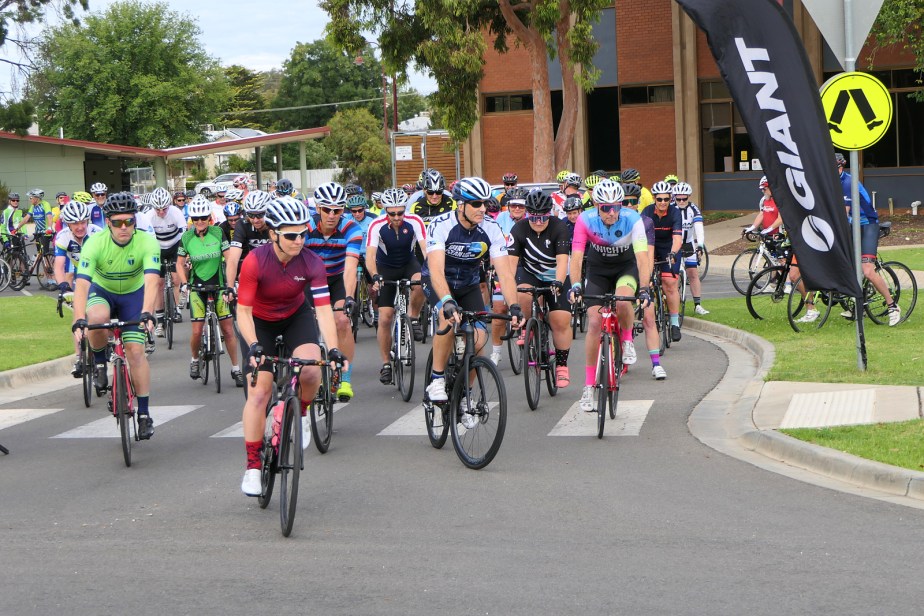
Most of these fit looking people are about to ride 108 km. I on the other hand will wimp it out with a mere 33.

That’s an average speed of 23.9 km/h – in line with expectations. Happy with that. The biggest climb is towards the end; fortunately there was still some gas in the tank.
It felt good to arrive back at the Maryborough Station and I’m sure it felt even better to the real heroes after 108 km …
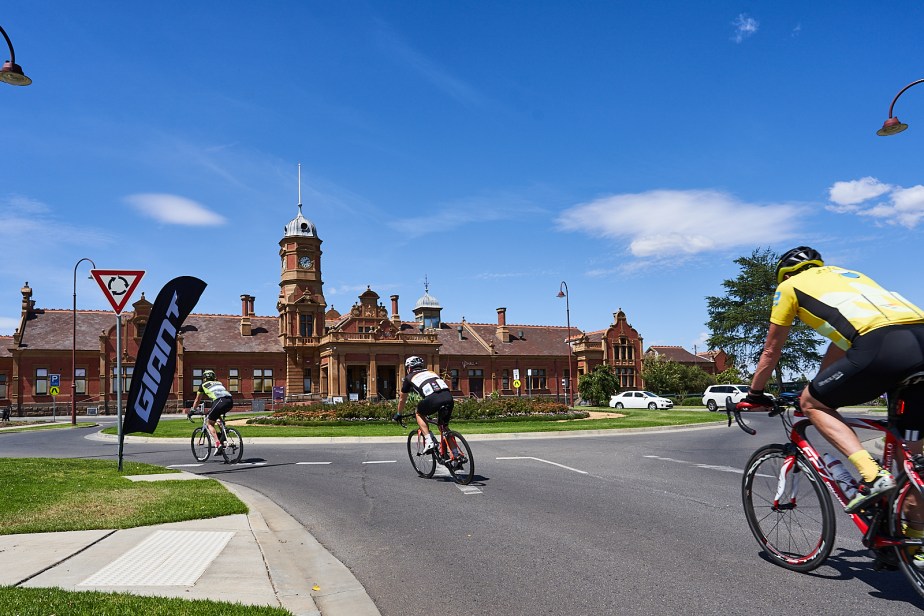
It is at least 25 years since I last entered an endurance event. As I recall it was a 42 km cross country ski race, the Kangaroo Hoppet at Falls Creek. I finished. It may have been 3000th, but I finished. I even had the cheek to sprint past some other poor bastard at the line condemning him to 3000 and 1st or so.
So now that I am a trained endurance athlete having completed three months of cycling about 20 km five times a week I am (or may be) ready for the R3R Charity Ride. It’s tomorrow and it’s not a race (not a race, not a race, not a race …)

The ride not race is organised by the Maryborough Rotary and sets off from the famous railway station. It is so impressive that Mark Twain described Maryborough as “A railway station with a town attached”. Unless, of course you believe the Twain scholars who tell us that he said no such thing. Even if he didn’t he should have.
If you want to join me you had better hurry up. Go <HERE>.
The route visits the three local reservoirs, hence the name, and the full journey is 108 km. However there is also an R2R – 73 km and an R1R – 33 km. I’ve signed up for the R1R. I know, pathetic.
But I will cut a dash. I am borrowing Gayle’s gloves. They will go on. It’s getting them off that’s the challenge but I’ll have all afternoon. I have invested in cycling shorts so that’s OK. The hi-vis work shirt tops the ensemble off, hopefully hiding the belly a little. Admittedly my fat wheels will put me at a disadvantage compared to road bikes. Nonetheless I do expect to be quicker than some grannies at least those accompanying very small children.
Wish me luck.
Who wouldn’t ride faster to catch the lovely Gayle?
I have a few days in the big smoke so a chance to find out why boys die faster than girls on bikes.
Melbourne sits on the east side of a large bay with only a narrow entrance to the ocean. Beach road winds its way along cliff tops and beside beaches. It’s beautiful and busy and very popular with cyclists. And they are not especially loved by the car drivers or indeed the pedestrians.
I spent two sessions with a clip board and pen sitting by the side of the road. The first session was from 5pm to 6pm on a Friday evening. Rush hour traffic. The second session was on Saturday morning from 8.20 to 8.35.
It might be considered likely that commuters were well represented in rush hour whilst virtually every cyclist on Saturday morning was riding for fun or fitness.
There were so many cyclists in the second session that I was restricted to counting one side of the road only.
So on Saturday morning I counted 241 cyclists passing my nose in fifteen minutes. 216 were male, 25 were female. The other side of the road seemed equally busy so it seems reasonable to double the number. Multiply by 4 to get an hourly figure which brings us close to nearly 2,000 cyclists an hour using Beach Road as a training track. 89.6% were boys 10.4% were girls.
By comparison there were few brave enough to tackle Beach Road during the evening rush hour the previous day. Just 54 passed counting in both directions during an hour of observation and only 2 were female. 96.3% versus 3.7%.
Why was it that 90% of cyclists killed 1999 and 2015 were male? Because there is a big imbalance between the sexes when it comes to cycling. 90% of cyclists are male.
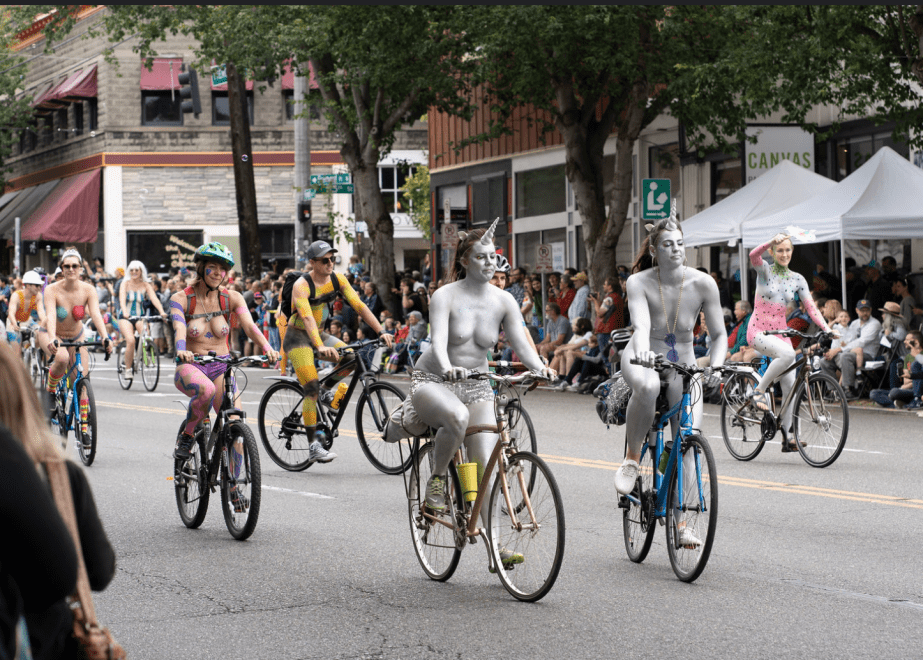
How can this ratio be improved? In an admittedly small sample it does appear that higher female participation rates can be achieved if they are given the opportunity to take their clothes off.
Learn to ride a bicycle. You will not regret it if you live. Mark Twain.
Thirty years ago I was scared away from the bike by the risks. Now at age 71 I’m back and so far having a ball.
What are the benefits?
Lifted straight off the Victorian Government Better Health website
The health benefits of regular cycling include:
- increased cardiovascular fitness
- increased muscle strength and flexibility
- improved joint mobility
- decreased stress levels
- improved posture and coordination
- strengthened bones
- decreased body fat levels
- prevention or management of disease
- reduced anxiety and depression.
Improved joint mobility and strengthened bones seem dubious claims. If you can’t put your knees, hips and ankles through a certain range you can’t cycle and they’ll never do anything extra no matter how many times you pedal. The evidence for bone density is mixed – cycling is often praised as weightless exercise you can’t expect too much.
Cycling Weekly (so much more beneficial than cycling weakly) would like to add better sleep, better sex and a better social life to the list.
Yeah, so it’s great. How great?
A study in the UK of 263,450 people with an average age of 53 followed for about 5 years published in the British Medical Journal
… found that cycling to work was associated with a 41% lower risk of dying overall compared to commuting by car or public transport. Cycle commuters had a 52% lower risk of dying from heart disease and a 40% lower risk of dying from cancer. They also had 46% lower risk of developing heart disease and a 45% lower risk of developing cancer at all.
That would appear to be sufficiently beneficial to outweigh the risk posed by riding in traffic at least in the UK but the risks are not negligible.
The Australian Institute of Health and Welfare* looked at hospital and death data for a 17 year period.
In 2015–16:
- about 12,000 cyclists were hospitalised due to injuries sustained in a crash—this was 1 in 5 of the 60,000 people hospitalised due to injury in a land transport crash
- nearly 6 in 10 of hospitalised cyclists were injured in an on-road crash (6,900 or 58%), and the rest were injured off-road
- nearly 6 in 10 hospitalised cyclists had sustained a fracture, with the most common injury being a fractured upper limb
Between 1999–00 and 2015–16:
- 651 cyclists died, an average of 38 deaths a year
- of cyclists who died, nearly 8 in 10 were aged 25 and over, and 9 in 10 were male
- nearly 160,000 cyclists were hospitalised, an average of more than 9,000 each year
- across all ages, the rate of hospitalisation rose by an average of 1.5% each year
- the proportion aged 25 and over rose, while the proportion aged under 25 fell
Of particular interest to a 71 year old male is that injuries tended to be more severe in older people requiring longer hospital stays.
The over-representation of males is interesting. Is it that 90% of cyclists are male or are the girls cycling with a great deal more care than the boys?
* AIHW: R Kreisfeld & JE Harrison 2019. Pedal cyclist deaths and hospitalisations, 1999–00 to 2015–16. Injury research and statistics series no. 123. Cat. no. INJCAT 203. Canberra: AIHW.
I liked the computer. I liked being able to see that I was going really fast. Downhill I could be really impressed with myself. For the secondary display I usually chose distance covered but on the eBig Tour you can cycle through all the options as you ride. It’s nice to be able check your average speed. Apart from the odometer the other data is ephemeral. I didn’t keep a record.
The new bike has no computer. I could buy one. I really like the Wahoo ELEMNT Roam which does all the tricks I had before plus GPS mapping. It comes in at a mere $600 but I’ve spent all my pocket money for the year on the bike.
I have a smartphone. There are a number of ways of putting that to use. I have been using the Strava app. You open an account and download the app on your phone. When you’re ready to go for a ride or a run you open it up.
Across the bottom of the screen there are a number of options, the centre one is labelled record. Press it and you are rewarded with a bright orange button. Once you have satellites press the button and set off. Don’t forget to take your phone!
At the completion of the ride press the finish button and you can give your ride a title and description, add a photo, write notes and sync it to the cloud. When you go to your real computer your session will look something like this …
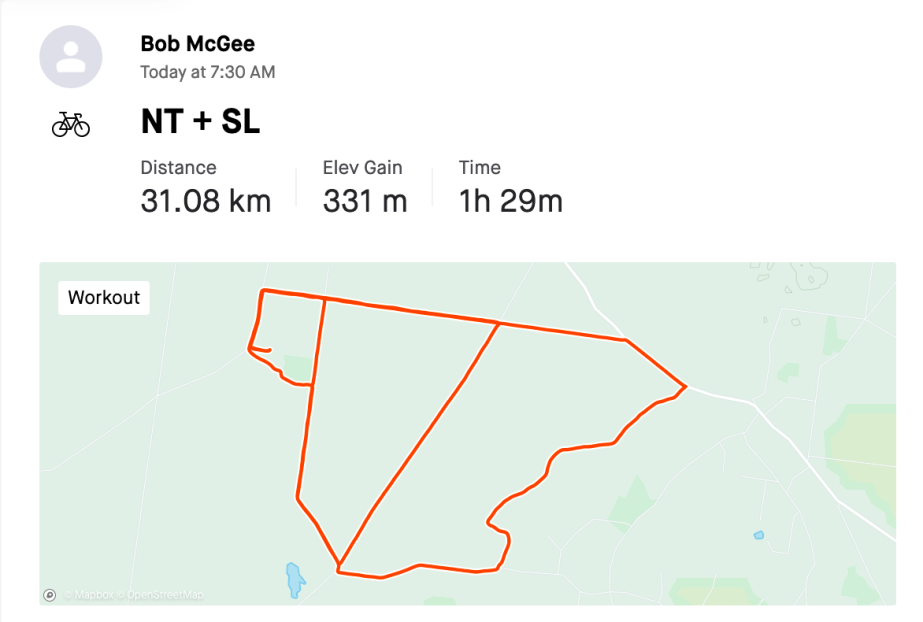
and you can track your workouts in a number of different formats. In addition you can compete against others over road segments.
It’s a combination of training log and social media. You can keep it private, share it with friends or share it with the world.
There are some other features to explore. You can sync heart rate and power monitors. The basic app is free but there is a deluxe version for those whose pocket money hasn’t run out. You can sign up at strava.com and get the mobile app from your friendly app store.
There’s no display to watch during the ride but you can work out your average speed at your leisure.
It happens that Gayle is a tall and elegant woman or in other words we are of similar height – both needing a medium frame on our bikes. Her second hand bike was an uncomfortable fit for her but she could transition to the eBig Tour without even needing the saddle moved.
This would have to be one of the strongest arguments for an ebike. They enable riders of differing abilities to enjoy a ride together.
Back to the shop I went. I wanted a similar set up but without the motor. A hard tail because I didn’t expect to be leaping from rock to rock but softer forks for the more ferocious corrugations. An aluminium frame for economy. A single chainring for simplicity. A very pleasant young man steered me to the Norco Charger.
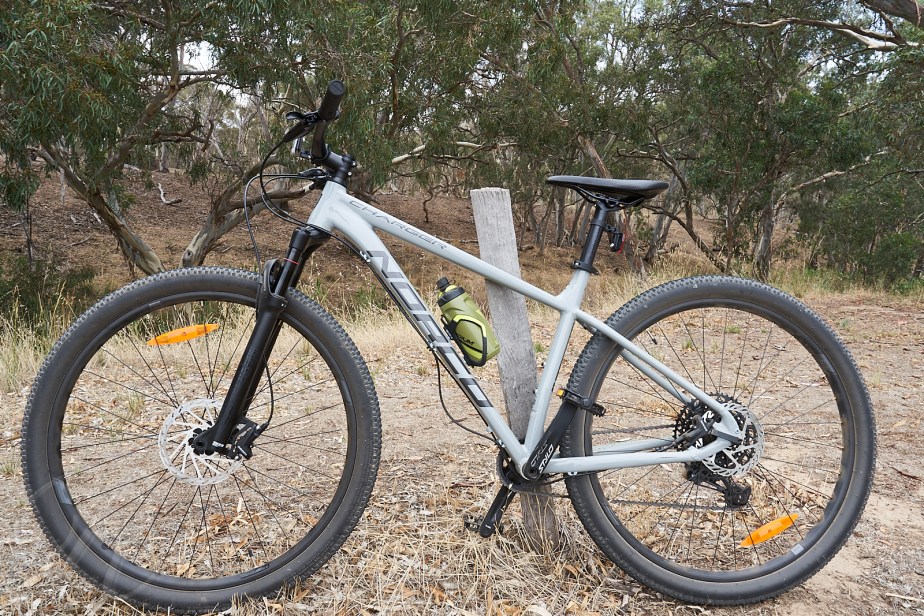
It was love at first sight – with the bike that is. I would have liked a more exciting colour but hey.
It’s a bit more mountain bike and a bit less the tourer. For rear suspension you stand on the pedals and absorb the bumps with your legs – just like skiing. The front forks are perfect.
Of course it weighs a lot less than an ebike so my average speed jumped a couple of kph.
What’s missing?
The computer …
The blame or the credit has to be sheeted home to friends John and Carole. They are both older and fitter than we are, how annoying. Gayle observed the difference in circumference between John and I and declared a war on my waist.
They keep trim by cycling and keep flexible with yoga. Cycling OK. Yoga is for yuppies. John extolled the ebike for a someone making a comeback. I negotiated a good price for two ebikes but Gayle chickened out and picked up a second hand ladies mountain bike of conventional propulsion.
I picked up my Merida eBig Tour on the first of December 2019 and off we went.
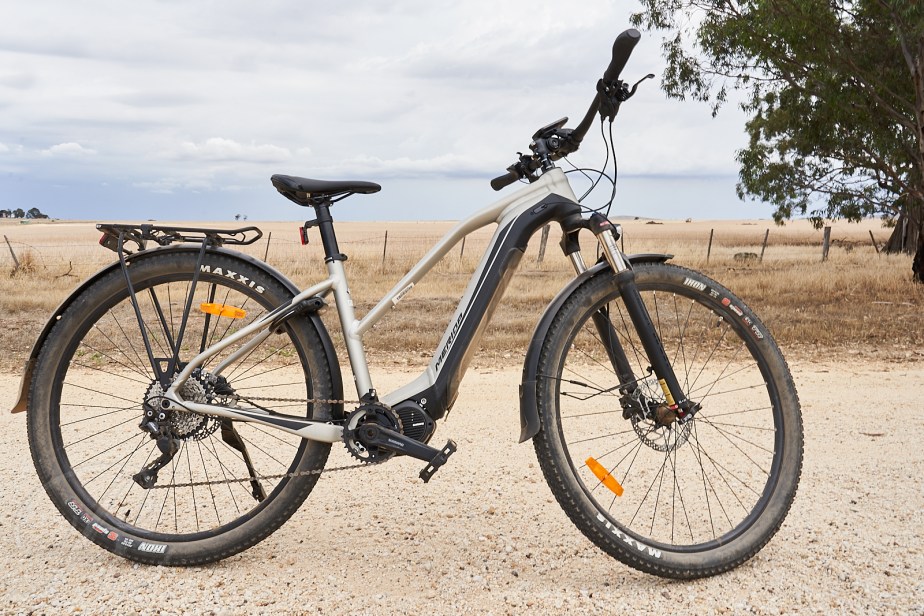
It has three levels of assistance from a Shimano motor cunningly concealed in the crankcase. Shimano terminology for them is eco, trail and boost. They are selectable via a control that falls under the left hand. The right hand controls the derailleur gears. Both hands have a disc brake to manage.
Eco provides a pleasant tailwind effect and the battery may be good for 120 km or so. I’ve never got that far. Trail provides more assistance but the range drops. Boost will leave a Ferrari for dead or at least make climbing hills easy. Take care the first time you select it.
There is a fourth option which is to have the computer on but the motor off. I really like the computer which provides your speed and average speed, elapsed time, distance traveled, cadence, odometer or range. You can review them all after the ride. Bloody luxury.
Now surely this is cheating. How are you going to get fit if a motor does the work?
The first thing to note is that if you don’t pedal it doesn’t go. There is no throttle. What happens is that your effort on the crank is measured and the motor adds some extra. You can work as hard as you like. Under Australian law the motor must cut out at 25 kph any way.
Riding the ebike is just like riding any other bike. The big difference is that you became a Tour de France quality rider overnight. It’s huge fun.
The eBig Tour is essentially a trekking bike. It has big fat tyres suggesting that it will do well in the gravel of our local roads and it can be ridden on fairly technical terrain. There is no suspension at the rear (a Hard Tail in Mountain Bike jargon) but the front forks compress and provide some relief on the corrugations. Reviews I’ve read generally find the forks adequate but they’ve not been tested on the roads round here. The ride can be uncomfortably hard at times.
After two months I’d done about 700 km mainly on gravel roads and forest tracks. I spent one afternoon climbing a little hill called Mount Hooghly and bombing down the other side. Boost got a work out on the climbs, I survived the descents.
The main problem was the disparity in riding speed between Gayle on her 24 inch conventional bike and my turbocharged eMTB. In order to get a good workout I did most of my riding with the motor off which gave me a good idea …
 bobmcgee