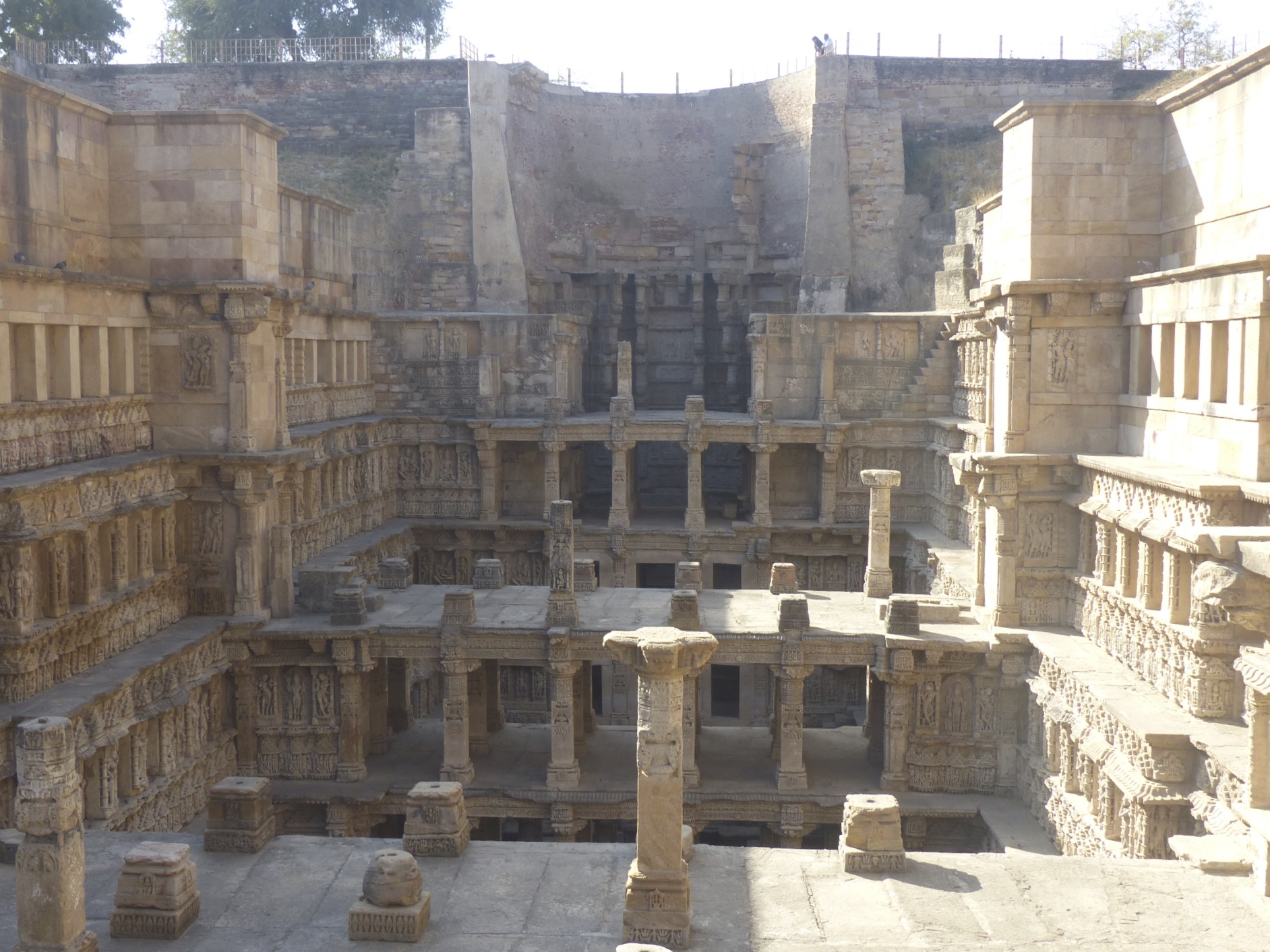
Gujerat is a dry state. In both ways … no alcohol and little rain. It is dry and sandy. Wells, therefore, had to be deep. A form of architecture evolved here where the wells would have steps down to the water, usually on just one side. They are mostly dug close to rivers or lakes and it came to be the case that providing such wells was seen as a meritorious act. The finest of them all is the Rani-ki-vav, or queen’s step well located just outside Patan close to the River Sarasvati. Once again it is a legacy of the Solanki dynasty. This one built by Queen Udayamati as a memorial to her late husband Bhimadeva I.
It is rectangular, the long axis runs east west and is 65m long 20 m wide and 27m deep. The well is at the west end. The walls are sheer except for the steps running down from the east end. It is large among step wells but the richness of the decoration places it above all others. In the lowest third of the rectangle there were a series of pavilions that braced the side walls. These have fallen into a state of disrepair, indeed the whole structure had fallen into disuse and debris had filled a good deal of the well. Considerable restoration has been undertaken.
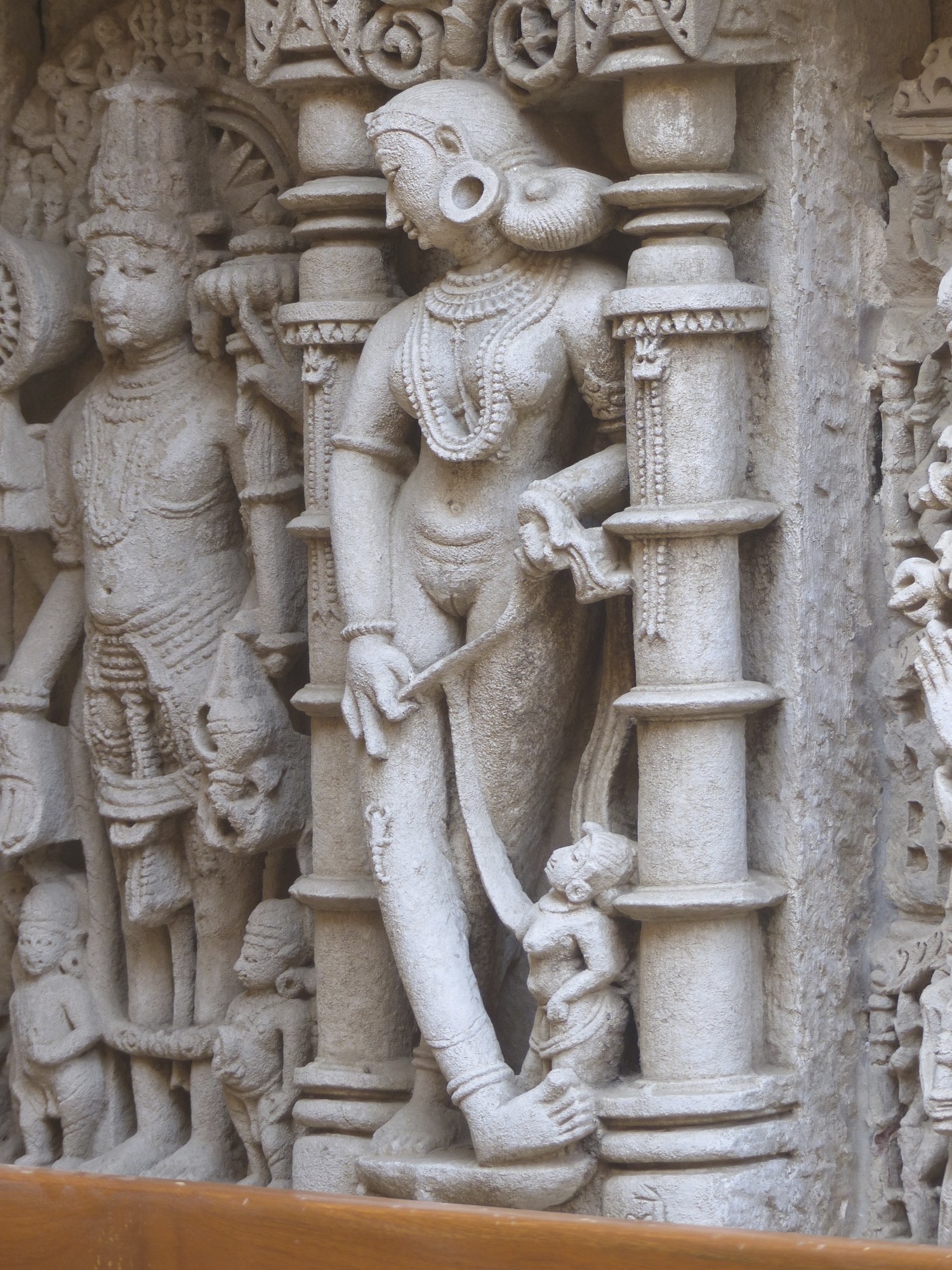
There are more than 800 elaborate sculptures among seven galleries. The central theme is the Dasavataras, or ten incarnations of Vishnu, which are accompanied by sadhus, brahmins, and apsaras (celestial dancers dressed in their celestial dancing outfits). At water level, no longer open to the public, there is a carving of Vishnu, reclining on the thousand-hooded serpent Shesha, resting in the infinity between ages.
Rani ki vav from the west end.
To negotiate the steps from terrace to terrace you turn left and right making patterns of progress as you choose your path. Long diagonals or short diagonals at your whim. Whenever you approach the walls you come close to the carvings including one of Queen Udayamati herself, seated on a cushion with a parasol held above her.
Looking west.About two thirds down into the well.
And a dancing girl to finish, take note of her plump beautifully formed owls.
This is part of a series that began with मुंबई … published 30/01/2014.
Most of the people I meet don’t have an accent. We’re all Australians. People from other places have accents, I’m sure you’ve noticed that.
Likewise, the ABC is not biased, right wingers are the only people who could possibly think otherwise.
Getup, a centrist organisation if ever there was one, is a good friend of the ABC determined to protect it from the IPA, clearly a fascist organisation. Really, every one with a brain realises that the Q&A audience are utterly typical of everyone with a brain. QED.
On the other hand, those of us that have got most of life’s major decisions right are not only likely to be of the right we also have the ABC to thank for the knowledge that not everyone is so blessed. For them the science is settled and if a voice is raised against the social monologue it must be shouted down ASAP. We, because we don’t think like that, are constantly reminded that science by its very nature is never settled and the social polylogue continues. It’s good to be aware of diversity.
Good but, perhaps, not worth a billion dollars a year, funded mostly by life’s higher achievers. The argument for a national broadcaster was compelling in a time when there was little else available. In this day and age we can source radio from anywhere in the world thanks to the web, there are TV channels aplenty, you can have the Age delivered or read the Times of India on-line instead. But even in modern Australia no other media organisation can have a TV channel or four, a Radio channel or four and an online print news service in the same market place.
It’s time to cut it loose. It’ll survive, it’s already receiving donations from little girls.
History starts when writing starts. Writing, I would venture, is a product of civilisation. We find the first great civilisations and writing springing into existence about 3,100 BC in Mesopotamia and in Egypt. About 500 years later the Indus Valley produced its own version which grew to cover a larger area than Egypt and Mesopotamia combined, built the major cities of Harappa and Mohenjo-daro and survived for more than a thousand years.
One of the finest archeological sites in India is at Dholavira, in the Kutch region of Gujerat. It is a Harappan site that was occupied from about 2650 BC until about 1450 BC. I hope that one day someone discovers there the earliest commercial brewery and distillery known to humanity.
In Australia we start slapping heritage listings on anything over fifty years old and our oldest buildings are barely pushing 200. Gujerat was there from the beginning of history.
My first glimpse of the glorious architecture of Gujerat was on one of the journeys onto the Little Rann. We passed the walled city of Zinzuwada. This was built in the eleventh century, a troubled time because of invasions from the north. The city has four magnificent gates, the best preserved is the Madapol Gate. I wish I could have had the time to explore it properly … next time.
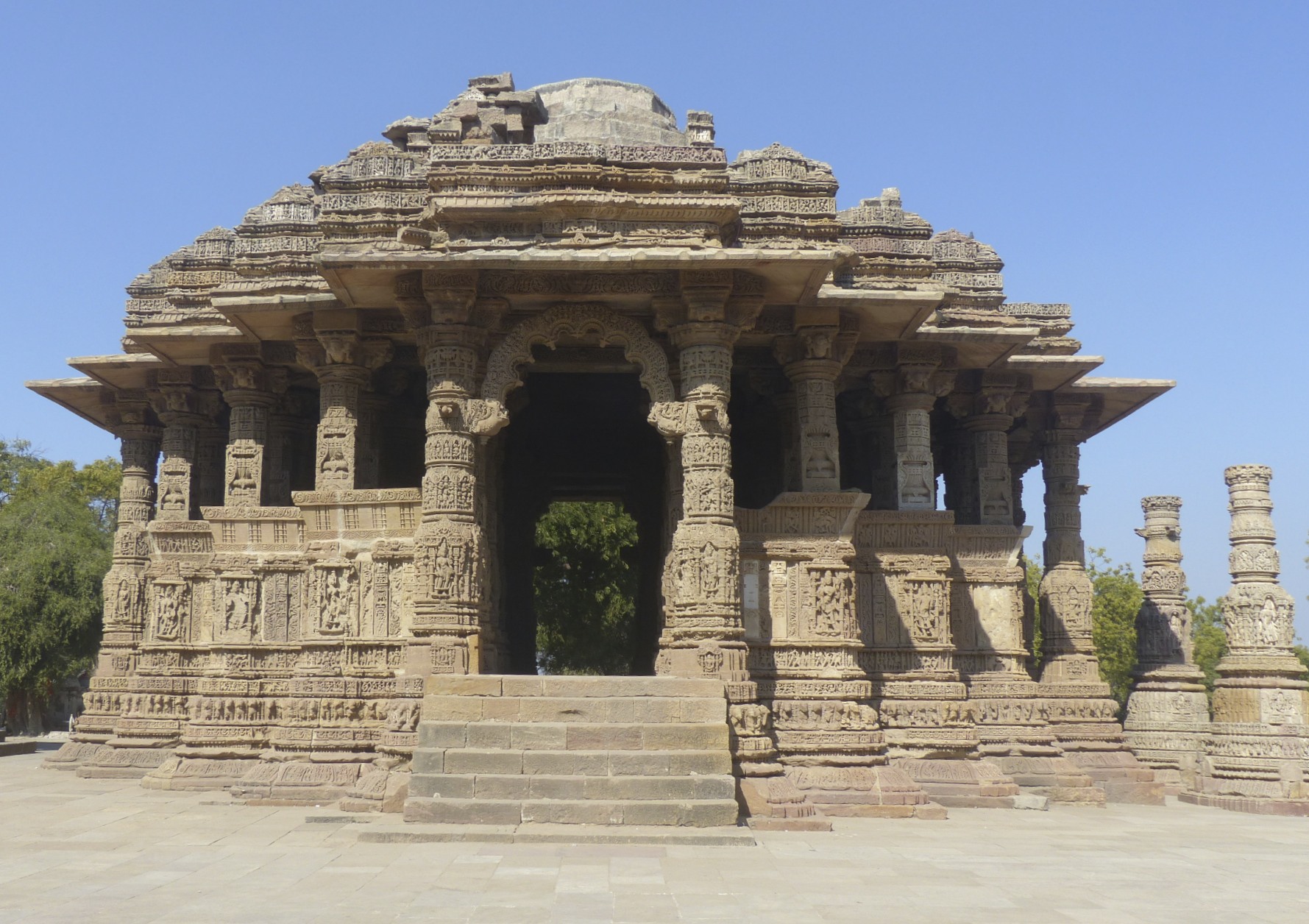
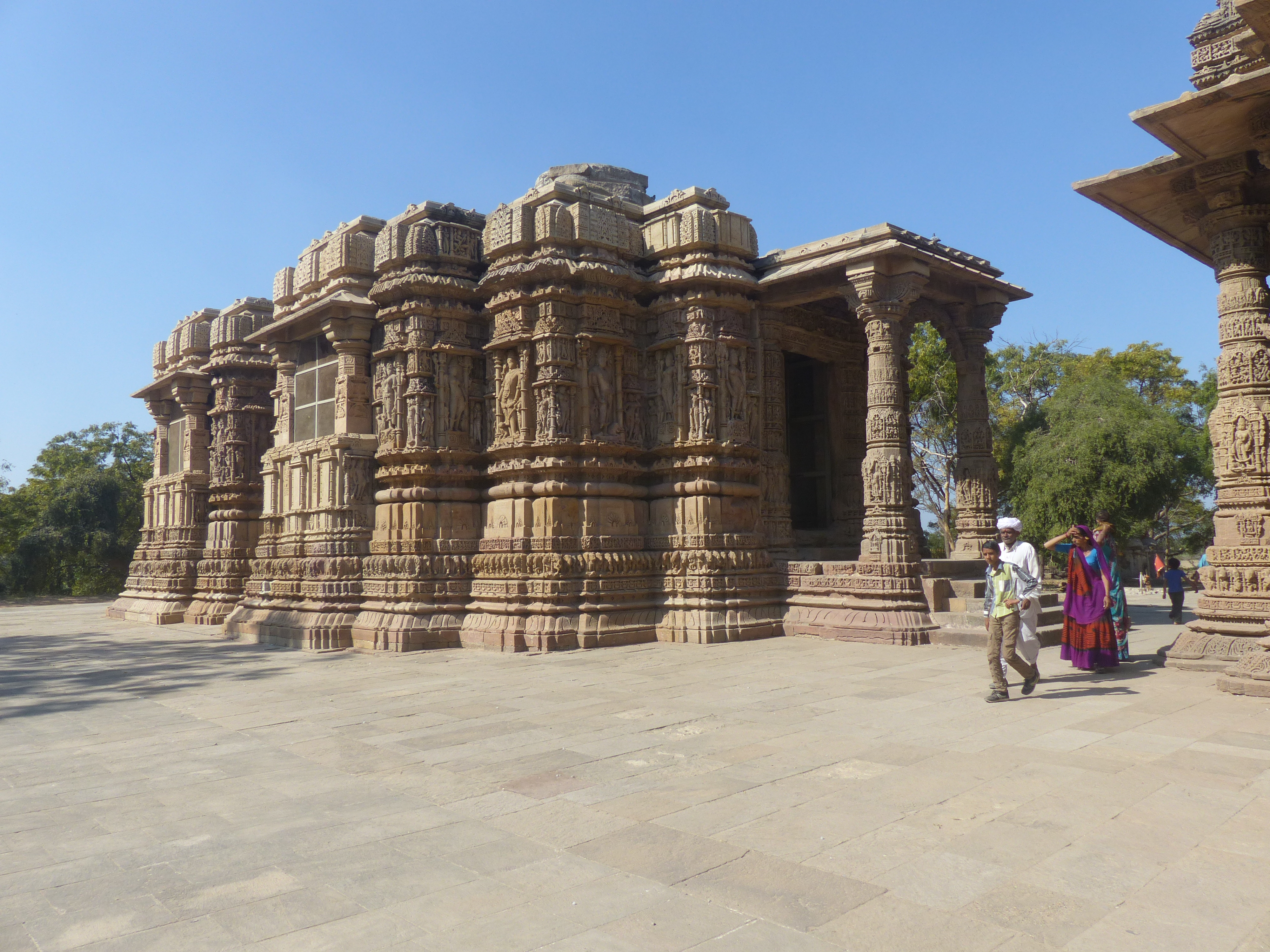
I was able to do better at the Sun Temple at Modhera. This is dedicated to the Hindu Sun God, Surya.
According to the little guide book one can purchase at the gate, there is an inscription on the rear wall of the central hall naming king Bhola Bhimdev as the builder in the year 1027 AD. That is around the same time as Zinzuwada and by a king of the same dynasty, the Solanki.
The temple is in three parts. The weary traveller would first bathe in the pool, the Suryakund, then ascend the steps, pass between two columns to enter the Court or Dance gallery, Sabha Mandap. The next building is the main temple, Garbha-griha. Legend has it that it once contained a magnificent and bejewelled pure gold idol of the Sun God and his chariot drawn by seven horses. This sat atop a pit, fifteen feet deep, filled with gold coins. It was designed so that the rays of the rising and setting sun on the day of equinoxes (round about 20 March and 21 September) fell on the sculpture and filled the temple with radiance. This was taken away by the marauding Mahmud Ghaznavi who is credited with 17 raids on India, carried out for fun and profit. His last invasion, however, was supposedly in 1026. Clearly the legend needs a little tidying up before the insurance claim goes through.
Considerable damage was wrought on the temple by the Sultan of Northern India, Alauddin Khilji, during his reign from 1296 to 1316. Gujerat was one of the first territories he conquered and annexed.
What we have left though is still magnificent. Symbolism is everywhere, just as the sun in its passage causes the lotus flower to open and close so the temple form follows that of the lotus. All the gods are represented in their appropriate forms in their appropriate places with their appropriate vehicles. Various manipulations of the calendar determine the number of pillars, the number of elephants and so on.
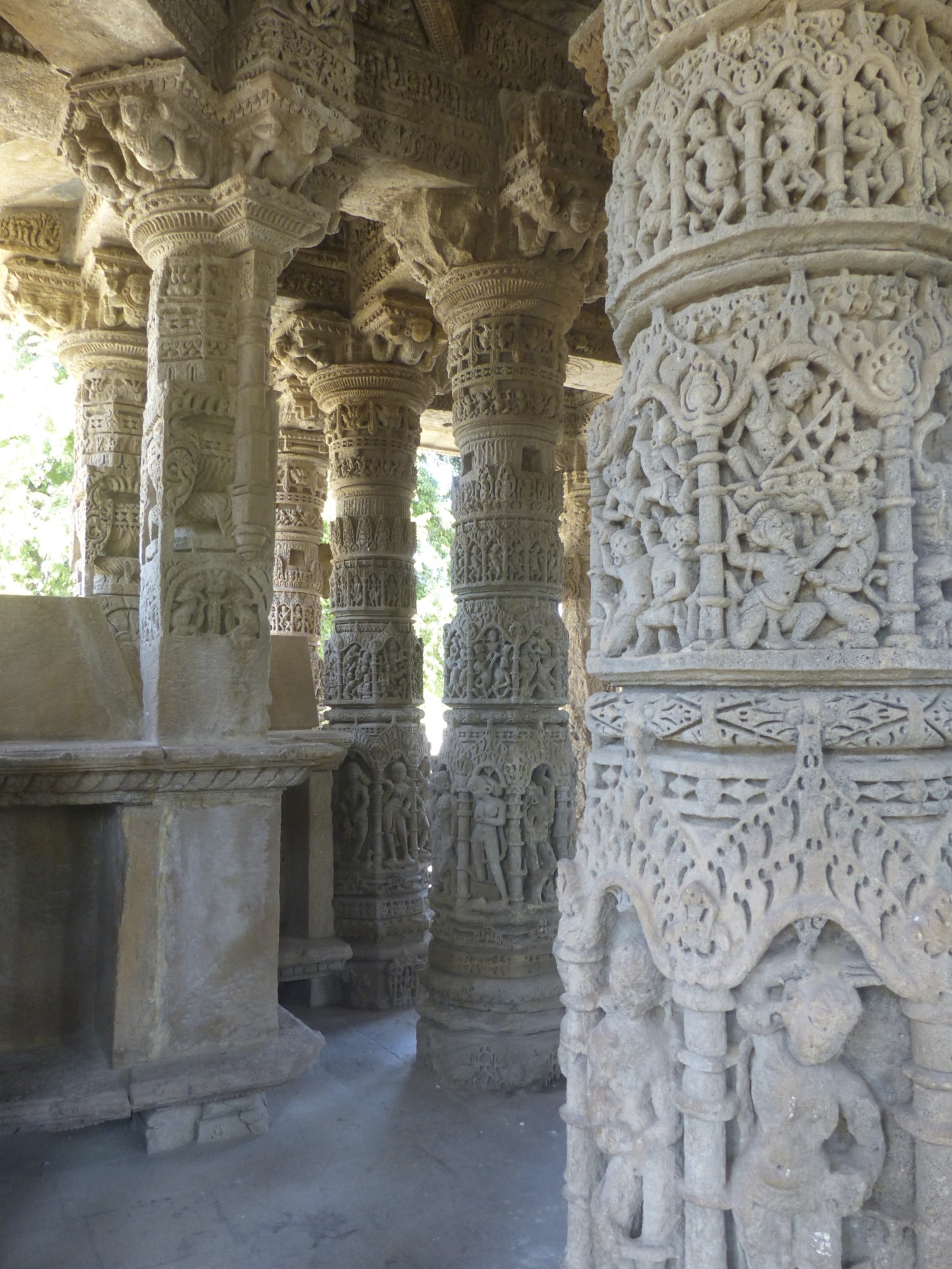
Sabha Mandap, built on 52 pillars.Pillars within the Sabha MandapThe dome within the Sabha MandapGarbha-griha
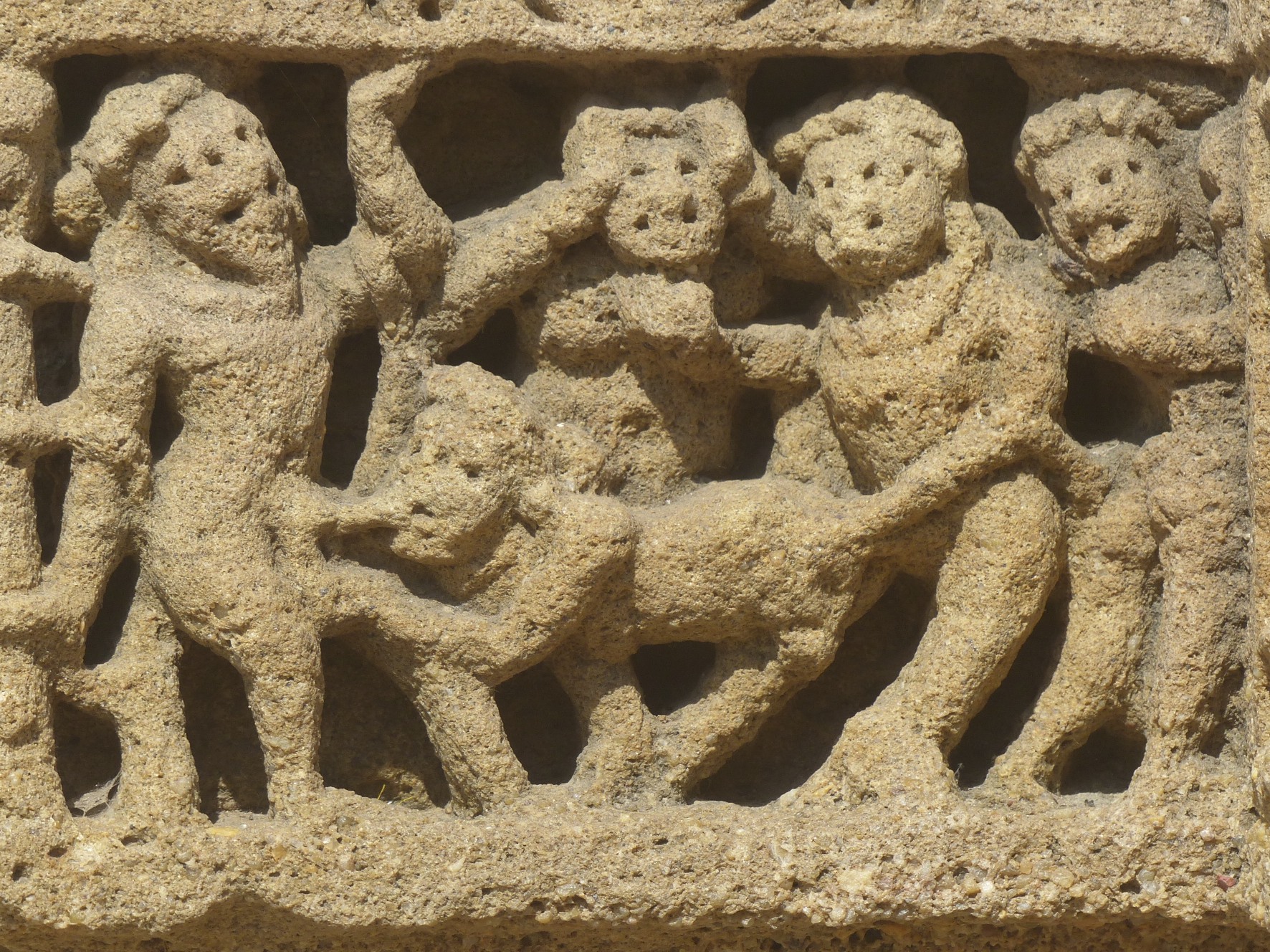
As can be seen from the photos, the stone work is intricately carved. Many of the panels depict what the little guidebook quaintly calls “sexual and amorous acts”…
This was all completed without the aid of cranes or engines. Once each layer was completed it was filled with sand. Elephants were used to drag the stones up ramps to the new level. Once the building was finished the sand was removed.
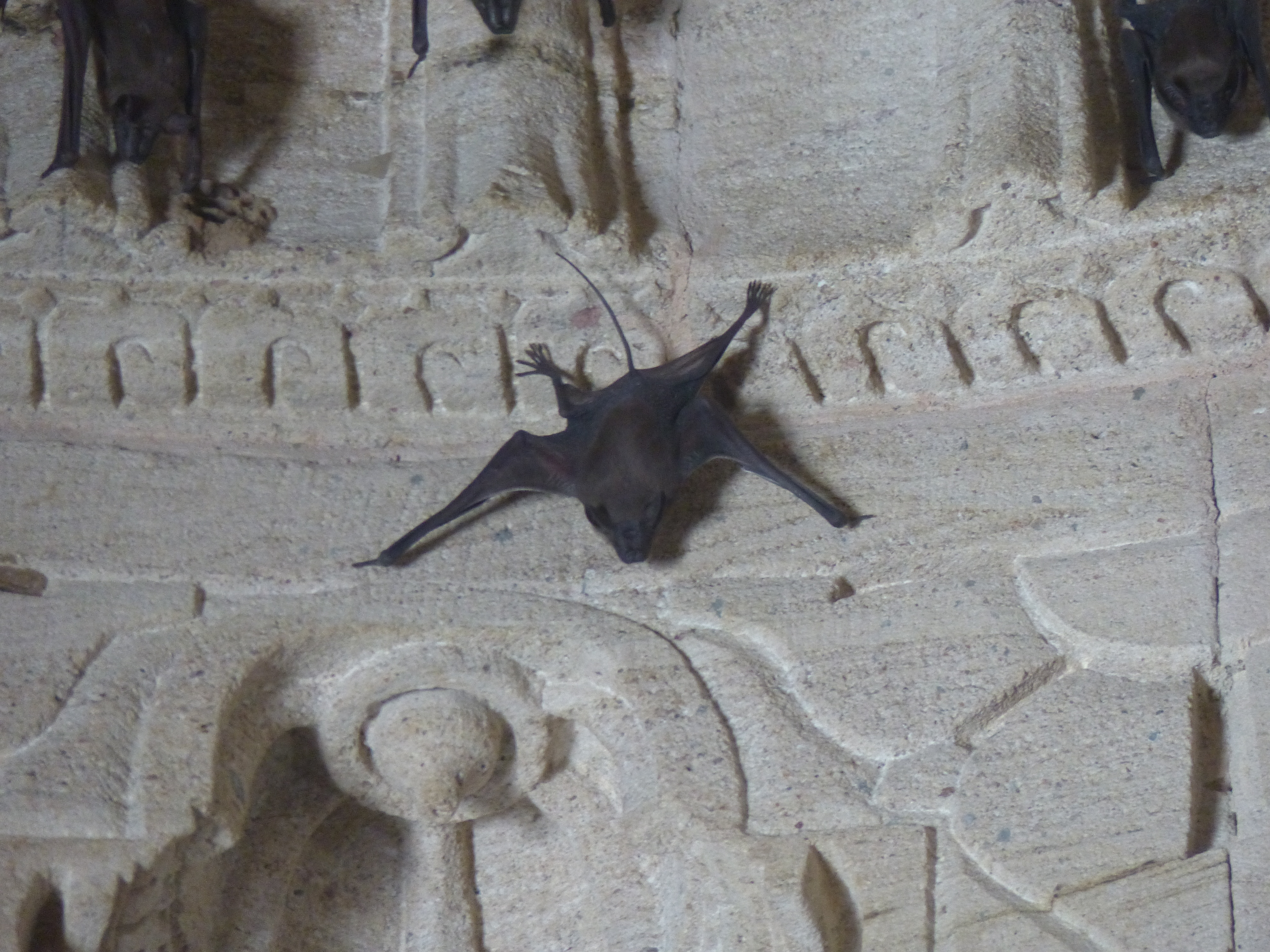
Prayers are no longer offered at the temple. The Garbha-griha is now the daytime roost of Greater Mouse-tailed and other bats.
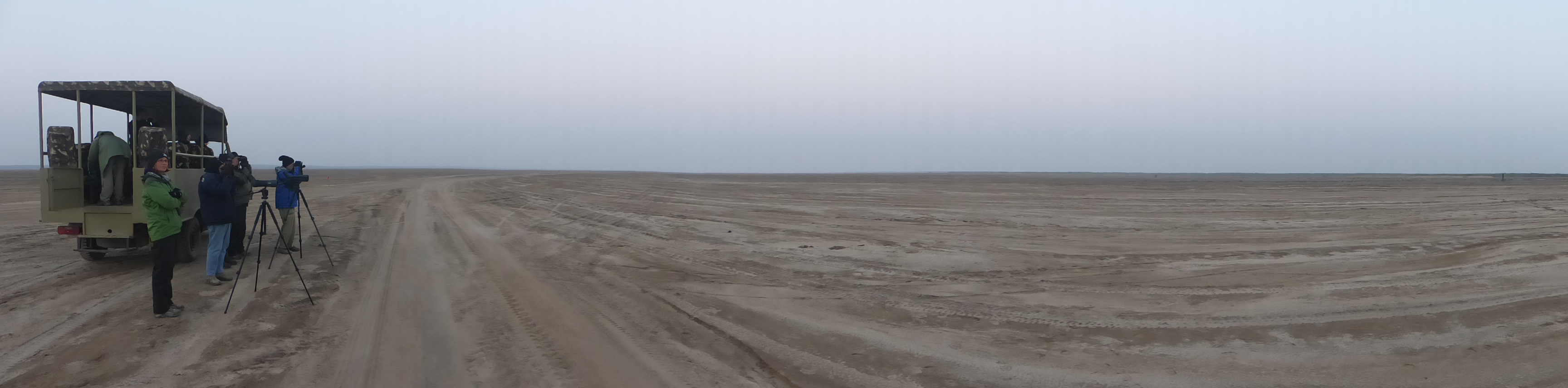
The next destination is Dasada and the Little Rann of Kutch. The Arabian Sea once extended into the belly of Gujerat in two shallow arms. Over time these have silted up to form the Great and Little Ranns of Kutch. Rann meaning saline desert and Kutch being the name of the region. These are inundated in the monsoon and steadily dry out through the remainder of the year. Some grass survives around the margins and within the marsh there are some low islands, called Bates, on which mesquite and some grasses persist but most of the Rann is utterly devoid of vegetation. Beyond the ancient coastline is the Thar desert.
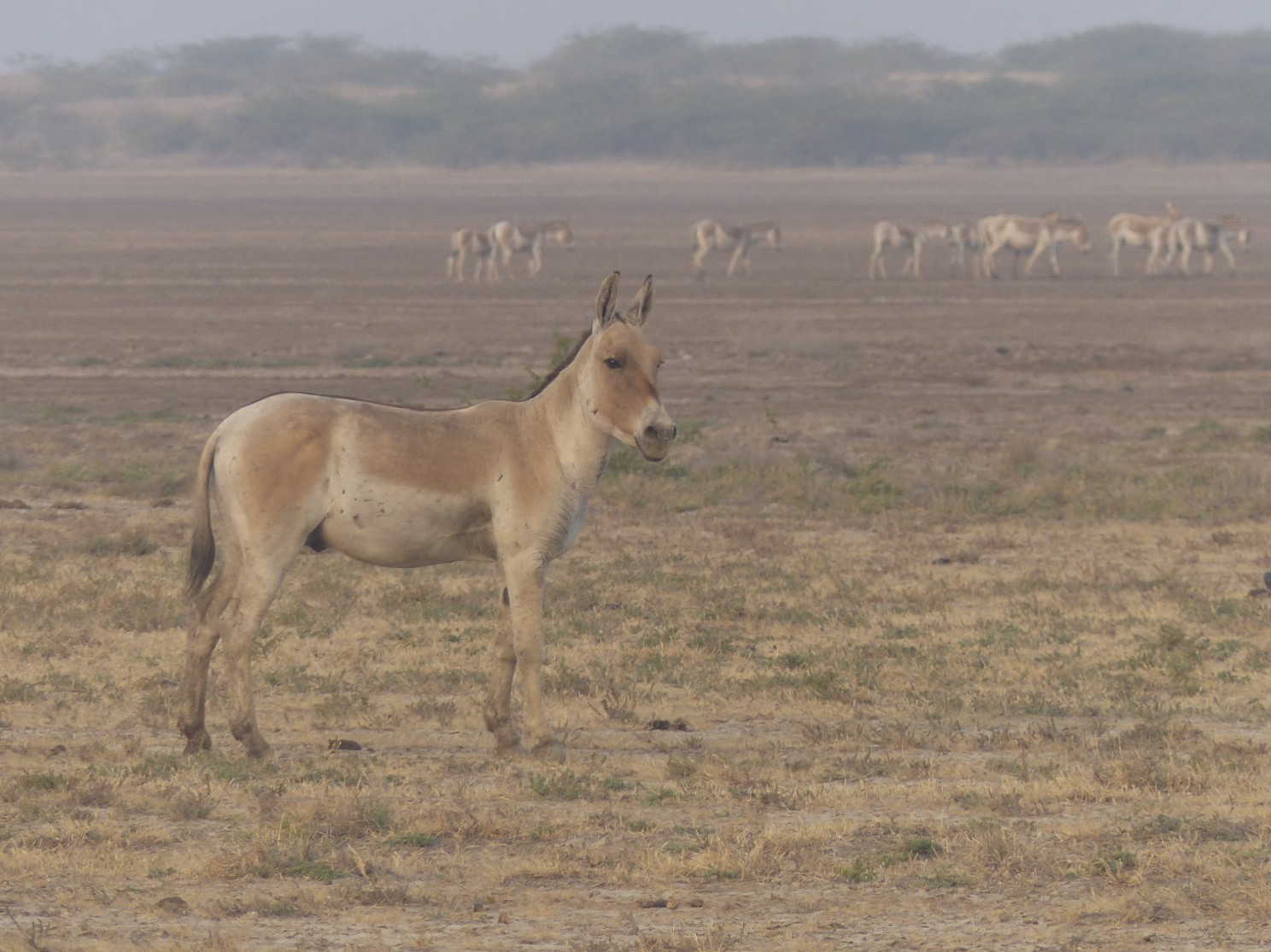
This place is not as sterile as it seems. It is the stronghold of the Khur or Wild Ass Equus hemionus khur. This was formerly widespread and numerous but has suffered from loss of habitat to the mesquite and herdsmen and also from some diseases. Recently given protection its population and range are currently increasing. Once the only place to see it, this is still the best place to see it. They feed mainly early morning and in the evening. They are more elegant than one might expect of an ass and can gallop at up to 80 km/hr, an impressive beast.
The Hoopoe Lark is another denizen of this empty landscape whilst the bates provide good habitat for Macqueen’s Bustard. Where there is water in an arid landscape one can be sure of a concentration of birds. We got as far as the tidal reaches of the sea and enjoyed Flamingoes, Ruff, Little Stints, Kentish Plover, Common Cranes, Greylag Goose and some Gulls and Terns.
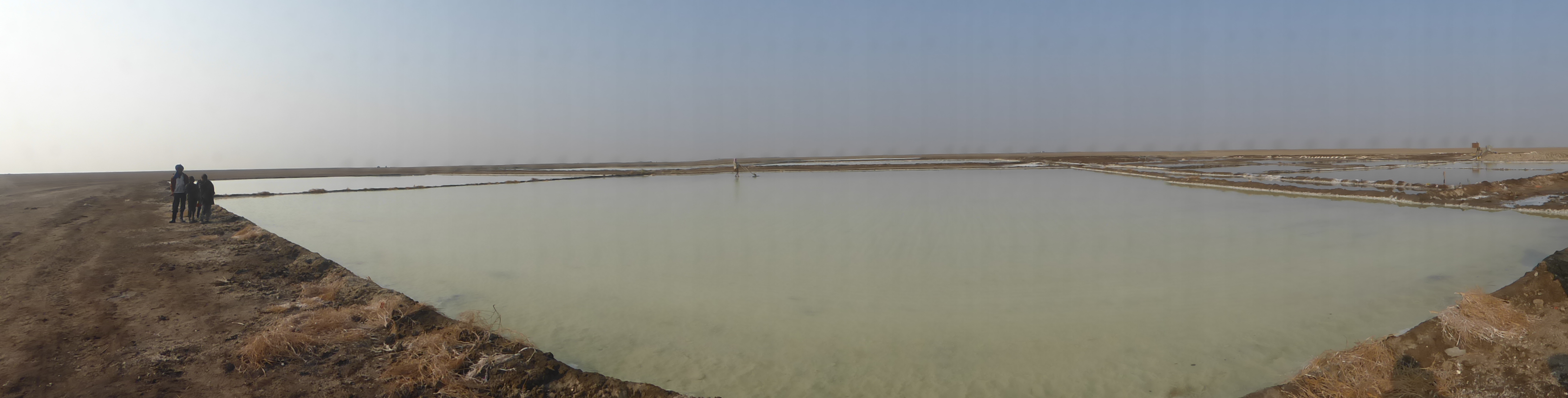
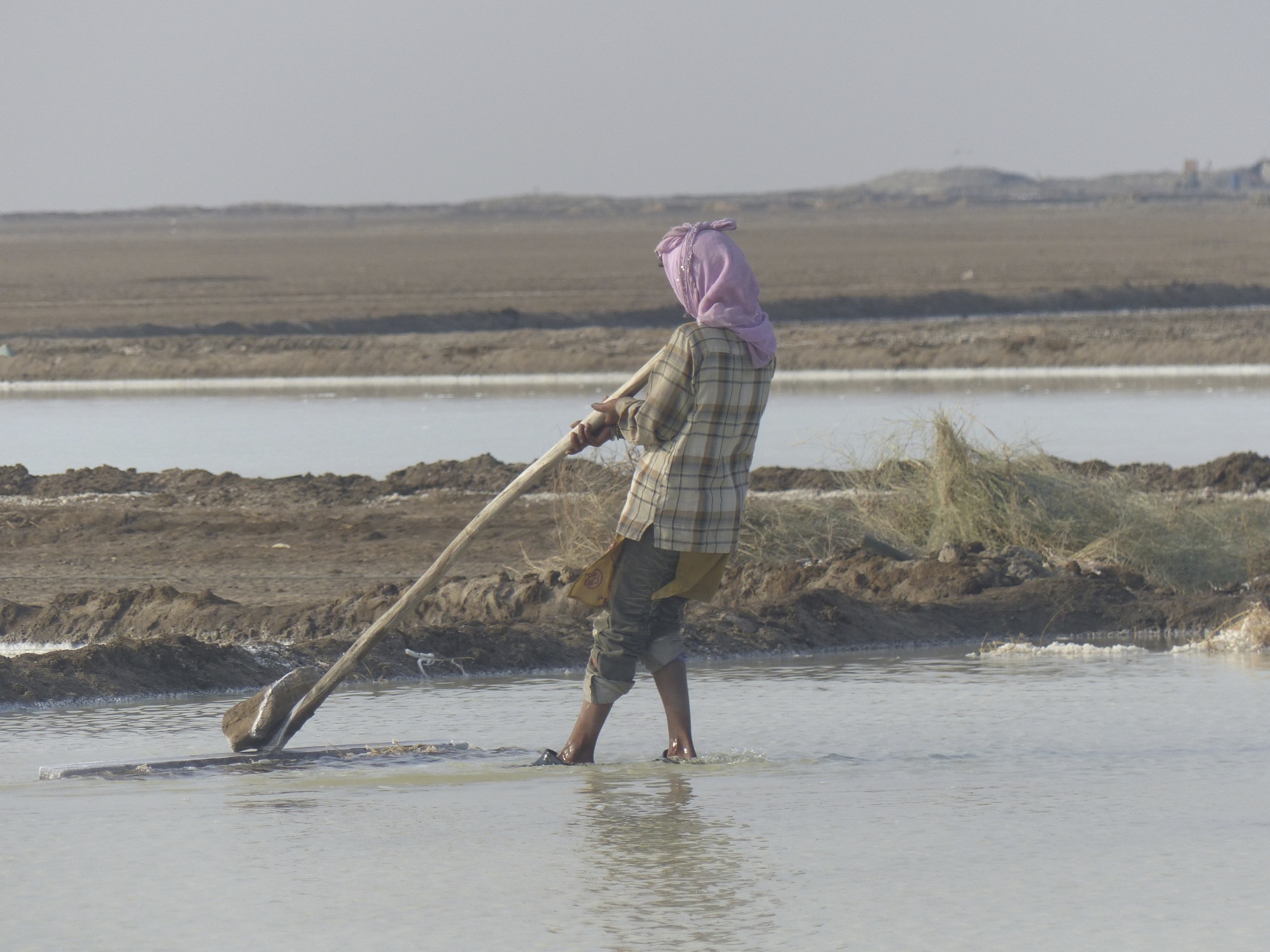
There are even people who can make a living out here. When the Rann is flooded it becomes a prawn fishery. As it dries out it can be exploited for salt production.
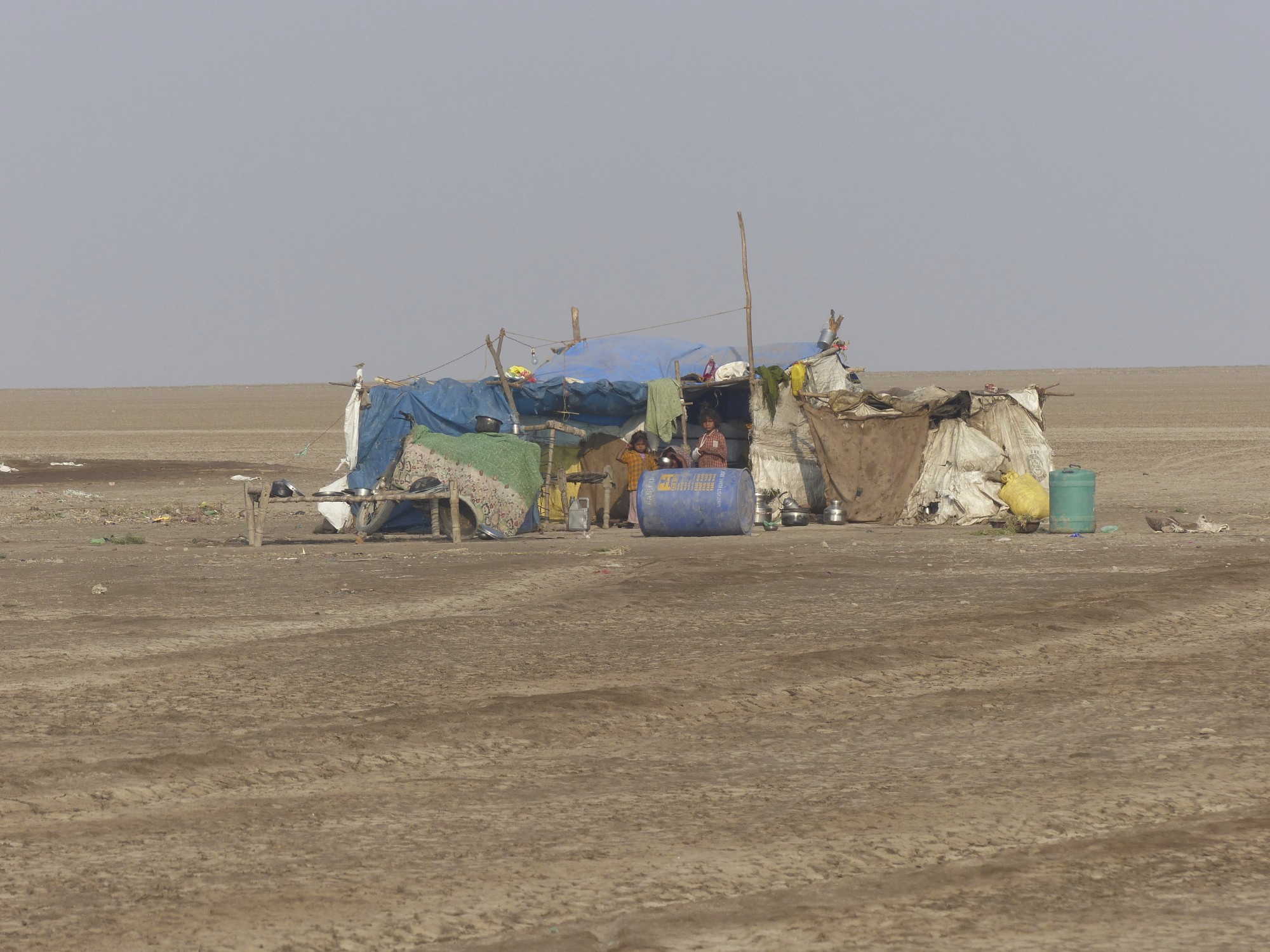
It appears to run as a small family enterprise with the family living a very humble and remote life right next to the pans.
After a last morning safari at Gir it’s on the road to Velavadar.
The journey takes us about 206 km north-east through countryside that is fairly flat and intensively farmed with the aid of extensive irrigation. From time to time we pass cotton processing plants with little mountains of cotton waiting for the gin (just to remind us that Gujerat is a dry state … it’s been four days now). There is still plenty of cotton awaiting harvest in the fields. Other crops include Castor, Millet and Mustard. Later in the year it will be time to plant Sorghum.
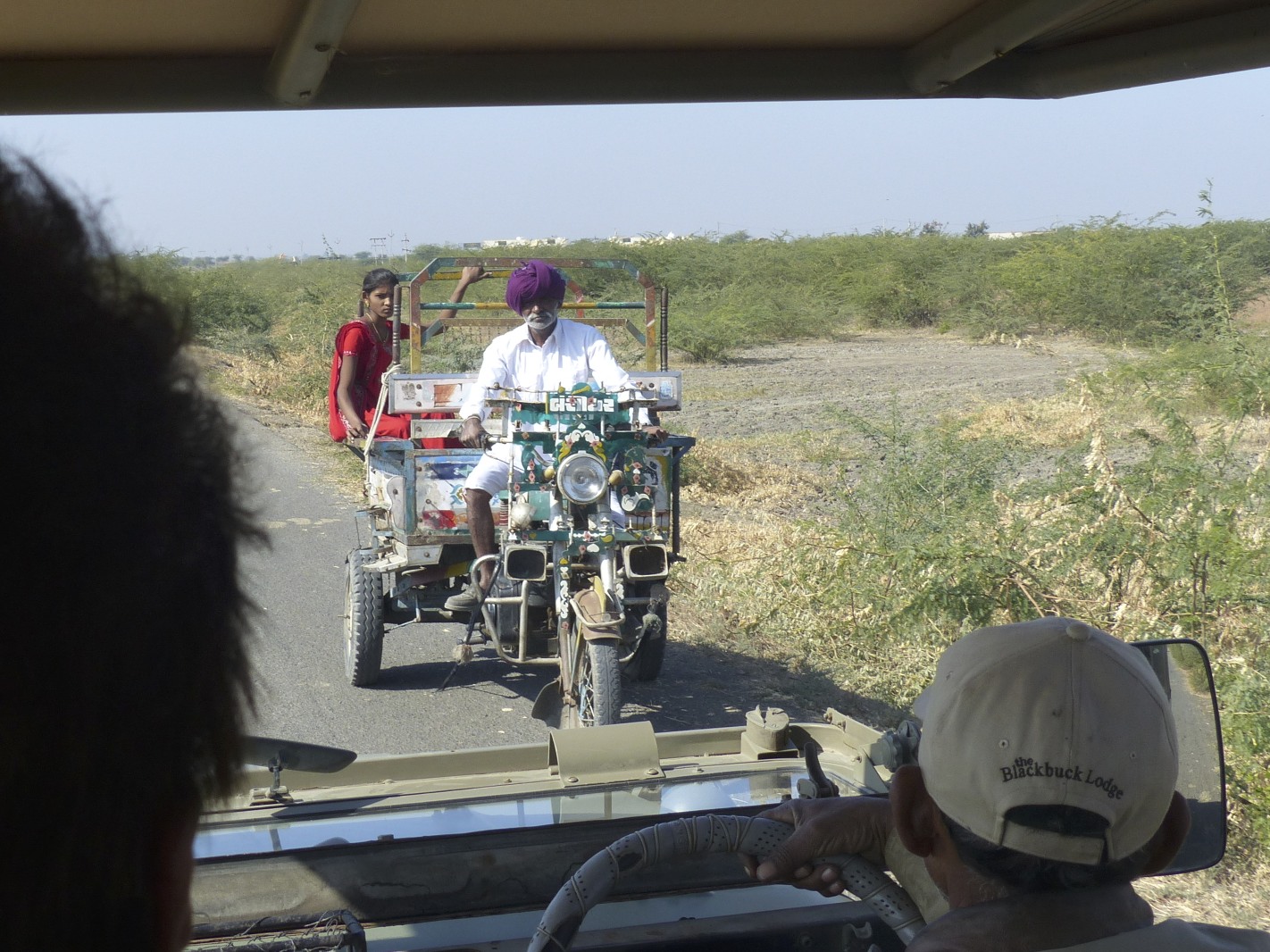
The roads are fair but busy. The trucks tend to be small by Australian standards and mobile works of art. As well as cars, they have to contend with tractor hauled carts, camel hauled carts, oxen hauled carts and a strange hybrid of motorcycle and cart called a chakra. Motorbikes and motor scooters are numerous and generally low powered. I will need to undertake a great deal more study before I can explain the system by which all these vehicles avoid collision but initial observations reveal that a good horn, good brakes and good luck are vital ingredients. An average speed of 50 km an hour would be a pretty good achievement and four or five hours of that should bring you to the verge of exhaustion.
Chakra
In former times the region we are headed to was an extensive open grassland. Much of the area has given way to agriculture or been lost to the encroachment of Mesquite, Prosopis juliflora, a native of the americas. It was introduced to provide fuel wood, which it has and it is also used to make fences. It has ferocious thorns and grows as dense thickets. Overall it has been much too successful. An area of 34.52 sq.km. has been preserved as Blackbuck National Park.
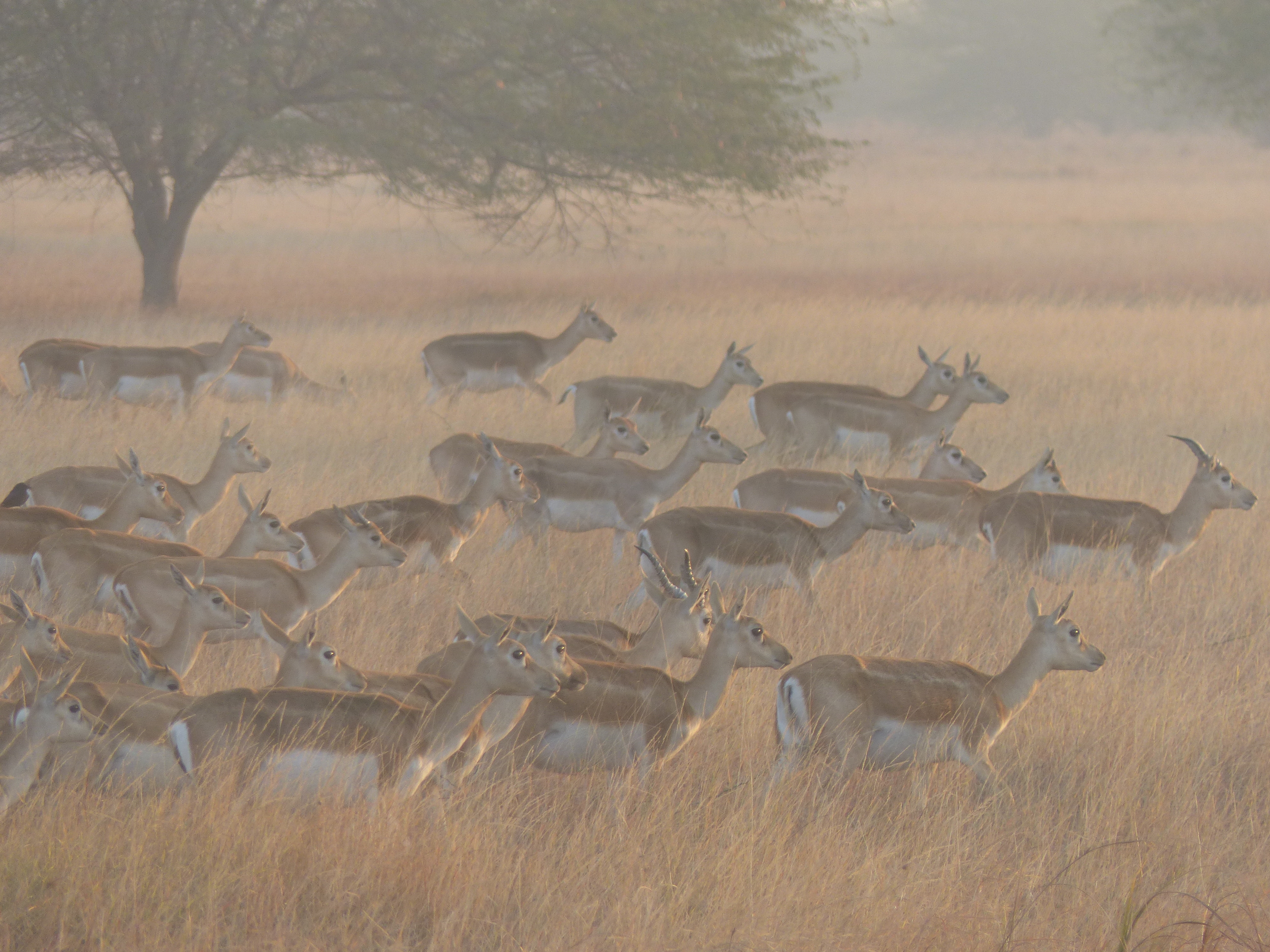
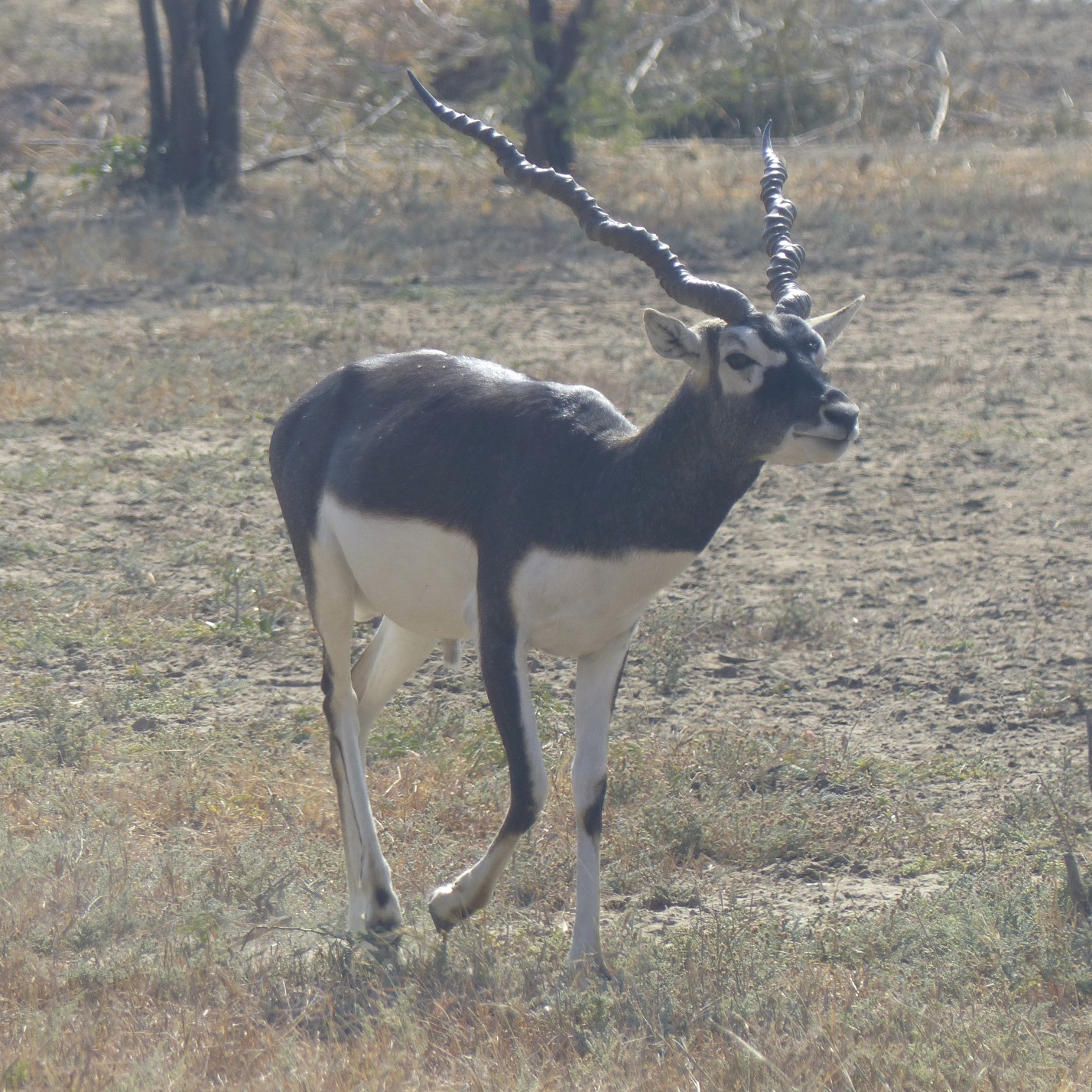
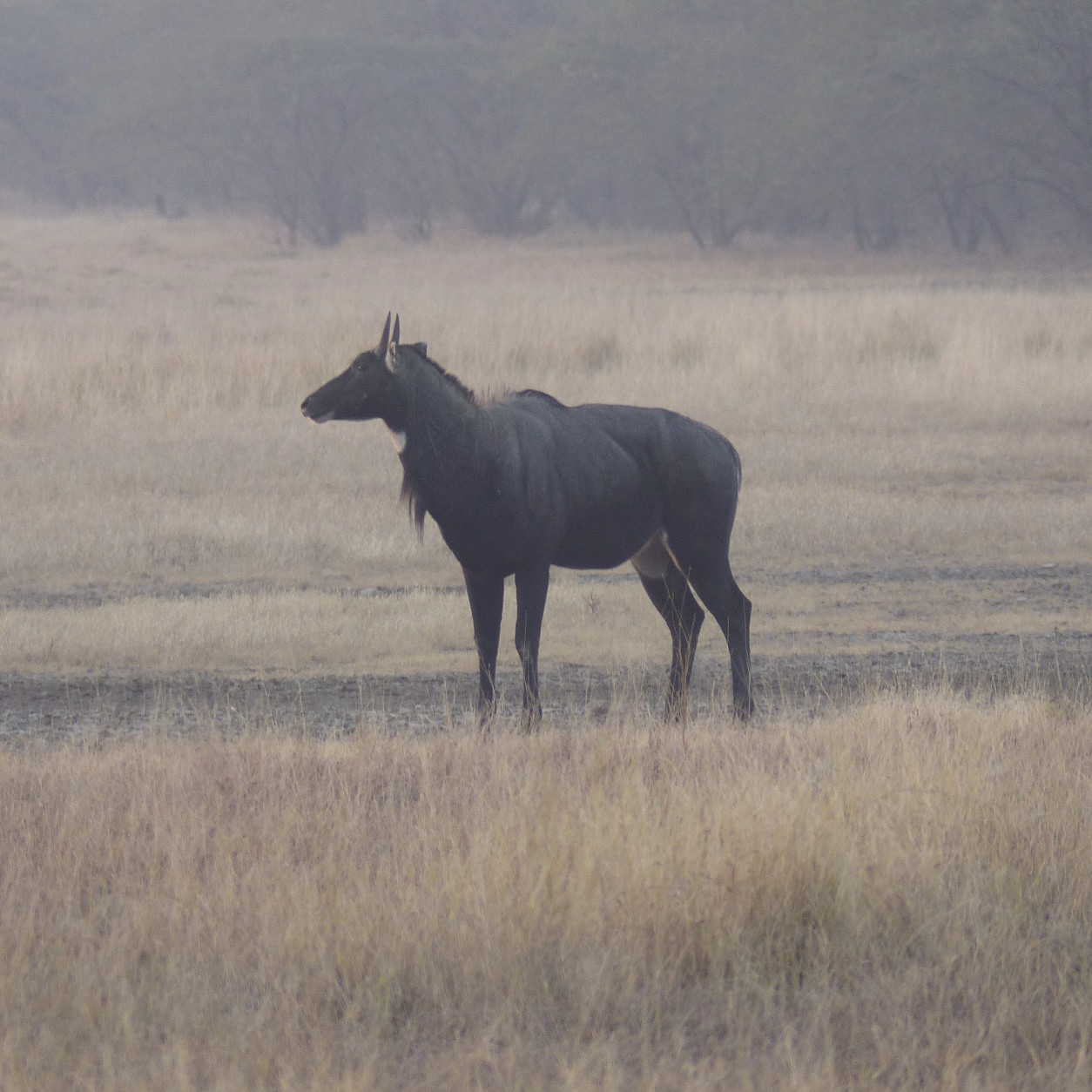
The grassland is home to the very elegant Blackbuck and also Asia’s largest antelope, the Nilgai. In winter it is visited by large numbers of Montague’s and Pallid Harriers, in the monsoon it provides a refuge for the small and endangered bustard, the Lesser Florican. There is a wetland in the park that can amuse the birdwatcher for hours with such creatures as pelicans, cranes, avocets and flamingoes, although they can be sure that the other occupants of the vehicle will drag them away in pursuit of wolves and hyena.
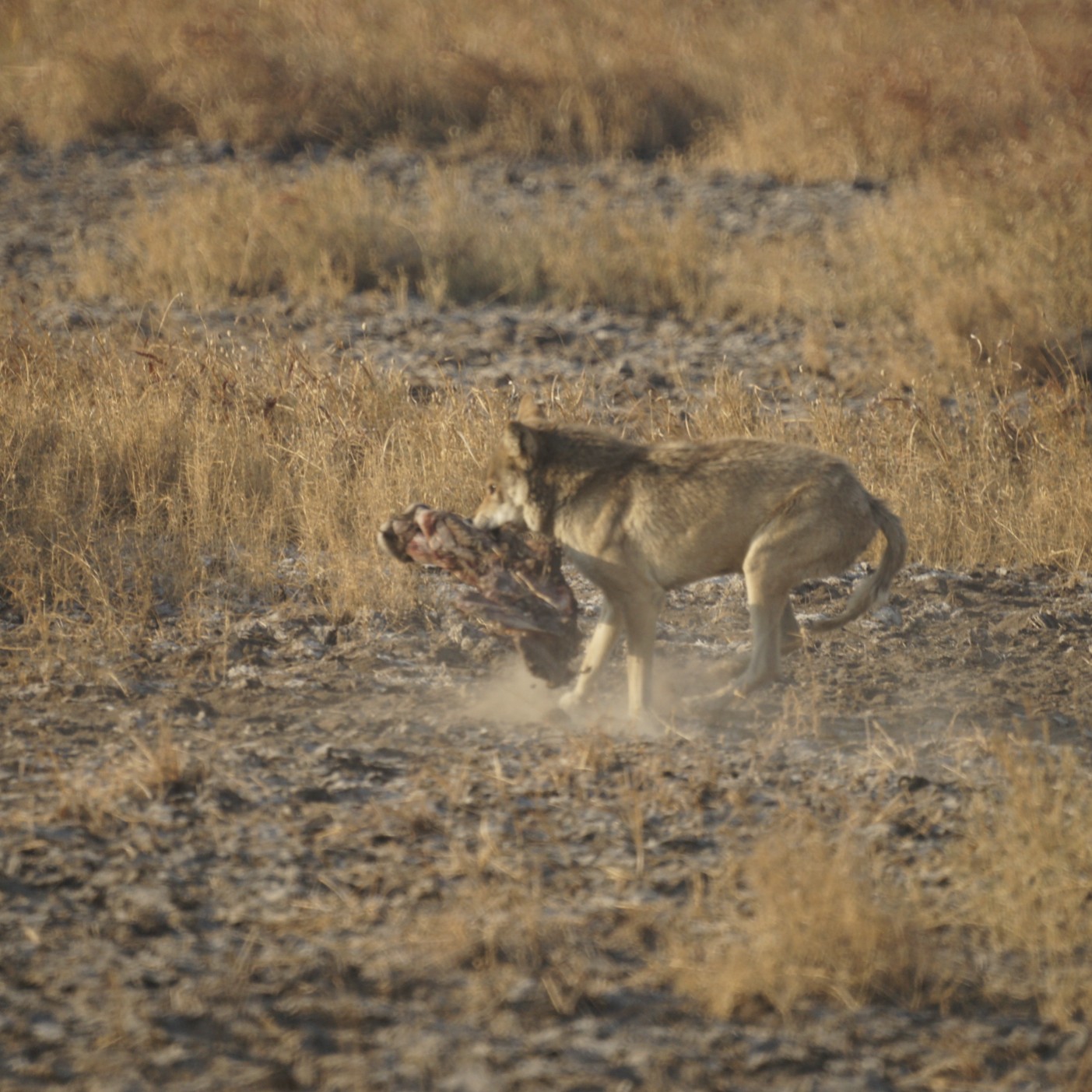
BlackbuckBlackbuck maleNilgai maleWolf
The wolf was in possession of a buffalo leg.
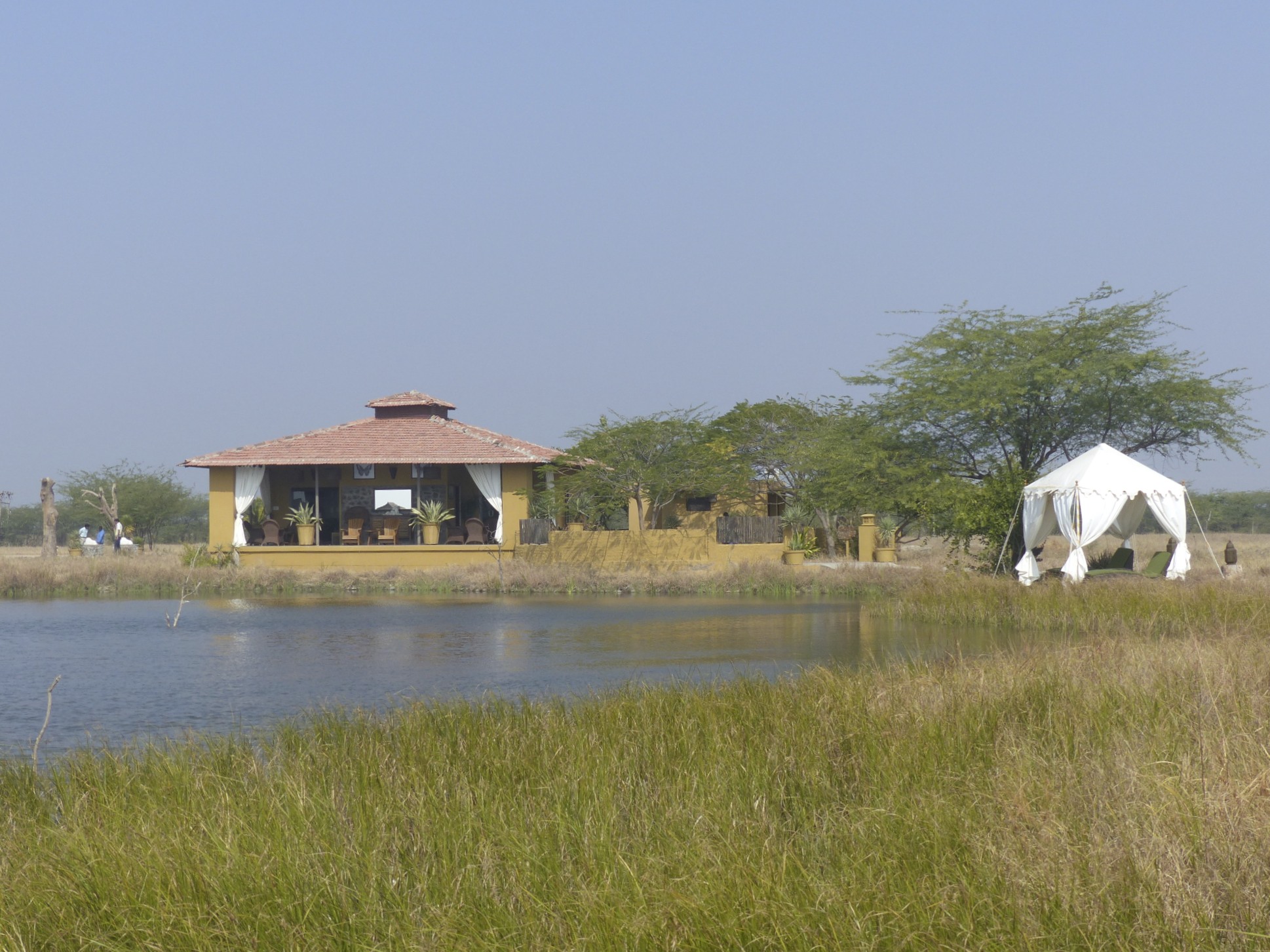
The obvious place to stay in Velavadar is the very comfortable Blackbuck Lodge situated only a couple of kilometres from the park gates …
and as you watch the sun go down over the mesquite you can contemplate a couple of lines from the Blackbuck National Park website …
The Park provides one of the world’s best roosting sites to thousands of Harriers that arrive here from Central Europe for wintering …
… An entirely different experience of the wildlife begins to transcend as the darkness falls. The persistent howls of jackal add to the feeling of true wilderness. The long, deep and threatening howls of wolves, occasionally penetrate the darkness .
… such a pity that the visitors had to be out of the park an hour or so earlier and won’t see the thousands of Harriers at their roost or be able to feel a shiver run down their spine as a wolf howls nearby.
My first contact with the Asiatic Lion came on my way to Gir. With about 20km to go, traveling through an agricultural landscape on a two lane highway we came to an enormous traffic jam, gridlock.
A lion had fallen into a well. It could not get out. The rescue unit from the national park were in attendance, they had sedated the lion, lifted it out of the well and caged it. The world had come to watch. There is no such thing as a small gathering in India. A small group is simply a coincidence, if they decide to gather expect a lac if not a crore*.
Once the mission was completed the crowd began to disperse and the traffic snarl slowly sorted itself out. My first sighting of an Asiatic Lion was a fleeting glimpse of a caged animal on the back of a truck awaiting resettlement.
The Asiatic Lion Panthera leo persica was well-known to the ancients, Christians were once an important part of their diet though Daniel was not, their former range spread from Bihar, northeast India, all the way to Turkey …
Given the chance lions eat livestock. This brings them into conflict with herders. They will return to their kill which means that revenge is easily visited upon them by poisoning the carcass. They are magisterial, they have been symbols of power and nationhood. It makes them excellent trophies, all the more excellent because they’re large, don’t hide during the day and can be easily approached on an elephant or in a vehicle. They will sit there for you while you load, have a cup of tea, discuss which room to display it in, aim and fire. Sport it never was, nor was courage ever required and someone who could actually shoot could always be next to you to make sure of success.
By the late 19th century, lions had been eradicated in Turkey. The last sighting of a wild living lion in Iran was in 1941 although it didn’t disappear from the national flag until 1980. By the advent of the twentieth century, they were confined to the Gir Forest protected by the Nawab of Junagadh in his private hunting grounds. There are said to have been only a dozen. This is likely to have been an underestimate, the first organised census was in 1936 which showed a population of 287 lions. Still a significant population bottleneck with genetic implications.
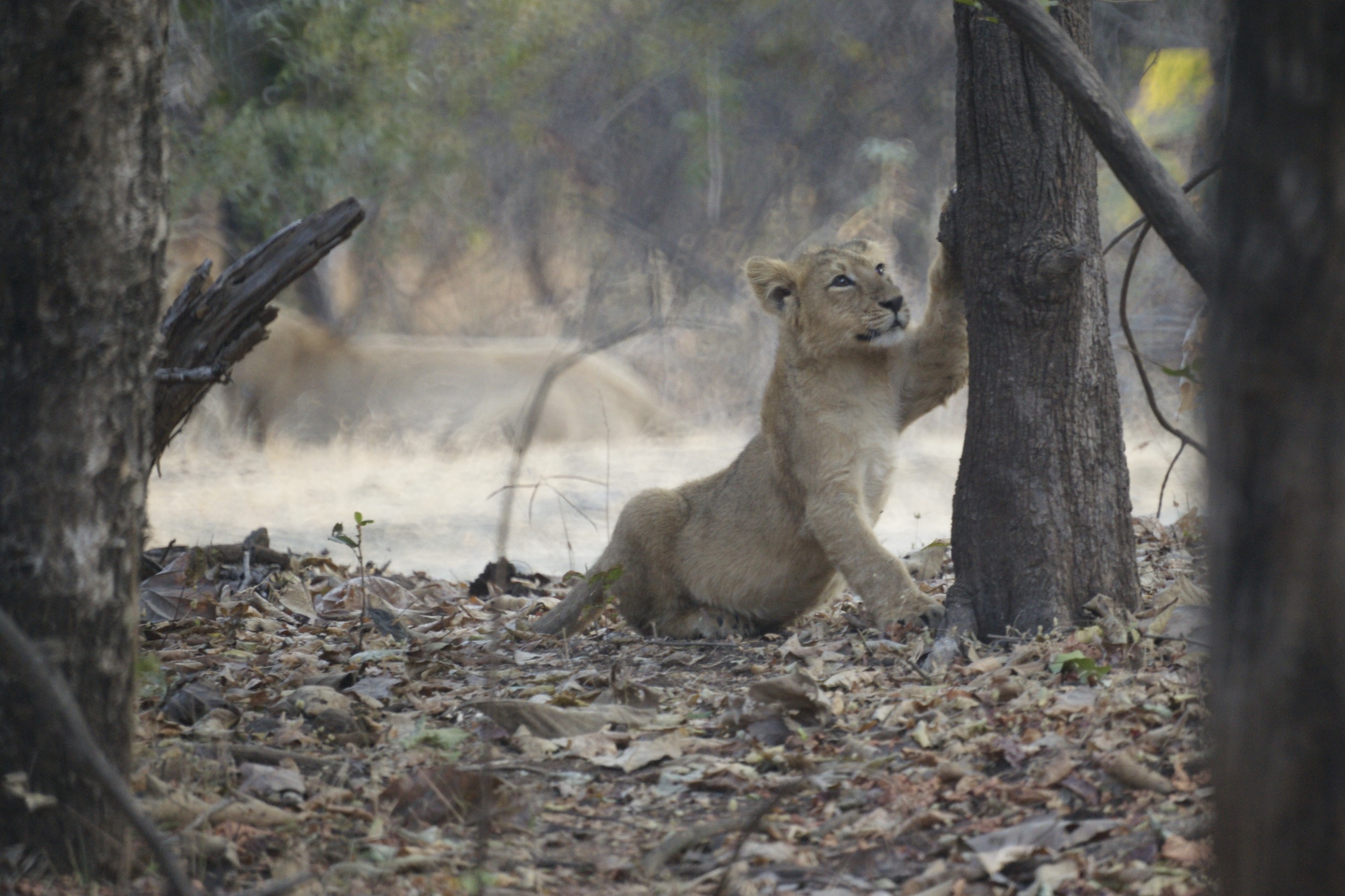
The Gir Forest holds the only population of wild Asiatic Lion. An area of 1,412.1 km2 was declared as a sanctuary for their conservation in 1965. There are now more than 400 lions which live in the park and the surrounding agricultural area. Conflict with people is not unknown but by and large the local people are very tolerant and well disposed to them, stock losses are compensated for by the government and tourism is a good little earner.
Tourism, however, is not something the Indian Forest Service does particularly well. The rules for access to National Parks vary from place to place and change frequently. At Gir there are three safari sessions per day, early morning, morning and afternoon, sixty vehicle permits are sold per session. Every vehicle is assigned a route to follow and must be out of the park by the end of the session. You will need your passport to establish your identity before being allowed in, you will not be allowed out of the vehicle. Visitors are not allowed in at night. Book an organised tour in advance. Always get to the gates early and complete the formalities otherwise they will bite into your time.
Once through the gate you are on a dusty road, probably in an open jeep known locally as a Gypsy. The forest is composed mainly of Teak trees but because the region is so dry these are not the huge trees you may expect. They have large leaves which were dry and dropping from the branches when I was there. It pays to cover your binoculars and camera whilst on the move to keep the dust at bay, and remember it will be cold in the early morning.
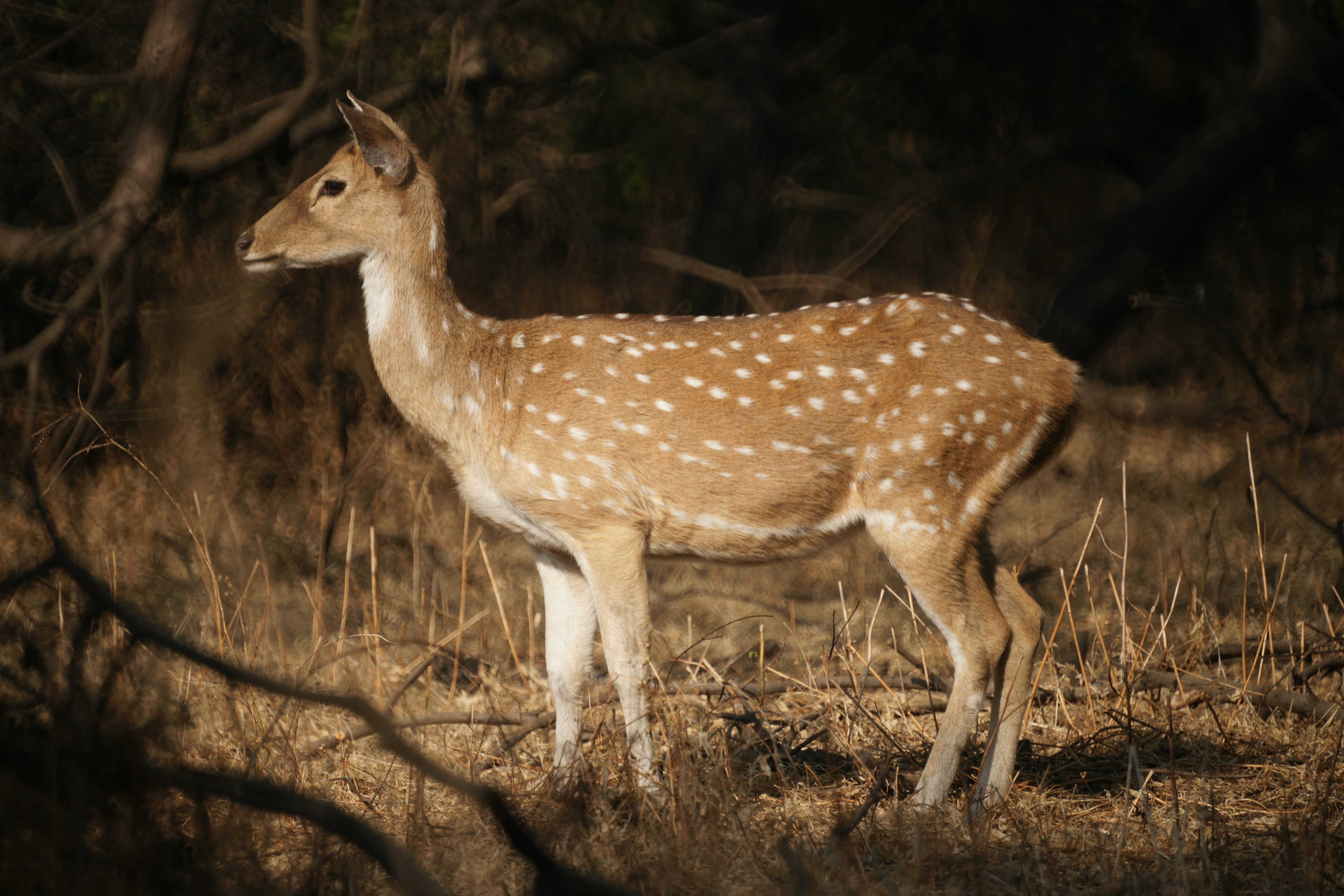
There are plenty of Sambar and Spotted Deer (Chital) and plenty of birds although chances are the other occupants of your vehicle are only interested in the Lion or even better a Leopard.
Spotted Deer
I went on seven consecutive safaris and saw lion every time, it’s not impossible to miss out but you would be very unlucky to fail if you took three or more.
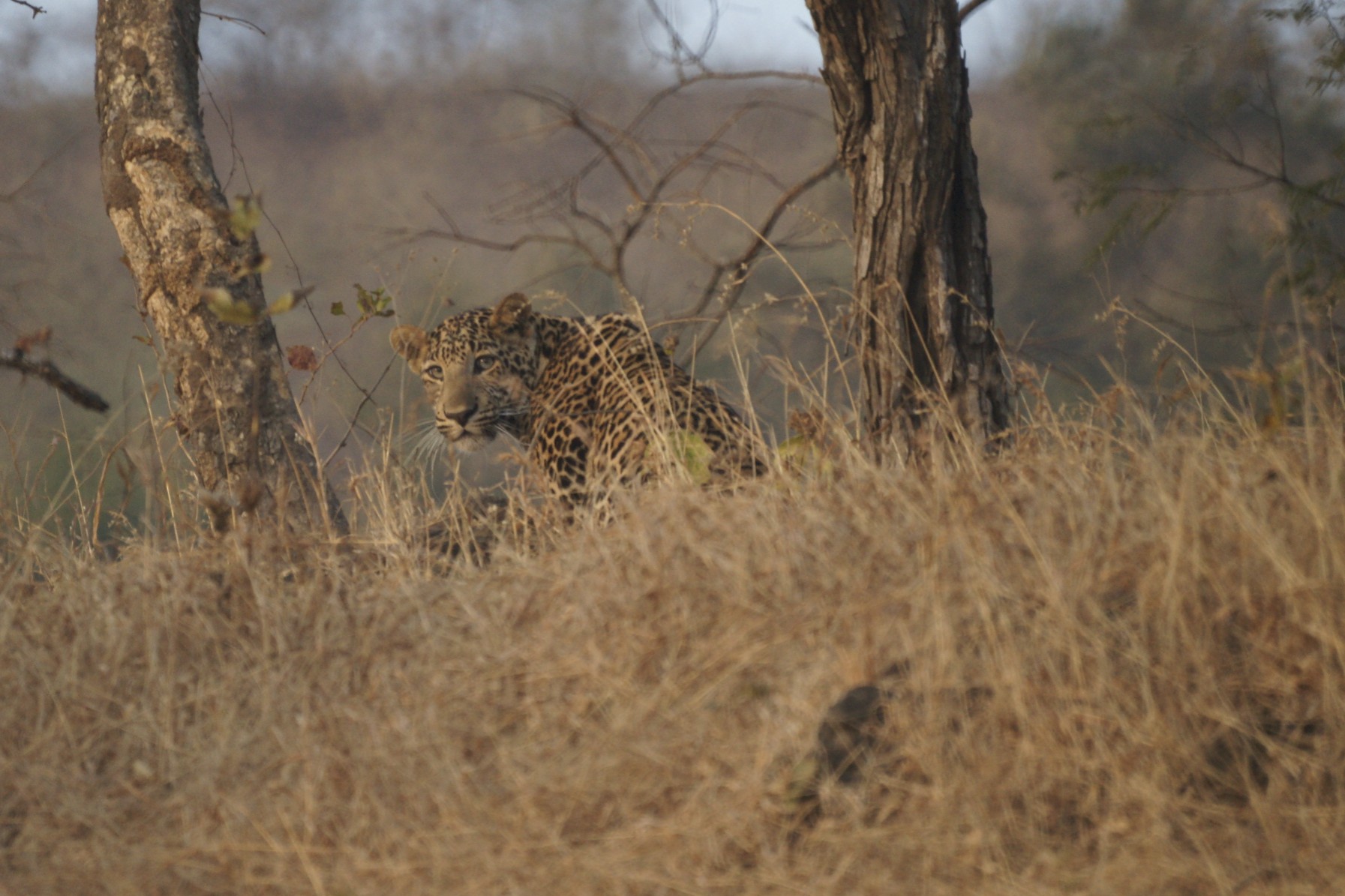
Leopard are widespread in India but are much harder to see than lion. Count yourself lucky if you get so much as a glimpse. Count yourself blessed if you get a shot like this …
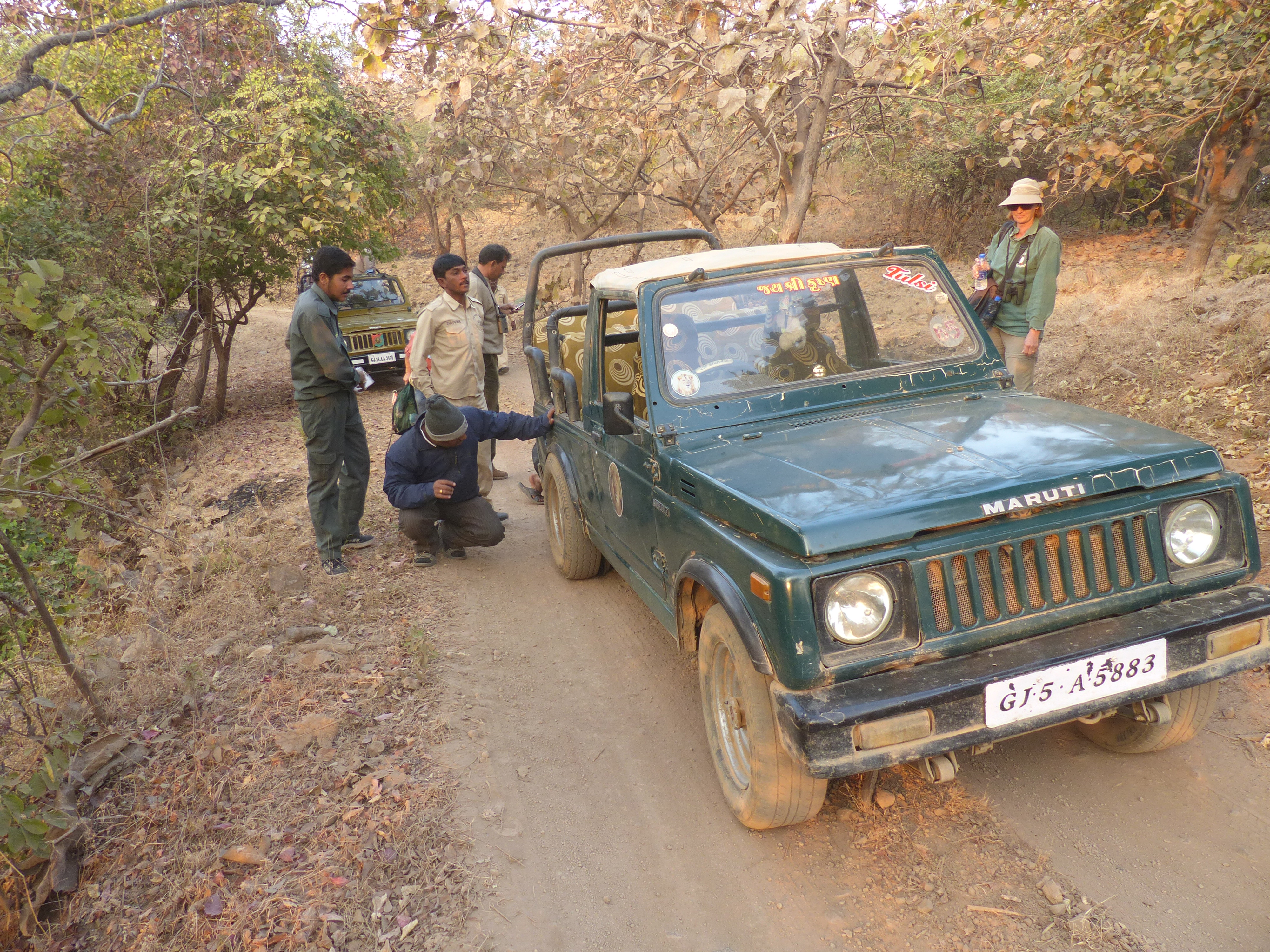
Regular readers will be aware that I do not have an unblemished record with four-wheel driving in wild places. This is the one time we were allowed out of the vehicle and for once it was not me at the wheel, although I was sitting in the corner that collapsed …
We were rescued by the jeep behind, the occupants scrunched up and we scrunched up and off we went. All with a gentle good humour and really that was what we received almost all the time.
*Notes …
The maps above were shamelessly filched from wildanimalelite.yuku.com which is worth a visit for its beautiful photographs.
The Indian system of numbering things is a little different from the West’s. As with our system, digits are separated by commas for ease of reading. The first comma goes before the last three digits, just where we would put it (1,000). After that, though, it separates every two digits (10,00,00,00,000). So after one thousand the next big one something is 1,00,000 which just cries out for a name of its own which it has. It is a Lac. The plural of Lac is Lakh. Two lakh = two hunded thousand.
Similarly, a Crore is 1,00,00,000 which we would render 10,000,000 and call ten million. You will need to know this if you wish to make sense of the Times of India.
A single small population has a precarious hold on existence. Smart mammal scientists in India would like to see more populations of Asiatic Lion (re)established elsewhere in suitable habitat. A sanctuary has been created in the state of Madhya Pradesh. It is almost as large as the Gir reserve and is said to hold good numbers of prey animals. State politics is the principle hurdle. Madhya Pradesh has tourism aplenty because of its tigers, Gujarat is unique in its lions but has no tigers. The matter has been to the Indian Supreme Court and was found for the reintroduction, the hearing of an appeal by the Gujerati Government is pending. Good luck lions.
Security is tight at Indian airports. To get into the departure terminal you must show a printed itinerary showing your name, destination, flight number, date and time, accompanied by your ID, which for foreigners means your passport. Your friends say their goodbyes on the pavement.
My destination was Gir which is in the state of Gujarat immediately north of Maharashta of which Mumbai is the capital. The nearest airport is Diu, the flight takes about an hour.
India is composed of 28 states and seven union territories. Daman and Diu together make up one of the territories. Along with Goa, Daman and Diu were excised from India by the Portuguese. When India gained control the trio were governed as a single territory, Goa was given statehood in 1987 leaving the two small enclaves of Daman and Diu, 198 kilometers apart, each surrounded by Gujarat. This has enormous practical importance, Diu is a small but busy seaside resort, Gujarat is a dry state. Lunch was accompanied by a couple of refreshing beers.
Then the drive to Gir, as a passenger of course.
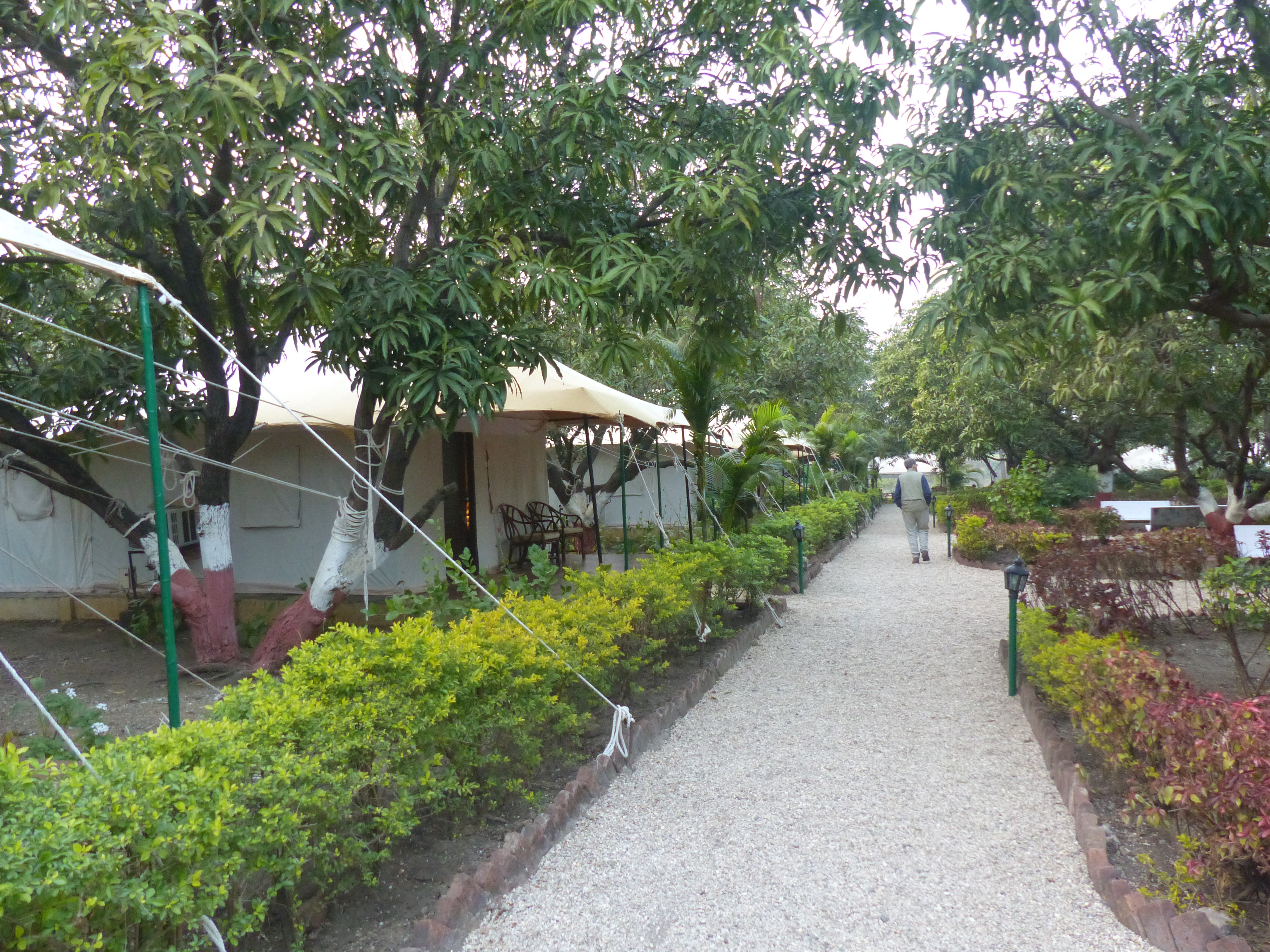
No palatial accommodation for me here, although that isn’t to say that good hotels aren’t available. For me one of these tents …
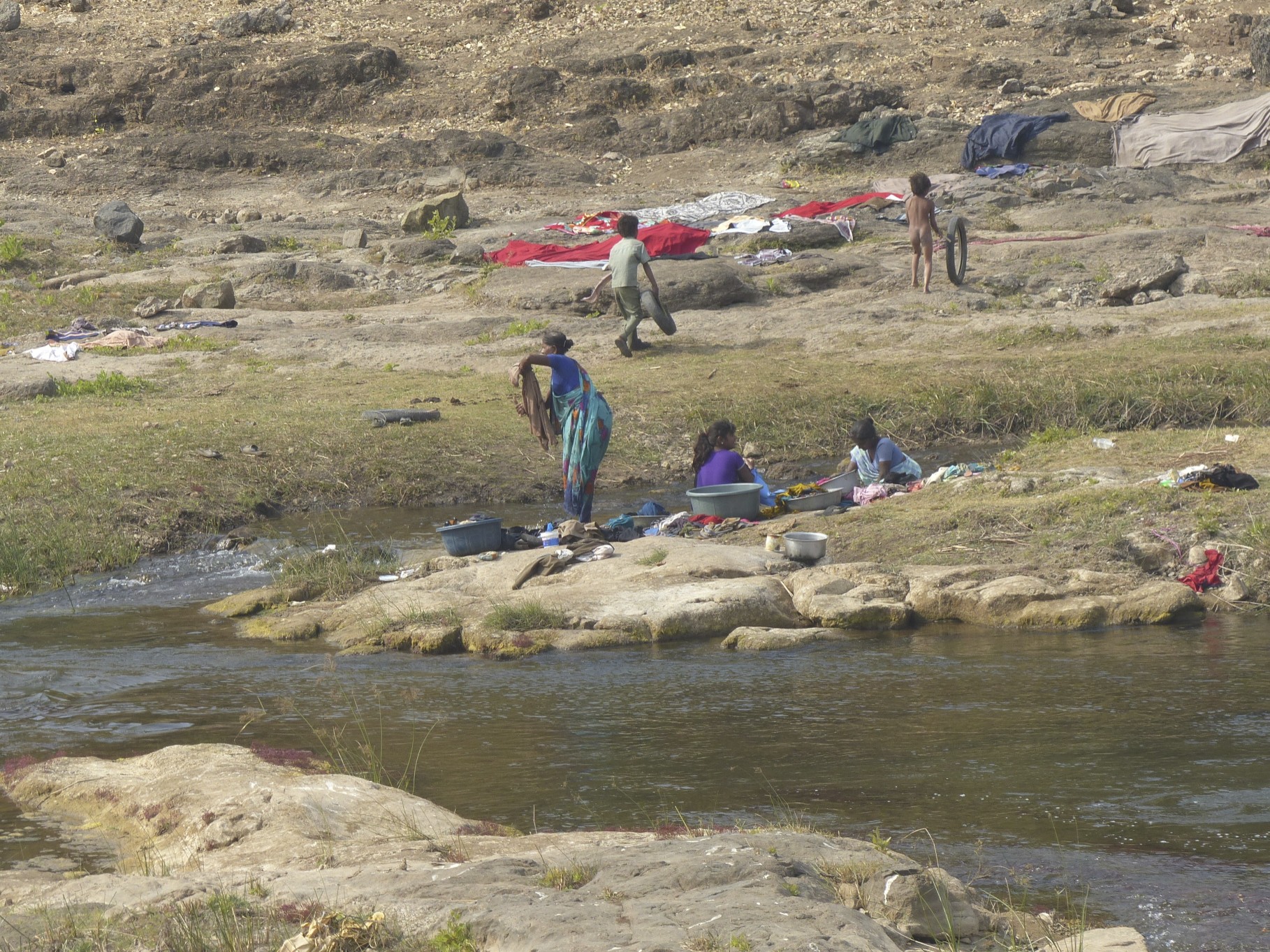
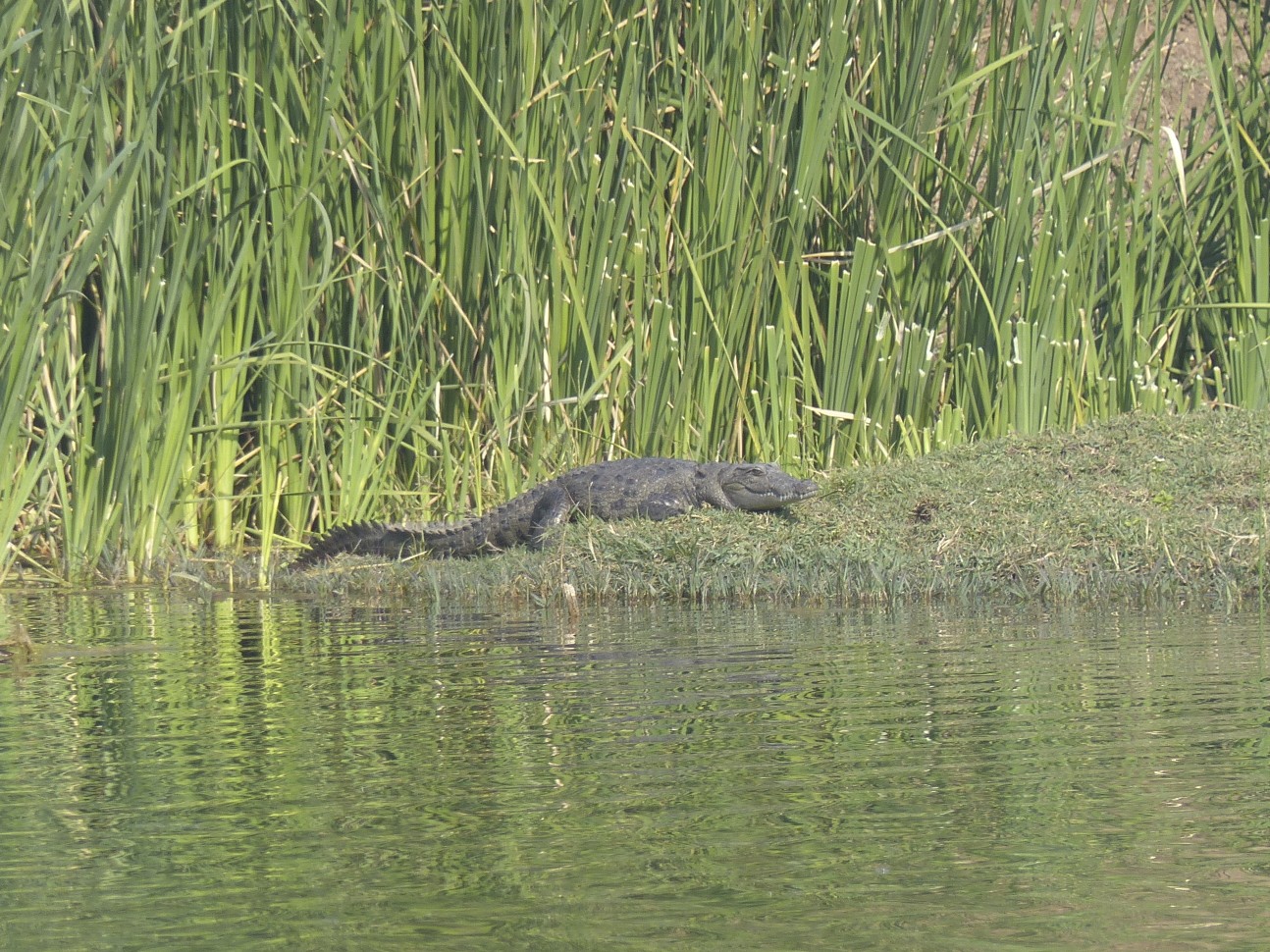
This is the Lion Safari Camp near the small town of Sasan Gir. The lions are a respectable distance away and the tents come with en suite facilities, hot and cold water and plenty of headroom. The camp is situated on the banks of a river, you don’t have to go far to find plenty of birds, the laundry, swimming pool and the odd Mugger Crocodile.
It’s reported that the Mugger is more famous for its tool use than it is for eating people. It is known to balance sticks on its head, birds, especially in the breeding season are tempted to take the sticks … swirl of water, snap, lunch.
I spent the next three nights at the camp making seven forays into Gir National Park and any spare daylight time birding around the river.
I caught the boat to Elephanta from just across the road from the Taj Mahal Palace Hotel. It’s a 10km trip. Photography is forbidden on the boat because the journey takes you past the naval docks. The navy was in town in a big way in readiness for the national day celebrations on the 26th of January, by a strange coincidence the same date as Australia’s.
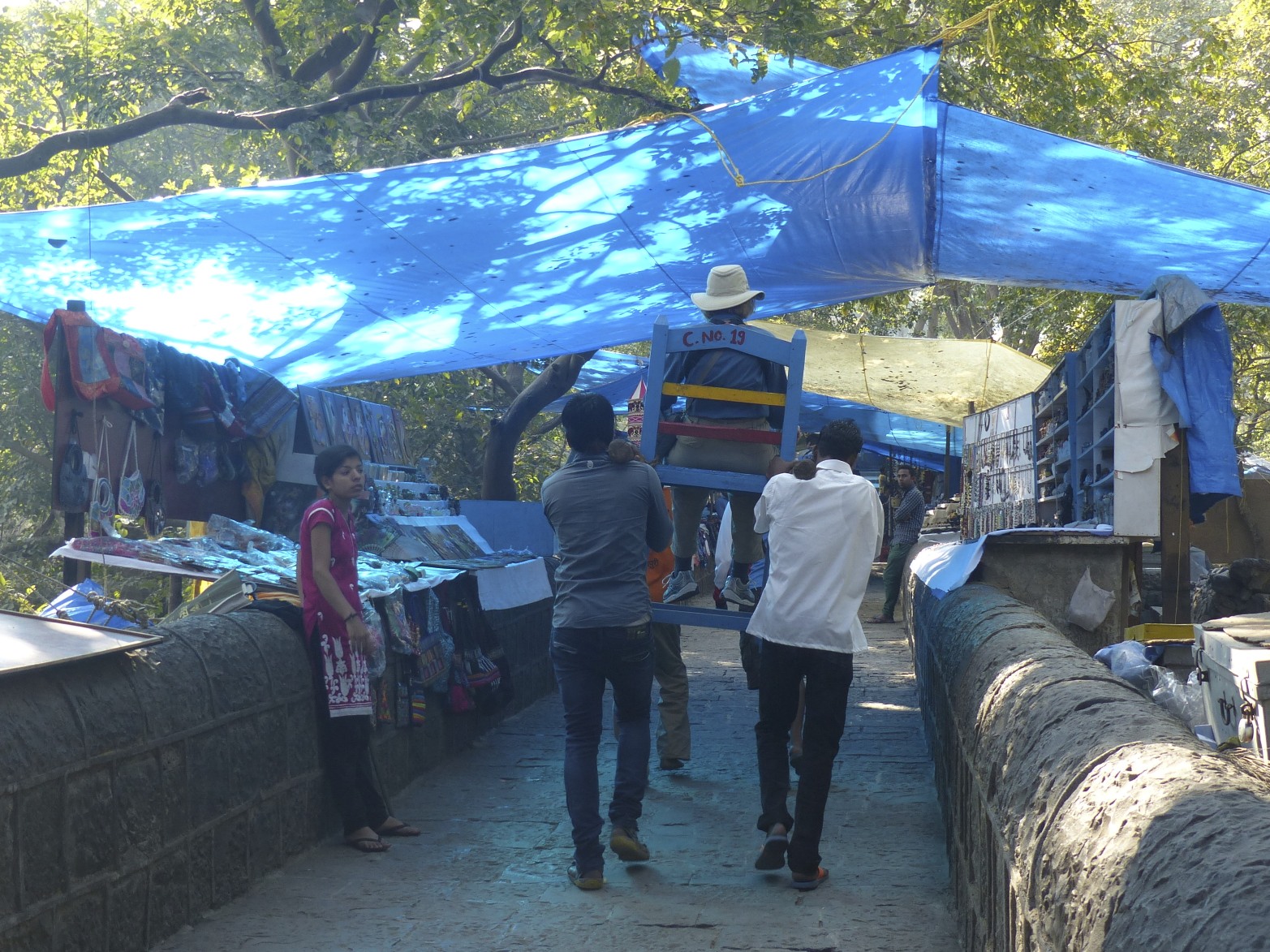
The island is the site of seven caves that were carved out of the basalt rocks probably between the fifth and eighth centuries. There is a cluster of five Hindu caves and away from them there are two Buddhist caves. The journey from the pier to the caves takes you up a fairly steep stepped slope between stalls. The weary traveller is shaded from the sun by tarpaulins. For those that are too weary to walk there are sedan chairs …
Chadstone Shopping Centre may not have Beware of the Monkeys signs or sedan chairs but there is at least one thing in common – just as Chadstone boasts 500 shops which really equates to five shops 100 times over, so too with the stalls, the same few themes again and again.
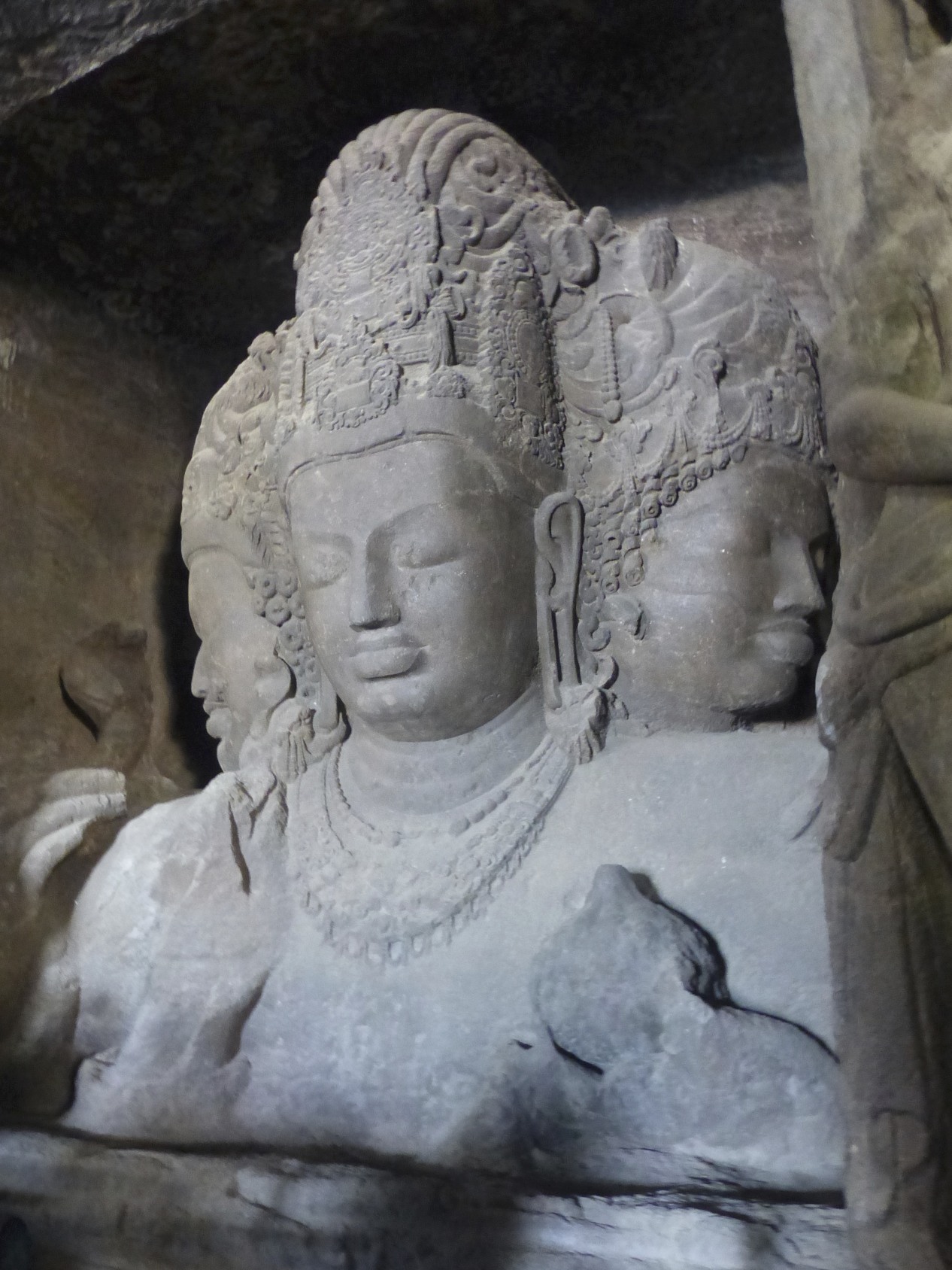
The main cave is a Hindu cave dedicated to Shiva. The central hall is a little over 25 metres by 25 metres, containing carvings and shrines. You can find more detail and a map <HERE>. The carvings have suffered over the centuries but are still very impressive …
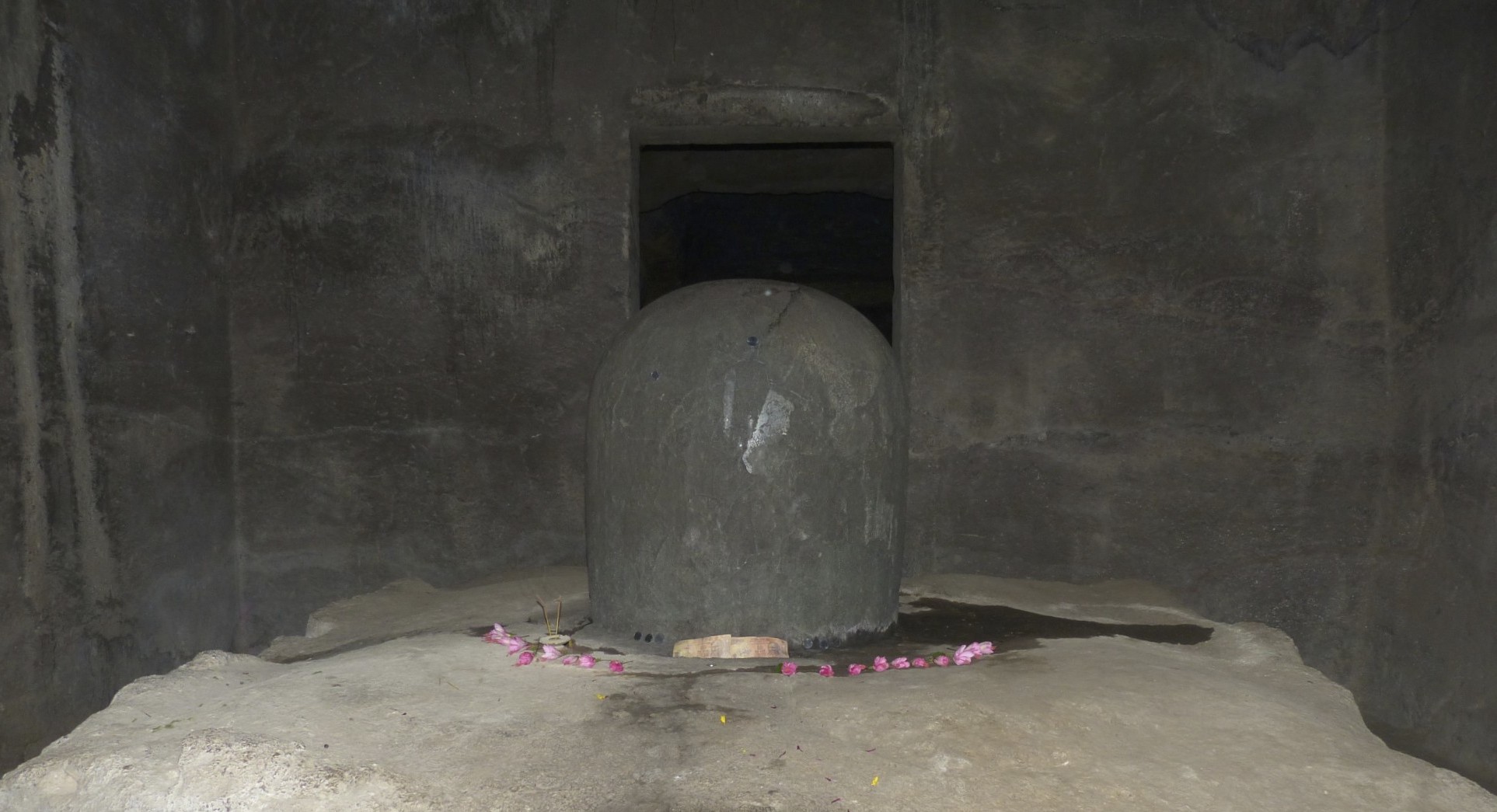
Above is the Trimurti, to be found on the rear wall. Below is the Linga which is set on a raised platform in a shrine …
It is of striking size, much bigger than mine although I do think mine has more pleasing proportions.
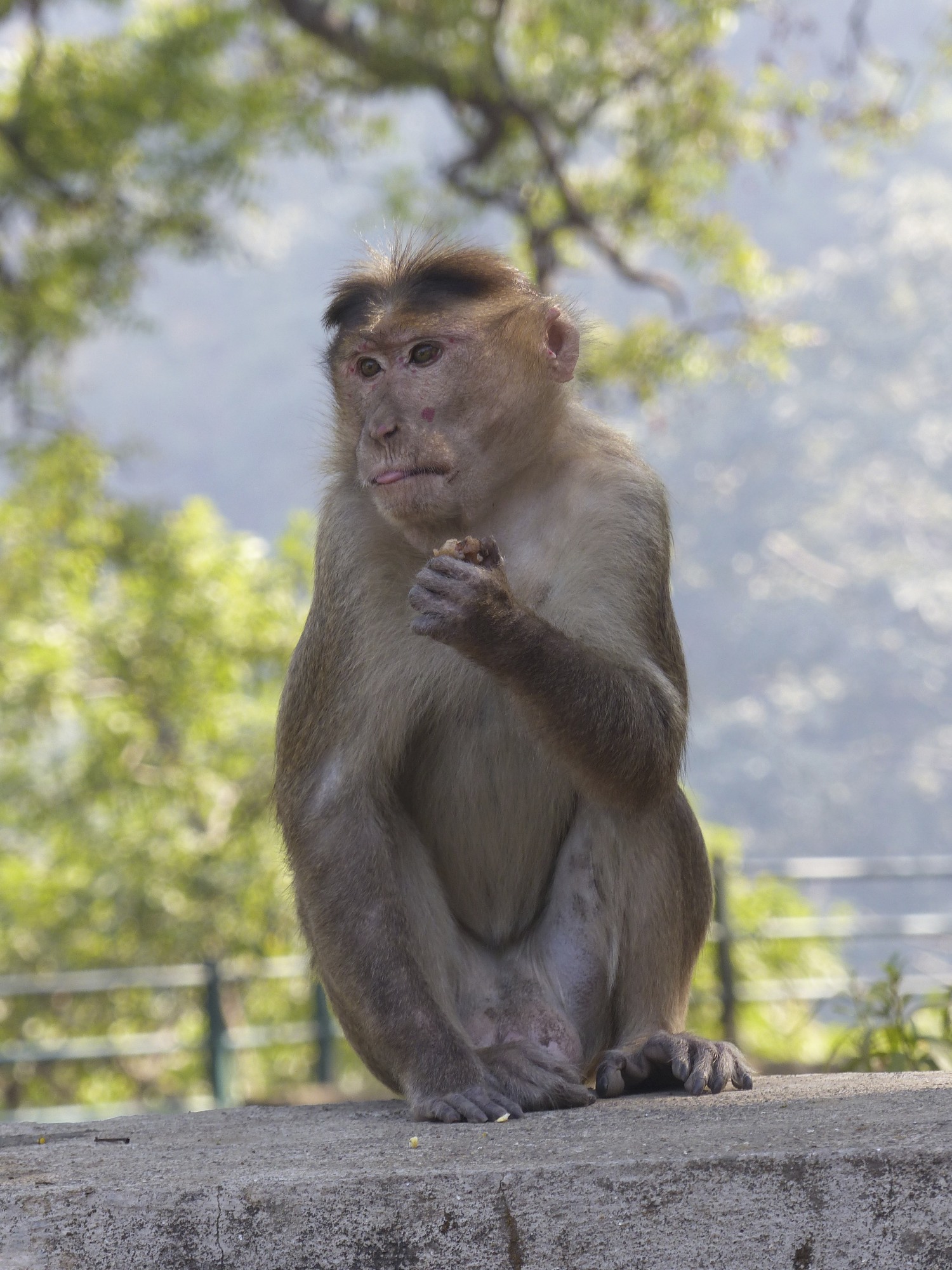
Outside the cave one can make the acquaintance of the local Bonnet macaques, Macaca radiata. These guys are serious snatch and grab artists, it is unwise to be holding food or even bottled water. They unscrew bottle tops in exactly the same way as we do, drink the contents and then toss the empty aside.
Travelling with a group you may be pushed through here at a faster pace than the island deserves. Travelling independently the bird watcher would be well rewarded by spending some time at the fringing mangroves where there are some waders, egrets and kingfishers to see. The odd Brahminy Kite passes over and Flamingoes are occasional visitors.