The French Line …

We had come here to enjoy the desert not conquer it. We’d knocked off the 1900 km to Hamilton in four days, an average of 475 km a day. For the next six days we would average just 88 km a day. This would keep us driving for as much as four hours a day but give us plenty of time to stop for anything that sparked our interest.

French Line

The desert was carpeted in wild flowers. I was surprised at how densely vegetated it was. Birds and reptiles were well represented but we saw little in the way of mammals. There were plenty of camel tracks and some camel droppings … by the way, these look like horse shit designed by a committee. To that can be added one House Mouse and a dingo.

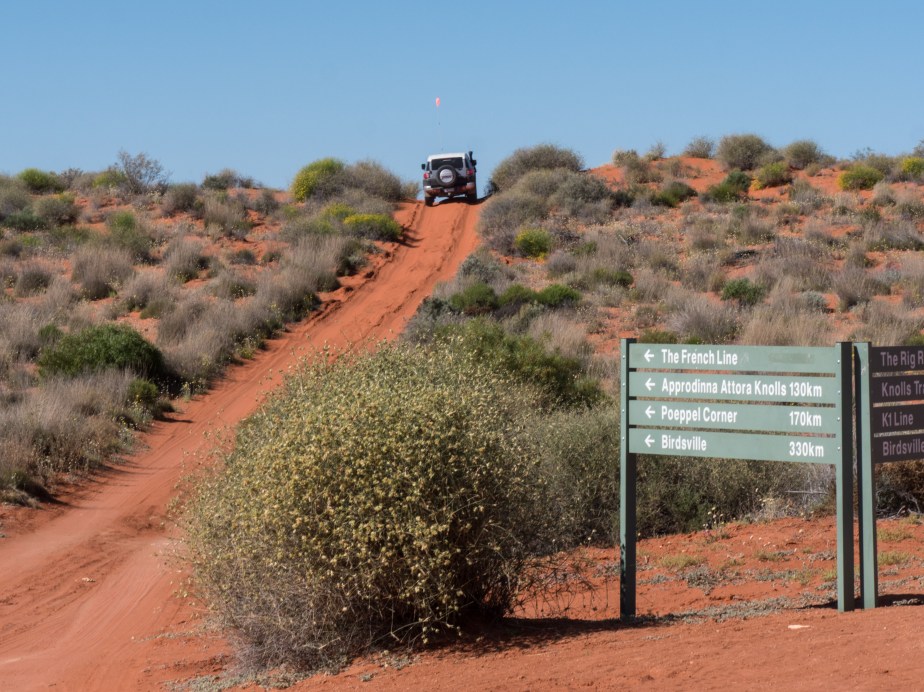
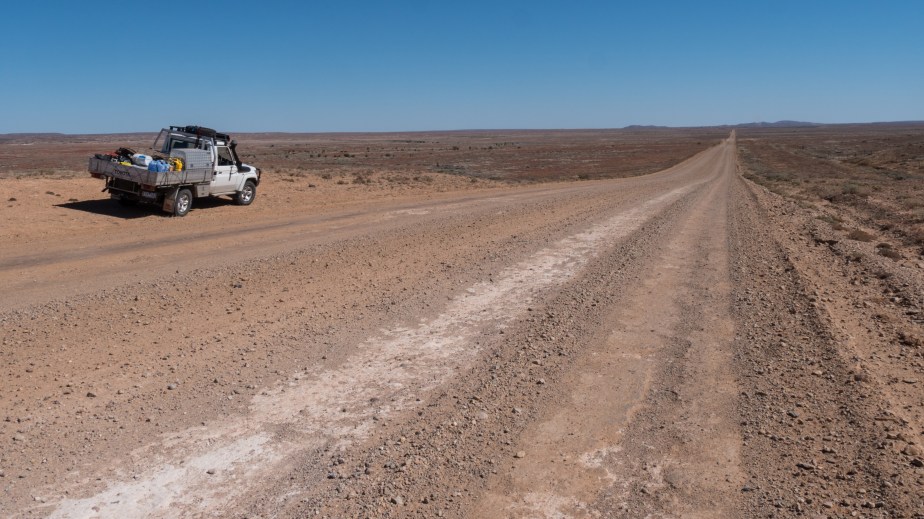
For all its awesome reputation driving the French Line west to east presented no great challenge. Concentration was required, you needed just enough momentum to ease you over the crest, too much would rearrange the contents of the vehicle unnecessarily. There was often a moment when all you could see was the bonnet and the sky. When the road came back into view it wasn’t guaranteed to be straight ahead.

The dunes trend SSE-NNW and continue parallel for many kilometres, some as much as 200 km unbroken. This pattern is seen throughout the deserts of Australia. The height and spacing between the ridges have an inverse relationship. Where there are 5-6 ridges in a kilometer, the height is around 15 meters. Where there are one or two ridges per kilometer the height jumps to 35–38 meters. Dunes on the west of the desert are mostly small but they increase in size as you head east. The eastern faces are not only steeper, they are also longer. (No you don’t get further and further below sea level, you climb quite gently across the interdune space before reaching the next challenge.) Where dunes are close together the surface in between mostly remains sandy but where they are widely spaced the surface is often clay – much more of a challenge than sand when wet.

In places the track is scalloped, this effect is blamed on the drivers who fail to lower their tyre pressure and those who insist on towing camper trailers although I think injudicious use of the brakes on the downhills is just as much to blame. On steep faces the scallops are out of phase, your left wheels go in as your right wheels come out, it feels like riding a camel. On lesser slopes they are side by side. Either way the wave length is the average length of a vehicle.

During the second night a cold front passed through. It brought no rain but the wind drove sand into everything. I woke with sand in my sleeping bag, even some between my teeth.


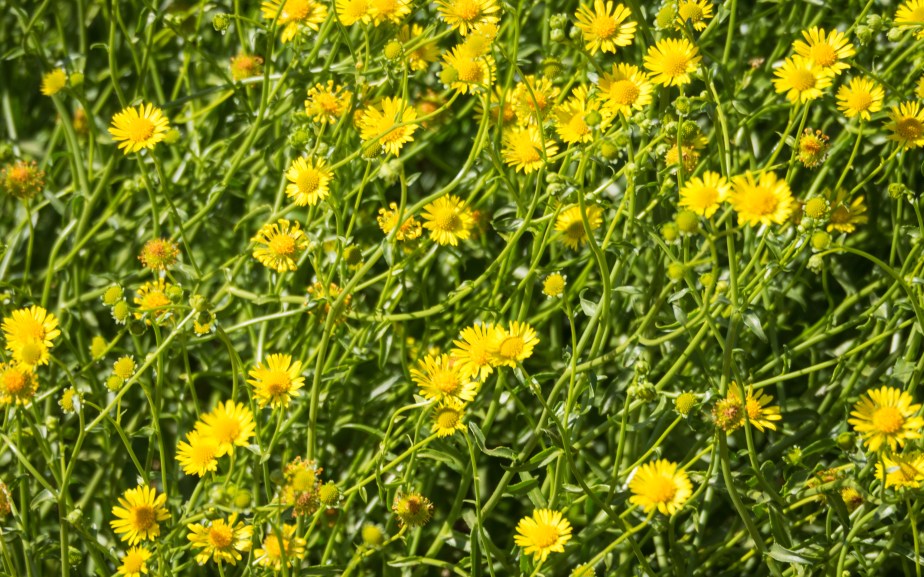
Regal Birdflower
Regal Birdflower
Fleshy Groundsel
Fleshy Groundsel
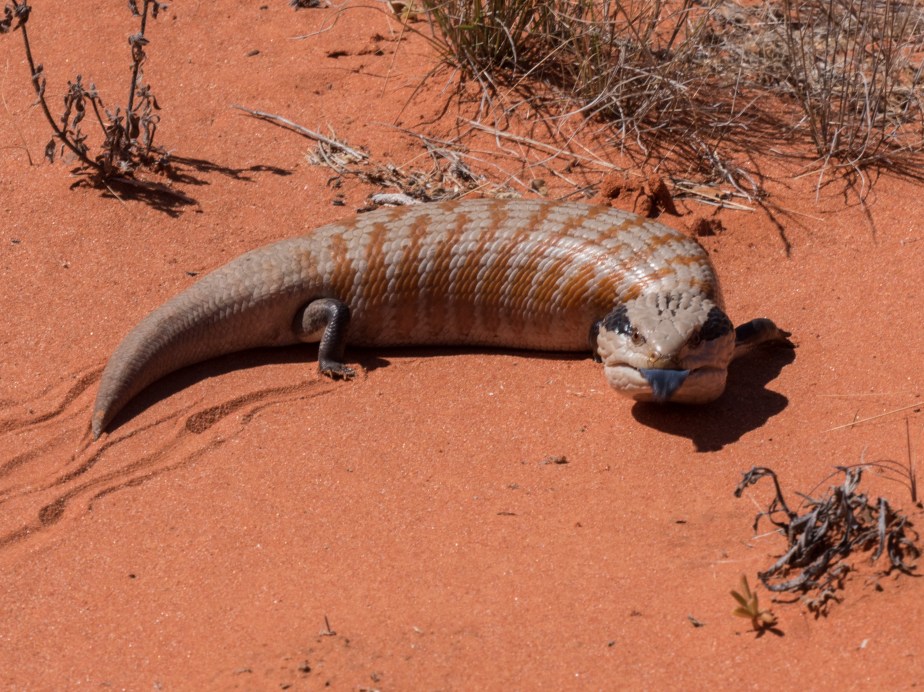
Central Blue Tongue
Central Blue Tongue
Central Netted Dragon

The desert has a stark beauty. Visiting is a little like scuba diving … we don’t have the means to live there but we can take what we need to enjoy it for a short time and come away looking forward to the next time.

Moon rise over the saltbush
A full moon rises over the saltbush.

Sand …

To see a World in a Grain of Sand
And a Heaven in a Wild Flower 
Hold Infinity in the palm of your hand 
And Eternity in an hour
                                      … William Blake

The road beyond Dalhousie Springs had not been graded and had a challenge for every season, clay pans for the wet, dunes for the dry and stones to puncture the tyres at any time at all. The corrugations were ferocious – we were carrying hard-boiled eggs that were actually peeled for us by the vibrations. Vehicle contents were redistributed freely – note to self, screw top lids are a really good idea. They would have saved scooping up the sugar off the floor of the car.

At Purni Bore it all changes. No more stones, corrugations become far less arduous. This is the start of the sandy desert. Time to drop the tyre pressures to 18 – 20 psi.

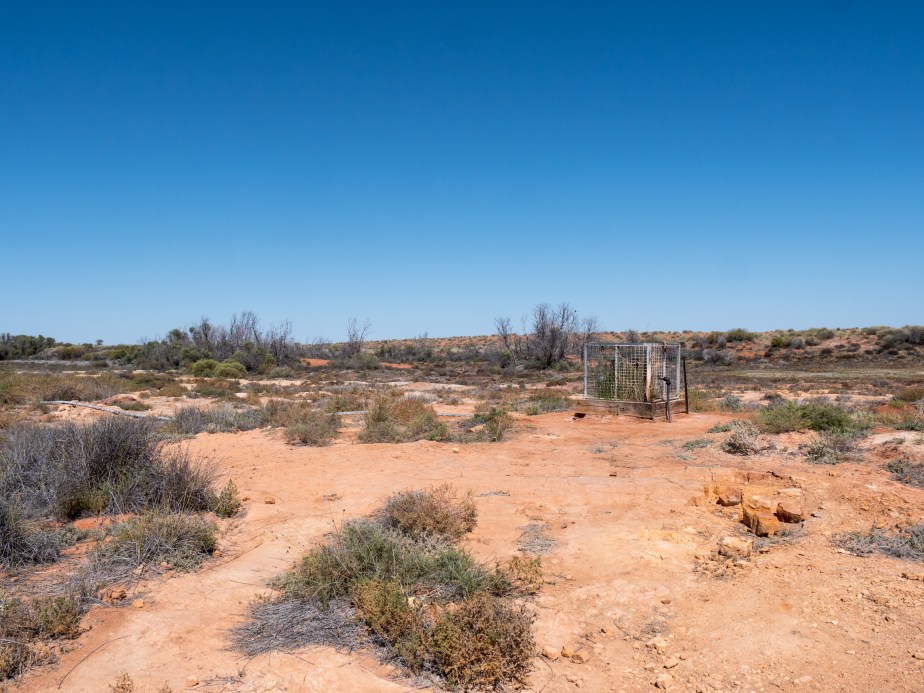
Purni Bore
Purni Bore

Soon we leave Witjira National Park and enter the Simpson Desert Regional Reserve. Before long we are cresting the first dune on the French Line. The first of many, you could count them, but be aware, if you get confused tradition dictates that you go back to the beginning and start over.

Intersection

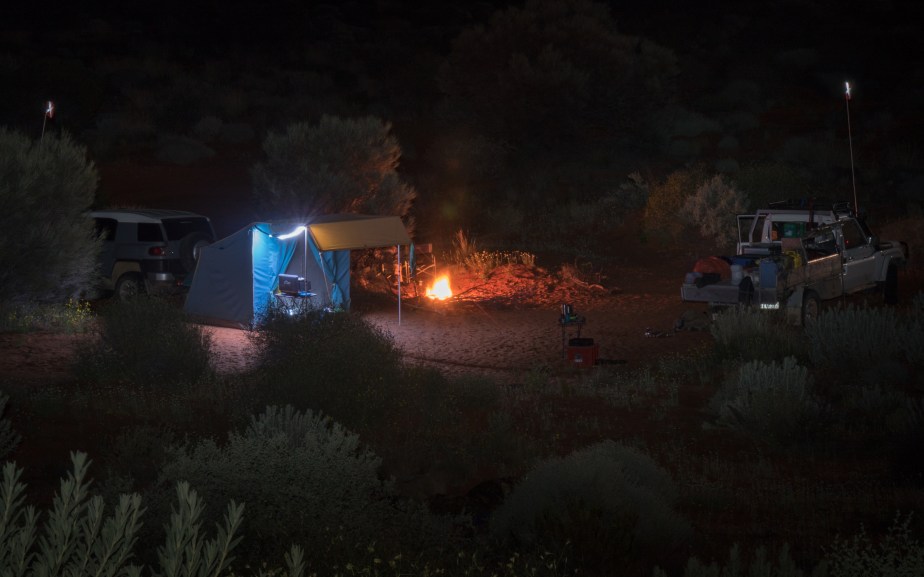
Camping restrictions are eased. We can now camp anywhere within 50 metres of the road.

Desert Camp

by Night


Witjira …

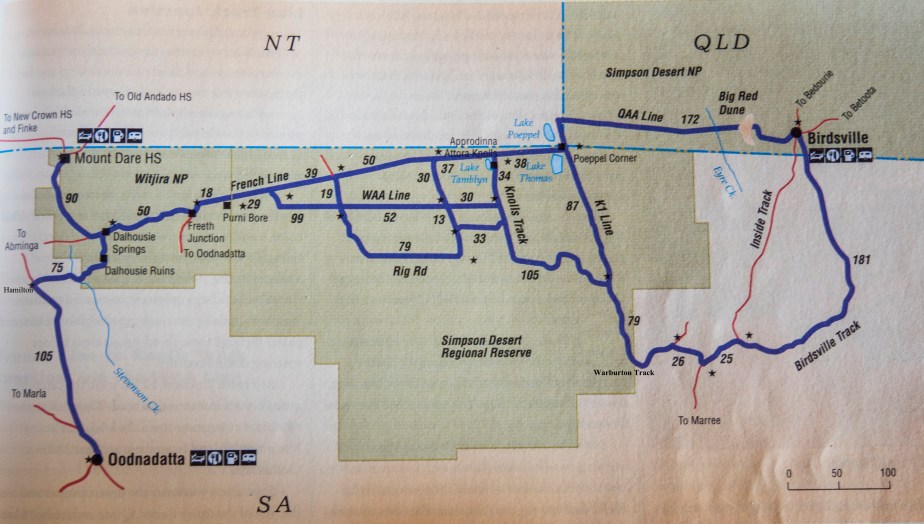
The map below gives you an idea of the possible routes through the desert. If you click on it it will enlarge sufficiently to be readable, the back arrow on your browser will bring you back here. Study it for a while, I’ll ask questions shortly …

SD Map

You do need a Desert Parks Pass to enter the South Australian section of the Simpson, when you buy that you will also receive some better maps but they don’t photograph well.

Our route was as straight forward as it gets, north from Oodnadatta to Hamilton, north-east to Dalhousie, east along the French Line, Poeppels Corner, north to join the QAA Line, east to Birdsville. Just a simple matter of cresting more than a thousand dunes.

The sand doesn’t actually start until Purni Bore. The road from Hamilton to Dalhousie Springs had been graded since the last rains. This was a pleasant surprise because we knew it had been cut up badly not long ago and we expected difficult going. There was just one spot where we needed 4WD, a wet creek crossing with muddy approach and departure.

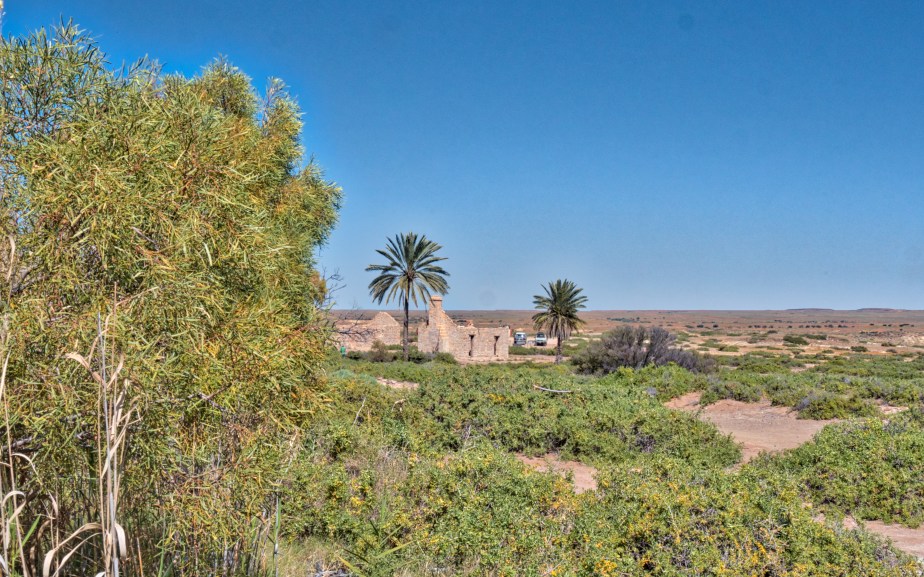
After a while we entered Witjira National Park which once was the Dalhousie Station and before long we came to the ruins of the homestead …

Dalhousie

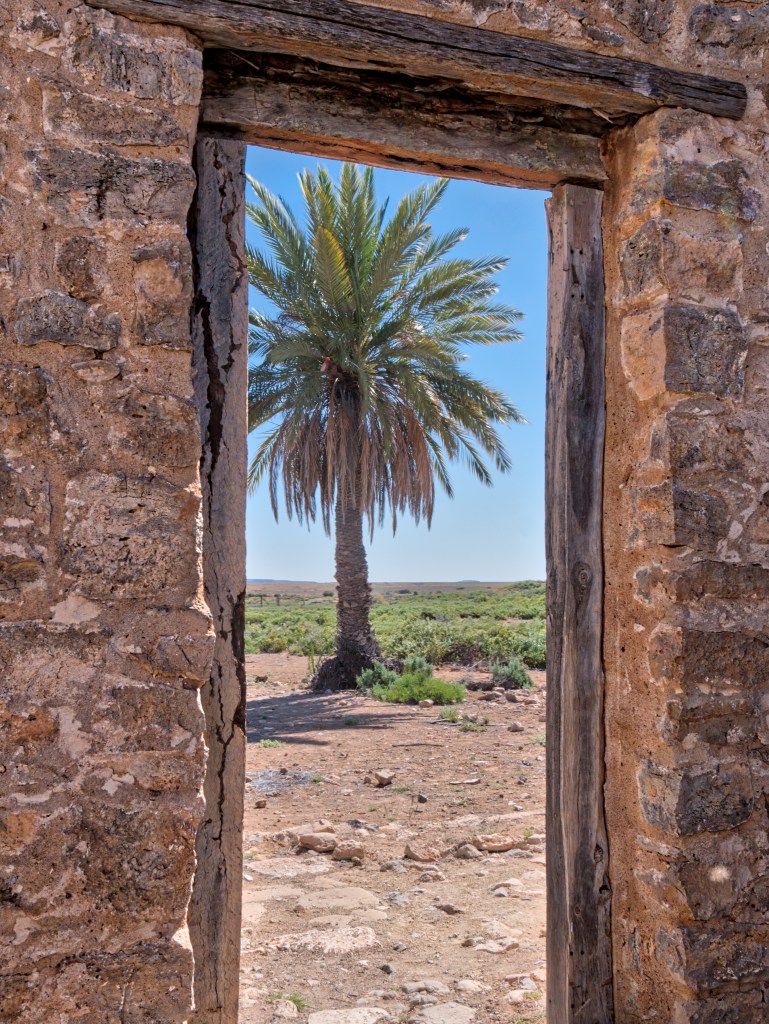
Dalhousie

The Dalhousie lease was granted to the Bagots in 1873, the home stead is situated adjacent to a reliable mound spring. Date palms were introduced very early in the piece and thrived on the springs to the detriment of everything that belonged there. The Parks service have removed all but a few male specimens.

We made a fairly short day of it and camped at Dalhousie Springs. This is another collection of mound springs, one of the resulting pools makes a splendid swimming hole, as large as  an Olympic swimming pool, about two metres deep and warm. It even has steps to help you in and out. There are some nice walks that take you through the Melaleuca woodlands supported by the springs and there are plenty of birds.

This Singing Honeyeater is just a juvenile which is evident from the yellow gape. Its parents were still feeding it but it did pick up food for itself as well. The name, Singing, was obviously bestowed by someone with rose-tinted hearing aids.

SiH

The arid zone seems an odd place for a cormorant, but this Little Pied Cormorant was perched above the swimming hole on the look out for a Dalhousie Goby or any of the other fish endemic to the region.

LiPdCormt

A dingo visited us shortly after sunset. We had heard them on previous occasions but this was the first one to show itself.

The campsite itself though is bleak and the population density is considerably higher than where you live (even if you come from Tokyo). The toilets are suitable for anyone with a working in confined spaces ticket and breathing apparatus. I would suggest tying a rope around your middle so that a safety observer can pull you out should you not emerge within a few minutes.

There are only three sites where you can camp in Witjira. The next site on our route being Purni Bore. Older accounts wax lyrical about the birding at Purni but the bore has been capped and it no longer seems all that exciting. It may have been better to go slightly out of our way and camp at Three O’Clock Creek, just stopping for a walk and a swim at Dalhousie on our way through.

Next time …

This is where we fitted our vehicles with their dune flags. The last thing you need on the crest of a dune is a surprise encounter with a vehicle headed in the opposite direction. The flags are visible before the front bumper.

Time as well to switch the radio to UHF channel 10. Chatter between other vehicles is often the only indication that you are not alone although occasionally someone has the wit to let the world know where they are and which way they are going.


Desert fringe …

At Oodnadatta we filled our fuel tanks.  Just as they reached the point where they could take no more we crept up behind the vehicles with a brick in each hand and clapped them together on the differentials …

We needed to travel about 650 km to the next fuel, we also wanted the option of taking any detour that might be necessary or desirable. Both the FJ Cruiser and the Landcruiser will do about 1200 km of country road on full tanks but we anticipated higher consumption in the days ahead. We took an extra 40 litres for each vehicle in Jerry cans.

We also topped up our water supply which we carried in a number of containers, we had already had one rub through because of corrugated roads – beer cans, too, needed careful scrutiny and emergency consumption at the first sign of deterioration. We travelled on with five days regular supplies plus a week’s reserve.

Just north of Oodnadatta we parted with the main road which goes on to Marla. Instead we headed to Hamilton Station where they have a very fine campsite about a kilometre off the road. We had up to this point been putting in big days of driving now it was time to smell the roses …

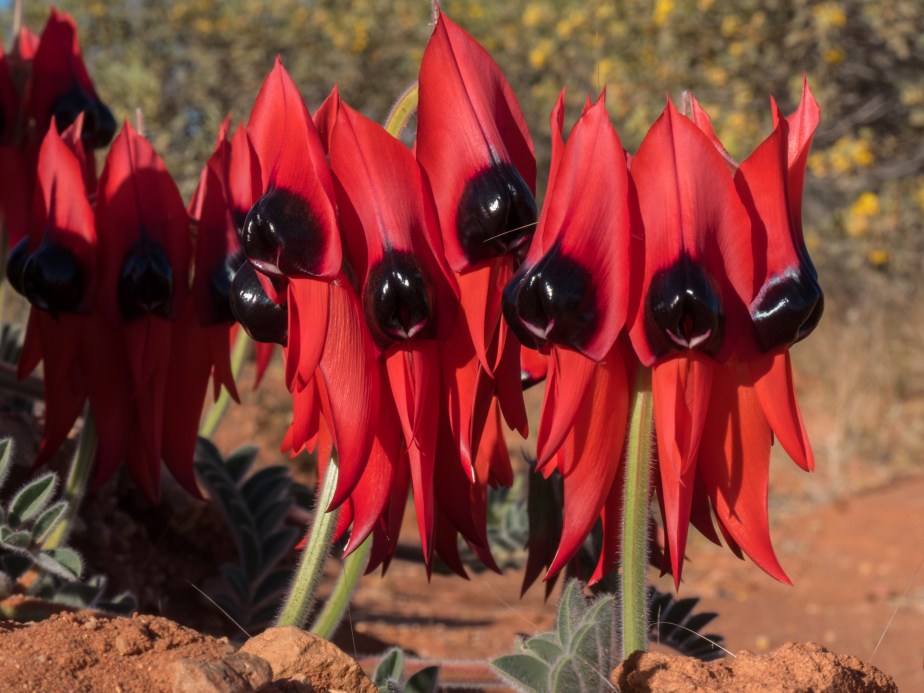
Sturt's Desert Pea
Sturt’s Desert Pea
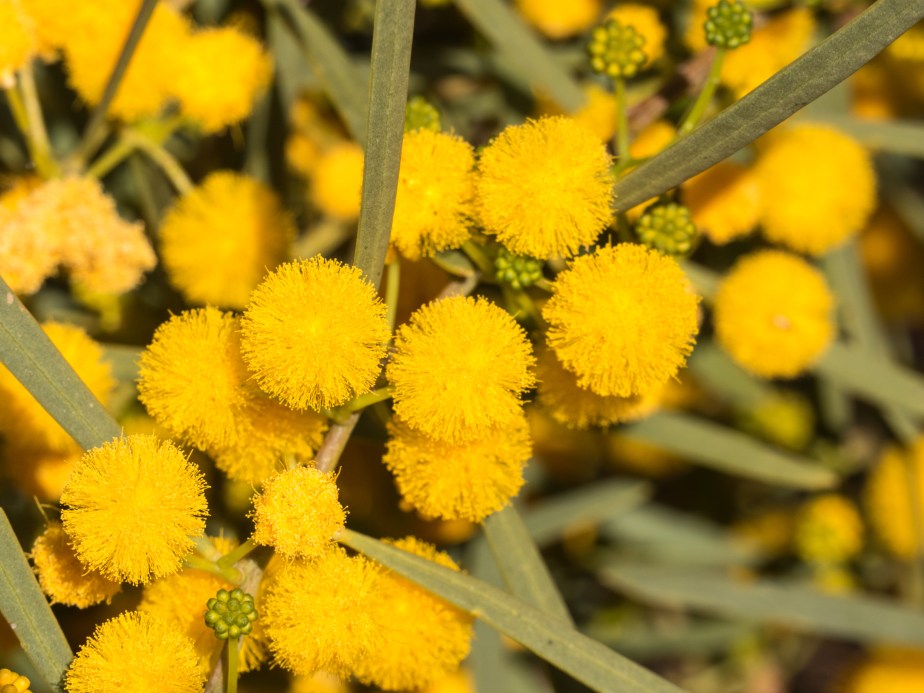
Acacia sp.
Acacia sp. (?murrayana)

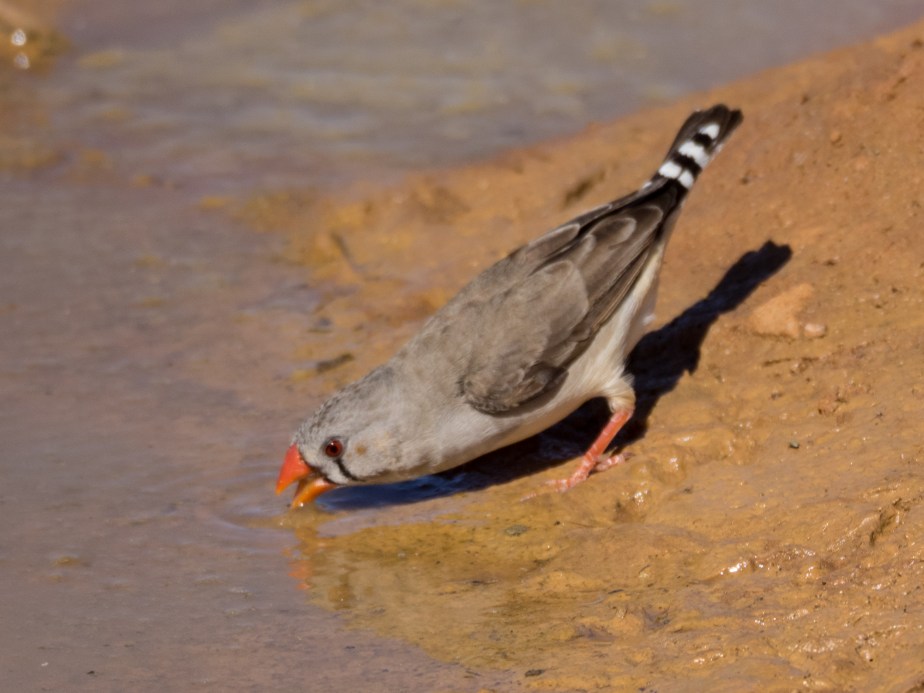
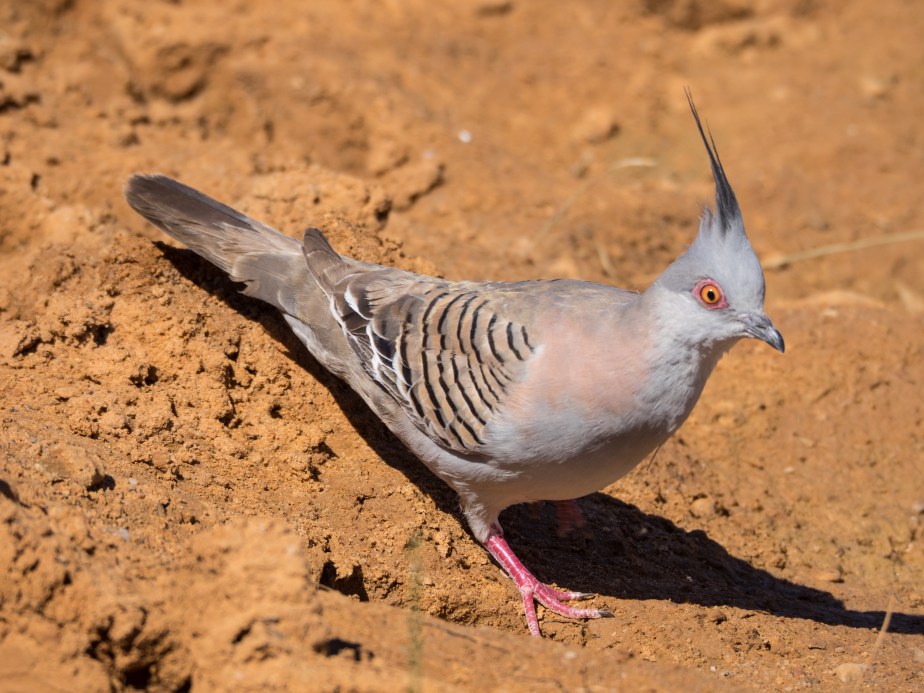
The dunes surrounding the camp were alive with wild flowers and the birding along the Hamilton River, on this occasion a series of pools, was excellent.

Zebra Finch
Zebra Finch
Crested Pigeon
Crested Pigeon

The Ghan …

From Farina we headed north to Marree and then up the Oodnadatta Track through the tiny town of William Creek to the world-renowned Pink Roadhouse in Oodnadatta itself.

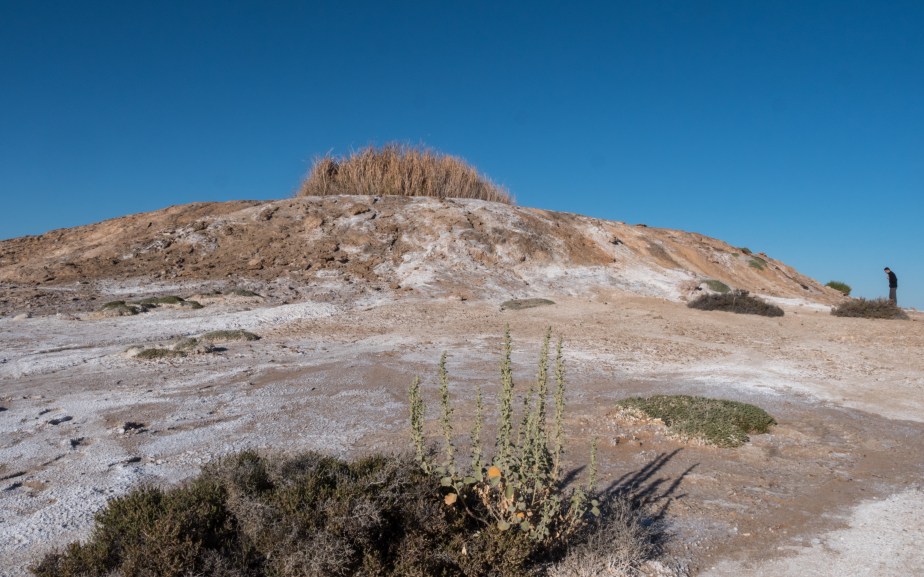
The sky is huge, the vegetation is sparse, the road is not sealed. The scene is occasionally punctuated by  a mound spring thrown up like acne by the underlying artesian basin. The road follows the same line as the telegraph and the railway, evidence of both is still present although the rails and wires are gone. This is part of the route pioneered by John McDouall Stuart but people lived here for thousands of years before he passed through.

The Australian Overland Telegraph line was completed in 1872. It stretched 3200 km from the south coast to the north. The poles were 80 metres apart, there were relay stations every 250 km. At Darwin it joined a submarine cable that went via Java to the outside world. It was the thinnest thread of 19th century high tech stretching through hostile country, usually dry but flood, paradoxically, a major hazard, and occupied by occasionally hostile people. The colonies of Victoria and South Australia were in competition to gain the commercial benefit of building the line. Part of the motivation behind Victoria’s Burke and Wills expedition was to find a suitable route. Stuart was largely financed by James Chambers who hoped to have a large stake in the resulting enterprise.

The railway followed. Construction went in fits and starts. Construction began in 1880 and the railhead moved slowly north to Hawker, Farina, Marree, reaching Oodnadatta in 1891. Here it took a pause until 1926  before pressing on to Alice Springs three years later. This was a narrow gauge line constructed for steam locomotives. The route needed to follow a line of artesian springs supplemented later with bores. The service ran at a loss and was notorious for washouts of the track and other delays. A flat car immediately behind the locomotive carried spare sleepers and railway tools, so that if need be the passengers and crew could work as a railway gang to repair the line.

It wasn’t until 2004 that the track reached Darwin. By this time diesel had replaced steam making it possible to reroute the southern section westwards to less flood prone ground. The railway still runs on the new route. It is now called the Ghan to commemorate the Afghan cameleers that it largely replaced (this seems to have started as a pejorative nick name). It’s in the non-urgent section of my bucket list – please give it a go to keep it running until I get around to it. Read all about it <HERE>.

Marree

As I said, the sky is huge and the veg is scarce, this is the Oodnadatta track …

Oodnadatta Track

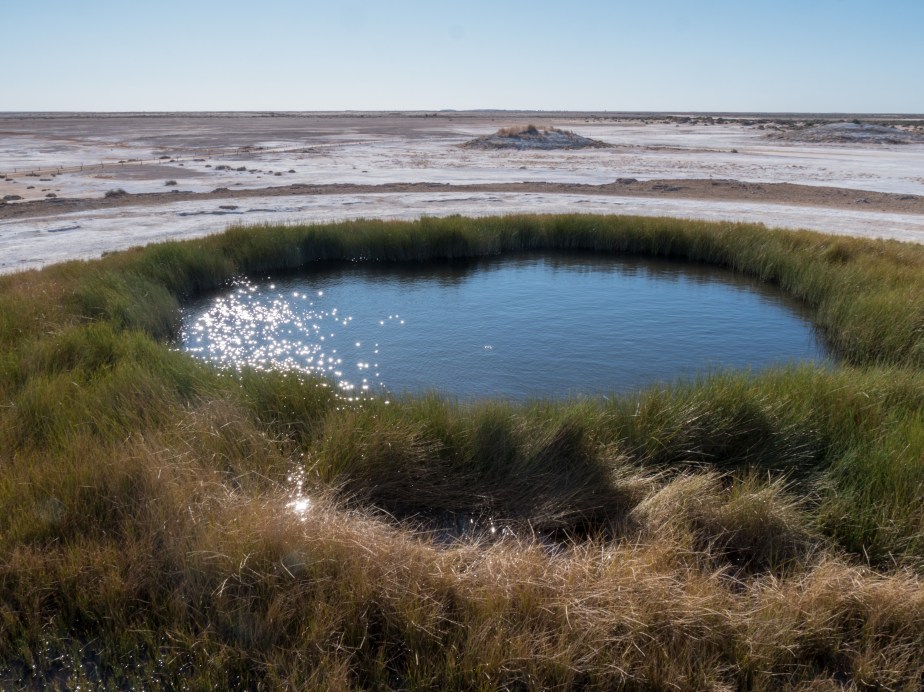
It passes ruins that would have housed telegraph and railway workers and the occasional mound spring. This spring is producing the merest trickle of water but it shows you the form …

Mound Spring

Now imagine yourself on a bigger and more productive example …


Mound Spring


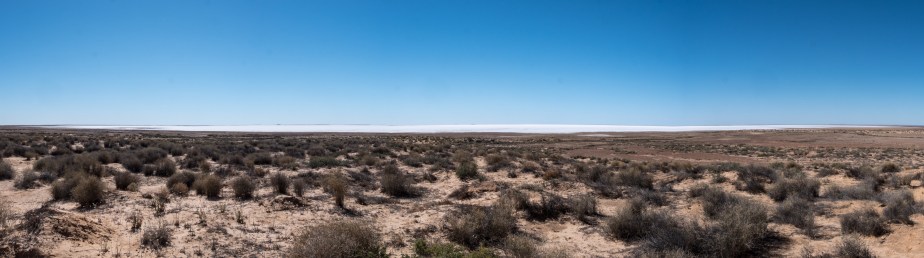
At Lake Eyre South the road, railway and telegraph are all very close to the lake edge. It is the ideal place to meditate on the way it was. Imagine yourself piling off the train and being put to work repairing the track, or simply stranded here for a week or so (click to enlarge) …

Lake Eyre South

The water that issues from these spring comes from the Great Artesian Basin that lies beneath 23% of Australia’s surface area, that’s the 1.7 million square kilometres shown in blue on this map.

220px-Great_Artesian_Basin

Water enters at the margins, mostly the eastern margin and is trapped in a layer of sandstone. It travels at a rate of one to five metres a year. Water coming to the surface in the south-west of the basin has been underground for about two million years. It comes out pretty warm and mineral rich but has sustained life in the desert where local rainfall is scant.

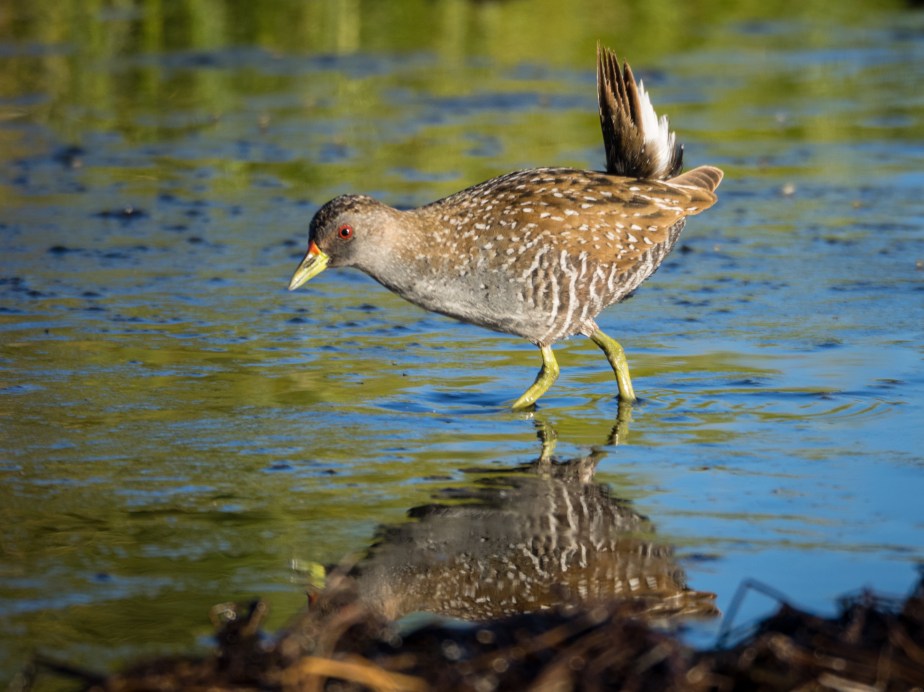
We overnighted at Coward Springs where the water flows freely enough to form a wetland. It is a commercial camp site but thoughtfully laid out. You can take a spa in the spring water but rather than do that I found a quiet spot in the reeds to look for the local inhabitants …

Ausstralian Spotted Crake
Australian Spotted Crake

Goyder was right …

I posted this episode on September 2nd but somehow it disappeared into the void, how embarrassing. Funnily enough it fits between day one, en route at last, and day three, Farina, which you may have read.

***

Day two of the Great Inland Expedition of 2016 would entail driving along the Goyder Highway.

Whilst this might sound like something that could be fixed by putting iodine in the salt, the name commemorates the surveyor George Goyder. The colony of South Australia was founded in 1836 as a free settlement, no convicts transported here! It was to be the very best of British, no unemployment and no crime. The new colony started without police force or jail. Nowadays most South Australians live in Adelaide, are extremely cultured, have double barelled surnames and an intense urge to save the planet with renewable energy. The remaining few are unemployed drug addicts who keep friends and relatives in barrels whilst collecting their unemployment benefits.

The settlers had big ambitions but soon realised that whilst they had a huge area to play with not much of it was fertile.

Explorer Edward Eyre was commissioned to find out what lay to the interior, and ambitious settlers moved out hoping that rain would follow the plough. All too often it didn’t. In 1865 Mr Goyder, the then Surveyor-General of the colony, was asked to map the boundary between those areas that received good rainfall and those that did not. After riding an estimated 3200 km on horseback he submitted his report and map to the state government. The map showed a line of demarcation, the areas north of which being those Goyder judged “liable to drought”, with the areas to the south deemed arable. He discouraged farmers from planting crops north of his line, declaring this land suitable only for light grazing.

The line is essentially the 250mm(10 inches) isohyet. It can be determined on the ground by inspection of the vegetation, north of the line there is mainly salt bush, south of the line is mallee scrub (mallee trees being slender multi-stemmed eucalypts).

Years with good rains led settlers to move north, subsequent droughts broke their hearts and brought them back. The ruins of abandoned farm houses dot the South Australian countryside.

Goyder's Line
Goyder’s Line

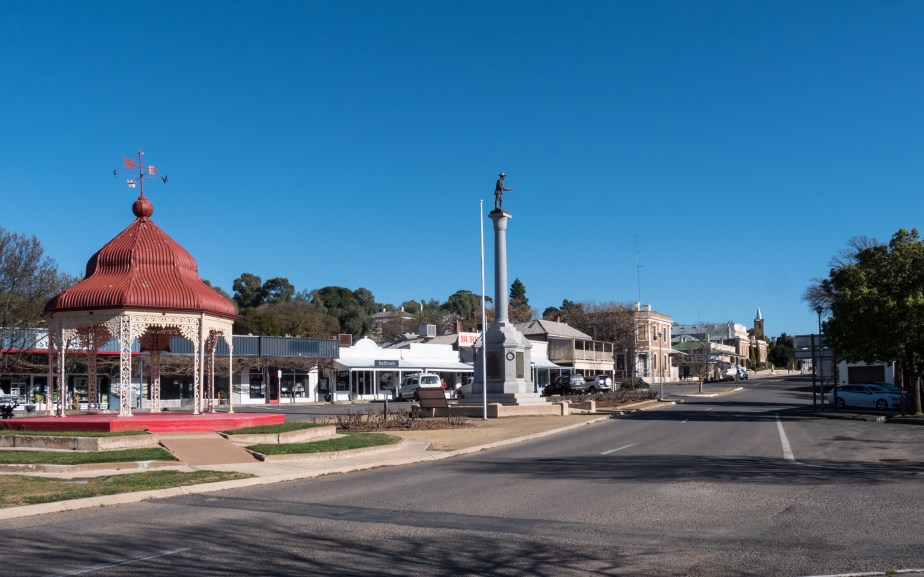
We stopped at Burra, a very picturesque town that started out as a single company mining town exploiting a large copper deposit. The mine began operations in 1848 and was largely worked out by 1877 although it operated occasionally until 1981. This was our chance to buy fresh food. Whilst the lovely Gayle shopped I ran around with the camera …

Burra SA

Burra SA

Burra SA

Here we parted from Goyder’s highway which runs northwest from to Crystal Brook. We would head pretty much due north into the arid zone our destination a classic example of drought versus dreams … Farina.

Farina …

After leaving Burra our route took us through Peterborough and Hawker and then north along the corridor between the Flinders Ranges and Lake Torrens.

Edward Eyre came this way on his first South Australian expedition in 1839 and then explored the region more thoroughly in 1840. Lake Torrens is an enormous salt lake stretching 250 km north south with an average width of 30 km. Eyre tried to cross it with horses but found it impossible. From the height of the Flinders Ranges he saw more of the same shiny white mud to the east and indistinctly to the north. Forced to retreat by lack of water he took with him the erroneous belief that Lake Torrens was horse-shoe shaped blocking passage to the north.

John McDouall Stuart from 1858 onward led six expeditions that culminated in the first return crossing of the continent. Stuart’s track runs west of Lake Torrens, we were taking a short cut and would intersect it in due course.

At Lyndhurst we made a brief side trip up the Strzelecki Track to search for the Chestnut-breasted Whiteface. One of our party had not seen this elusive little bird despite several past attempts so we took him to a spot where Gayle and I had had success on previous occasions. We searched on foot until the afternoon wore on. And he didn’t see it once again.

We arrived at Farina as the sun neared the horizon.

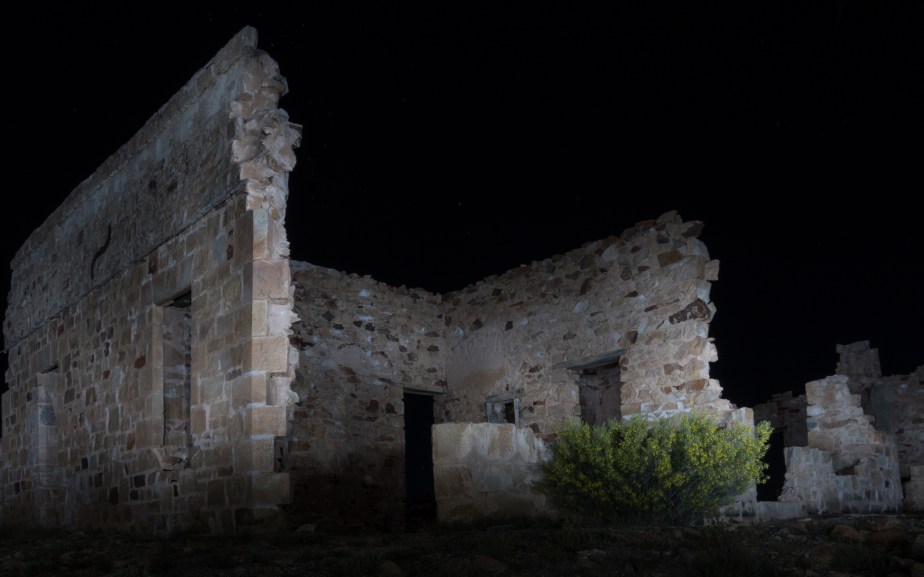
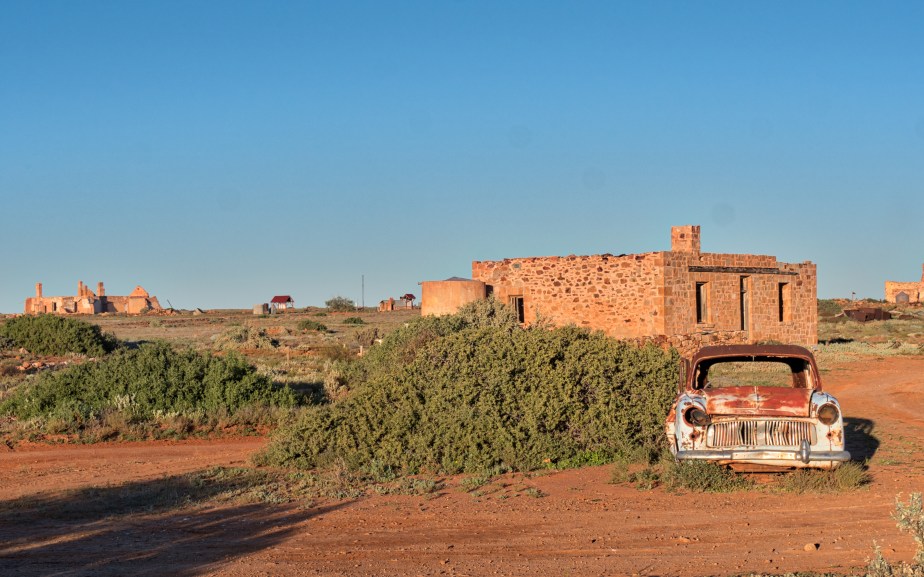
A number of things had conspired to draw people north from Adelaide. As dry as it is, cattle and sheep can be grazed in the hinterland, a railway is a good means to transport them to market. The route chosen for the new fangled telegraph that would connect South east Australia to the outside world was Mr Stuart’s route from Adelaide to the north coast. And of course, the science was settled, plough the earth, plant your crops and the rain would come, a theory promoted by scientists of the day such as the noted American climatologist Cyrus Thomas. The settlement here was founded in 1878 as Government Gums. Its name was changed to Farina to reflect the intention to grow wheat. It grew to reach a peak population of approximately 600 in the late 1800s. It was the rail head for a time. In its heyday, the town had two hotels (the Transcontinental and the Exchange) and an underground bakery, a bank, two breweries, a general store, an Anglican church, five blacksmiths, a school and a brothel. No wheat was grown. All that remains today are the ruins and the cemetery.

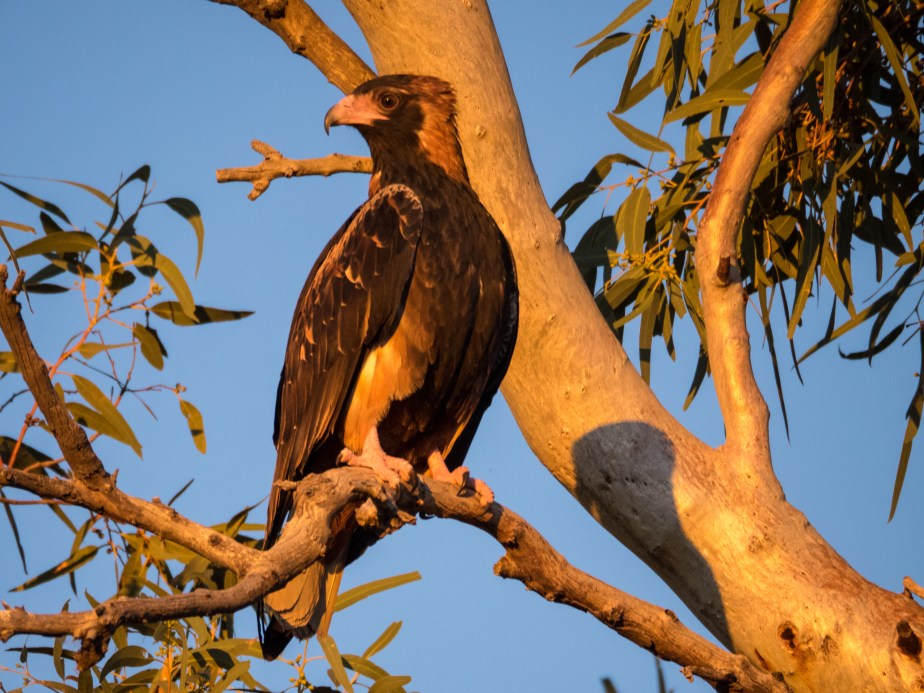
We pulled into the camp site. The first thing to catch my attention was a magnificent Black-breasted Buzzard. Life can impose some cruel choices upon us. With just minutes of the photographer’s golden hour remaining … the ruins or the bird?

BBBu

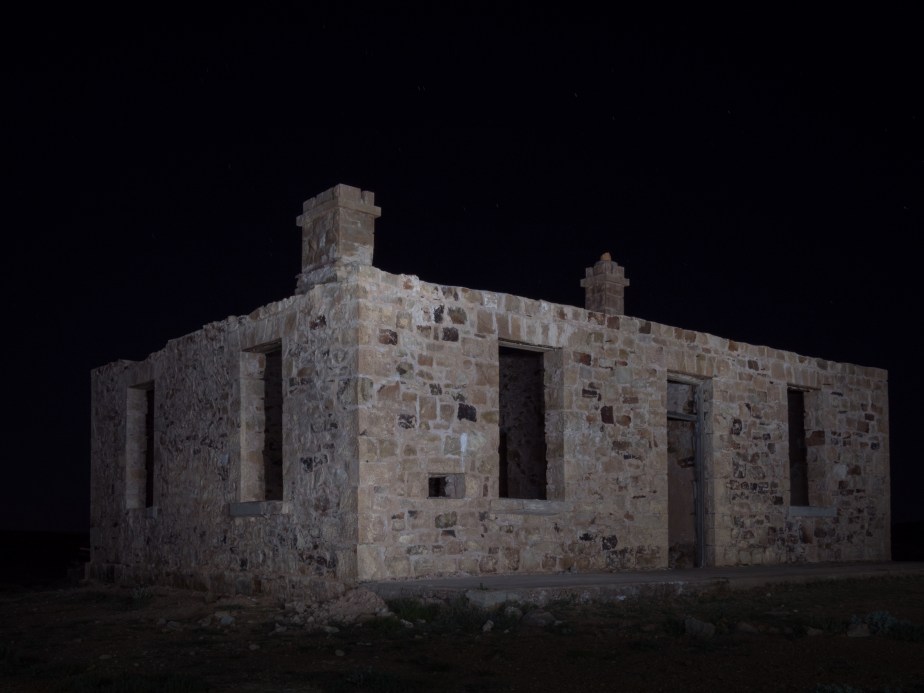
As it happened there would be a gibbous moon …

Farina

Farina

and another golden hour in the morning

Farina by day

but I actually prefer the night shots.

I thoroughly recommend the Farina camp ground, showers, clean toilets, scenic and just $5 per person per night.


En route at last …

It has been a very wet winter. We had been watching the weather closely for a month or so. Rain had closed the roads to the Simpson Desert repeatedly. We had gone so far as to make alternate plans – the Nullarbor surely would be dry.

Plan A would take us across the French Line to Poeppel’s Corner and then south via the Warburton Track to the Birdsville Track near Mungerannie. The Warburton River was not in the mood to cooperate. Plan B was to head to Birdsville instead. But before you can cross the desert you have to get there.

The party assembled in the Victorian Goldfields on the 12th of August. The quartet was Mark and Will, both professional biologists thrilled to get into the field without the burden of their jobs to consider, the lovely Gayle and myself. After last minute packing we set off the next morning.

During the day we crossed the South Australian border into the Riverland. Quarantine restrictions are in force to protect the region’s agriculture. Honey, fresh fruit and vegetables are forbidden. Canned, processed and freeze-dried foods are OK as are meat, eggs, dairy products, nuts, mushrooms and seeds. Potatoes are forbidden, sweet potatoes are permitted, the rules are somewhat convoluted. If arriving from Tasmania (presumably by plane) you may take date palms but coming from Victoria we must leave our date palms behind. Soil is forbidden no matter what … how do Tasmanian date palms get on in hydroponics?

A little over 600 km later we camped for the night in the South Australian Mallee.


SAMallee

Not far from our camp we found the excavations of the Southern Hairy-nosed Wombat. This is a creature that mines on a grand scale. Their burrows are interconnected into warrens that are shared by as many as ten wombats. We staked out a burrow and hoped that as night fell one would choose this particular exit. Despite considerable patience (two beers at least) we were not rewarded. However, a return visit later in the night surprised one above ground. It didn’t stay long.

It was one very cold night.

The Great Inland Expedition 2016 …

It started as a thought bubble, why don’t we drive across the Simpson Desert?

According to the frequently erroneous Wikipedia, the Simpson is the world’s largest sand dune desert, with the world’s longest dunes. It covers 176,500 km2 (68,100 sq mi) and the dunes range in height from 3 metres in the west to around 30 metres on the eastern side.

There are no made roads and no fuel stations. The tracks are well-defined, even sign-posted in places, but you must take them just as you find them. The prevailing wind is from the west. This has a profound effect on dune morphology, the west face of the dunes has a slope of 10-20° whilst the eastern face has a slope of 34-38°. West to east seems a good idea for a beginner.

There are a number of routes to choose from. Of the two most popular, the French Line is reputed to be harder than the Rig Road. So the Rig Road seems another good idea for a beginner. We chose the French Line.

Last fuel on the west can be either Oodnadatta or Mount Dare Station the next, on the east, is at Birdsville (taking the QAA Line from the end of the French Line) or Mungerannie (taking the Warburton Track). Mount Dare would have been a little out of our path but shortens the distance a little. The longest of the possibilities is Oodnadatta to Mungerannie at about 750 km.

A solo trip seems foolhardy for a beginner so I invited some friends along. Two high clearance 4WD vehicles were set up for the gig, an FJ Cruiser (petrol) and a Landcruiser series 70 ute (diesel). Both have electric winches, radio and a shovel – the first self rescue item to turn to in sand. There was one satellite phone. And of course, the sand flags. We would carry some extra fuel.

We would be travelling in the tracks of countless aborigines and many other Europeans including Mrs Middleton’s little boy, Johnny; and Bill from Cunnamulla who did it twice on his bike. The first white explorer to see the Simpson was Charles Sturt back in the 1840’s. It was in the way of his attempt to travel north to the geographic centre of Australia. He was unimpressed …

We had penetrated to a point at which water and feed had both failed … The spinifex was close and matted, and the horses were obliged to lift their feet straight up to avoid its sharp points. From the summit of a sandy undulation close upon our right, we saw that the ridges extended northwards in parallel lines beyond the range of vision, and appeared as if interminable. To the eastward and the westward they succeeded each other like the waves of the sea. The sand was of a deep red colour …

In 1880, Augustus Poeppel, a surveyor with the South Australian Survey Department made an incursion from the east along the 26th parallel, the Queensland/South Australia border, and marked the point where they meet the Northern Territory. He placed the tristate junction a little too far west, in the middle of what is now Lake Poeppel. It has since been moved to its correct position and is called Poeppel’s Corner.

Development on each side of the desert occurred quite early. Edward Meade Bagot took up the lease on Dalhousie Station on the western fringe in 1873. Birdsville, on the eatern fringe,  dates from about 1881 initially as Diamantina Crossing but quickly renamed. The Birdsville Post Office opened in January 1883.

David Lindsay, a formidable explorer, joined the dots. In January 1886, the height of summer, he set out from Dalhousie on the west side of the desert with Paddy – a Wangkangurru Aboriginal man and Charles Bagot, the pastoral lessee of Dalhousie Station and headed east into the Simpson Desert. He visited and documented a series of nine Aboriginal wells and travelled to the Queensland/Northern Territory border. Considering the country further eastwards to be “discovered” and also considering Mr. Bagot’s health, he backtracked to Dalhousie.

In 1886 Warburton, properly Peter Egerton-Warburton (1813-1889) penetrated from the south. He explored the area around the north shore of Lake Eyre searching unsuccessfully for Cooper Creek but found a large river which was subsequently named the Warburton River. He traced this north to the Queensland border. We hoped to follow his track south from Poeppel’s Corner but his river just happened to be in flood.

The name Simpson Desert was coined by Cecil Madigan, in honour of Alfred Allen Simpson, an Australian industrialist, philanthropist, geographer, and president of the South Australian branch of the Royal Geographical Society of Australasia. Mr Simpson was the owner of the Simpson washing machine company. Madigan made an aerial reconnaissance flight over the desert in 1929, which proved that the desert was composed of numerous parallel sand dunes, with no evidence of permanent water.

Ten years later Madigan crossed the desert by camel and celebrated being the first across the entire desert in the very readable Crossing the Dead Heart.

He was not, of course, the first, in fact not even the first European. That honour goes to Ted Colson who had traversed the full width of the desert in both directions three years earlier.

On 27 May 1936 after a season of good rains, Colson set off from Mount Etingamba 53 miles north of Bloods Creek with a lone aboriginal companion Eringa Peter. He carried provisions for two months, a compass and maps and travelled due east following the 26th parallel. Facing approximately 140 miles of unknown country, they subsequently traversed over a thousand sand ridges. He named some hills near the western side after his wife Alice, and a dry salt feature Lake Tamblyn after John Tamblyn his school master. His course took him to Poeppel’s Corner then on to Birdsville which they reached on 11 June, and set out for the return journey three days later. He had missed the corner post on the outward trip (by only 300 yards), but found it on the return journey and took photographs as it was still in good condition a little over 50 years after its placement. They arrived back at Bloods Creek on 29 June 1936, after 36 days and almost 600 miles of travel.

The first crossing by car was by Reg Spriggs with the wife and kids in September 1962. They took 12 days to travel from Andado Station to Birdsville in a short wheelbase Nissan Patrol. The following year French Petroleum commissioned a seismic survey which involved bulldozing a route a little to the south of the Spriggs’ – the French Line.

So, the plan …

 Inland 2016


You can click  on the map to enlarge it.


The Races …

Birdsville, Queensland, has a population of about 100. The annual races are run in the first week of September. T’other day all roads were closed and the track was underwater. The camp grounds were a sea of mud, you grew taller as you walked about.

The weather forecast for …

Thursday 1 September

Summary
Min 14
Max 22
Rain.
Possible rainfall: 25 to 40 mm
Chance of any rain: 100%

Cloudy. Very high (near 100%) chance of rain. The chance of a thunderstorm. Heavy falls possible. Winds east to southeasterly 15 to 20 km/h turning southerly during the morning then tending northwest to northeasterly 25 to 40 km/h during the afternoon.

courtesy of the BoM on August 30th.

Tipped to win …

2a237cdfc47f71d73b58dc071a0acf7d